
2026 Detroit Policy Conference explores a new leadership era in the region
Season 10 Episode 32 | 26m 46sVideo has Closed Captions
Hundreds of people attend the Detroit Policy Conference to talk about economic progress in the city.
This year’s Detroit Policy Conference hosted by the Detroit Regional Chamber took place at a new venue, The Department at Hudson’s in downtown Detroit. The theme was “a new leadership era.” One Detroit sat down with some of the area’s top leaders to discuss driving growth in the state.
Problems playing video? | Closed Captioning Feedback
Problems playing video? | Closed Captioning Feedback
One Detroit is a local public television program presented by Detroit PBS
2026 Detroit Policy Conference explores a new leadership era in the region
Season 10 Episode 32 | 26m 46sVideo has Closed Captions
This year’s Detroit Policy Conference hosted by the Detroit Regional Chamber took place at a new venue, The Department at Hudson’s in downtown Detroit. The theme was “a new leadership era.” One Detroit sat down with some of the area’s top leaders to discuss driving growth in the state.
Problems playing video? | Closed Captioning Feedback
How to Watch One Detroit
One Detroit is available to stream on pbs.org and the free PBS App, available on iPhone, Apple TV, Android TV, Android smartphones, Amazon Fire TV, Amazon Fire Tablet, Roku, Samsung Smart TV, and Vizio.
Providing Support for PBS.org
Learn Moreabout PBS online sponsorship- Coming up on One Detroit.
We're at the Detroit Policy Conference hosted by the Detroit Regional Chamber.
And we are in a brand new venue this year, The Department at Hudson's right in downtown Detroit.
- Hundreds of people are here to talk about a new leadership era in the region.
Just ahead, we'll hear from some of the areas top leaders about driving growth in the state.
Stay right there.
One Detroit is next.
- [Announcer] Across our Masco Family of Companies, our goal is to deliver better living possibilities and make positive changes in the neighborhoods where we live, work, and do business.
Masco a Michigan company since 1929.
Support also provided by the Cynthia and Edsel Ford Fund for journalism at Detroit PBS.
- [Announcer] The DTE Foundation is a proud sponsor of Detroit PBS.
Through our giving, we are committed to meeting the needs of the communities we serve statewide to help ensure a bright and thriving future for all.
Learn more at DTEFoundation.com.
- [Announcer] Nissan Foundation and viewers like you.
(upbeat music) - Hey, I am Stephen Henderson.
- And I'm Zoe Clark.
One Detroit is coming to you this week from the Detroit Regional Chamber's Detroit Policy Conference.
We are at The Department at Hudson's, right here in downtown Detroit.
- This year's conference theme is a new leadership era, which refers to all the major leadership transitions that are taking place in the Detroit region.
The sessions are focused on the importance of collaboration among business, government, civic, and philanthropic leaders to make sure that we move Michigan forward.
And that is the agenda this year.
Not just here in Detroit, but all over Michigan.
Lots of transition taking place.
- It is a year of change, Stephen.
Of course, we are beginning this year with a new mayor of Detroit members of city council, but statewide it will have huge repercussions for this region.
Open race for governor, secretary of State, attorney general, and a really competitive open US Senate seat.
- Yeah, I can't remember the last time that you had so many things changing at once.
That brings into focus all of our problems, right?
What are the things that we want these new people to actually do once they get there?
I feel like we're off to a little bit of a slow start on that conversation, but, you know, it's January, we got... - It's January.
- Nine months.
- It's a little cold.
We've all gotta warm up into it.
- Well, Stephen, as I mentioned earlier, we are here at The Department at Hudson's.
It's part of Bedrock's new development on the site of the former Hudson's department store.
Our colleague Nolan Finley had a chance to sit down with the CEO of Bedrock, Jared Fleisher.
- What was the idea behind this project?
What did you hope to accomplish with it?
What's its purpose?
- Today was what Dan hoped to accomplish with this building, where we have hundreds of people from all across the region coming to downtown Detroit, gathering in downtown Detroit, supporting the economy of downtown Detroit.
It's a multi-use building.
So we have retail on the first floor, 'cause you need your shopping and your restaurants.
The middle part of the building is this event space.
And Dan is very focused on bringing people from all over the world to Detroit.
And that's why we have this world class event space.
And then office space above it, which helped keep the General Motors Corporation in the city of Detroit, a big deal, right next to it.
The tower is gonna have a five star edition hotel, critical for us to be able to attract conventions.
And, you know, the largest conventions in the world.
You need hotels like that Final Four.
And 96 condos above it.
If you'd like one, we have one with your name on it.
- There you go.
Is it filling up?
- It is.
The office space is 93% leased.
The department has, you know, event after event.
You see with the retail, you have Aloe, you have DaKovas, you have General Motors display space.
There's no question that we built it and Dan built it and people came.
- Filling that vacant Hudson's spot, and we were talking earlier about when it came down and I was standing a few blocks from here.
- Yes.
Yes.
- And watched the building just disappear.
- Yes.
And it stayed disappeared for a lot of years.
- 20 years.
- What do you expect the impact on the city as a whole because of this project.
- What makes Dan such a visionary is, first of all, he saw this hole.
And literally we say in the heart of the city, we mean that both literally and figuratively.
A hole in the heart.
When Hudson's came down.
And Dan saw that hole and he saw this incredible building in its place, and he wanted it to be really a symbol of Detroit's rise and inspiration about what's possible, what's happening, but also very practically an economic engine for the city.
And that's why you see the expensive to build it.
But the multi-use components, retail, event space, office, hotel, condos, public space are bringing all those elements together you truly get an economic engine.
And we're seeing it with all these hundreds of people here.
And this is happening all the time.
- The next challenge on your list is the Renaissance Center.
- Yes.
- Where does the redevelopment of that site stand?
Yeah, I think it's useful to think about the downside and then the upside when it comes to the Renaissance Center.
It is the tallest and most iconic building in the state of Michigan.
You go ChatGPT, gimme an image of Michigan, you're gonna get the Renaissance Center.
And there's enormous downside if that building is blighted and deteriorating, that's a symbol of our city and our state.
On the upside is if we turn it into an icon for the next generation, not only is it back to life, but we will go from there and redevelop the 40 acres of the riverfront next to it to create the best waterfront district in the country.
So hundreds of housing units, major entertainment destinations, bars, restaurants, another economic engine, just like this is on an even bigger scale.
We're talking 48 acres of the riverfront.
And as I talked about in my speech today, we need to attract young talent to the state of Michigan.
The economy, if you want higher wages, more prosperity, you need talent.
Businesses want to be where talent is.
Talent wants place, just like we've done down here.
If we build an extraordinary riverfront an incredible place will attract the talent and get the virtuous cycle of growth.
- So you all have a billion dollars in that project?
- Yes.
- GM's got consider above.... - 250 million.
Yes.
- And you've got another 250 from local... - And that's really what we're waiting on.
We're waiting on a little bit of partnership from the state of Michigan through the Brownfield Program.
And the beauty of the Brownfield program is, and Mike Duggan actually talked about this today, nobody's writing you a check.
The Renaissance Center today is empty generating no revenue.
Once we have this massive redevelopment, it generates all this new revenue, new tax revenue by rebating a portion of that new tax revenue back into the project to make the math work.
It's the ultimate win-win.
That bill passed the Senate.
It's sitting in the house.
And we listen, the proof is in the pudding.
This program has been around since Governor Snyder created in 2017.
There's been 11 of them transformational projects across the state.
It's really redeveloping Grand Rapids entire riverfront right now.
We just need that to pass that partnership from the state and we will do incredible things.
- So the Brownfield credit was part of your three-point plan today for making taxation policy work to encourage growth?
Go over those three pieces.
- Yeah, so I outlined a three pronged plan for tax reform.
Number one, to tax vacant land held by speculators higher in order to lower the tax on homeowners and people who want to build in the city.
Number two, to do an excise tax on our central city where you have so many tourists and visitors.
So instead of your martini being $16, it's $16 and 16 cents.
It's not gonna change anybody's behavior, but it's gonna raise money for the city, use that to lower property taxes.
And then tax abatement reform, because our taxes are so high right now, every project has an abatement that basically says, you don't pay much at all.
Our proposal is make those abatements half as generous, twice as long.
The math is the same, but the city then gets revenue on the front end for those 10 years, uses that revenue with these other things to lower property taxes and create a pro-growth environment for the city.
(crowd murmuring) - The Maryland based high tech firm Eccalon made headlines when it announced the corporate headquarters is gonna be relocating right here to Detroit, creating up to 800 new jobs.
I caught up with the company's founder and CEO Andre Gudger here at the conference.
We talked about why he selected Detroit over other cities.
I want to talk to you about your business and what you guys do.
But before we get to that, I just wanna have you talk about this decision to move your business from Maryland, which is a state I know really well, I lived there for a long time, to Michigan, we don't hear a lot about people making that kind of decision.
We hear from a lot of people that we're getting it wrong on business attraction and workforce development and all the things that people kind of look at when they try to relocate their business.
So walk me through that decision on your part.
- You know, that's a phenomenal question.
And a very complicated decision... - Is that?
- To be honest with you.
Yeah, you know, when you're in search of finding the right home and reevaluating the home you're in, maybe that is the right home, you have to boil the ocean, you're looking at everything.
You're looking at the economy, the people, and quite frankly, you're looking at a workforce or the workforce of the future.
And I will tell you that in Michigan, there is a lot of right happening.
We may not tell the story as well as we want to or need to right now, but it's happening, it's evolving, and it's a dynamic picture.
So what attracted us to Michigan was the fact that Michigan wanted us.
- What are those things that we're getting right, 'cause I don't think most people here necessarily feel like that's the case.
- Yeah, look, I'm meant to tell you one thing you got right, was the people.
- Yeah.
- What happens at the grade school level on up, making talented people, multidisciplinary people, interdisciplinary people, sequential thinkers, kind people, is the reason why we're here.
And we were more fortunate to have Michigan and Michigan having us.
- So when we talk about Michigan being behind, right, 40th in educational outcomes, 40th in per capita earnings, what about that doesn't scare you?
I guess.
What about that says to you, I can work with that.
- Hey, it's an opportunity for Eccalon, bringing in a new industry.
Bringing in a 22nd century industry.
Bringing in a new economy.
It's right.
So we're gonna bring high tech jobs, high science jobs into the state of Michigan.
We're gonna attract ancillary industries into the state of Michigan.
That's alongside of what we do.
And I see the education numbers as an opportunity.
When I meet the people, I talk to the people, it may not be the best test takers in the world, but they're damn sure smart.
And it's something to build on.
It's a very capable workforce that's very unique in nature because it is very practical.
The hands on is of this city, the hands on mission that this state has had, and as it transformed into a digital economy, Eccalon can be one of those vessels to get that right, help it stay on that narrow path of righteousness.
- We make stuff here we have for centuries, and that's an opportunity.
- Absolutely.
In fact, when people think of Eccalon, they see us as a machine learning, high science and tech company.
And we do those things.
But we also manufacture, we also study novel materials, we also in the biotechnology.
So those things will be designed, made in Michigan.
- In Michigan.
Yeah.
So let's talk about your company and sort of how it started.
You've got a story too about where all this comes from.
- Yeah, you know, it was one lonely morning in February of 2017 thinking about creating intellectual property that could be transformative, and taking the things I learned from the time I was in the government and looking at what this country needed to restore American's dominance across the world.
And I'm locked into that, both on the commercial side and on the government side.
And I wanted to birth a company that would create a unique set of minds that could come together and do make the impossible possible.
- Yeah.
Yeah.
No, that's really great.
Well, we're excited, you're gonna locate right here in the city of Detroit.
- Yes.
- You said on the riverfront, right?
- Look, it's a phenomenal facility.
It handles everything.
It has the best name in the world.
It's called the Icon.
I didn't name it.
- The Icon.
- I inherited.
And I have a great partner there, you know, in Bedrock.
And so it just, the perfect suit came together to make something very special.
(crowd murmuring) - And speaking of technology, there are a lot of conversations taking place here at the conference about supporting innovation in the region.
One of the panels focused on the impact of artificial intelligence in the business sector.
I talked about the future of AI with Dana Williams, she's president and CEO of Detroit Employment Solutions Corporation.
Well, you're here today at the conference and you've been talking about artificial intelligence.
One of the real focuses though, is on human-centered AI.
- Yes.
- What does that mean?
- So it does sound a little bit strange, right?
Digital technology plus people, but people really is the special sauce.
And we can have all these tools that are wonderful, that can make our jobs easier, that can make our life easier.
But if they're not designed in ways that people can actually use them easily day to day, if folks don't understand the basics of how to use them, if we don't take a step back and think about now how does this technology improve an entire work process, it's not gonna be adapted or adopted the way that it really should be.
And so that's one of the things that we focus on at Detroit Network.
- Give me an example of what this looks like in practice.
- Yeah.
So a couple of things.
So we serve about 80,000 Detroiters a year.
Now, sometimes that's just them coming in to use our computers, right to do the very standard job search online.
30,000 of those customers though come to us and need an actual service of some kind.
They sit down and talk to a career coach.
And about 10,000 of those individuals really have some complex barriers that might be stopping them from going to work.
And those are things like transportation and childcare, sometimes even housing.
And what we're also determining is that at the very baseline, it's actually digital access and skills.
Because today, if you don't have the tools or the understanding to pay your bills online, to order food, right, it really is stopping you from living.
And so that's where the human-centered approach is so important for us.
When we design our systems and our processes to serve Detroiters, we're keeping the person's experience at the core.
- There's certainly though, I think, for folks when they hear AI, right, there can be some concerns about what that looks like.
Tell me about how you're interacting with them?
So as an organization, so DESC, we're actually the nonprofit that helps to run all of the systems and interacts with our partners and our community agencies.
So for us, we have to take a step back and say, what are the types of guidelines and protocols that are going to one make sure our data is safe and that are gonna allow our people to feel safe using the product.
It can create templates for us to do a lot of our work better and faster, but we have to be careful about what we put in those templates, right, no personal identification information.
We're not putting social security numbers into AI to run queries, right?
But knowing that in advance and setting those guidelines is an example of the way that we're thinking about how we both integrate AI in serving our Detroit customer.
- Do you think folks are thinking enough about those guardrails day to day?
- No.
(laughs) - Tell me how you really feel honest about it.
(both laughing) - So, as DESC, we knew as the leadership team that we had employees that were engaging with the tools.
We could tell, right?
Not that they were bad.
And people were honest about it, hey, I'm going to utilize the tool to help me develop this new template, or to help summarize some of our data to create reports.
All good stuff.
And as we thought about it, we then said, okay, just like we have a standard IT policy that we've got policies that guide how the way that we talk to people, this needs one too.
(laughs) - Yeah.
Yeah.
- And luckily, one of our employees actually raised his hand with a personal passion for it.
And so went out and got a certification that we helped to cover the cost for and came and brought that information back to our organization.
And so that was step one is establishing those guidelines.
- I am curious about how you see the, I mean, all of us are wondering about the future of AI, right?
How are you thinking about the future, particularly in your work that you do?
- So one thing that I find really interesting, there is data now that is saying that the youngest generation working, so that generation Z is actually more fearful of using AI than those of us, I include myself in the, I'll say, more experienced generations.
We've been through a lot of economic change.
We've been through technology changes.
Now, lots of times I'm a part of the generation that remembers when wireless internet started, right?
I just throw that dial up - AOL dial-up... - Sound in my... - Exactly.
Exactly.
So we've done this a number of times.
They haven't... They were born into technology and haven't been through this yet.
And so as we think about how we prepare Detroiters for jobs, we have to keep that in mind at the same time.
One, the generational differences of adoption of technology and AI specifically, but then also making sure that people have the foundational skills to even understand it.
- Yeah.
- Right?
There are things that we take for granted.
Those of us that are more comfortable using technology overall.
We know the type of prompt to put into Google to get the right search term.
We know that the three dots in the upper right hand corner probably mean a menu.
Those are things that if you've never interacted with the systems and just like AI are gonna make it even harder for you to both obtain and keep a job in the future.
- Yeah.
So some of this sounds like too, the ability for it to be full of equity.
- Yes.
- And making sure that everyone sort of has a seat at this futuristic table that you're talking about.
- That's exactly right.
So we've embedded, thanks to some special grants, we are building digital coordinators into our service system for Detroit residents so that they can understand at the frontline level what people are asking for in terms of skills and where we can connect them to resources that already exist here in the city to help build up those skills so that they're ready to hit the ground running with AI and anything else.
- [Zoe] Yeah.
(crowd murmuring) - Philanthropy plays a crucial role in growing the city's economic ecosystem.
I spoke with Sarida Scott, who's vice president of program at The Skillman Foundation, about the importance of philanthropy and fostering economic development and community building.
Philanthropy plays this incredible role in Detroit that it doesn't play in other communities.
What do you think it needs to be playing right now with all the transition that we're seeing - This is a really critical time.
And this is a moment where we talk a lot about the need to connect.
I really see philanthropy playing that role of connecting.
One of the things that I always say is like the philanthropy superpower is the convening power.
We can bring people together.
And we really need this now in this moment.
- Yeah.
So at Skillman, you guys are focused on youth education.
Tell us what you're up to now, given how different things are than they were just a year ago.
I mean, it's amazing to think of all the things that have changed and all the problems that have surfaced or gotten worse in that time.
- In this moment though, we're really focused on education, as we say, people power.
So listening to those who are most impacted by the education system, students, educators, the community, to really help us in, you know, driving the solutions, identifying the solutions.
It's also a part of the bridging.
I mean, for as much as we want to do in the city, as much as we invest, no one entity can impact and change the education system.
And it's really this moment that we need to remind everyone that education touches everything.
And so when we're here talking about business and economic development, it all goes back to education.
So that's really allowed.
What we're trying to do is remind people that we need to listen to those who are impacted by the system.
They need to be brought in and be working on the solutions.
And we need to be doing this all together.
- Yeah, I know that's work that you've been involved in for years and years long before you came to this role at Skillman.
I wonder if you can help people understand the things that you hear and see from those folks, from students, from parents, from educators, especially in Detroit, about how things are going and what they need so that we can go faster and further.
- So there's, I mean, there's so many challenges, we know.
I mean, we talk a lot about the post-COVID and the COVID generation and the challenges.
So we all know that mental health has been a lot of the issues that have been raised.
We know that there is a concern about what's AI, and how does AI look for, you know, the careers for the future, and how are we helping students be prepared for that?
And students are concerned about that.
We also know we're in this moment where we have, there's a lot of talk about the value of higher education, and is that still worth it for students?
So there's so many things that they're grappling with.
And also just the rest of what's going on in the country.
- Right.
Right.
- I mean... - And it has an effect on young people that I think we don't stop and think about all the time.
- Yes.
And we need to because they are experiencing it in such a different way because it also then impacts the way they think about their future and what opportunities they have and what's possible.
So there's so much that we need to do around helping them continue to think about the future.
Just as we were talking about that, reminding ourselves, we will move out of this, this will pass.
- Yeah.
Right.
Everything does at some point, right?
- Exactly.
- We just gotta survive.
That's always... - And also, how are we setting things up so that we recognize that that children can thrive in the future.
- Yeah.
Yeah.
So I wanna talk a little about the transition that we're seeing politically here in Detroit right now.
We've got a new mayor, a lot of new council people.
Philanthropy worked very closely with the last two mayors really in terms of just trying to get things going in Detroit again.
Is there a different role philanthropy will be asked to play for this new administration?
Or is it just kind of making sure everything's still standing up and moving forward?
- Well, to start, philanthropy has already expressed support for the new administration.
I mean, this historic time with Mayor Sheffield.
And we all wanna see her succeed, because if she succeeds, the city succeeds, the region succeeds, the state succeeds.
Everybody needs to be seen if there are some different roles that she might be interested or the administration might need.
But what is consistent is that there is clearly an intent across the sector that we wanna be supportive and do what we can.
(crowd murmuring) - That'll do it for this week's special edition of One Detroit coming to you from the Detroit Regional Chambers Detroit Policy Conference at The Department at Hudson's.
Thanks for watching.
- You can see more One Detroit stories at ONEDETROITPBS.ORG.
- And as always, connect with us on social media.
Take care, and we'll see you next time.
(upbeat music) - [Announcer] Across our Masco Family of Companies, our goal is to deliver better living possibilities and make positive changes in the neighborhoods where we live, work, and do business.
Masco, a Michigan company since 1929.
Support also provided by the Cynthia & Edsel Ford Fund for Journalism at Detroit PBS.
- [Announcer] The DTE Foundation is a proud sponsor of Detroit PBS.
Through our giving, we are committed to meeting the needs of the communities we serve statewide to help ensure a bright and thriving future for all.
Learn more at DTEFoundation.com.
- [Announcer] Nissan Foundation and viewers like you.
(upbeat music) (logo chimes)

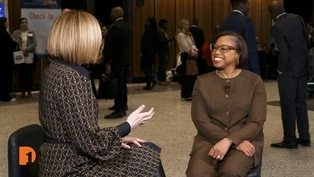
Bedrock CEO Jared Fleisher discusses growth and development in Detroit at Detroit Policy Conference
Video has Closed Captions
Clip: S10 Ep32 | 5m 38s | Bedrock CEO Jared Fleisher sits down with One Detroit to discuss expansion and development. (5m 38s)
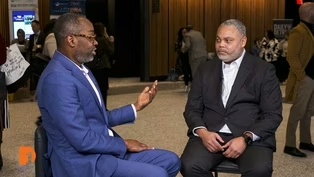
Video has Closed Captions
Clip: S10 Ep32 | 6m 12s | One of the panels focused on the impact of artificial intelligence in the business environment. (6m 12s)
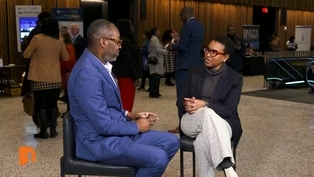
Eccalon CEO discusses moving company to Michigan at Detroit Policy Conference
Video has Closed Captions
Clip: S10 Ep32 | 4m 49s | Founder and CEO André Gudger sits down with One Detroit to discuss the city’s opportunities. (4m 49s)
Video has Closed Captions
Clip: S10 Ep32 | 4m 32s | Vice President of Program Sarida Scott talks about the crucial role of philanthropy in Detroit. (4m 32s)
Providing Support for PBS.org
Learn Moreabout PBS online sponsorship
- News and Public Affairs

Top journalists deliver compelling original analysis of the hour's headlines.

- News and Public Affairs

FRONTLINE is investigative journalism that questions, explains and changes our world.











Support for PBS provided by:
One Detroit is a local public television program presented by Detroit PBS