
A look back at the legendary career of television journalist Tony Brown
Clip: Season 54 Episode 28 | 12m 25sVideo has Closed Captions
Remembering journalist, educator and civil rights advocate Tony Brown who passed away last month.
We take time to remember legendary TV journalist, educator and civil rights advocate Tony Brown who passed away last month at the age of 93. Brown’s legacy includes launching American Black Journal in 1968. The show was originally called “CPT” or “Colored People's Time.”
Problems playing video? | Closed Captioning Feedback
Problems playing video? | Closed Captioning Feedback
American Black Journal is a local public television program presented by Detroit PBS
A look back at the legendary career of television journalist Tony Brown
Clip: Season 54 Episode 28 | 12m 25sVideo has Closed Captions
We take time to remember legendary TV journalist, educator and civil rights advocate Tony Brown who passed away last month at the age of 93. Brown’s legacy includes launching American Black Journal in 1968. The show was originally called “CPT” or “Colored People's Time.”
Problems playing video? | Closed Captioning Feedback
Where to Watch American Black Journal
American Black Journal is available to stream on pbs.org and the PBS app.
Providing Support for PBS.org
Learn Moreabout PBS online sponsorship- We would like to take some time now to remember veteran, television journalist, educator, to remember veteran, television journalist, educator, and civil rights advocate, Tony Brown.
Everybody knows that name who passed away last month.
Brown's legacy includes launching the program you are watching right now in 1968.
The show was originally called "CPT" or "Colored People's Time."
Imagine that being the name of a television program.
And it was one of the nation's pioneering Black public affairs television program.
"CPT" provided a voice for African Americans at a really pivotal point in Detroit's history, just a year after the 1967 rebellion.
Here's a portion of one of the earliest episodes produced and hosted by Tony Brown.
(energetic music) (audience applauding) - Good evening.
I'm Tony Brown and welcome to "CPT."
An experience in living color.
Tonight we're going to see the second part of the Olympic revolt.
We're going to hear the Inkster Community Choir and the Brothers of Soul.
Also, we have two special guests tonight, Wild Bill Davis and our own Martha Jean the Queen.
Sandy, what's on the grapevine?
- BOBTAT will be explained.
Whatever happened to the ex supreme.
what Detroiter will be starring in a stage hit at the Fisher Theater?
Who is "CPT"'s Together Sister of the Week?
And the "CPT" players will present Langston Hughes' Jesse B. Semple to life.
And now tonight's newsman, Reggie Wilson.
- Tonight on "CPT News," we'll hear of an urban league study which shows that the brother occupies fewer city appointed jobs now than in 1963.
A Black congressman gives his opinion of the Nixon candidacy and "CPT" has an exclusive speech by Stokely Carmichael delivered at an international conference.
Tony?
- And now the conclusion of the Olympic Revolt.
(energetic music) Last week in part one of the Olympic Revolt, "CPT" took a look at the illustrious history of Black athletes in the Olympics.
We talked to some of the past champions and probed their feelings on Olympic competition.
(uplifting music) This week we will discuss the idea of a Black boycott of the Olympics.
Tonight, we'll talk again with those past champs and also we will hear what the brother and the sister on the street thinks about the boycott idea.
It's clear that Black Olympic champions may face severe problems when they return home from their tours.
This was the chief complaint of the organizer of the boycott, Professor Harry Edwards, former sociology instructor at the San Jose College in California and now at Cornell University.
Edwards is the man that some people accuse of stirring up trouble in paradise with his talk of a Black Olympic boycott.
But Edwards insists that paradise has always been full of snakes.
When he announced the boycott, Edwards said that he intended to show the exploitation of Black athletes by the U.S.
who, despite being champions on the field, are only second class-citizens when they return home.
Edwards also indicted the U.S.
for playing politics and its scheduling of tours for Black and white athletes.
He cited the world tour of Tommy Smith from California.
Black runner and Richmond Flowers, white sprinter from the University of Tennessee.
This tour designed to show racial teamwork in the U.S.
was called hypocrisy by Edwards, "Beneath the dignity of the Olympic Games."
Basically, he sees athletics as a wedge to improve the second-class position of Blacks who dominate track and field.
Edwards explains.
- [Harry] In the movement which sent upon the athletic arena in the United States and also to a large extent on international level, particularly when it regarding the question of South Africa, the strategy was entirely different.
We did not concern ourselves and waste our energies with time to get rid of a individual cracker, a individual racist, or an individual cog in a wheel which is grinding out racists every day.
We moved against the system in its athletic and its social and its economic spheres.
The use of Black athletic talent was challenged.
The legitimacy of the use of Black athletic talent by the system was challenged under these circumstances that existed in the United States.
The U.S.
will never again be able to assume carte blanche that Black athletes will serve as propaganda fodder, as economic capital in its 20th century gladiators for the corrupt and genocidal system that exists in the United States.
(audience clapping and cheering) - The white sports columnists and sports officials were infuriated.
They blasted the boycott and pointed to gains they felt Blacks had made through sports despite discrimination.
Some sports figures, Blacks and whites, did more than become infuriated, according to Edwards.
Some Black athletes working for white interests joined the boycott and worked to destroy it from within.
Edwards said that some professional teams took reprisals against any Black athlete who supported the boycott.
In an exclusive interview with "CPT," Edwards cited the case of University of California's Bob Smith.
Promised a position on the Los Angeles Rams, Smith found himself totally ignored in the draft following his support of the boycott.
Edwards told "CPT" that he would name names of Blacks and whites who conducted reprisals in his soon to be published book, "Racism, Politics and Athletics: The Revolt of the Black Athlete in America."
- When Tony Brown left Detroit, he became the host and executive producer of the national program "Black Journal," which was based in New York.
That show later evolved into "Tony Brown's Journal" and it aired for several years on public television.
Brown returned to Detroit in '75 for a guest appearance on the show he helped create, which had been renamed "Detroit Black Journal."
Here's a clip from that interview.
- Good evening and welcome to this edition of "Detroit Black Journal."
Tonight we are very privileged to have as our guest one of the, if not the pioneers in Black public television broadcasting in Detroit and around the country, Tony Brown.
How did it feel coming back into WTVS Channel 56?
- (laughs) It feels kind of nostalgic.
I was looking at the studio and it was nothing like this when I left.
(laughs) - [Candy] Well, how long ago did you leave?
- I left in 1970.
I went to New York to take over "Black Journal."
And a couple years after that, I think Channel 56 moved into these very luxurious headquarters.
We were way out in the country in Southfield.
I was looking at the garage and I told a friend of mine, "That's what we used to be."
(both laugh) - And now public television has taken off and it's pretty popular around the country.
And as far as the Black media, you had probably most to do with that.
- Well, I was very involved.
I like the fact that when I was doing Black-oriented programs on Channel 56 before I started doing "Black Journal," that I was out of step.
When I started doing "Black Journal," I was out of step.
As the revolution and times progressed, I became mainline and now I'm out of step again.
I think my new out of stepness has a lot to do with the fact that I've come to become terribly critical of the concept of desegregation and its ally integration and how that is applicable in programming.
I remember when I first started doing Black-oriented programs on Channel 56, I was called a separatist.
Channel 56 at that time to some extent because of the program was called separatists.
Of course when the so-called riots happened in Detroit, there were responses.
So they weren't called separatists.
But at this point I've watched the entire evolution of alleged integration and desegregation and we now see it so explicitly in television programming.
And it says that any program that is oriented to Blacks with a Black perspective is segregation.
And that Blacks can have a role in television if it's integrated.
And they have these real cute things they do about the American family.
One family is Black.
Or they have these cute things they do about the workers.
One worker is Black.
Or the cute things about Blacks in, people in broadcasting, one person is Black.
So in effect, the new concept in integrated programming, and I would have to say that public television has the leadership in that coinage of that concept, is that there is no place for a Black presence which I find regressive.
I find it a throwback on the other side of when we struggled to get into television at all.
- It sounds as if you're saying that this integration is not portraying a Black perspective.
- No, what I'm saying is that integration is a game.
There's no polite way to say it.
Integration is a noble, wonderful idea like motherhood, but all women aren't good mothers, like being a good Christian, but all Christians aren't good Christians.
Like Judaism, but all Jews aren't good Jews.
They're good ideas.
When you get down to the reality of it, when you say, "Let's desegregate."
If you desegregate, you don't always have to have a white majority.
If you are saying that desegregation means a white majority, you're saying you have a new definition for racism and we're being destroyed.
Black people are being institutionally destroyed by the practicing concept of desegregation, which is probably most conspicuous in most forms of television programming.
- Is this happening because there are no Blacks in control of programming making executive decisions?
- No, that's not true.
Frederick Douglass said, I forget the exact quote, but the endurance of whatever the exact quote is, he said, "An oppressed people will determine the measure of oppression by the amount of oppression that they will tolerate."
White people are not oppressing Black people in broadcasting.
They're not oppressing Black people in education.
They're not oppressing Black people in business.
Black people allow themselves to be oppressed.
The Jews, particularly the young Jews, have a saying "Never again."
We will never tolerate the treatment that the previous generation of Jews took.
Blacks don't understand that.
Blacks take it.
If we allow ourselves to be oppressed and subjugated, if we believe that being 1 out of 10 or 1 out of 100 always a minority is the way for America to be, then how can we blame white people for doing it?
- Tony Brown was 93 years old.
We thank him (upbeat music) for being an African-American trailblazer and pioneer in public television.
We are proud to follow in his footsteps by elevating African-American voices and perspectives every week here on "American Black Journal."
 New
NewHow The Heat and Warmth Fund is helping to stabilize and empower Michigan families
Video has Closed Captions
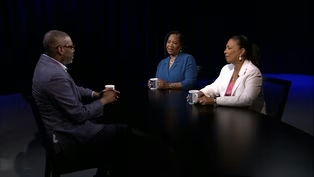
Clip: S54 Ep28 | 11m 56s | Host Stephen Henderson sits down with Katrina McCree and Tanya Hill from the nonprofit to learn more (11m 56s)
Providing Support for PBS.org
Learn Moreabout PBS online sponsorship New Episode
- News and Public Affairs

Top journalists deliver compelling original analysis of the hour's headlines.

- News and Public Affairs

FRONTLINE is investigative journalism that questions, explains and changes our world.

 New Episode

 New Episode
 New Episode

 New Episode
 New Episode
Support for PBS provided by:
American Black Journal is a local public television program presented by Detroit PBS