
ACA Health Insurance Subsidies Set to Expire. What to Know
Clip: 12/8/2025 | 7m 32sVideo has Closed Captions
People depending on Affordable Care Act plans could see insurance prices spike.
A vote is set for Thursday on whether to extend Affordable Care Act health insurance subsidies that made premiums more affordable.
Problems playing video? | Closed Captioning Feedback
Problems playing video? | Closed Captioning Feedback
Chicago Tonight is a local public television program presented by WTTW
WTTW video streaming support provided by members and sponsors.
ACA Health Insurance Subsidies Set to Expire. What to Know
Clip: 12/8/2025 | 7m 32sVideo has Closed Captions
A vote is set for Thursday on whether to extend Affordable Care Act health insurance subsidies that made premiums more affordable.
Problems playing video? | Closed Captioning Feedback
How to Watch Chicago Tonight
Chicago Tonight is available to stream on pbs.org and the free PBS App, available on iPhone, Apple TV, Android TV, Android smartphones, Amazon Fire TV, Amazon Fire Tablet, Roku, Samsung Smart TV, and Vizio.

WTTW News Explains
In this Emmy Award-winning series, WTTW News tackles your questions — big and small — about life in the Chicago area. Our video animations guide you through local government, city history, public utilities and everything in between.Providing Support for PBS.org
Learn Moreabout PBS online sponsorship>> Residents who depend on the Affordable Care Act for health care coverage could see their premiums spike, depending on which way Congress votes this week.
vote is set for Thursday on whether to extend federal health care subsidies that have helped make ACA premiums more affordable for some.
But those subsidies set to expire at the end of this month.
As many as 100,000 Illinois could lose coverage.
Joining us to dive deeper is Anthony also a health care economist and professor who chairs the Department of Economics at the Treehouse College of Business at DePaul University.
Welcome.
Thanks for joining Thanks.
as we mentioned, Congress votes this Thursday on a plan that Democrats have united around it seeks to extend these existing tax credits for another 3 years.
What changes could happen if Congress does not extend the subsidies?
>> Well, what's going to happen is that temporary subsidies were enacted during the pandemic, it was an emergency situation with the pandemic.
That's what we're talking about.
They are temporary.
They are by act of Congress scheduled to end at the end of the year.
So what they are, they're enhanced premium tax credit.
These are these are for generally middle income people.
They will not.
The change will not affect lower-income residents.
They there are middle income people who will experience greater exposure to the true cost of the health plans that be considering purchasing within exchanges than what would the options be for some of those higher middle income folks.
>> Who will be impacted?
Well, I think what we're seeing and you mentioned, you know, the expected number recent estimate ID number of people who might choose not to take up coverage given that they're going to be paying more out of pocket for the premiums for these plans.
They'll primarily be healthier people who prop coverage and those people who are going to be value in coverage more will tend to be less healthy and so that's why that's one of the reasons why we're seeing premiums spiking in for 2026.
So that's really the nature, the change that we're talking about here because it has an impact everybody's premium.
Of course, when the bulk of people who are needing this particular coverage >> are less healthy.
It costs more to care for them.
That's that's correct.
Premiums are going to go up for everybody.
Although again, I will say what the sum total of the changes is that the average premium that is paid for by the government will go from about 88% to around 83%.
So meaning that on average people will be going from paying about 12% premium to around 70 If you're low income going to be no change at all.
If your higher income middle income, you will feel some of take on more fat premium cost to.
There's also Republican pant plan not up for a vote yet.
It is called the health care freedom for Patients Act.
>> Make health care affordable again.
It proposes ACA enrollees between the ages of 18 to 49 years old who earn less than 700% of the federal poverty level that they receive $1000 in an HSA a health savings account.
$1500 for people who are 50 to 60 years old.
Expanding plan options available to consumers by extending eligibility for catastrophic coverage plans to all individuals starting January first, 27 cutting Medicaid funding to states that provide coverage to undocumented immigrants and prohibiting the use of Medicaid funding for gender affirming care.
Does this help in your opinion, does this help market incentives are just shift the costs?
there are a lot of competing proposals right now flying around Washington.
You know, I I personally don't think that they necessarily get at some of the major drivers that we're seeing again, it was called the Affordable Care Act.
I'm not entirely convinced that it has made.
And I think that's a good evidence to suggest that it has not made health care more affordable.
I would like to push towards thinking more about reforms that.
Beating a temporary extension of the enhanced subsidies for more fundamental kind of structural reform of the subsidies themselves.
I think those are the ones that are sort of miss targeted this type of reform.
I think it's partly gets there because I I do think you want to get patients 2 enrollees to have patience to have money of their own to control with regard to their healthcare purchases.
I'd like to see them get the subsidy in a health account of some sort so that they can use it to buy whatever plan they would like available on the exchanges if they choose a more formal plan, they get keep the difference in their account, use it for their cause sharing, use it for deductible payments.
Use it for Co pays I think that would be a smarter way to make some meaningful reforms and to stop the system that we currently have, which really is one where money gets sent directly to the insurance companies and enroll.
These don't really see it along the way.
And so I personally would like to see the patients and the enrollees have more skin in the game.
I'd like to see insurers be forced to compete more in the marketplace.
They're called marketplaces, but as the currently structured.
Insurers don't have a lot of incentive to compete with one another.
And so reforms that are more structural in nature to try to move the needle on healthcare costs.
I think by and sent in competition with one of your peers, economist Craig Garthwaite recently co-authored a paper called coverage isn't care and abundance agenda for Medicaid offering propose solutions as well.
>> Some of those recommendations include ease restrictions on doctors trained in other countries.
Allow nurse practitioners and physician assistants to practice independently and loosen regulations to allow for AI assisted care to Medicaid patients.
Do you think those are those like some of the structural changes that you are also suggesting?
Could those make a difference?
I think these are great ideas.
Craig is a super smart guy.
He's focusing on the supply side.
I think that's really critical.
And health care.
>> Growing the supply side that reduces costs.
I'm focus a little bit more on as an economist.
I call the demand side.
So how do we structure incentives so that the prices are right for the services and that there are that there are real efforts and real means of competition in these marketplaces, of course, blow having coverage is important.
That coverage does not necessarily guarantee and appointments or affordability.
Once you get an appointment, should the policy debate shouldn't be shifting from coverage numbers to access and quality care?
>> I think those are super important issues.
They should always be front and center in any debate when it comes to health care because, yes, it doesn't mean anything.
You're the nature of your health insurance contract doesn't mean anything if you can't get in to see a doctor.
>> That's where we'll have to leave it obviously something
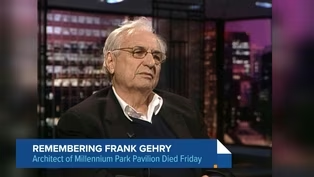
Remembering Architect Frank Gehry
Video has Closed Captions
Clip: 12/8/2025 | 2m 6s | Frank Gehry, who designed some of most imaginative buildings ever constructed, has died. He was 96. (2m 6s)

Small Business Owners Sound the Alarm Over Proposed Hemp Ban
Video has Closed Captions
Clip: 12/8/2025 | 9m 19s | A key committee last week voted 10-6 to send the measure to the full Chicago City Council. (9m 19s)
Providing Support for PBS.org
Learn Moreabout PBS online sponsorship
- News and Public Affairs

Top journalists deliver compelling original analysis of the hour's headlines.

- News and Public Affairs

FRONTLINE is investigative journalism that questions, explains and changes our world.












Support for PBS provided by:
Chicago Tonight is a local public television program presented by WTTW
WTTW video streaming support provided by members and sponsors.