
Appraisal: Anishinaabe Man's Beaded Bandolier Bag, ca. 1890
Clip: Season 30 Episode 6 | 2m 56sVideo has Closed Captions
Appraisal: Anishinaabe Man's Beaded Bandolier Bag, ca. 1890
Check out Ted Trotta's appraisal of an Anishinaabe man's beaded bandolier bag, ca. 1890, in Georgia State Railroad Museum, Hour 3.
Problems playing video? | Closed Captioning Feedback
Problems playing video? | Closed Captioning Feedback
Funding for ANTIQUES ROADSHOW is provided by Ancestry and American Cruise Lines. Additional funding is provided by public television viewers.
Support provided by:


Appraisal: Anishinaabe Man's Beaded Bandolier Bag, ca. 1890
Clip: Season 30 Episode 6 | 2m 56sVideo has Closed Captions
Check out Ted Trotta's appraisal of an Anishinaabe man's beaded bandolier bag, ca. 1890, in Georgia State Railroad Museum, Hour 3.
Problems playing video? | Closed Captioning Feedback
How to Watch Antiques Roadshow
Antiques Roadshow is available to stream on pbs.org and the free PBS App, available on iPhone, Apple TV, Android TV, Android smartphones, Amazon Fire TV, Amazon Fire Tablet, Roku, Samsung Smart TV, and Vizio.
Buy Now

ANTIQUES ROADSHOW's 2026 Production Tour
Enter now for a chance to win a pair of free tickets to one of the three stops on ANTIQUES ROADSHOW's 2026 Tour. Sweepstakes entry deadline is April 6.Providing Support for PBS.org
Learn Moreabout PBS online sponsorshipGUEST: I bought this piece back in about 1985 in Athens, Georgia, at a thrift shop.
APPRAISER: Do you know where it's from?
GUEST: No-- I don't know anything about who made it or, you know, what part of the country, or anything.
APPRAISER: It's from the Great Lakes area.
It's made by the Chippewa Indians.
In Canada, they're referred to as the Ojibwe, and they refer to themselves as the Anishinaabe, the people who were the original ones of that area.
It's one of the largest tribes in North America and Canada.
This is called a bandolier bag, made by a woman.
A man would wear this across his shoulder, along his side.
Anybody who saw that man wearing this would instantly know his tribal affiliation.
And the man would put all sorts of things in the pouch: fire-making materials, maybe potions to keep him safe.
The woman who made this had a, a certain brilliance for design.
The color combinations are exceptional.
Do you know where the beads are from?
GUEST: No.
APPRAISER: Venice, Italy.
GUEST: Are you serious?
(chuckling) APPRAISER: And all of these cloths were imported from Europe.
You have all this white background in what's called lane stitch, and they're just laying down horizontal lines.
But notice the pattern on the flowers.
It's all what's called contour beading.
This is not the first bandolier bag that she made.
GUEST: Yeah?
APPRAISER: This is special.
We can date this in a variety of ways.
The beads, particularly these clear beads, came into, uh, the Great Lakes region around 1880, 1890.
The floral arrangements have developed from very abstract forms to figurative forms, and that, too, helps date it.
Maybe right around 1880, 1890.
These geometric patterns going up and down the sides and across the top, those are called patterns of power.
And in abstract form, they replicate the footprints or patterns of an otter trail.
Otters are very special creatures, because they inhabit two domains, both the underwater world and the land world, and that was considered quite special.
So this is a protective design, empowering the person who's wearing this.
And then all of these floral elements, they're not just decorative flowers, they're representations of herbal healing power.
So there's a lot of symbolism going on here.
This bandolier was longer at one time, and the lady reduced the size by maybe eight or ten inches.
At some point, it got passed on, perhaps to a smaller person.
And it, that kind of suggests how much it was a treasured object.
It wasn't going to be discarded.
It wasn't going to be packed away.
Do you recall what you paid for it?
GUEST: I think I paid about $30.
APPRAISER: I think on a retail basis today, this would sell for about $1,800.
GUEST: Okay, okay.
APPRAISER: Yeah.
GUEST: Thank you!
APPRAISER: And, and if you were insuring it, maybe about $2,400.
GUEST: Okay.
APPRAISER: I love it.
GUEST: Oh, I do, too-- thank you very much.
(chuckles)
Appraisal: 1865 Eyewitness Account of Lincoln Assassination
Video has Closed Captions
Clip: S30 Ep6 | 2m 58s | Appraisal: 1865 Eyewitness Account of Lincoln Assassination (2m 58s)
Appraisal: 1937 Hindenburg Airship Fragments
Video has Closed Captions
Clip: S30 Ep6 | 2m 8s | Appraisal: 1937 Hindenburg Airship Fragments (2m 8s)
Appraisal: 1966 A.E. Backus "Shelling Gungo Peas" Oil Painting
Video has Closed Captions
Clip: S30 Ep6 | 3m 22s | Appraisal: 1966 A.E. Backus "Shelling Gungo Peas" Oil Painting (3m 22s)
Appraisal: 1974 Cundo Bermudez Watercolor Painting
Video has Closed Captions
Clip: S30 Ep6 | 1m 4s | Appraisal: 1974 Cundo Bermudez Watercolor Painting (1m 4s)
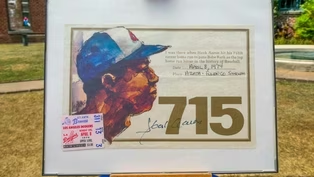
Appraisal: 1974 Hank Aaron 715th Home Run Group
Video has Closed Captions
Clip: S30 Ep6 | 3m 4s | Appraisal: 1974 Hank Aaron 715th Home Run Group (3m 4s)
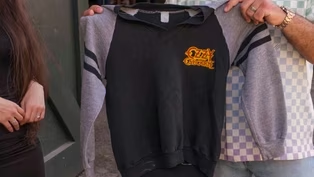
Appraisal: 1982 Bootleg Ozzy Osbourne Sweatshirt
Video has Closed Captions
Clip: S30 Ep6 | 1m 21s | Appraisal: 1982 Bootleg Ozzy Osbourne Sweatshirt (1m 21s)
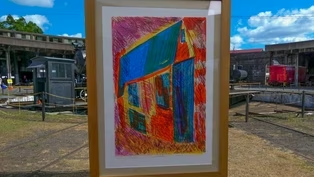
Appraisal: 1987 Beverly Buchanan "Happy Shack" Lithograph
Video has Closed Captions
Clip: S30 Ep6 | 2m 57s | Appraisal: 1987 Beverly Buchanan Happy Shack Lithograph (2m 57s)
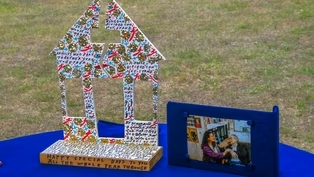
Appraisal: 1993 Howard Finster Mixed-media Artwork
Video has Closed Captions
Clip: S30 Ep6 | 3m 14s | Appraisal: 1993 Howard Finster Mixed-media Artwork (3m 14s)
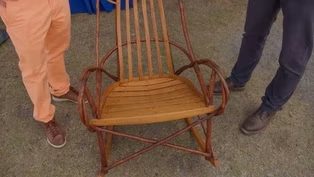
Appraisal: Adirondack Twig Rocking Chair, ca. 1930
Video has Closed Captions
Clip: S30 Ep6 | 1m 18s | Appraisal: Adirondack Twig Rocking Chair, ca. 1930 (1m 18s)
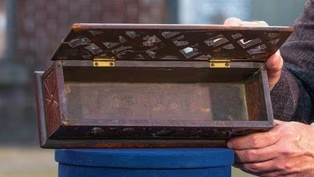
Appraisal: Civil War POW Carved Wooden Box
Video has Closed Captions
Clip: S30 Ep6 | 2m 49s | Appraisal: Civil War POW Carved Wooden Box (2m 49s)
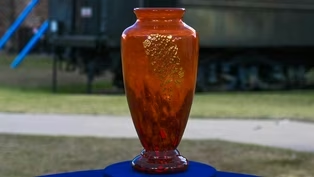
Appraisal: Daum Nancy Art Deco Glass Vase, ca. 1920
Video has Closed Captions
Clip: S30 Ep6 | 1m 52s | Appraisal: Daum Nancy Art Deco Glass Vase, ca. 1920 (1m 52s)
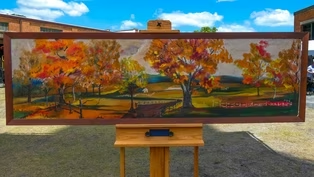
Appraisal: Ernie Barnes Oil Painting, ca. 1963
Video has Closed Captions
Clip: S30 Ep6 | 2m 47s | Appraisal: Ernie Barnes Oil Painting, ca. 1963 (2m 47s)

Appraisal: Ming Dynasty Bronze Vase
Video has Closed Captions
Clip: S30 Ep6 | 2m 29s | Appraisal: Ming Dynasty Bronze Vase (2m 29s)
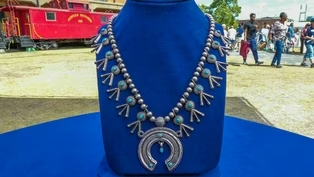
Appraisal: Navajo Squash Blossom Necklace, ca. 1930
Video has Closed Captions
Clip: S30 Ep6 | 1m 56s | Appraisal: Navajo Squash Blossom Necklace, ca. 1930 (1m 56s)
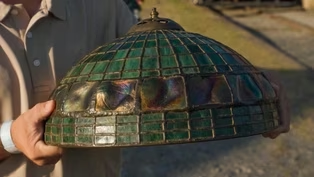
Appraisal: Reproduction Tiffany Lamp, ca. 1980
Video has Closed Captions
Clip: S30 Ep6 | 1m 1s | Appraisal: Reproduction Tiffany Lamp, ca. 1980 (1m 1s)

Appraisal: Sèvres-style Pottery Urns, ca. 1900
Video has Closed Captions
Clip: S30 Ep6 | 2m 57s | Appraisal: Sèvres-style Pottery Urns, ca. 1900 (2m 57s)
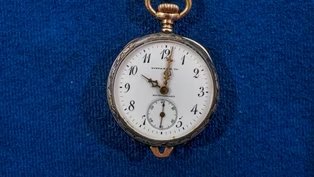
Appraisal: Tiffany & Co. Pocket Watch, ca. 1890
Video has Closed Captions
Clip: S30 Ep6 | 2m 10s | Appraisal: Tiffany & Co. Pocket Watch, ca. 1890 (2m 10s)
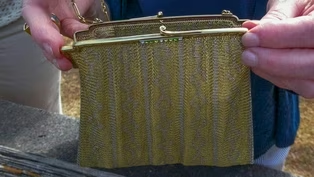
Appraisal: Tiffany & Co. Purse, ca. 1915
Video has Closed Captions
Clip: S30 Ep6 | 2m 6s | Appraisal: Tiffany & Co. Purse, ca. 1915 (2m 6s)
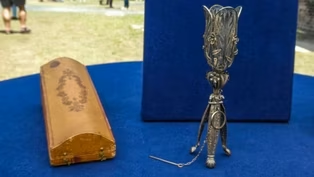
Appraisal: Tussie-Mussie with Fitted Box, ca. 1869
Video has Closed Captions
Clip: S30 Ep6 | 2m 20s | Appraisal: Tussie-Mussie with Fitted Box, ca. 1869 (2m 20s)
Preview: Georgia State Railroad Museum, Hour 3
Video has Closed Captions
Preview: S30 Ep6 | 30s | Preview: Georgia State Railroad Museum, Hour 3 (30s)
Providing Support for PBS.org
Learn Moreabout PBS online sponsorship
- Home and How To

Hit the road in a classic car for a tour through Great Britain with two antiques experts.













Support for PBS provided by:
Funding for ANTIQUES ROADSHOW is provided by Ancestry and American Cruise Lines. Additional funding is provided by public television viewers.