
Black Church in Detroit series examines Black presence in the Bible and “Faith in Detroit”
Season 54 Episode 8 | 26m 46sVideo has Closed Captions
A look at the African presence in the Bible and a new project encourages stories about faith.
Our “Black Church in Detroit” series looks at the African presence in the Bible. We’ll examine the historical evidence that challenges the idea that the biblical text is solely focused on Europeans. Also, we’ll have details on a new project titled “Faith in Detroit,” which encourages Metro Detroiters to share stories about faith and resilience.
Problems playing video? | Closed Captioning Feedback
Problems playing video? | Closed Captioning Feedback
American Black Journal is a local public television program presented by Detroit PBS
Black Church in Detroit series examines Black presence in the Bible and “Faith in Detroit”
Season 54 Episode 8 | 26m 46sVideo has Closed Captions
Our “Black Church in Detroit” series looks at the African presence in the Bible. We’ll examine the historical evidence that challenges the idea that the biblical text is solely focused on Europeans. Also, we’ll have details on a new project titled “Faith in Detroit,” which encourages Metro Detroiters to share stories about faith and resilience.
Problems playing video? | Closed Captioning Feedback
How to Watch American Black Journal
American Black Journal is available to stream on pbs.org and the free PBS App, available on iPhone, Apple TV, Android TV, Android smartphones, Amazon Fire TV, Amazon Fire Tablet, Roku, Samsung Smart TV, and Vizio.
Providing Support for PBS.org
Learn Moreabout PBS online sponsorship- Just ahead on "American Black Journal," our "Black Church in Detroit" series looks at the African presence in the Bible.
We will examine the historical evidence that challenges the idea that the biblical text is solely for Europeans.
Plus, we'll hear about a new project that encourages Metro Detroiters to share stories about faith and resilience.
You don't wanna miss today's show, "American Black Journal" starts right now.
- [Announcer 1] Across our Masco family of companies, our goal is to deliver better living possibilities and make positive changes in the neighborhoods where we live, work, and do business.
Masco, a Michigan company since 1929.
Support also provided by the Cynthia & Edsel Ford Fund for Journalism at Detroit PBS.
- [Announcer 2] The DTE Foundation is a proud sponsor of Detroit PBS.
Through our giving, we are committed to meeting the needs of the communities we serve statewide, to help ensure a bright and thriving future for all.
Learn more at dtefoundation.com.
- [Announcer 1] Also brought to you by Nissan Foundation and viewers like you.
Thank you.
(bright music) - Welcome to "American Black Journal," I'm your host, Stephen Henderson.
Today we are continuing our series on the "Black church in Detroit," which is produced in partnership with the Ecumenical Theological Seminary and the Charles H. Wright Museum of African American History.
It is Black History Month, and we're taking a look back at Black history in the biblical context.
For ages, there have been questions about whether people of African descent were present in biblical history.
My guest today is the President and Founder of the Bible is Black History Institute.
Dr.
Theron Williams has written several books exploring the historical images and evidence that show the significant role of Black people in the scriptures.
He is a Detroit native and pastor of Mt.
Carmel Church in Indiana.
Welcome back to "American Black Journal."
- Thank You Thank you, it's good to see you.
- Yeah, it's good to see you.
And of course, your bounty of work here in front of (crosstalk) - Yes, yes.
- Let's start with that question that I was talking about in the open.
There are people who don't understand, or don't know, or just openly question the idea in that people of African descent are part of the scriptures.
Let's talk about why we know, why you know that's not true.
- Oh, well, people of African descent are the foundation of the biblical story.
And a lot of the information has been suppressed, but it is now coming to light.
Well, it has been come to light, but it's still been ignored.
And that knowledge has been marginalized.
For example, major scholars, such as Cain Hope Felder, who is a Columbia University graduate and scholar, and for years, was a professor at Howard University, wrote that groundbreaking book, "Troubling Biblical Waters," where he explores, from an academic perspective, from a scholarly perspective, Black presence in the Bible.
- Mm-hmm.
- And then you have other scholars like Tudor Parfitt who is a Oxford University scholar and historian.
And he spent a lot of his career studying Black presence in the Bible, particularly the Lemba tribe of South Africa, where DNA evidence and genetic evidence have proven that they have a genetic connection to the biblical Israelites, particularly the priestly tribe of Aaron.
And so, you have these Africans in South Africa.
And then Thomas C. Oden has written extensively, he's another brilliant scholar, has written extensively about the seed bed of Christianity being in Africa.
So, the roots of the religion of Moses and the roots of Christianity are actually African.
And so, there is major African presence- - Yeah, yeah.
- In the Bible.
- Now, talk about why that matters though, and why it matters now.
I think there are also some people who would say, "Well, the scriptures are for everyone, and it is about one belief, one God, one church."
So, what's the reason for us to emphasize that Africans played a role?
- Well, first of all, because it's true.
- Yeah, well, right, mm-hmm.
- It is a historical fact.
- As a journalist, I agree that that's important.
- Right.
And so, we just study the Bible.
And then secondly, the biblical story has been co-opted by White evangelical theology that painted everything in the Bible White to make it consistent with their theological narrative.
And so, when African Americans read the Bible, by and large, it feels like we are interloping on someone else's story.
- Mm-hmm.
- And so, when we reclaim that story by highlighting the reality that this story emerged from a people of African descent, or from a people who look like us, it makes us a part of the story.
So, when we open the Bible and begin to read it, and we imagine these people look like us, people of African descent, it causes that story to resonate more profoundly with the reader.
So, that's why it's important, it's a psychological connection that you have.
And also there is evidence the research is saying that these images of White Jesus, how destructive and marginalizing they are, that long-term exposure to White Jesus, it has been documented.
In fact, on my podcast, I do an interview with a lady who did the research on this, that long-term exposure to White Jesus causes Black and White people to have a less favorable view of African American people.
- Sure, yeah.
- Just because of that- - There are lots of things in our culture, in fact, have that.
- Oh yeah, yes.
- Yeah.
How do you reconcile this with the history in this country of Christianity being imposed on African people?
I mean, we were brought here, not as citizens, as property and chattel, and it was White slave owners who forced Christianity on us.
And how do we square that with this rich history of us being the basis for their belief?
- Yeah.
(Stephen chuckles) Well, see, and it wasn't the indigenous, the original Christianity expression, like Thomas Oden said, the seed bed was in Africa, it was a bastardized version of Christianity that was twisted to support the White supremacy system.
- [Stephen] Mm-hmm.
- And it was that brand of Christianity that was imposed on the West African, the one that were brought here as chattel.
And the reason it was imposed on them, was they used it as a tool, as a weapon, to get them to accept their subordinate role in human hierarchy, you know?
But our forebearers finally learned how to read because reading was criminalized.
When they learned how to read the Bible, they read it.
And the biblical story did not fit the narrative that they hadn't been taught, you know?
So, they see how God is on the side of the enslaved Hebrews and against the enslaved Egyptians, and then they read about Jesus who is beaten and whipped.
They are beaten and whipped.
How Jesus was alleged on a tree at Calvary and how many of them were.
And so, they said, this story is our- - Our story, right?
- Yeah, yeah.
And so, from that, emerged a brand of Christianity that's unique to people of West-African descent that we practice here now.
in the United States.
- Yeah, I wanna talk some about your work, but I wanna talk especially about the work that you're doing that involves literature for young people- - Yes.
- A children's books.
- Yes.
- And why that's so important.
- Yeah, that's important.
Thank you for bringing that up, Stephen.
We have the Bible is a Black History online academy.
And that academy is designed to spread this information and to help people to understand.
It was put together by myself, along with other scholars.
And in that curriculum, we have a full children's curriculum that we have animations, we have books, we have activities to engage and to involve children in the story.
Because I know, you know, I grew up in the church.
And I fantasized about, how might I would have developed differently if I were exposed to this type- - As a young boy.
- Yes, as a young person, you know?
And so, it has impact on people when they study themselves.
And the literature is also out that the study of Black history, African-Americans who study Black history have a higher self-esteem and a higher appreciation for themselves and self love than African-Americans who don't study Black history.
So, Black history is important beyond February.
We need to be doing it 365 days because it impacts us on a totally different level.
- Yeah, yeah.
If you don't know where you've been, it's hard to know where you're going.
- Yeah, and it's hard to know where you are.
- Where you are.
- Yeah.
- Right, right.
This is a great subject for Black History Month.
Talk about how this lives in your church.
I mean, you're a pastor as well, how does this sort of, you know, exist in the fabric of your ministry?
- Well, Stephen, it's a struggle, it's a continual struggle because why the evangelical theology has been so embedded and deeply rooted in the American experience, and how we understand Christianity, how we understand the role of Christ, and how we understand the function of the Bible.
So, it's deeply rooted in us.
But we have been slowly transforming our congregation to reimagine what Christianity is, to reimagine what Christ's role was, and to reimagine the function of the Bible.
And that takes a while, but it does work.
And it has been transforming, you know, our congregation in a extremely meaningful way.
- Can you gimme an example of how you see that, like, that transformation?
How does that manifest itself?
- Well, the fact that now that when we read the Bible, just the images itself, those images are different.
They reflect our story, they reflect our imagination.
So, it causes a deeper connection with the Bible.
It causes a deeper connection with the biblical story when you can resonate with that story because you are a part of the story.
Now, you know, people in my church, you know, pick up the Bible and say, "This is my story."
- [Stephen] This is me," yeah.
It's an interesting way to think about it.
I mean, if you are learning about the Bible and you think of Moses as a Black man, or Noah as a Black man, or Esther as a Black woman, that changes the way that- - Oh, that changes, yeah.
- It is a different story.
- Yeah.
(Stephen chuckling) - No, I mean, if I handed you a book, Stephen, and had these same information in it, but the depictions that were embedded in that book were of you, your family, your children, and all of that, book that has your images in it is going to be more appealing to you because it's speaking to you as a opposed to a book that has somebody else's interlope.
You'll feel like you are the interlope in that story.
Yeah.
- Yeah, yeah.
- Dr.
Williams, it's always great to talk with you.
Thanks for being here.
- Thank you for having me.
- A new initiative led by Christ church Cranbrook in Bloomfield Hills is gonna lift up compelling stories of faith lived up by people all across our region.
This four-year project is titled Faith in Detroit.
It's supported by Lily Endowment, and Detroit PBS is the lead storytelling media partner.
I got all the details from Reverend Dr.
William Danaher of Christ church Cranbrook, and Reverend Dr.
Theodore Turman from the Ecumenical Theological Seminary, which is one of the project's partners.
Father Danaher, Reverend Turman, welcome to "American Black Journal."
- Thank you.
- Good to be here.
- So, I wanna start with the title of this project.
It's not Church in Detroit, it's not Belief in Detroit, it's not Religion in Detroit, it's Faith in Detroit.
And I love that phrase, it's a wonderful sort of welcoming phrase, I think.
But I want to start with each of you talking about why that name matters, and what it means in the context of this project.
Father Danaher?
- Well, when we were deciding about this, we decided to think about Faith in Detroit meaning two things.
First of all, it's the way we experience faith in Detroit.
The incredible diversity, and the incredible power, and the incredible history of faith in Detroit through its many houses of worship, but also through its many leaders and through the people who do the work that they do.
But we also wanted to talk about people who had faith in the city that in Detroit when Detroit didn't have a lot of believers.
And those are the people that are the most interesting, to me and to us, I believe.
Because so often, the master narrative about Detroit is one of rise and ruin.
- Mm-hmm.
- And when I got to know the faith communities of Detroit, and I'm so grateful for the Black churches of Detroit that I've had the ability to build relationship with, I began to see that Detroit is made up of people who believe in the city, and these are people who are resilient and who are focused on resurrection.
- Hmm.
- So, we wanna challenge, a little bit, the dominant narrative about Detroit.
We want to actually reflect the real narrative about Detroit as told by Detroiters.
And we want to equip storytellers, and we wanna help them share their stories across mediums in different ways.
And we do that by capturing both of those things, the faith we find in Detroit and the people who believe in Detroit is a place of faith.
- Mm-hmm, yeah.
Reverend Turman?
- One of the things that I learned early on was how to define faith.
And we, you know, we do a lot of equations in church.
And so, we decided that faith was belief plus action.
And so, kind of piggybacking off of those who believed in Detroit, it was also then, what did that look like?
What did that belief, how did that manifest?
And how does it continue to manifest?
So, the notion that we are exploring what belief plus action has looked like, but also continues to look like, and even to some degree, beginning to project what it might look like in the future.
And then I think the second part of it which is worth exploring, is just the name Detroit.
- Yeah.
(chuckles) - It means so many different things.
And there's, both fortunately and unfortunately, there's no one who has total control over what that word means, right?
Because we have all experienced conversations where people say, "I'm from Detroit."
Where?
- Yeah, right, right.
- Well, what does that mean?
What are- - It's not always a question, sometimes it's a little bit of an accusation, right?
- Absolutely, absolutely.
- Yes, yes, 100%.
- Stepping into that conversation of what it has meant and this journey of defining both faith and defining Detroit was something we really wanted to not shy away from, but really intentionally engage.
- Yeah.
- Yeah.
Reverend Turman, in the Black-church, in particular, story, I think, carries this across history in super important ways.
Talk about how in this project, that through line of narrative and story will- - Mm-hmm.
Well, if you think about it, oftentimes, we identified leaders by their ability to tell stories.
If you could command a crowd, they'd put you in the pulpit.
- [Stephen] Right, right.
(chuckling) - If you could capture people- - It's still kind of a test.
Right?
- Yeah.
If you could capture people's imagination with your words, they almost immediately began to see some spiritual gifts in you.
And so, there are things that we have done very naturally that we didn't necessarily believe was, we usually believe it was more art than science.
And now we're trying to sort of reverse that and think about the sort of the science of it, along with the artistic expression.
- Mm-hmm.
Let's talk about how this project reaches individuals.
- [Theodore] Sure.
- People living here in metro Detroit, and I guess what you hope they'll draw out of it.
- So, the way we conceived of this, is we wanted to create a kind of ecosystem of storytelling.
But there's, in all reality, an incredible ecosystem already.
And one person I've been watching for a long time is Satori Shakur and her incredible work with the Secret Society of Twisted Storytellers.
- Twist storytellers, right?
- And I'm a huge fan of hers and a huge fan of that work.
And I see so many layers.
Every time I go, it's an amazing experience.
And so, that's one form of storytelling, right?
That's the person on the stage in a audience who's actually invited to be empathic at the very beginning.
She has an incredibly wonderful approach.
But the more and more I spent with people through different projects that I did with a collaborator in Detroit on art, with Billy Mark, who is a interdisciplinary artist and remarkable performance artist, poet, IB, and also seeing the stories that are not rehearsed, that don't appear on stage.
- [Stephen] Mm-hmm.
- And also, I see the artistic community as looking to find ways to improve their skill as storytellers, not just for the stage, but maybe in written print.
- [Stephen] Hmm.
- So, we wanted to find partners who could help us, at the most basic level, meet the storytellers and have the trust to tell us their stories.
And Detroit PBS is an amazing partner because the model of Detroit PBS is you lead, we follow, it's a community-based organization in terms of the way it invests in the communities.
Because of the work I do through my church, we actually know a lot of the same people.
And that allowed us to think about Detroit PBS being a key partner because of their understanding of how we have to be in the midst of the community.
So, we have Detroit PBS, which is gonna be doing opportunities for people to tell their stories at the communities that they do.
We also have an artist collective led by Billy Mark, and that's actually gonna do something as exciting and unproven and experimental.
But he's gonna build an app that's gonna try to map stories.
- Yeah, wow.
- And he's gonna, because of his, he's got a playfulness in his artistic practice, he's going to create pews where we're gonna place them in either public places or in places of worship where someone could sit and either hear a story or tell a story.
And we just want to catch, at that basic level, people who are willing to do storytelling.
And then from there, we have our relationships with Ecumenical Theological Seminary, which is gonna help people tell a story in a deeper way with scripture and tradition and history to really equip mostly pastors, but also people who are Christian leaders.
And of course, we know there's a lot of that shared work in our community, but also with Detroit Opera to actually see if we can pull some leading stories to tell the story of faith in Detroit differently.
And then I'm really excited to be working with Oakland University and the Center for Public Humanities, because there are people who want to tell their story, they may not be drawn to Satori Shakur's approach, and she's a consultant for us, and we're working with them, but they may want to tell their story in written form.
And so, we have a online journal that we're gonna be doing, and as well as intensives.
And all of this, and then there's another layer even, but I won't go too much into that.
But what we're hoping to do, is get that ecosystem built by many ways of telling a story rather than just the person on the stage or the person on the pulpit.
- Sure, sure.
And by reaching really deeply into different parts of the community.
- And so, we are looking for stakeholders because there are, the informal networks of faith are the really profound way to get into any community.
And so, you know, if anybody knows a story, we will be sending along information.
It's, we got an intake.
- Come and tell it, right?
- Yeah, come and tell it, and then we'll find the venue.
So, I'm very excited that our first storytelling opportunity will be at Fellowship Chapel.
And I'm really grateful for Dr.
Constance Simon for organizing that.
And she is a brilliant leader, and a wonderful person, and- - [Stephen] Frequent guest on this show.
(Stephen chuckles) - [William] Nobody better.
- Yeah.
- And to have her ability to be a stakeholder and to help us draw in the storytellers is gonna be critical.
- [Stephen] Yeah.
- No one does this alone.
- Right, right, right.
- If I can be ever so critical of the church, I think historically, the church has had a difficult time holding stories that did not fit neatly into the church.
And so, one of the things that made this project attractive, was Father Bill's intention on creating spaces outside the church to still tell stories of faith, right?
I think that one of the things that we're seeing, particularly in these days, that people are coming to, and expressing their faith, in numerous ways outside of the church.
Now, that makes church people anxious.
- A little bit nervous, right?
- Oh, but I still think that it's valuable.
And I think the church has an opportunity to reflect on why we haven't been able to make room for some of those stories.
- Yeah.
- And so, there are going to be people who look at our project and say, "Well, what's the opera here for?"
Or, "What are the schools here for?"
And the point is that we're trying to create as many avenues, as many pews, as many doors, and put up as many microphones as we can to capture compelling stories.
And so, that's what I'm excited about.
- And you can see my entire conversation with Father Danaher and Dr.
Turman at americanBlackjournal.org.
That is gonna do it for us this week.
You can find more about our guests on our website, and we've included a list of resources about Black presence in the Bible.
Connect with us anytime on social media as well.
Take care, and we'll see you next time.
(bright music) - [Announcer 1] Across our Masco family of companies, our goal is to deliver better living possibilities and make positive changes in the neighborhoods where we live, work, and do business.
Masco, a Michigan company since 1929.
Support also provided by the Cynthia & Edsel Ford Fund for Journalism at Detroit PBS.
- [Announcer 2] The DTE Foundation is a proud sponsor of Detroit PBS.
Through our giving, we are committed to meeting the needs of the communities we serve statewide, to help ensure a bright and thriving future for all.
Learn more at dtefoundation.com.
- [Announcer 1] Also brought to you by Nissan Foundation and viewers like you.
Thank you.
(gentle music)
 New
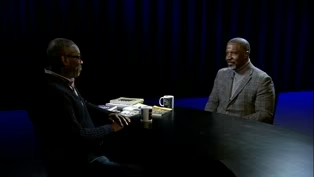
NewBlack Church in Detroit series examines Black history in the Bible for Black History Month
Video has Closed Captions
Clip: S54 Ep8 | 11m 42s | Dr. Theron Williams has written a series of books on "The Bible is Black History." (11m 42s)
 New
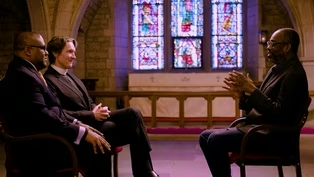
NewClip: S54 Ep8 | 30m 57s | Check out our extended interview with the Rev. Dr. William Danaher and the Rev. Dr. Theodore Turman. (30m 57s)
Providing Support for PBS.org
Learn Moreabout PBS online sponsorship
- News and Public Affairs

Top journalists deliver compelling original analysis of the hour's headlines.

- News and Public Affairs

FRONTLINE is investigative journalism that questions, explains and changes our world.











Support for PBS provided by:
American Black Journal is a local public television program presented by Detroit PBS