
Black Church in Detroit series examines voting and the church
Clip: Season 54 Episode 30 | 16m 43sVideo has Closed Captions
How the Black church is mobilizing congregants to vote as the August primary nears.
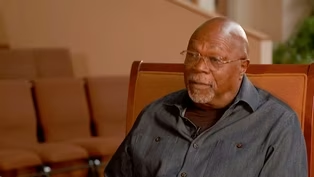
Our "Black Church in Detroit" series examines the role of the Black church in mobilizing the community to vote. Host Stephen Henderson sits down with Bishop Edgar Vann of Second Ebenezer Church and seminarian Ashley Lewis, who is a member of Fellowship Chapel and the Community Action Program Coordinator for UAW Region 1. They discuss strategies the Black church can use to help get out the vote.
Problems playing video? | Closed Captioning Feedback
Problems playing video? | Closed Captioning Feedback
American Black Journal is a local public television program presented by Detroit PBS
Black Church in Detroit series examines voting and the church
Clip: Season 54 Episode 30 | 16m 43sVideo has Closed Captions
Our "Black Church in Detroit" series examines the role of the Black church in mobilizing the community to vote. Host Stephen Henderson sits down with Bishop Edgar Vann of Second Ebenezer Church and seminarian Ashley Lewis, who is a member of Fellowship Chapel and the Community Action Program Coordinator for UAW Region 1. They discuss strategies the Black church can use to help get out the vote.
Problems playing video? | Closed Captioning Feedback
Where to Watch American Black Journal
American Black Journal is available to stream on pbs.org and the PBS app.
Providing Support for PBS.org
Learn Moreabout PBS online sponsorshipToday, we're continuing our Black Church in Detroit series, which is produced in partnership with the Ecumenical Theological Seminary and the Charles H. Wright Museum of African American History.
We're just days away from the August primary, and black churches are working to get souls to the polls.
Historically, the church has played a really vital role in mobilizing the African-American community to participate in the democratic process.
Here to talk about getting out the vote, our Bishop Edgar Vann, senior pastor at Second Ebenezer Church, and seminarian Ashley Lewis, who is a member of Fellowship Chapel and community action program coordinator for UAW Region 1.
Welcome both of you to "American Black Journal."
I want to start with just the times we're kind of living in and through.
And I guess how much that elevates the role that each of us plays in democracy.
I think that message has to get out a lot more frequently and a lot stronger than it has so far.
Bishop Vann, I'll start with you.
- Well, absolutely.
I mean, I think we know the precariousness of the times, the unprecedented things that are going on.
Things that we've never seen and some of which we've never imagined.
Which call, a clarion call, really, for first of all, more voter education.
People being, understanding how government works.
I don't think most people do.
Understanding what it can do, what it cannot do, which I don't think most people know.
And being able to mobilize and ultimize our strength and power in making things happen for our community and for our people.
- Yeah, yeah, Ashley.
- So I think in this moment, specifically for a generation that is probably a little bit further removed from the civil rights movement, I think we have to start thinking strategically about, you know, what is our messaging going to be?
Because my parents taught me to vote, right?
But they experienced the whites only signs.
I didn't experience that, right?
And so I think that we have to think more strategically about what messaging is actually going to motivate people to go vote.
So it's not just enough to register.
It's actually really conveying to them the why.
We have to start with the why and strategically think about, what is our messaging?
What's the economic pain point for them?
Is it gas?
Is it groceries?
Because starting that policy, people don't understand policy.
They don't connect policy to their daily lives.
And while we know that there are people in power now who are harming us, they connect that, that there's this federal government that's not doing policies that help us.
They don't connect how it actually touches them individually.
- Wow, wow.
Bishop Vann, I want to have you talk a little about what's going on in the church that you lead as we get closer to election day.
The kinds of things that the church is involved in and the ways the church is reaching outside its walls to make sure that people get the message.
- It's kind of like organized, mobilized.
And it's also, again, an education piece.
This is what's missing.
I'm probably the oldest one at the table here.
And so I remember a time where we had civics lessons.
I remember a time where we had voting booths in the schools and we discussed the issues.
We knew what they were.
We had our debates and our discussions.
And as kids, we were literally voting.
I mean, we understood the process.
And I agree that there's a whole generation that is far removed from this particular process.
And you got to tell people more than just go vote.
You got to tell people more than just take souls to the polls.
You got to tell people, what are they voting about?
We now vote personality as opposed to policy.
And so at our church, of course, you know, we've had PACS in the past.
We now have a pretty robust get out the vote apparatus in our church that is organized.
We do, we knock on doors.
We do a whole lot of things that normal political organizations may do, though we are a faith-based institution.
But what we're finding is, again, people are divorced from that process, removed from that process, oftentimes because they don't understand that process.
And when a person doesn't understand something, their answer is no.
- Yeah, yeah.
- They're not gonna participate in something that they don't understand.
- No, you know, you bringing up the voting booth that we used to have in school.
I mean, I remember that as a child and they showed you how to use it, and they let you go in and try it out.
And you think about the impression that probably has on a young person by the time they get ready to be able to vote.
It's not something that's unfamiliar.
- Absolutely.
- Yeah, yeah.
Ashley, what's going on at the fellowship this time of the year?
- So our pastor, I've been at this church since I was seven years old.
So for me, civic engagement and faith are mutually intertwined, right?
There's no separation.
And that being said, our church has its own pack.
And through the pack, we bring in people from all over the country to really talk about the issues while equally talking about defraud, which is something that we know is big in Detroit, right?
Like how do we actually really bring resources to the residents so they understand that meeting resource and the politician is what I mean, because that brings in accountability, right?
Because this is the issue that people are dealing with.
Now we have to meet it with the actual politician who's responsible for it.
And so I think we do a good job of doing that.
And then, of course, with him being the president of the Detroit branch of the NAACP, we always are doing get out the vote work intersectionally with them as well.
- Yeah, yeah.
You have a study that, about how young people engage with this issue that I think has some really interesting findings.
I want you to share that with the viewers.
- Yes, yes.
So there was a study, and I always, it's one thing to sense it, but it's another thing to put math behind it.
So the study was done actually by his strategies and in coalition with labor unions.
So we had the Coalition of Black Trade Unionists, SEIU, National Black Voters, different coalitions.
But what the study found was that overall, under age 50, they're not necessarily the people that are just going to vote because it's their right.
And saying that it's our job to defend democracy, the messaging doesn't work.
And so what they found is that we have to identify what are the economic pain points, and then invite them into a overall movement.
Because the movement is where you build that perpetuity in voting.
Under 50, they're less likely to vote because they've been conned into believing that it doesn't matter.
And so the question is, we don't need the civil rights movement of the 1960s.
We need the 2026 civil rights movement, right?
We have to start pushing for a democracy that meets this moment.
And I think the difference is that under 50, they weren't met with the adverse conditions that that generation experienced, which pushed them to fight.
But now we're experiencing that.
And I think right now is a time for the black church to now say, okay, you have a president and this president is not doing things that work for you, but now we're gonna connect how you can't afford your groceries, right?
How you can't afford to get to work every day because gas prices are up.
So connecting the economic pain point to policies, because people don't always connect the dots.
Even though they know something is bad, they don't always connect the dots.
- Yeah.
Is it enough to get them to think about that individual effect on, you know, on themselves to get them to vote?
Or do we even have to go further to, you know, the idea that a movement needs to kind of form around pushing back against all of this?
- I think it's a both and.
I don't think it's a either/or.
Because many of those who were under 50 were waiting to be asked to be invited to the movement.
A lot of them don't even know how to engage, right?
They don't even know if a rally is happening or what's going on.
Like, and so I think that that was interesting because in labor, this always our key thing.
What's the ask, right?
You lay the groundwork, but what's the ask?
And so I think that was missing for a lot of them.
And when they encounter anti-black rhetoric, right?
Or we're talking about economic pain points.
Like for example, black women, you know, the unemployment rate for black women right now is through the roof.
Even though they're most educated group.
So this myth of education yielding, right?
Economic mobility is no longer there.
And so using those things to actually mobilize them to vote, because many of them are educated.
Many of them are.
I mean, that's what our parents taught us.
Go to school.
Get your education.
Yeah.
- Yeah.
Bishop Vann, I want to talk to you about the arc of things and how we are seeing today attacks on progress that you were part of making years and years and years ago.
And I guess what that feels like.
But also how we respond and get, as Ashley's pointing out, people who didn't experience it before to understand how serious that rollback is.
- I couldn't agree more with Ashley as it relates to that demographic.
- [Stephen] Uh-huh.
- I've been a pastor for 50 years.
So I've seen the ebbs and flows, the ups and downs over a continuum of history.
- Right.
- And I've seen our people, and I've seen younger generations come and I've seen them get older.
So I understand that.
You can't appeal to that demographic talking about the civil rights movement.
It has no import.
- Yeah.
- I think that politics only takes us to a certain place.
It is necessary.
Of course, it is a necessary strategy that leads us, and of course helps define policy that affects us.
But from that, we have to also, on our side, be able to gather, you know, sort of our own way of what we're going to do as a people.
And not be so dependent on the personalities of politics necessarily.
By that I mean, as has been expressed, our own economic self-determination, I think is very, very important.
And it comes from our political participation.
- Yes.
- But it ought to lead to something.
It should not stop with a political person in office.
Those change too much.
Agendas change too much.
Here in Michigan, we swing back the pendulum every four to eight years, right?
We do that nationally.
So we can't depend on that.
We're going to have to depend on, as we participate in it, something more lasting toward us, the economic self-determination, a code of behavior among us of how we interact and treat one another.
An emphasis, renewed emphasis on education, but more on training.
Education that is not going to expire by the time the person gets out of school.
There needs to be a retraining of the workforce.
There are a number of things that need to happen that we can't sit back and wait on an election to fix.
Let's do the elections.
Let's do them well.
Let's make sure people are educated toward what they need to know.
Let's have the movement.
Let's have the activism.
But where does it lead to for us as a people?
That's our responsibility beyond the election.
- Yeah.
Did you ever feel like the things that we're seeing, the kind of direct attacks on progress that was made in the '60s in particular would unfold in your lifetime?
Did you ever expect to be here?
- I'm not particularly surprised.
- Yeah.
- I'm not particularly surprised because I'm at an age where nothing really surprises me.
- You've seen enough, right?
- Right, and attitudes don't change that much.
And again, again, I say, as much as this conversation is so salient, politics doesn't necessarily change people's attitudes.
Their attitudes remain the same.
And so people, and this was stated so eloquently.
People have been plotting this particular- - Waiting to, for the opportunity.
- For a long, long time.
Now, we should be doing the same.
However, since we don't, we fall victim sometimes to other people's plans if we are caught unaware.
- Right.
- But I'm saying that, yes, I'm not so surprised that some of these ideas have not changed.
And I think it's gonna be very, very important that there is a mobilized movement that helps to protect our people.
At the same time, I'm also saying that we need to do, have a more self-determined agenda for our own people ourselves.
- Yeah.
Yeah, do you see that emerging with young people?
That idea of that self-determination?
- I think that the black church has to reestablish things like freedom schools.
Because when you had this integration of schools, I believe we lost some of the identity.
Some of the things when you talk about just that self-determination, we don't have it because we are not being cultivated in it.
And a lot of people aren't coming to church.
I'll be quite frank.
I grew up in a church, so I have a different level of self-determination.
And so I think that we have to get back to actually training by educating, but equally by helping them to have an identity.
If you go to these schools even in a predominantly black school, because they're so far removed from the history, right?
To understand America is to understand every time there's a revolution, there's a kind of revolution.
We had the 1800s where black men got the right to vote, they were elected.
And then they killed them.
Like this is the history of America.
So we can't be surprised by this moment, but I think as the black community, we have to rethink how are we grooming our children to be the benchmark of democracy?
Because that's what the black community has done.
We have always forced America to live out its ideals.
And so how do we train the next generation to do the same?
- Yeah, okay.
We could have this conversation all day and I would enjoy that.
But we are out of time.
Good luck with the work in advance of the election.
Thanks so much for being here.
- Thank you.
- Thank you.
- Thank you so much.
 New
NewDetroit NAACP President Rev. Dr. Wendell Anthony shares his faith journey
Clip: S54 Ep30 | 7m 26s | Rev. Dr. Wendell Anthony talks about the creation of his church in the “Faith in Detroit” series. (7m 26s)
Providing Support for PBS.org
Learn Moreabout PBS online sponsorship New Episode
- News and Public Affairs

Top journalists deliver compelling original analysis of the hour's headlines.
 New Episode
- News and Public Affairs

Today's top journalists discuss Washington's current political events and public affairs.
 New Episode
 New Episode
 New Episode
 New Episode
 New Episode
 New Episode


 New Episode
Support for PBS provided by:
American Black Journal is a local public television program presented by Detroit PBS