
“Caregiving Conversations” highlights caregivers and their stories
Clip: Season 54 Episode 18 | 7m 23sVideo has Closed Captions
As part of our ongoing caregiving coverage, Detroit PBS presents the stories of local caregivers.
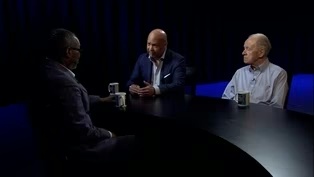
We'll hear the personal stories of three caregivers who took part in the Detroit PBS “Caregiving Conversations” series. The Detroit residents talk about their experiences and the resources available to them during their caregiving journey.
Problems playing video? | Closed Captioning Feedback
Problems playing video? | Closed Captioning Feedback
American Black Journal is a local public television program presented by Detroit PBS
“Caregiving Conversations” highlights caregivers and their stories
Clip: Season 54 Episode 18 | 7m 23sVideo has Closed Captions
We'll hear the personal stories of three caregivers who took part in the Detroit PBS “Caregiving Conversations” series. The Detroit residents talk about their experiences and the resources available to them during their caregiving journey.
Problems playing video? | Closed Captioning Feedback
How to Watch American Black Journal
American Black Journal is available to stream on pbs.org and the free PBS App, available on iPhone, Apple TV, Android TV, Android smartphones, Amazon Fire TV, Amazon Fire Tablet, Roku, Samsung Smart TV, LG TV, and Vizio.
Providing Support for PBS.org
Learn Moreabout PBS online sponsorship- As part of our coverage on caregiving, Detroit PBS has produced a series of conversations with local caregivers.
We've captured their personal stories about the challenges and rewards of caregiving.
Here are some of those stories.
(bright music) - My mom is Julia Esaw.
She's 105 years old as of October 29th last year.
Actually, I don't consider myself a caregiver 'cause we take care of each other.
My belief is if a person can already do an activity, allow them to do it until they can't do it anymore, then that's when the caregiver steps in and does it for the person.
So my mom is, which is 105 years old, she is able to dress herself, tie her shoe laces, put on her boots in the wintertime.
She cuts up our fruit and makes our fruit bowl in the morning.
She cuts up our vegetables and makes our tossed salad in the evening for dinner.
And she basically does everything herself.
There are caregiving workshops that mom and I have attended 'cause we attend almost everything together and there are caregiving workshops.
And I listen to people and they tell me the problems that they're having.
But mom and I, we don't have those problems.
But it's nice to know that there are other people who are in similar situations.
(bright music) - I've been a caregiver since COVID and I'm a caregiver for my mother.
When COVID came about, my mother, she has health issues, so she wasn't able to go out in public.
So that's when it all started.
So I had to start doing her grocery shopping and running other errands for her.
It was very difficult at first 'cause I didn't know what I was doing.
But then, it flowed naturally for me because it's someone that you care for.
And then I knew I had to do this and I had to be on front to support my mother.
My sister is a great resource for me to go to to help me, to help my mother a whole lot better by her working in the healthcare field, especially working with older adults.
Caregiving showed me that I have patience and I didn't think I had, and the way my mother cared for me, made me want to do the same for her.
So that's what gave me that motivation to do that.
When she texts me and says, thank you son, that's the reward.
'Cause I don't do things just for accolades or anything.
Just for her to acknowledge that fact and she sees that I'm going above and beyond, just that acknowledgement, just from a text that brings me joy.
What I would recommend to someone that's starting off in caregiving, reach out to different organizations that are available here in the Metro Detroit area that assist you and give you insight in how to become a better caregiver and also how to navigate that process.
(bright music) - I first came into caregiving just observing my mother who was caring for her mother, my grandmother, who lived to be a hundred, and she lived in the family home with my mom.
And I just sort of, from a distance, I helped and filled in when I needed to, but I never realized the complexity of it.
So it was grandma first.
And then after she passed, about five years later is when mom's health began to decline.
And we had a five year run.
I was here, there's just two of us, my sister and I. My sister was in California, and five years in, then dad began to decline.
And so I had a 10 year run with both mom and dad.
I knew nothing about healthcare systems really.
I didn't know about long-term care.
I didn't know the difference between Medicaid and Medicare.
I didn't know anything and I was 50.
If I had known what I known now, I would have started with Detroit Area Agency on Aging where they could have plugged me into different services.
Mom had to go into a nursing home.
Dad was at the family home, which was about 10 blocks from each other, which made it easy.
I got a job with the Institute of Gerontology at Wayne State and I had an old journalism degree.
I call it a 20th century journalism degree.
So all of that, once I realized that this was something that a lot of people were struggling with, I said, and this was early on in the caregiving, people need some place where they can go and get their information.
Through my advocacy work with the state, once I worked at Wayne State and then I sat on the Michigan Commission for Service for the Aging.
And I learned how the dollars flowed and what they went to.
I learned that there were very few dollars that went towards marketing of resources.
So a lot of programs were underutilized.
So I said, when I get through this, I'm going to come up with a newspaper and inform people and educate people about what's available.
I titled the paper Urban Aging News, and it's a quarterly and it launched in 2015 and I circulated to all three counties, Wayne, Oakland and Macomb to senior centers.
A lot of churches.
I used to run a piece in the paper where we highlighted caregivers and most of them would say, and I had to agree with them, that caregiving mom and dad or one of the parents, maybe one of them, they weren't as close to, that it really brought about them being closer to their parent.
It's a awesome responsibility.
And that became very clear to me.
I'm totally responsible for mom, I'm totally responsible.
And I guess, I mean, she was totally responsible for me at one point.
But it makes you very clear that that's what caregiving is.
And if you love the person, you wanna make sure that you're providing them with this as excellent of care as possible.
- You can see more caregiving conversations at detroitpbs.org.
 New
New2026 Small Business Workshop explores how to navigate challenges in today’s economic environment
Video has Closed Captions
Clip: S54 Ep18 | 12m 52s | The theme for this year's workshop is "Resilient by Design: Innovating Through Disruption.” (12m 52s)
Providing Support for PBS.org
Learn Moreabout PBS online sponsorship
- News and Public Affairs

Top journalists deliver compelling original analysis of the hour's headlines.

- News and Public Affairs

Today's top journalists discuss Washington's current political events and public affairs.












Support for PBS provided by:
American Black Journal is a local public television program presented by Detroit PBS