
Caregiving, Detroit Future City, Destination Detroit
Season 10 Episode 24 | 26m 46sVideo has Closed Captions
A report on caregiving, a look at Detroit Future City’s forum and more from “Destination Detroit.”
Our caregiving series examines the inner workings of a home health care business and the health professionals taking care of people in need. Plus, the CEO of a national think tank brings a message of racial and economic justice to Detroit and our “Destination Detroit” series introduces us to a woman whose grandmother came to Michigan to further her education and career.
Problems playing video? | Closed Captioning Feedback
Problems playing video? | Closed Captioning Feedback
One Detroit is a local public television program presented by Detroit PBS
Caregiving, Detroit Future City, Destination Detroit
Season 10 Episode 24 | 26m 46sVideo has Closed Captions
Our caregiving series examines the inner workings of a home health care business and the health professionals taking care of people in need. Plus, the CEO of a national think tank brings a message of racial and economic justice to Detroit and our “Destination Detroit” series introduces us to a woman whose grandmother came to Michigan to further her education and career.
Problems playing video? | Closed Captioning Feedback
How to Watch One Detroit
One Detroit is available to stream on pbs.org and the free PBS App, available on iPhone, Apple TV, Android TV, Android smartphones, Amazon Fire TV, Amazon Fire Tablet, Roku, Samsung Smart TV, and Vizio.
Providing Support for PBS.org
Learn Moreabout PBS online sponsorship- This is the way we like to- - [Host] Coming up on "One Detroit," our caregiving series examines the inner workings of a home healthcare agency, and the health professionals taking care of people in need.
Plus, the CEO of a national think tank brings a message of racial and economic justice to Detroit, and our "Destination Detroit" series introduces us to a woman whose grandmother came to Michigan to further her education and career.
It's all coming up next on "One Detroit."
- [Narrator] Across our Masco family of companies, our goal is to deliver better living possibilities and make positive changes in the neighborhoods where we live, work, and do business.
Masco, a Michigan company since 1929.
Support also provided by the Cynthia & Edsel Ford Fund for Journalism at Detroit PBS.
- [Narrator 2] The DTE Foundation is a proud sponsor of Detroit PBS.
Through our giving, we are committed to meeting the needs of the communities we serve statewide, to help ensure a bright and thriving future for all.
Learn more at dtefoundation.com.
- [Narrator] Nissan Foundation, and viewers like you.
(relaxing music) - [Host] We're continuing our special series of reports on caregiving with a story about the home care business.
"One Detroit's" Bill Kubota reports on how one home care agency in Clinton Township was started by three firefighters who saw the challenges of taking care of aging parents at home.
He also takes a look at the burgeoning business of home healthcare.
(relaxing music) - [Bill] The Brain Injury Association of Michigan's annual conference in Lansing.
Here, you'll find companies that provide caregivers.
- I think our roster now is about a hundred, - It has gone up.
- About 120 people on the payroll.
- [Bill] Inspire Home Care, offering nurses, therapists, caregivers, helping people with brain injuries and the elderly, in business 16 years.
- 2008, we had a bad economy crash and I was in advertising at the time.
Lorine was in home care, but I was laid off.
Lorine was out of a job and nobody was hiring, really.
- [Bill] Lorine and John Beattie went all in with their home care business, the growth industry with Michigan's aging population.
They joined the care economy, now in the trillions of dollars nationwide.
With so many elderly and the disabled, many from auto accidents, it brings caregivers and providers here, networking and improving their skills.
- Having resources here and having exhibitors here so people can pick up bits and pieces of information that will help them provide better care is really what this is about.
- Just the catastrophic industry of auto accident victims alone with traumatic brain injuries and spinal cord injuries is about a billion dollars a year in total.
That's just in what the MCCA, the catastrophic fund, spends.
- [Bill] You're just talking in Michigan.
- Just in Michigan.
- Compared to my previous career, advertising, I used to think I was doing good in the world by selling cars.
And this is, it's a different level of reward.
You feel like you're at least making a difference in somebody's life, you know?
- [Bill] Bob Mlynarek got his start in the industry too, after the 2008 downturn.
In Macomb County, he and fellow Harrison Township firefighters, Mike Barnard and Jason Growth, ran a side business, remodeling basements.
When that went bust, Jason discovered home care.
- [Bob] It seemed like an up and coming industry.
And a few nights later, after Jason came up with this idea, Mike and I were on the ambulance, working for the fire department, and we got a call at like three in the morning for a elderly female that was disoriented, didn't know where she was, confused.
So the daughter came and said, "I don't know what to do.
I can't take care of her.
You know, we can't afford to put her into a nursing home.
I want her to stay at home.
I need somebody to come in and help take care of her."
And me and Mike looked at each other and we said, "Well, this is our business."
From there, we never looked back.
- [Bill] First Call Home Healthcare now serves 50 patients across the state, with an in-home staff of as many as 150 caregivers.
How many folks do you have to deal with on a given day?
- Depends.
Sometimes 20, sometimes 30.
It just depends on how the day is going.
- All right.
Are we ready?
All right.
- [Bob] Every week, we get together at the beginning of the week and we go over each case with our nurses, with our care coordinators and our schedulers and we say, okay, what's happening with this case?
- And this is a straight nursing case, insulin, management.
We have different levels of caregivers, and then some cases, our actual nurse cases where we need to have a nurse in the home for those 12 hour shifts that we do.
- [Bill] The issues, medical, logistical, And then there's the personal chemistry between caregivers and patients.
- She went out to two appointments.
She really likes her.
- [Bob] Good.
- [Speaker] Yeah.
- She did really good.
- I hear what they may not like, what they may like, what they think should improve, and then I bring it back here.
And then as a team, we discuss that to make it better for the people in the field.
- [Bill] Many first call patients are catastrophic, auto accident survivors with caregivers always by their side.
The office staff here, out the door on site from time to time.
- Sometimes I am in Sterling Heights.
Sometimes I may have to drive an hour and a half to Northville for patients.
Sometime I may have to go to Grand Rapids and train caregivers.
- [Bill] First Call's Rhonda Prescott is checking in with caregiver Patricia Burks and patient Guy Hedrick at an assistant living facility in McComb Township.
- Guy had an automobile accident, back in 2015, and since then, he's had some mobility issues.
- [Bill] When Hedrick takes a step, Burks is there with him.
- No changes, right?
- The cure plans?
No, no changes.
I mean like, you know, they changed like a medication.
He's doing real good on that.
- So our caregiver, Patricia, does four 12 hour shifts and then we have 24 hour care.
So we have 12 hour shifts around the clock, every day of the week.
He's always got somebody here.
- [Bill] Burks has been a caregiver for 25 years, nearly a decade with First Call.
Industry wide, finding and keeping staff can be hard.
So much turnover, the numbers can be head turning.
- Nationwide, there's a very, very high turnover rate, in the 70 percents, and we've gotten that down to be 50 to 55%, which is amazing for the caregiving industry.
- I would like to set up an interview with you if you could give me a call back and give- - [Bill] Recruiting more caregivers seems never-ending in the home care business.
Well, the big issue is compensation though, isn't it?
- Right, mhm.
- [Bill] And where's the world on all of that?
- It has drastically increased since 2020, since COVID, by almost $10 an hour for nursing staff.
We've also greatly increased our benefits package in the last five years.
Home care as an industry did not typically offer a lot of benefits for staff.
That has changed.
- [Bill] There are more patients out there First Call would like to help.
People more recently severely injured in auto accidents who saw medical coverage change because of a revision in Michigan's no fault insurance law.
With that change, companies like First Call say they can't afford to provide that care, but First Call keeps moving forward.
- [Bob] Especially after COVID, when the use of the internet and Zoom and Google Meet has allowed us to recruit and even train staff virtually, it's gotten a lot easier to service clients all over the state.
When we started out, we were the business owners, we were the recruiters, we were the trainers, we were everything.
We've hired smart people and that we thought that was the best way to do it, and then managed that, and we've grown quite a bit in the last 15 years.
- [Host] Let's turn now to Detroit Future City's annual forum, held earlier this year.
Civic, non-profit, and business leaders came together for a day of strategizing about the city's next chapter.
The events keynote speaker was Michael McAfee, president and CEO of PolicyLink, a national research and action institute based in California.
He talked about community, equity, and leadership during a time of deep division in this country.
One Detroit contributor, Stephen Henderson of "American Black Journal," spoke with him at the forum.
Here's a part of their conversation.
(relaxing music) - [Stephen] I wanna start with you talking about whether you feel we are ending one thing to go to another.
And if so, how do we do that on our own?
How do we separate, I guess, from what we have known, all of us, our entire lives, to go to something different?
You use the word all.
A lot of people don't want to go with us, I feel, to something different.
So how do we make sense of that?
- Thank you for the question.
What we're asking for, the nation wasn't designed for.
We just gotta own that and accept it.
Our institutions weren't designed for it.
Our laws weren't designed for it.
That is what the tension is.
The fundamental problem in the nation, right now, is the founders and all who participated in the democracy and the economy and the early part of it, never asked themselves one question, what happens when the thing that you've never loved becomes the majority in the nation?
See?
They forgot to send us back.
(audience laughing) And so now you're having to sit with that.
I mean, think about it.
That's not a simple question.
What happens when the thing you've never loved, you gotta live with?
And it's become the majority in many of the places and getting ready to become the majority of the entire nation.
It's already, where I live in California, people of color are already the majority.
Think about how disruptive that is when you founded a nation that said I wasn't even human.
And now we're the majority.
You talk about disruptive.
Now you may have just wanted the economic benefit, but you still now gotta live with the consequence.
See, and that's part of the problem when you're asleep a= at the wheel of a democracy in an economy.
Didn't think about that.
This tension is about that.
But we can't even talk about race in America.
That's the problem.
We don't even know our history.
So the problem is, what happens when you have an ignorant citizenry, at the same time you socialize people to be maximally selfish, no matter what color they skin?
'Cause black and brown folks bought into this capitalist thing too.
So I say this as a founding moment, because in many ways, we've gotta socialize an entire new generation of folks to hold the interest of the all.
It's not how we were socialized.
We all were socializing, I mean kids today, starting the time they were born, to compete, to step over you, to get into the good school, for what?
You ain't gonna have no jobs now.
You're gonna have student loan debt.
But you're doing all this stepping over people, for what?
You know, I'm fascinated by how we don't care about the all, until I'm in trouble.
You know, I'm in the bay and all these folks who thought they didn't have a dog in this equity fight and wanna run away from it, oh, I bet you they talking about equity now that they losing their jobs because of AI.
See now they like, "What we gonna do about the economy?
What are we going to do about the economy?"
We ain't gonna do nothing.
You just said we don't care about diversity, equity, and inclusion.
You just said we taking that off the table.
You just said, we can't talk about equity, our gaps.
So what can we do, right now?
So yeah, you got that $2 million home.
Figure out how you're gonna pay for it.
That's rugged individualism.
You see my point?
Because that's real, folks.
The very folks who don't like equity, don't like diversity, equity, inclusion, they gotta eat their own dog food right now, because you're not replacing that salary that helps you with that $2 million house in the bay now, because AI has come for your job.
But when it was coming for low wage workers, you didn't care about them.
It was a personal defect about them.
I wonder what the personal defect is about you now?
You see how we get into this?
Because we've never wanted to focus on the system.
Absolutely, personal responsibility is important, and so is understanding the design of an economy that is designed to extract labor, at the lowest cost, for all of us.
But when you don't tend to these things, you miss that point.
So that's why I think it's an exciting point, 'cause I think you get into a place, just from a street smart perspective where you gonna have enough pain from everybody that folks are ready to do something different, and what I'm asking us to think about, this is actually not that foreign.
There is a whole area of organizational development literature, it's called popular ecology, where I'm asking us to think about, how do we ride these waves of these environmental jolts to usher us into something new?
Because people are going to feel the pain, and the folks that I'm least worried about are poor people, 'cause we know how to survive.
I ain't worried about poor people.
I'm worried about all these middle class folks who have forgotten how to survive, or who never had to.
So folks think as they cut programs and things like that, that they're actually hurting poor folks.
No, you're not.
You ain't never seen how a poor people's economy works, you really should go check it out.
I get to see it every day with my sisters, and I come from it.
That's not what you gotta worry about.
There's a generation of people who have not been conditioned to perform in a society where they're getting ready to lose all supports on top of, we've unraveled the basic safety net that we had.
So I think this is an exciting time because our institutions are framed, et cetera.
I mean, think about how relevant an institution is if they have to have a board meeting to say they're gonna help black people.
Think about that.
If PolicyLink had to have a board meeting to say, "Is it safe enough for me to help poor whites," do you think that would be a relevant institution?
Because if you're that scared, you ain't gonna do no real work anyway.
And so what I'm trying to signal to you, our institutions were already irrelevant and feckless.
We've just not wanted to say it publicly.
So this is a moment where if we're smart, we don't get lost in all the calamity of it all, and we start building that future.
- [Stephen] Yeah.
You know, I also go back just five years, right?
To a really different moment in this country when all of a sudden, it seemed as though there was real momentum on the side of reckoning with history, of reckoning with inequality, the whole phrase DEI was kind of coined five years ago as people started to say, "Okay, look, we have to do something different."
And now DEI is a pejorative, right?
It's an insult that you watch the cable news shows or on social media, someone gets called a DEI hire or a DEI this or that.
I mean, in five years, it feels like we've lost everything that built up to that moment.
But is there anything that we can take with us from that five years into the future to rebuild it?
- The first is to understand, what would happen when you introduce a significantly new intervention into a space that was never readied for it?
You know, it wasn't like the nation did work to get ready for the racial awakening.
It hurled into it.
That was like one of those environmental jolts that I'm talking about.
And so yeah, people started having their own journeys.
I saw white folks do the most beautiful processes of educating themselves and thinking more deeply about race and changing organizations.
It was actually beautiful.
I saw black and brown folks doing the same.
But the problem was, the nation wasn't ready for it.
But there was also a lot of bad practice going on.
You know, we never said to ourselves, what would happen as a trainer if you stand up in front of a room and just tell people they suck over and over and over?
At what point do you think that they're not gonna rebel against you?
And we never checked that bad practice.
That's not evidence-based adult learning practice, folks.
It wouldn't work for any population.
So in many ways, on the wide spectrum of all the things that happened, there were a lot of good things that happened, but there were a lot of bad things.
But most importantly, there was not a strategic approach to advancing the agenda.
And that's why I'm asking us to be deliberate and founding.
We should have expected that there was gonna be a major blow up.
Our institutions weren't ready for this.
Our society wasn't ready for this.
Our citizenry still is ignorant about this.
And we never said, well, what would happen if you just then dropped this bomb in the middle of it?
Right?
So we should be smarter as we go forward, now.
That's why I'm saying, we gotta be the founders.
We live through that, we should be smart enough now to know how to lead, the next time we get a chance through it.
But what also happened was, and this is where we have to be honest, in many instances, because we'd been hurt, we weren't holding the interest of the all.
We was just like, look, I'm fine just serving black people 'cause you know what, nobody cares about our issues.
So I'm signaling this, because we even had to deal with this at PolicyLink.
When I centered the hundred million at the time, living at 200% of poverty, the staff asked me a question.
They said, "Can we just focus on the 50% of that population that is black and brown, 'cause folks don't want to."
And I said no.
I had just became president of PolicyLink.
And I'm like, "Man, y'all gonna hit me with this right now?"
But it was going to be a deal breaker about whether I stayed or left.
Because remember, the operative word in the equity definition was all.
And even though they were asking, not from a malicious place or a discriminatory place, it was coming from a hurt place.
I understood it, but it wasn't going to be right.
It wasn't going to be right.
And these are the tough decisions that we gotta make, every day.
It is time for us to do the right things when we get a chance to, holding the consciousness of the all and those founding capacities that I shared.
- Yeah.
I'm big on the idea of, especially in moments like these, helping people understand what their specific role is, what they can do, what they can think about, what they can learn that helps build, that helps this new founding that you're talking about.
You go back in history and think of different times in which new things are created, there's individual action behind all of that.
And I think there are a lot of people struggling with what to do, especially right now as so many people are just kind of suffering through what's happening to them.
So what would you say to this audience or another about action?
What do they do?
- The first thing I want you to do is remember what I said.
You gotta remember that we earned this moment because if you skip over that, you will be unaccountable, because it's easy to blame someone else for how we got here.
I'm not saying blame the victim.
That's not what I'm saying.
I'm telling you to remember all those things that we've said.
Don't talk about race, class, gender, all the times that we've tried to change the words, we were not only our work and our power.
All the times it was okay to call Michelle Obama a monkey, all the times it was okay not to allow Obama Supreme Court nominee to go forward, see, these are all the frame that we forget about.
We thought these were just conversation topics.
They're not.
- [Host] Turning now to "Destination Detroit," our series that explores the region's rich history and the people who helped shape it.
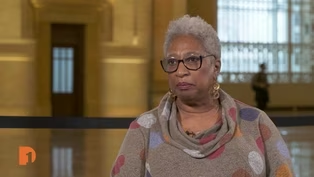
Metro Detroit resident, Sandra McCoy, shares how her grandmother came here from Georgia and made professional and personal strides as an African American woman, living in Detroit.
(bright music) - My family came to Detroit in the 50s from Georgia.
My grandmother came first.
Unfortunately, she was a single parent and she ended up having her children stay until she got settled.
And when she got settled, she sent for her two sons, who is my father.
She actually came to finish her education in college.
She was a graduate of Wayne State University and she graduated with a degree in teaching.
So she taught for a while and after she talked, she ended up getting hired by the city of Detroit as what they would call a bus driver.
You know, I'm not sure.
It probably didn't have too many bus drivers that were female.
And she ended up working for the City of Detroit as a matron in the women's jails.
I believe that my grandmother initially settled in the black bottom area, and when it was, you know, dissolved, she ended up moving over in I think the north end area.
And eventually she moved from the north end area to the Boston Edison area in 1955.
And she lived there 'til she was 102 years old.
She was always a person that was, she was quiet, but she was very, you know, thoughtful about, you know, how she wanted to raise her family and how she wanted to, you know, have something of substance, you know, during that time 'cause you can imagine in 1955, it probably wasn't a lot of black females who owned homes in the Boston Edison area.
You know, as a family, we really take pride in our history and you know, what it took at that time to survive.
I actually started on the assembly line and I worked my way up to a union position in the international UAW, and I retired as a international representative with the UAW.
I think the audit industry really provided my family with a basis of security and being able to, you know, find jobs and because of those jobs we had, we were able to educate our children and they were able to get degrees, and my grandchildren are in college.
So I think it's just a legacy that I am proud of, and Detroit will always be my home, whether I stay inside the city or outside the city, and born and raised in Detroit.
(bright music) - [Host] For more "Destination Detroit" stories, go to onedetroitpbs.org/destinationde.
That'll do it for this week's One Detroit.
Thank you for watching.
Head to the One Detroit website for all the stories we're working on.
Follow us on social media and sign up for our newsletter.
(relaxing music) - [Narrator] This program was made possible in part by Ralph C. Wilson Junior Foundation, Michigan Health Endowment Fund.
Across our Masco family of companies, our goal is to deliver better living possibilities, and make positive changes in the neighborhoods where we live, work, and do business.
Masco, a Michigan company since 1929.
Support also provided by the Cynthia & Edsel Ford Fund for Journalism at Detroit PBS.
- [Narrator 2] The DTE Foundation is a proud sponsor of Detroit PBS.
Through our giving, we are committed to meeting the needs of the communities.
We serve statewide to help ensure a bright and thriving future for all.
Learn more at dtefoundation.com.
- [Narrator] Nissan Foundation, Michigan Central, and viewers like you.
(relaxing music) (bright music)

Caregiving at home: For some a growth industry
Video has Closed Captions
Clip: S10 Ep24 | 7m 25s | Caregiving at home: For some a growth industry (7m 25s)
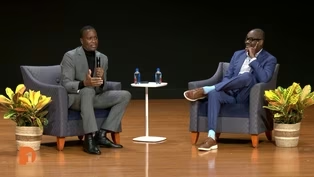
Detroit Future City Forum’s keynote speaker shares message of racial and economic justice
Video has Closed Captions
Clip: S10 Ep24 | 12m 46s | PolicyLink CEO Michael McAfee talks about how Detroit can help reshape the nation’s future. (12m 46s)
Video has Closed Captions
Clip: S10 Ep24 | 2m 41s | Metro Detroit resident Sandra McCoy participates in One Detroit’s “Destination Detroit” series. (2m 41s)
Providing Support for PBS.org
Learn Moreabout PBS online sponsorship
- News and Public Affairs

Top journalists deliver compelling original analysis of the hour's headlines.

- News and Public Affairs

FRONTLINE is investigative journalism that questions, explains and changes our world.











Support for PBS provided by:
One Detroit is a local public television program presented by Detroit PBS