
Cartoonist Keith Knight on using art and humor to spark a dialogue on social, racial and political issues
Clip: Season 54 Episode 2 | 11m 17sVideo has Closed Captions
A look at award-winning cartoonist Keith Knight's appearance at the Charles H. Wright Museum.
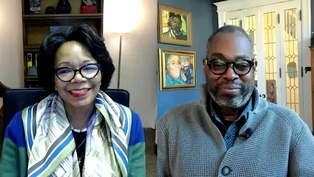
Award-winning cartoonist Keith Knight appeared at the Charles H. Wright Museum of African American History as part of "The Wright Conversations" series in partnership with PBS Books. Knight talks about why he started creating comics and how aspects of his own life are depicted in his works. He also discusses how he uses art and humor to spark a dialogue about racial, social and political issues.
Problems playing video? | Closed Captioning Feedback
Problems playing video? | Closed Captioning Feedback
American Black Journal is a local public television program presented by Detroit PBS
Cartoonist Keith Knight on using art and humor to spark a dialogue on social, racial and political issues
Clip: Season 54 Episode 2 | 11m 17sVideo has Closed Captions
Award-winning cartoonist Keith Knight appeared at the Charles H. Wright Museum of African American History as part of "The Wright Conversations" series in partnership with PBS Books. Knight talks about why he started creating comics and how aspects of his own life are depicted in his works. He also discusses how he uses art and humor to spark a dialogue about racial, social and political issues.
Problems playing video? | Closed Captioning Feedback
How to Watch American Black Journal
American Black Journal is available to stream on pbs.org and the free PBS App, available on iPhone, Apple TV, Android TV, Android smartphones, Amazon Fire TV, Amazon Fire Tablet, Roku, Samsung Smart TV, and Vizio.
Providing Support for PBS.org
Learn Moreabout PBS online sponsorship- Award-winning cartoonist Keith Knight is known for using art and humor to spark dialogue on social, racial, and political issues.
He's the creator of the semi-autobiographical comic strip, "The K Chronicles."
And his life and work inspired the Hulu comedy series, "Woke."
Knight was in town recently for "The Wright Conversations" at the Charles H. Wright Museum of African American History.
PBS Books teamed up with the museum to capture his appearance.
Here are some excerpts.
- I grew up in 1970s Boston.
And so right here is basically probably the most famous photograph coming out of 1970s Boston.
And as a little kid, I vaguely kinda knew what was going on in it, but as I got older and learned about everything, I come to see it as a metaphor for America.
But we'll return to that at the end.
This is one of my earliest autobiographical comic strips.
And I think I did this in eighth grade, and these are all my buddies.
And I didn't know it then, but what I realize now is I was making up for something.
I never received a book where people of color were the protagonists.
I got more books where animals were the heroes, and not people of color.
So in a way, I was making up for the lack of representation in the books I was being assigned.
So I created these comics where we were the center of the action.
And I say this all the time.
I think I prevented myself from getting my butt kicked many times because I would make fun of people in my comics.
And they were just happy to be in there, to just be seen, like the bullies in real life were just happy.
"Oh wow, I'm in this comic."
You know?
It's like, what, you're not, are you mad 'cause I'm making fun of you?
Like, no, this is kinda cool.
So I realized, this would be a great job if I could get away with it.
And so I started to incorporate it into a lot of my schoolwork.
And I started getting better grades because I was incorporating my comics into my schoolwork, in everything except math.
Math, it's either right or wrong.
You can't dress it up, you can't do any comics about it that's gonna make it any better.
But everything else, it really, it said something.
And I started doing it for my junior high newsletter and then my high school newspaper.
And I just went from there.
Now, here's a wild thing, especially being in a city that's 80% Black.
I never had a Black teacher until I was a junior in college.
So that might be a reason why I didn't get any books where people of color were the protagonist.
That junior year in college, I had an American literature teacher who was Black.
And he assigned us Ralph Ellison, Richard Wright, Maya Angelou, and James Baldwin.
And when someone said, "Why are you giving us all Black writers?"
they asked him.
He said, "This is an American literature class.
I'm giving you all American writers."
And that just exploded my head.
Because I love the fact that this guy was working within the system, but he was subverting the system at the same time to let us know that, that the be all end all of American literature isn't Mark Twain.
There's a lot more that you're missing out on.
And so I dove into this class and I ended up getting an A-minus.
This guy was a hard, hard teacher.
And no matter how many drawings I put in my assignments.
But really like, my work went from being autobiographical comics about keg parties to what it's like to be a Black man growing up in America.
America has always been about race.
Always!
Even when you don't wanna make it about race.
It totally is, in every aspect of it.
Whether you're standing in line at an ATM, and you have to stand a certain amount away or otherwise, the person at the ATM's gonna freak out, to, I don't know, Band-Aids, to anything.
Anything and everything!
It's all about race.
And I don't know how people try to not make it about race.
Like the fact that you actually come up and say, "It's not about race."
That means it's about race!
If you're bringing it up, of course it's about race!
So people say, "Oh, why you have to always make it about race?"
Well, this brings us to the second James Baldwin quote, which is, "I love America more than any other country in the world.
And exactly for this reason, I insist on the right to criticize her perpetually."
Okay?
I am a huge "Star Wars" fan, but I will tell you right now, I will freely admit that "Star Trek" has more decent movies and more decent series now than "Star Wars" does.
It's hard for me to say it, but it's the truth.
And I say that because I love "Star Wars" and I want "Star Wars" to be better.
But if you saw "The Last Skywalker," it is the worst piece of trash film you'll ever see.
And I don't say it because I hate "Star Wars."
I say it because I love it.
So I want it to be better, and I want America to be better.
And the only way America can be better is for it to acknowledge its past, its present, and its future problems.
And the biggest one is race.
- So you said that America suffers from racial illiteracy.
- Totally.
- If you could assign one comic of yours that was required reading in every classroom, which would it be?
- Which would it be?
Oh, man.
I mean, it might be just about the fact that America suffers from racial illiteracy and we need to get it from a third grade or kindergarten level to at least a sixth grade level.
Like we have to teach, I mean, as much as I love the fact that Jackie Robinson was a great athlete, he was not the first professional, Black professional ballplayer.
It was Moses Fleetwood Walker in the late 1800s.
- [Neil] Right.
- And White owners collectively said, "Let's not hire any more Black people."
And like those type of stories, and you see what they did to Colin Kaepernick.
Like, everything that's happening today has happened in the past.
So, just letting people know, like you don't realize how much you don't know.
And so maybe it's that racial illiteracy strip, just like, get out and learn this stuff.
'Cause you're not gonna learn it in school.
And you're not gonna learn it watching TV.
Like TV is... - [Neil] Yeah.
- I only see a ton of TV when I'm in a hotel room, and then I just flick like crazy.
And do you see how many cop shows there are?
Like, it's total cop-agenda, like realize, like just take the time to see how many cop shows there are out there that make it seem like there's crime all over the place, constantly, nonstop.
And it's not, it's not!
Like crime is down at all across the nation.
- [Neil] Yeah.
- And like, down to like the '60s and everything.
People talk about the '90s and how wonderful they were, like reflecting on them.
And the '90s were like the peak of like, violence in cities and stuff.
But like, we live in a relatively safe place.
And keeping people afraid, constantly paranoid and afraid is part of the plan to, it's part of the plan.
- So I wanna talk a little bit about "Woke."
I know a lot of the folk, particularly our young folks that have joined us today, are just curious how does that really happen, right?
That you're sitting in a cafe, you're writing, you meet a producer.
It's obviously not that simple.
But what I want, I guess to dive into a little bit more, what does it take to go from, let's just say that moment, to where you have a show on Hulu?
- Yeah, I mean, there are a lot of planets that have to align.
- Exactly.
- A lot of planets that have to align.
And all I can say is like to, I, we... Yeah, it is a lot.
You have to be, you have to have this obviously this open mind, but you have to align yourself with people that you think, Hollywood is full of people who work really hard, but it's also full of a lot of jerks.
- [Neil] Jerks, yeah.
- And if you find nice people, you glob onto them, you stick with them.
And so one of my producers, John Will, is such a nice guy.
And I was like, "Okay, this is someone I can, I gotta glob onto."
And then he brought my work to Eric Christian Olsen, if you've ever seen it, is it "NCIS LA?"
Or "NCSLA?"
I don't know, it's one of these cop shows.
But he was like Deeks.
He was like the blonde guy that everyone... And his dad was an American literature professor, and he brought his work to his dad, and his dad grabbed him and said, "This will be the most important show you ever make."
I feel like he said, "You have to make this show.
You have to."
'Cause he really loved my work.
And so I was like, "Okay, this is great."
- And you can see that entire conversation with Keith Knight at pbsbooks.org.
How The Henry Ford is celebrating the legacy of Dr. Martin Luther King, Jr. over the holiday weekend
Video has Closed Captions
Clip: S54 Ep2 | 10m 20s | Programming will include plays, musical performances, conversations, and more. (10m 20s)
Providing Support for PBS.org
Learn Moreabout PBS online sponsorship
- News and Public Affairs

Top journalists deliver compelling original analysis of the hour's headlines.

- News and Public Affairs

FRONTLINE is investigative journalism that questions, explains and changes our world.












Support for PBS provided by:
American Black Journal is a local public television program presented by Detroit PBS