
Celebrating car culture at The Purple Rose Theatre, fighting food insecurity, Wisdom Gone Wild event
Season 10 Episode 31 | 26m 46sVideo has Closed Captions
A look at a play directed by Jeff Daniels, food insecurity in Michigan and an upcoming film screenin
One Detroit goes behind the scenes of The Purple Rose Theatre Company’s new play, “The Classic King,” and learns about how United Way for Southeastern Michigan is helping families put food on the table. Also, as part of Detroit PBS’ caregiving series, get the details on an upcoming screening and panel discussion for the film “Wisdom Gone Wild,” which documents the story of a daughter caring for he
Problems playing video? | Closed Captioning Feedback
Problems playing video? | Closed Captioning Feedback
One Detroit is a local public television program presented by Detroit PBS
Celebrating car culture at The Purple Rose Theatre, fighting food insecurity, Wisdom Gone Wild event
Season 10 Episode 31 | 26m 46sVideo has Closed Captions
One Detroit goes behind the scenes of The Purple Rose Theatre Company’s new play, “The Classic King,” and learns about how United Way for Southeastern Michigan is helping families put food on the table. Also, as part of Detroit PBS’ caregiving series, get the details on an upcoming screening and panel discussion for the film “Wisdom Gone Wild,” which documents the story of a daughter caring for he
Problems playing video? | Closed Captioning Feedback
How to Watch One Detroit
One Detroit is available to stream on pbs.org and the free PBS App, available on iPhone, Apple TV, Android TV, Android smartphones, Amazon Fire TV, Amazon Fire Tablet, Roku, Samsung Smart TV, and Vizio.
Providing Support for PBS.org
Learn Moreabout PBS online sponsorship(indistinct) (participant claps) Boom, deal!
- [Announcer 1] Coming up on "One Detroit".
We'll take you behind the scenes of the Purple Rose Theatre Company's new play, "The Classic King".
Plus we'll hear how United Way for Southeastern Michigan is helping families put food on the table.
Also ahead, as part of our caregiving initiative, we'll tell you how you can see the film "Wisdom Gone Wild", which documents the story of a daughter caring for her mother with dementia.
(participants clap) It's all coming up next on "One Detroit".
(participant laughs) - [Announcer 2] Across our Masco family of companies, our goal is to deliver better living possibilities and make positive changes in the neighborhoods where we live, work and do business.
(bright music) Masco, a Michigan company since 1929.
- [Announcer 3] Support also provided by the Cynthia & Edsel Ford Fund for Journalism at Detroit PBS.
(gentle music) - [Announcer 4] The DTE Foundation is a proud sponsor of Detroit PBS.
(video whooshes) Through our giving, we are committed to meeting the needs of the communities we serve statewide to help ensure a bright and thriving future for all.
Learn more at dtefoundation.com.
- [Announcer 5] Nissan Foundation, and viewers like you.
(bright music) - [Announcer 1] Just ahead on "One Detroit", we'll tell you about efforts by United Way for Southeastern Michigan to assist families facing food insecurity due to inflation and other factors.
- Understanding.
- [Announcer 1] Plus, we'll preview an upcoming free screening and panel discussion for a documentary about a person-centered approach to caregiving titled "Wisdom Gone Wild".
- [Participant] After dinner.
- But first up, a new play at the Purple Rose Theatre Company in Chelsea is paying tribute to Michigan's love of automobiles.
"The Classic King" is a comedy directed by the theater's founder actor Jeff Daniels.
It tells a story of four salesmen trying to deal with a changing industry and modern customers at a struggling used car dealership in metro Detroit.
It's the world premier of the play, which was written by retired "Automotive News" editor Richard Johnson.
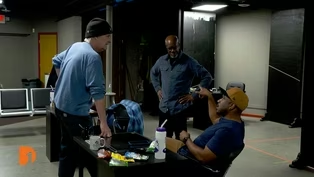
"One Detroit's" Chris Jordan attended a rehearsal and spoke with Johnson and two of the actors.
- Ginormous guy in a hub just landed in the truck out.
I badge beard down to his navel.
- That's not in too good a shape.
Neither is the biker.
- Don't all jump at once.
- [Narrator] The Purple Rose Theatre Company's rehearsal space in Chelsea early January, a rehearsal for "The Classic King", a new play by Richard Johnson, directed by Jeff Daniels.
The play follows the staff of a struggling car dealership in Detroit.
- He is trying to stay afloat.
They got 30 days to do it.
The banks put some pressure on the dealership and it's, it's four guys trying to to get through the month.
- You know, you missed 100% of the shots you don't take.
- You gonna pay danger money?
All right, good, do it again.
- Really good, really good.
- [Narrator] Playwright Richard Johnson had a long career in automotive journalism as the print editor of "Automotive News".
After he retired, he decided to write a play set within the industry he'd spent his career covering.
- I always thought the industry was fascinating, I mean, not just, you know, designing and selling cars, but just the way people talked.
I used to be be at dinners, at industry events and hear guys talking, wanting to throw a tape recorder on the table just so I could, I could capture it 'cause they had their own way of speaking.
And when I retired a few years ago, I thought it would be fun to try to work this into some kind of drama setting.
I had thought that the history of the Ford Motor Company would make a good play, and I was dumb enough to actually attempt to do that.
He had great characters.
Lee Iacocca and Henry Ford II and Robert McNamara and great cars like the Mustang.
And I thought, there's a story here.
My ex-boss at "Automotive News", great guy by the name of Peter Brown, who's on the board of the Purple Rose, said, "That is pretty good."
He liked it, showed it to Jeff.
Jeff immediately said this, there's no way in heck that this is gonna work on a stage (participant laughs) because it has, it's so long.
It has maybe 30 characters and 100 scene changes in the whole thing.
- Easy to produce.
- But he said, "Come on in, let's talk about some other ideas."
And it was in those meetings with Jeff, together, we came up with the idea of, of a, of a used car dealership.
And very focused, one stage, four characters.
Much easier to do.
- And so, so this play was very much developed at the Purple Rose?
- Oh, absolutely.
- I had a buddy at the Harley shop down the street, called him, they bid on it.
(participant claps) Boom, deal!
Only motorcycle they ever run.
(participant laughs) - Nice work, Braden.
- Thanks, Mike.
- Beginners of luck.
- I'll take any kind of luck I can get.
- I play Mike, who is the owner of the dealership.
He's at its wits end trying to keep the place afloat.
He is beating back the, the competition, the large pervasive competition in doing all that he can to rally the troops.
- I play Jerry Flanagan.
He's been working at, with Mike, for Mike at Starlight Classic Cars since he was a kid.
Selling cars runs in his family.
It's in his blood.
His dad did it.
His grandfather did it.
So this is the world Jerry is comfortable in.
- See that.
Got a live one.
- So do we.
- At what stage do you guys as actors come into the process of work-shopping and developing these original plays here?
- That's-- - Pretty early on.
Yeah, we've done readings of Rick's play probably a little over a year ago.
He would rewrite, we would do other, I don't know, we did a handful of readings so that Rick and Jeff could hear it out loud, do a bunch of rewrites and that.
So we were involved pretty early on.
Rick's constantly working stuff.
We're working stuff, seeing what lands, what doesn't and making adjustments every minute of the day.
- Listening and collaboration is so important.
And it's, it, you see the work grow as we put it up, go through iterations, have the feedback.
I had an idea who Mike was, and then showed up in the room and threw it all away.
(participants laugh) - Yeah.
- One of the important things is that you allowing yourself, you listen to your scene partner and allowing that to inform some of your choices.
- He did it, he did it, he did it.
Is this the high five?
This?
- Yes.
- Yeah, great.
- Nice work, Brandon.
- Thanks, Mike.
- Boom!
High five, like that.
Like that.
Boom.
- And if you can go, you can do whatever you want.
Do what?
And hit it with.
- I'll take any kind of luck I can get.
- Oh, don't take that for a, that ain't casual.
That's it.
No, you're wrong.
I need a lot of luck I can get.
- It's alive.
The material is alive.
- Yes, it's that own in the business and.
- And walk right into that luck thing, then hit him with that and they get your to office.
- That's the amazing thing about Jeff who the vision he has when he watches these guys rehearse, well, here's 15 ideas of how you could do this better.
And he just rattles them off.
He's so good at that.
And it's, again, one of the many things I'm amazed about as I watch this process.
- Yeah, whenever you're-- - He'll watch us throw, you know, a dozen behavioral ideas in one moment and let, gives us the freedom to do that, and then says, yeah, just pair down, make it about this, that and the other.
And he's so good at simplifying the complexities that at least I tend to bring in when I'm, when I'm working.
Just the wealth of experience and knowledge, having that in the room is, is so helpful.
(participant laughing) It's a love letter to the car enthusiast.
Really, at the end of the day, it's a celebration of that world in that community.
(participant laughing) Even if you don't know a lot about cars, if you're from Michigan, you're gonna understand just because our car culture here in Michigan is runs deep.
You know, first and foremost, it's really funny.
These guys, how they interact is hilarious.
The world that when you walk into the theater, you're stepping into this very vivid world.
- It's one act, it's a bullet train.
There's a lot going on.
It's a great story and wonderfully executed.
(participant laughing) - Good.
- One more time.
Really good.
- [Announcer 1] Rising prices, federal funding cuts and an unstable economy are making it difficult for many families to put food on the table.
United Way for southeastern Michigan has taken action to assist residents who are experiencing food insecurity.
The agency has raised more than $700,000 for its Every Family Fed Emergency Food Fund, which gets distributed among 21 community-based food banks and pantries.
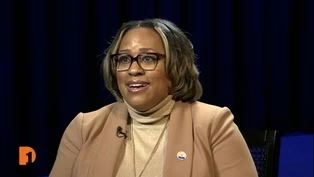
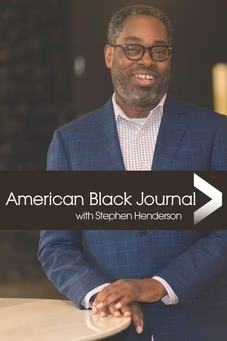
"One Detroit" contributor, Stephen Henderson of "American Black Journal" spoke with United Way President and CEO, Dr.
Darienne Hudson, and Operation Refuge Executive Director, Pastor Velma Jean Overman, whose organization is one of the grant recipients.
(gentle music) - I wanna start with something that President Trump said when he was here in Detroit that bothered me quite a bit.
He said, "Affordability, this issue of affordability is fake news."
Now, I live here, I interact with people here.
I know lots of people like the two of you who are kind of called to, to pull up the nets for people who are, who are suffering.
But you were the kind of people I thought of when I heard that.
I was like, there's nothing fake about what's going on and your work every day to try to meet this this hunger need is, is proof.
- You're absolutely right.
We have 43% of the households in our region that are identified as ALICE, and that's essentially an acronym, Asset Limited Income Constrained and Employed.
- It's a measure of poverty.
- That's right.
These are working families who are still struggling to meet their most basic needs.
We receive 800 calls a day on our 211 helpline, and they ask for different needs.
It's not just one need that they call for.
It's food, it's utility assistance, it's transportation and childcare.
So these are very much things that are out of reach for many of our residents in southeastern Michigan.
We are now at $710,000.
And so gifts just continue to come.
People are hearing about what we're doing.
They wanna be able to help.
Many people who've been doing their own individual drop offs at pantries, they see the empty shelves and they wanna be part of the solutions.
- Absolutely.
- Yeah.
So, so one of the things I quite like about this program is you're collecting the money and, and the resources, but you're distributing it to the places where people are.
- Absolutely, where Mother's Pantry, where our families are in line as we speak today, receiving the food.
And when we think about our ALICE families, I wanna make it very clear, they're working, but all you need is one thing to happen.
- [Interviewer] Right.
- Your dad's got COVID this week and so the check doesn't come next week, so I'm now in a position where I'm food insecure and I can't make my ends meet.
And for the leader of the country not to understand how vulnerable the population of our families are is very disturbing.
But thanks to our partners, like the United Way, we were able to be recipients where we can make sure that we keep our shelves full because week to week they're full and then they're empty.
- Yeah.
- And it's a very common practice in the City of Inkster, and we touch families all around our community.
- Yeah.
- So.
- So so tell me more about Operation Refuge.
- Oh-- - Where it is and how it works.
- It's in the City of Inkster and it is a client choice pantry we've developed over the years.
Like most pantries, we started in a church basement with a bag of food.
- That's right.
- Right?
But because of partners like the United Way, over the years, we've moved into our own facility.
It is client choice where the most important thing, me being the oldest of 14 children, I understand what it's like when families don't receive dignity when they need support.
So I wanna make sure that when you walk in our space, you are shopping for what you need.
We're very intentional with our partnerships where we have halal, we also have kosher, and we make sure that we have what you need on the shelves is nutritious and you have access.
So we're very thankful for the partnership that we've had throughout the years with United Way where we went from the basement to the support of partners in a building.
And I think when you are in need, you can't feel bad about it.
- How key is that support?
I mean, what, what are the other ways you end up having to source the food that you're able to give to families?
- So when you think about the key partnerships, it's the connections that United Way offer its partners, like we're connected to for Garden Harvest, to Gleaners, to Zaman, to Yad Ezra.
Right?
So our needs are met in various ways, and we have a whole team that help us build our internal capacity where you're able to meet your family's needs.
- [Interviewer] Yeah.
- So I'm very thankful for the connections.
- Yeah.
When we think about what's going on right now with affordability and poverty, I'd love for you to put it in perspective.
You've been at this now for, for a while and with us here in southeast Michigan for a while.
How, how bad is it?
- So in our state, 1.4 million, that's about, you know, 13% of the residents in Michigan receive SNAP benefits.
What people need to understand is that 78% of the households that are receiving these benefits are drawing down income.
They're working families.
- Right.
About 10% of these individuals are veterans.
36% are older adults and one in four are children.
- Wow!
- And I think these stats are so important because these are our most vulnerable populations.
These are, you know, we say our children are most valuable resources, most important resources, but this is how they're being treated.
And so we have to put this in real time.
When people call 211, Steven, it didn't matter if it was COVID, if there were floods, gas leaks, food is still one of the top three needs that people have.
And so, you know, they call needing food.
When they have to start making different changes to their budgets, that's when they stop paying their utility bills.
That's when they're not able to get the transportation or their kids, you stop, stop seeing them coming to childcare 'cause they can't afford it.
- Yeah.
- So it, it's a, a real challenge in our community.
We have social navigators that are actually providing concierge services, if you will, walking people through the different services that are available.
And it, it's painful, Steven, to hear some of the stories.
We're getting people just in the gate for shelters because the shelters are full.
- Yeah.
- You know, we're able to send them to a pantry one day and they're able to get a box.
They go the next day, their shelves are empty because the needs are so great.
But that's why we have these partnerships, and what Pastor Jean is talking about, it's hard for me not to smile when she's sharing these stories because we have a long history together.
And I remember when it was literally just bricks on the ground and we were trying to figure out how we could write some grants together to get resources into Inkster.
- Yeah.
- And that's what makes United Way go.
It really is powered by people.
- I love that.
It is powered by people.
- Yeah.
So 1.4 million people in the state.
You know, I try to emphasize all the time that when we say poverty or challenged, for a lot of people, the first thing that comes to their mind is Detroit, which is our largest city and of course one of the poorest jurisdictions.
But you know, one of the things that I think is becoming more and more evident right now is how hard this is hitting everybody.
- Absolutely.
- And people in communities where-- - Absolutely.
- You wouldn't necessarily jump to the conclusion that they would be.
- Absolutely.
And and I alluded to that earlier.
Our partners are coming from Berkeley.
- Yeah.
- Like we read, there is a shelter Yad Ezra, where you would think the Jewish population didn't have the need, but it's there, and they're able to bring things that are not kosher all the way Dave will drive it to Inkster, or my neighbors that need halal.
Right?
So it's not just who you think.
It is all of us.
- It's everybody.
- Because the challenges are real and the fact that we think it's A okay for us to be not on the agenda in this country at this time is totally ridiculous.
And I'm so thankful that we're able to share it and you're able to get the word out that we need to make sure that we're intentional about supporting the United Way.
And if you bring food to Mother's Pantry, we are forever grateful.
But I understand that if we could get a collective energy to make sure that our major partners are funded and it's downstream, you know, that agenda that they say we're supposed to receive from the very wealthy, that their money's supposed to trickle down to those of us working that haven't found this way.
But what we do see is that those that have the heart for philanthropy and for organizations that support our larger organizations like the United Way, that it really does get to us.
We were able to purchase a van through a grant where we are able to take the food to families that can't stand in the line.
- Yeah.
- Right.
You, it's hard to be in a line waiting your turn to go inside when you have a walker in the cold.
- Sure.
- But if we can just get it to you.
- That's right.
- And we were able to receive a van and now we have mobile access for our families.
So it's so many great things that happen when you're in partnership, and they're very intentional with reaching out and helping build capacity around smaller organizations like Operation Refuge.
- I would imagine that United Way, you're also in the middle of trying to meet other needs-- - That's right.
- That, that are coming up short.
I mean, food is critical and a staple that we've gotta make sure everybody has access to, but there are other things, healthcare.
- Absolutely, education.
- Education.
- Summer discovery, right?
- We're really seeing a kind of fraying of the public infrastructure around those things.
- We are.
I mean, we've had over 100,000 calls and rides delivered now for people who need transportation through Ride United.
You know, we still get calls all of the time for people trying to find affordable childcare.
You know, some of the most basic things, you know.
We have a partnership with Henry Ford and our local food pantries to try to close the loop, literally, when people are going to receive healthcare, then we refer them to the pantries.
So, you know, all of these things are interconnected.
These are systems that are not working for our families.
So we have to be strategic in how we bring our partners together and how we tackle these different issues.
- Yeah.
- The one thing I did wanna lift off also, Steven, is that, you know, we have our corporate campaign every year.
- Yes.
- But a number of our corporate partners, our community partners, they started doing their own food drives.
They started taking it upon themselves.
They just, you know, selected different agencies and said, we can make a difference from where we sit.
And that's the most important message I want everyone to hear.
If you're, if you're frustrated, if you're trying to understand like what we can do to tackle these numbers, everyone can make a difference.
You know, call your local pantry, take a ride down to your local church and and find out what their, their needs are.
- Yeah.
I mean I always feel like the church is the place that people kind of naturally gravitate to for-- - Support.
- If they want to do these things.
Right?
If they want to pitch it, but there are other places as well.
- Absolutely.
And we have a number, like I said, Stellantis, Clark Hill, Honigman, Accenture, you know, some of these large corporations, they just said, you know what?
We can make a difference in our community.
We can just come to work every day and bring resources to support those in need.
- Yeah.
I wonder what else you guys think you need in the way of support.
I mean, we could talk about government, and that's always very difficult to deal with the politics there and things like that.
But what are some of the other ways that, other than even the corporate community, that we can again, stitch together enough other than that so that people are just not falling through it?
- Well, one, I think that everyone has to understand ALICE is all of us.
- Yes.
- So no matter where you live, every community has a significant ALICE population.
So I think becoming more informed, understanding the communities that we are in and who we are, who we serve.
- Yeah.
- Being strategic about, you know, how we start to share resources.
We need to talk more about philanthropy and individual giving.
- Absolutely.
- We need to do a better job, I think, of investing in our community organizations that are doing that work.
And then I would just say continue to ask the tough questions of why we are in these positions and figuring out how we can again, partner with local agencies and be a part of the solution.
We just need everyone being solution-minded.
- Yeah.
- And, and I think that's the key is the intentionality.
- Yeah.
- Like on purpose.
- Right.
- I'm looking for ways to support.
And for some of us it's extremely easy to say, I have two hours I can donate to Mother's Pantry.
What do you need?
Do, like our link to feed, how can I help you with administrative?
Right?
How do I help your families with information?
Because one of the big issues we have in our community is high blood pressure.
So we are very intentional when we are giving out our canned goods that we just say rinse them.
- Yeah, right.
- Right?
We just wanna make you have a healthy life.
Everyone deserves the American promise of life, right?
- Yes.
- And the scriptural promise of it being more abundant.
- [Announcer] We hope you join us next Thursday for a special episode of "One Detroit".
We'll bring you interviews from the Detroit Regional Chamber's Annual Detroit Policy Conference.
This year's event took place at a new venue in downtown Detroit, The Department at Hudson's.
A new leadership era was the theme of the day-long conference.
It focused on the importance of collaboration to move the region forward.
So be sure to watch on February 5th at 7:30 p.m.
We also hope you'll join Detroit PBS for a film screening and panel discussion on Tuesday, February 10th at 6:30 p.m.
at the Michigan Theater in Ann Arbor.
As part of our caregiving initiative, we're presenting a free showing of the documentary "Wisdom Gone Wild" in partnership with the Michigan chapter of the Asian American Journalist Association, the Michigan Theater, and the Ann Arbor Area Community Foundation.
The film chronicles the 16 year journey of a daughter caring for her Japanese American mother diagnosed with dementia.
(gentle music) (Participant singing) (Participant clapping) - Yay!
(Participant laughing) (gentle music) - It's okay, Mia.
Don't take my picture.
- [Participant 1] You wanna take my picture?
No, look through here.
You can take my picture.
- [Participant 2] Is that right?
Okay, now you have to ask me a question.
(gentle music) - Didn't your mother show you how to (indistinct) - [Participant] You're my mother.
(Participant laughing) - She had nothing to do here.
- [Participant] Now, did your father come from Japan?
Was he born in Japan or was he born in the-- - Ah, he was born in Japan.
- He was born in Japan.
- So go to call a Jack.
My mama and papa grew strawberries.
- [Participant] Strawberries?
- Yeah.
- [Participant 1] They had a strawberry farm and that was probably taken away.
(gentle music) - [Participant 2] What about Vince Taje?
There is no Taje.
We have a father named Vince Taje.
No, no, no, no.
- [Participant 3] Mom, come to dinner.
Mom.
You gonna hurt me?
- No, I'm gonna take care of you.
You have to learn about yourself.
Why I'm this way, why I'm that way.
- [Participant] And what are you learning about yourself?
- Oh, you'd be surprised.
You'll be so surprised.
(bright music) - [Announcer 1] For more information on how to attend the February 10th free screening and panel discussion for "Wisdom Gone Wild", visit onedetroitpbs.org.
(bright music) That'll do it for this week's "One Detroit".
Thanks for watching.
Head to the "One Detroit" website for all the stories we're working on.
Follow us on social media and sign up for our newsletter.
- [Announcer 2] Across our Masco family of companies, our goal is to deliver better living possibilities and make positive changes in the neighborhoods where we live, work and do business.
(gentle music) Masco, a Michigan company since 1929.
- [Announcer 3] Support also provided by the Cynthia & Edsel Ford Fund for Journalism at Detroit PBS.
(gentle music) - [Announcer 4] The DTE Foundation is a proud sponsor of Detroit PBS.
(video whooshes) Through our giving, we are committed to meeting the needs of the communities we serve statewide to help ensure a bright and thriving future for all.
Learn more at dtefoundation.com.
- [Announcer 5] Nissan Foundation, and viewers like you.
(bright music) (gentle music)
How United Way for Southeastern Michigan is fighting food insecurity in the state
Video has Closed Captions
Clip: S10 Ep31 | 12m 16s | United Way for Southeastern Michigan is helping feed families affected by inflation and funding cuts (12m 16s)
Video has Closed Captions
Clip: S10 Ep31 | 6m 50s | The Purple Rose Theatre Company’s latest original play runs from January 29 through March 8. (6m 50s)
Providing Support for PBS.org
Learn Moreabout PBS online sponsorship
- News and Public Affairs

Top journalists deliver compelling original analysis of the hour's headlines.

- News and Public Affairs

FRONTLINE is investigative journalism that questions, explains and changes our world.











Support for PBS provided by:
One Detroit is a local public television program presented by Detroit PBS