
Celebrating Kwanzaa at the Charles H. Wright Museum of African American History
Clip: Season 53 Episode 50 | 10m 44sVideo has Closed Captions
The Charles H. Wright Museum is presenting a week of activities for Kwanzaa from Dec 26 through Jan
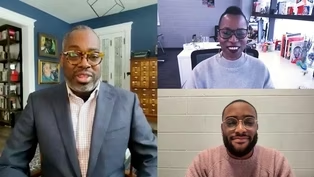
The details on this year's Kwanzaa celebration at the Charles H. Wright Museum of African American History from the VP of Learning & Engagement Lance Wheeler and Manager of Community Engagement Yolanda Jack. Jack gives a rundown of some of the activities happening over the week-long holiday, which will take place at the museum and at one of its
Problems playing video? | Closed Captioning Feedback
Problems playing video? | Closed Captioning Feedback
American Black Journal is a local public television program presented by Detroit PBS
Celebrating Kwanzaa at the Charles H. Wright Museum of African American History
Clip: Season 53 Episode 50 | 10m 44sVideo has Closed Captions
The details on this year's Kwanzaa celebration at the Charles H. Wright Museum of African American History from the VP of Learning & Engagement Lance Wheeler and Manager of Community Engagement Yolanda Jack. Jack gives a rundown of some of the activities happening over the week-long holiday, which will take place at the museum and at one of its
Problems playing video? | Closed Captioning Feedback
How to Watch American Black Journal
American Black Journal is available to stream on pbs.org and the free PBS App, available on iPhone, Apple TV, Android TV, Android smartphones, Amazon Fire TV, Amazon Fire Tablet, Roku, Samsung Smart TV, and Vizio.
Providing Support for PBS.org
Learn Moreabout PBS online sponsorship- The Charles H. Wright Museum of African American History is presenting a whole week of activities for Kwanzaa, from December 26th through January 1st.
Each day is dedicated to one of the seven principles of the holiday.
The festivities include African drum and dance performances, youth showcases, poetry, and community reflections.
Here to tell us more is the museum's vice president of learning and engagement, Lance Wheeler, along with the manager of community engagement, Yolanda Jack.
Welcome back, both of you, to American Black Journal, and of course, happy holidays.
You know, I feel like every kind of special time or event we have during the year somehow gets captured by the programming at the Wright, whether it's Juneteenth or Kwanzaa or lots of other things.
And I think this is a particularly special time of the year at the museum.
Yolanda, why don't you start by telling us about sort of how the programming for something like this comes together, what you're thinking about, and what you're thinking about from the perspective of those who will experience this holiday at the museum?
- Kwanzaa is a wonderful holiday season.
It is a part of the end of the year, traditional celebration.
So it's an opportunity for people to get together, and it's an opportunity for people to think about togetherness and opportunities to connect.
Whether they are a particular religion or a particular ethnicity, it's an opportunity to think about the African-centered principles and how we got here.
So we think about those things.
We really concentrate on that when we connect to the different programs, to the different partners, to the different activities that we're doing.
We're thinking about the best of us.
We're thinking about what got us here, how we got over, as it were, as the song says.
So just thinking about all of those things, and the year that we've been through as well.
So not only over all of the history over our families, but also just the past 12 months, how we've managed to make it to this day.
- Yeah.
Yeah.
I mean, one of the cool things about Kwanzaa, of course, is that it does kind of wrap its arms around a very broad vision of African and African American culture and spirituality and belief.
And of course, those seven principles are things, I don't know, you can't really argue with 'em, right?
Like, who could be against those ideas?
- The Nguzo Saba really just help us guide us through the year, through the days, over the seven days, we get a chance to think about each of the Nguzo Saba, each of the principals of Kwanza, how these principles have managed to maintain humanity, our families, our cities, our states, our buildings, our schools.
Like, there's so many ways that we can think about that individually through the lens of all of the ways that we can interact with each other through the community, whether it's through work or through school or social gatherings.
All of the ways that we can, we all have an opportunity to think about unity and self-determination, how we solve each other's problems and work together, how we build opportunities economically together, what our purposes are, and how we deliver these things creatively and beautify the places that we live in and dwell in, and then how all of these things have begun and end through faith.
The idea, the hope, the dreams of how our people have gotten us here and what we want for the future.
Every one of those seven principles that I just defined there connect to all of us in some aspects, or in many ways, in every aspect of our lives.
- Yeah.
Yeah.
Lance, of course, this is kind of core content and programming for the museum and its mission here in Detroit, but also in the region, and I'm thinking increasingly in the state.
I mean, I'm fascinated in fact by the fact that when I go other places in the state now, I hear more from people about the Wright.
People say that they've been there or that they are interested in it.
And so that's becoming much more of a symbol of, you know, African-American culture and celebration to lots of people who are just not even here and closeby.
- I think that it's beauty in that.
I think it's beauty in that.
And that's one of the missions I believe that Dr.
Wright himself set, you know, to share the impact of African American history and contribution to not just Detroit or Michigan, but nationally, internationally.
And then, like I just said a few minutes ago, we've been doing that for 60 years, right?
And so Kwanzaa has been around since 1966, right?
Founded in the Civil Rights Movement, while this museum itself is also created and founded in the Civil Rights Movement.
So they're having conversations with each other without really knowing that, right?
Preserving black history, ensuring that we know who we are, but also what Yolanda just said, that every day principles that we should be living, not just between the 26th and the 1st of January, but every single day.
- Yeah.
- And so, ZM is continuing to do that through our programming, through our history, through our tours, and through our partnerships.
And so we've been doing that once again for 60 years.
- Yeah.
Yeah.
I mean, it is incredible.
I was at the 60th anniversary gala, and it is amazing to think about all the time that has passed to this museum, has been there and been growing.
And again, investing in the idea of bringing people into those traditions and the understanding of the African American presence, here in Detroit.
When you guys are putting something like this together, how heavily do you think about, I guess, the current context?
Yolanda, you mentioned the year, right?
And that some of what you're doing is trying to reflect or at least acknowledge the year.
This has been a tough year for a lot of folks.
How does that play into how you celebrate Kwanzaa at the museum?
- Absolutely.
It is a forethought of a grounding conversation.
When we think about the days as they go through, just as we live our lives, we are happy to be able to get through whatever issues, whatever problems.
But people, as you have said, have really been dealing with major circumstances, not only across the world, but thinking about what's happening nationally.
And then as we trickle down to the smaller, smaller circles, even within our families, we don't know how people are able to survive the issues.
So our different partners, including the African Liberation Day Committee, the planning committee, the Million Man March committee, thinking about the work that those people have done over the decades, continuing on to the Malcolm X grassroots movement, who will be celebrating on our second day of Kujichagulia, the celebration of that particular Nguzo Saba principle.
And then as we move on, thinking about how a DASI Detroit organization, the people who have learned to celebrate and remember the men and women who did not make it through the days of enslavement while we were being transported from Africa, understanding that those men and women, though they didn't survive, their energies did make it to how they wanted to be, where they want the freedom, the hopes, the dreams.
All of those things still exist.
And then on our last day in the building at the museum, we will be celebrating cooperative economics, of course, thinking about the museum store.
We are so proud to have that store be named for four years, running the best museum store by the Michigan Chronicle.
So that's a wonderful thing, and our marketplace will reflect that.
And then as we move beyond the fourth day into the fifth, sixth, and seventh days of celebration, we will move out of the museum into the Mama Imani Humphrey Hall at the Detroit People's Food Co-op, where we will continue celebrating with our partners, our community partners who will be there at that space, will be the UNIAACL.
It will be the Hood Research Group, and of course the shrine of the Black Madonna, which will be the faith day, the New Year Day, we end the celebration of Kwanzaa and begin the new year on faith as every day, I believe should be a consideration of faith.
We wake up each morning, we believe we will wake up each morning.
So those ideas and opportunities to connect with one another.
We really wanna consider, that's what it is.
And as we turn into 2026, we'll begin thinking about we who believe in freedom, how do we believe in freedom?
Where do we believe in freedom?
These principles in Nguzo Saba fulfill and inform how those activities get done.
They help us understand where we should be thinking, where should we be pointing our attention.
So this, I think, is just a wonderful opportunity to close the year, begin the year, but also live our year every single day.
- Yeah.
Wow.
- Also, we quickly want to add to that.
One of the things, when we are thinking about our program, we're always thinking collectively, who we can work together with.
You know, as Yolanda just mentioned, she mentioned our partners and one of the things that we wanted to do here, particularly with Kwanzaa, is we're not doing this by ourselves.
There have been people in community who've been doing this work for a very long time, just as 60 years, or even longer, or even new, but we wanted to really say, this is a group of us together, uplifting our community and finding ways to do programs together, right?
Here at the building, but also in community.
And so that is always our approach when we're thinking about programs for learning engagement, and at the Wright Museum.
- Yeah, yeah, yeah.
You said it perfectly.
That's I was gonna say was, it's great to hear you guys are taking this out of the museum and to some of the places, some of the other places that value African American culture and wanna lift it up.
So we will look forward to all of these wonderful celebrations of Kwanzaa at the end of the month.
Thanks to both of you for being here with us on "American Black Journal."
- Thank you so much.
- Thank you.
- That's gonna do it for us this week.
Eating healthy with Detroit chef Quiana “Que” Rice of Cooking with Que
Video has Closed Captions
Clip: S53 Ep50 | 11m 44s | Que is on a mission to teach people how to eat to live with a focus on plant-based meals. (11m 44s)
Providing Support for PBS.org
Learn Moreabout PBS online sponsorship
- News and Public Affairs

Top journalists deliver compelling original analysis of the hour's headlines.

- News and Public Affairs

FRONTLINE is investigative journalism that questions, explains and changes our world.











Support for PBS provided by:
American Black Journal is a local public television program presented by Detroit PBS