
Celebrating the Martin Luther King, Jr. holiday at The Henry Ford, cartoonist Keith Knight discusses his work
Season 54 Episode 2 | 26m 46sVideo has Closed Captions
A look at The Henry Ford’s MLK Day programming and Keith Knight's talk at the Charles H. Wright Muse
American Black Journal host Stephen Henderson gets details on how The Henry Ford in Dearborn is planning to celebrate the upcoming Martin Luther King, Jr. holiday. Plus, cartoonist Keith Knight talks about his award-winning work, which addresses serious issues in a humorous manner.
Problems playing video? | Closed Captioning Feedback
Problems playing video? | Closed Captioning Feedback
American Black Journal is a local public television program presented by Detroit PBS
Celebrating the Martin Luther King, Jr. holiday at The Henry Ford, cartoonist Keith Knight discusses his work
Season 54 Episode 2 | 26m 46sVideo has Closed Captions
American Black Journal host Stephen Henderson gets details on how The Henry Ford in Dearborn is planning to celebrate the upcoming Martin Luther King, Jr. holiday. Plus, cartoonist Keith Knight talks about his award-winning work, which addresses serious issues in a humorous manner.
Problems playing video? | Closed Captioning Feedback
How to Watch American Black Journal
American Black Journal is available to stream on pbs.org and the free PBS App, available on iPhone, Apple TV, Android TV, Android smartphones, Amazon Fire TV, Amazon Fire Tablet, Roku, Samsung Smart TV, and Vizio.
Providing Support for PBS.org
Learn Moreabout PBS online sponsorship- Just ahead on "American Black Journal," we'll hear how the Henry Ford is planning to celebrate the upcoming Martin Luther King Jr.
holiday.
Plus, award-winning cartoonist Keith Knight talks about how he uses his work to address serious issues with a little bit of humor mixed in.
Don't go anywhere.
"American Black Journal" starts right now.
- [Announcer] Across our Masco family of companies, our goal is to deliver better living possibilities, and make positive changes in the neighborhoods where we live, work, and do business.
Masco, a Michigan company since 1929.
Support also provided by the Cynthia and Edsel Ford Fund for Journalism at Detroit PBS.
- [Announcer 1] The DTE Foundation is a proud sponsor of Detroit PBS.
Through our giving, we are committed to meeting the needs of the communities we serve statewide, to help ensure a bright and thriving future for all.
Learn more at dtefoundation.com.
- [Announcer 2] Also brought to you by Nissan Foundation, and viewers like you.
Thank you.
(upbeat music) (upbeat music continues) (upbeat music continues) - Welcome to "American Black Journal."
I'm your host, Stephen Henderson.
The nation is gonna pay tribute to Dr.
Martin Luther King Jr.
on Monday, January 19.
This is the federal holiday that recognizes his contributions to civil rights, social justice, and of course, community service.
The Henry Ford in Dearborn is celebrating Dr.
King's legacy with a full weekend of activities from January 17th to the 19th.
I got all of the details from the Henry Ford's Vice President and Chief Marketing Officer, Ellen Hill Zeringue.
It's great to have you here on "American Black Journal."
Thanks for joining us.
- Thank you for having me.
- Yeah.
So let's talk first about this holiday, and I guess what it means at the Henry Ford.
I think when a lot of people think of the MLK holiday, they think of the Wright Museum in midtown Detroit.
But it's just as important at a place like the Henry Ford.
Tell us why.
- Absolutely.
First of all, we're thrilled to be able to once again, commemorate the amazing legacy of Dr.
King.
And when you think about Dr.
King, he was just an ordinary person who did extraordinary things.
And that's what we do at the Henry Ford.
We tell those stories of amazing innovators, and he aligns no different than the Rosa Parks bus that we have, or the Kennedy limousine that we have, or the other stories of innovators and amazing people who just did, ordinary people who just did extraordinary things.
And it's also an opportunity for us to really highlight one of our collecting categories, which is social transformation, and the impact that Dr.
King had on changing the trajectory of our country.
It's very important from an innovation standpoint, a history standpoint, and that's what we do with the Henry Ford.
- Yeah, yeah.
So what will that look like on the 17th through the 19th?
- We've got a wonderful program, three days of programming, which as you mentioned, will start on the 17th.
On the 17th we will start with, we're going to have a play called "The Beginnings of the Boycott."
And the significance of this play is that it tells the background story of arranging and organizing the movement and the boycott surrounding when Mrs.
Parks refused to give up her seat.
And on December 1st, 1955 when she was arrested, we know that that first boycott had over 40,000 Blacks who decided not to ride the buses.
But after that, there was so much more significant planning because that one day was great, but it didn't have the impact, the full impact.
So "The Beginnings of the Boycott," which was written by one of my colleagues, X. Alexander Durden, really tells a story of that background story of organizing, and also highlights that moment where they appointed Dr.
King to be the leader of that boycott and that movement.
Following that, we'll also have, on the 18th, we'll have musical performances.
We'll have Ashley Baylor, who's a local soprano.
We'll have Sean Burden, who's a pianist, so we'll have music happening.
And also on the 18th, we will have Dr.
Jeanne Theoharis.
And Dr.
Theoharis is a world-renowned bestselling author, New York Times bestselling author.
And she wrote the book, "King of the North," that's her most recent book.
And the "King of the North" really highlights the impact of Dr.
King and his advocacy in the north.
When we think of Dr.
King, we think about the south.
But really, he was very instrumental in many movements in the north.
And Dr.
Theoharis is a strong advocate for telling that story.
So on the 18th, she will sit down with our curator of Black History, Amber Mitchell, and we'll have a conversation about her book, but also about the overall impact of Dr.
King in the north.
- Yeah, that's a great segue to my next question, which is about the significance of Dr.
King's work and his legacy here, specifically in Detroit.
I'm not sure how many people know of his visit here, the time he spent in Grosse Pointe, and the things that he learned about his struggle and his work from seeing what people here were dealing with.
- Absolutely.
There's so many significant ties with Dr.
King and the city of Detroit.
One thing that I learned very recently is that the "I have a Dream" speech, which obviously became very famous in Washington D.C.
but he first did it here in Detroit, but it was also taped by Berry Gordy.
And so you have that Motown connection where you can get the recorded version of the "I Have A Dream" speech, and there's that tie with Motown and Berry Gordy and then Berry Gordy's another visionary African American.
And also we know that Dr.
Theoharis, again, is just such a strong advocate about telling the story and making sure that people understand the rich history and legacy and tie Dr.
King had to Detroit, but just the overall impact throughout the north.
- Yeah, yeah.
What do you hope that people who visit the museum over the three days, are able to kind of take away from not just Dr.
King and the holiday, but also this sense of place with regard to Dr.
King being here in southeast Michigan?
- Stephen, we're really fortunate to Henry Ford that we're in a position where we can really celebrate this important moment and Dr.
King.
And so what I hope people get from being here is a renewed sense of inspiration.
This is a tough time for many in our country right now.
And it was a tough time then.
And Dr.
King, the organizers, many other civil rights advocates, the advocates fought against what was a very challenging environment in our country.
And so I hope that people will learn, I hope that they will be inspired, and I hope they will understand that it took the work of ordinary people.
And these were young people, Stephen.
These were not people in their 50s and 60s.
These are people in their 30s.
And in many instances, people in their teens, college students who just did what they could do in their own personal capacity to try to affect change.
And I think what's really special about the days that are coming up for the King holiday is that on Monday, January 19th, the museum will be free admission.
So everybody can come.
And on that day, we will have for the first time on display, the chair that Dr.
King was sitting in on the day that he heard Lyndon Johnson's speech, "We Shall Overcome," which was signaling the impending signing of the Voting Rights Act.
- [Stephen] Yeah.
- So that chair will live on in the Jackson Home, which you know is a recent acquisition that we've acquired here that will open this summer.
But the opportunity to just sort of get a glimpse of that chair and understand the magnitude of that moment, all the work that Dr.
King and his advocates and civil rights partners were doing in that very moment, he heard the President of the United States signal to him.
And we have that chair.
And when I see that chair, I am reminded of not only the great works of Dr.
King, but again, what ordinary people can do to affect change in our country.
- Yeah, yeah.
And again, you're ahead of me.
I was gonna ask you to talk about the Jackson Home and, - Sure.
- And how significant that will be, not just for the museum, but for this connection between Dr.
King and his work and his legacy and Detroit.
We have this home.
- Yeah.
- That was really his home in many ways, in Selma.
And it's gonna live on in Dearborn.
- Certainly, the home was Dr.
King's home for a very short period of time in 1965.
He needed a place where he and his colleagues could come together to organize.
And organizing a movement, I'd like to say, is not just a simple thing.
People think nowadays that you can put something on Facebook and say, "Meet me at the corner with 10 people with signs," and it's a movement.
That is not what they had to do.
They had to think about moving mass numbers of people in the Selma to Montgomery marches, mass numbers of people, getting them food, getting them, getting messages out, getting people from all across the country.
And so in this home, he asked Dr.
Sullivan and Richie Jean Jackson if he could use their home as a safe haven, as a headquarters, so that he and other members of his team could compose parts of the Voting Rights Act, could rest.
And I think, again, you think about Dr.
Sullivan Jackson and Mrs.
Richie Jean Jackson, that they were ordinary people, opened up their home, and they gave people food, hospitality, a place to sleep.
She answered the phone for Dr.
King when President Johnson would call him.
They together created a safe haven for the important work that had to be done.
- Yeah.
- So we are thrilled to have the Jackson Home at Greenfield Village opening this summer.
- Yeah, yeah.
And we'll have to spend some time before that opens again, talking about that painstaking work that you guys are doing, which I think is fascinating, right?
You didn't just move the home here.
You are trying to recreate the home as it was when Dr.
King was living there.
I just can't imagine the fascination and, - Yeah.
- And again, the attention to detail, and tedious work that's going on there.
- Yeah, absolutely.
8,000 artifacts.
- Yeah!
- And I would encourage people, Stephen, before we leave, that if you want more information on all of our events that are happening during the King holiday weekend, go to thf.org.
But again, I really want people in this moment to know that we are here to help to inspire, to remind people of what we can do as a people, as a country, and that bring your family and friends, come out and really be intentional this year when other institutions across the country are being challenged with their opportunity or their abilities to be able to tell and preserve some of these stories.
Our doors are open.
- Yeah.
- So join us throughout the weekend and throughout the year, because we hope to inspire people.
- Yeah.
Okay, Ellen Zeringue, great to have you here again.
Thanks for joining us, and we will look forward to the Martin Luther King holiday weekend at the Henry Ford.
- Thank you so much.
- Coming up next, we're gonna hear from African American cartoonist Keith Knight during his appearance at the Charles H. Wright Museum.
But first, let's take a look at this 1993 clip from Detroit Black Journal.
It features Coretta Scott King talking about Dr.
King's dream.
- It's my commitment to the dream that keeps me going, that motivates me.
That when we speak about the dream, we're talking about the beloved community that Martin Luther King Jr.
described.
We're talking about a time in our society and our world community.
When people have learned how to resolve their conflicts nonviolently, so that they, it doesn't mean that people won't have differences, but they know how to resolve them without violence, without trying to destroy each other.
It means a time when poverty has been eliminated, or at least so much of it has been eliminated.
It means a time when racism is also eliminated.
And war.
He talked about triple evils in our society.
And so the dream of a world of the beloved community of brotherhood and sisterhood and of opportunity, and of prosperity, 'cause God intended for us to live here together with the things that we need to fulfill ourselves and to serve others.
It's important that people happily fulfilled in their lives.
And I don't think people can be happy just being self-centered.
They have to be, they have a need to give back something.
Well, I envisioned the King Center becoming that institution that perpetuated the teachings of Martin Luther King Jr.
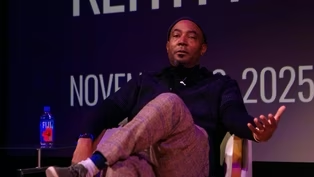
- Award-winning cartoonist Keith Knight is known for using art and humor to spark dialogue on social, racial, and political issues.
He's the creator of the semi-autobiographical comic strip, "The K Chronicles."
And his life and work inspired the Hulu comedy series, "Woke."
Knight was in town recently for "The Wright Conversations" at the Charles H. Wright Museum of African American History.
PBS Books teamed up with the museum to capture his appearance.
Here are some excerpts.
- I grew up in 1970s Boston.
And so right here is basically probably the most famous photograph coming out of 1970s Boston.
And as a little kid, I vaguely kinda knew what was going on in it, but as I got older and learned about everything, I come to see it as a metaphor for America.
But we'll return to that at the end.
This is one of my earliest autobiographical comic strips.
And I think I did this in eighth grade, and these are all my buddies.
And I didn't know it then, but what I realize now is I was making up for something.
I never received a book where people of color were the protagonists.
I got more books where animals were the heroes, and not people of color.
So in a way, I was making up for the lack of representation in the books I was being assigned.
So I created these comics where we were the center of the action.
And I say this all the time.
I think I prevented myself from getting my butt kicked many times because I would make fun of people in my comics.
And they were just happy to be in there, to just be seen, like the bullies in real life were just happy.
"Oh wow, I'm in this comic."
You know?
It's like, what, you're not, are you mad 'cause I'm making fun of you?
Like, no, this is kinda cool.
So I realized, this would be a great job if I could get away with it.
And so I started to incorporate it into a lot of my schoolwork.
And I started getting better grades because I was incorporating my comics into my schoolwork, in everything except math.
Math, it's either right or wrong.
You can't dress it up, you can't do any comics about it that's gonna make it any better.
But everything else, it really, it said something.
And I started doing it for my junior high newsletter and then my high school newspaper.
And I just went from there.
Now, here's a wild thing, especially being in a city that's 80% Black.
I never had a Black teacher until I was a junior in college.
So that might be a reason why I didn't get any books where people of color were the protagonist.
That junior year in college, I had an American literature teacher who was Black.
And he assigned us Ralph Ellison, Richard Wright, Maya Angelou, and James Baldwin.
And when someone said, "Why are you giving us all Black writers?"
they asked him.
He said, "This is an American literature class.
I'm giving you all American writers."
And that just exploded my head.
Because I love the fact that this guy was working within the system, but he was subverting the system at the same time to let us know that, that the be all end all of American literature isn't Mark Twain.
There's a lot more that you're missing out on.
And so I dove into this class and I ended up getting an A-minus.
This guy was a hard, hard teacher.
And no matter how many drawings I put in my assignments.
But really like, my work went from being autobiographical comics about keg parties to what it's like to be a Black man growing up in America.
America has always been about race.
Always!
Even when you don't wanna make it about race.
It totally is, in every aspect of it.
Whether you're standing in line at an ATM, and you have to stand a certain amount away or otherwise, the person at the ATM's gonna freak out, to, I don't know, Band-Aids, to anything.
Anything and everything!
It's all about race.
And I don't know how people try to not make it about race.
Like the fact that you actually come up and say, "It's not about race."
That means it's about race!
If you're bringing it up, of course it's about race!
So people say, "Oh, why you have to always make it about race?"
Well, this brings us to the second James Baldwin quote, which is, "I love America more than any other country in the world.
And exactly for this reason, I insist on the right to criticize her perpetually."
Okay?
I am a huge "Star Wars" fan, but I will tell you right now, I will freely admit that "Star Trek" has more decent movies and more decent series now than "Star Wars" does.
It's hard for me to say it, but it's the truth.
And I say that because I love "Star Wars" and I want "Star Wars" to be better.
But if you saw "The Last Skywalker," it is the worst piece of trash film you'll ever see.
And I don't say it because I hate "Star Wars."
I say it because I love it.
So I want it to be better, and I want America to be better.
And the only way America can be better is for it to acknowledge its past, its present, and its future problems.
And the biggest one is race.
- So you said that America suffers from racial illiteracy.
- Totally.
- If you could assign one comic of yours that was required reading in every classroom, which would it be?
- Which would it be?
Oh, man.
I mean, it might be just about the fact that America suffers from racial illiteracy and we need to get it from a third grade or kindergarten level to at least a sixth grade level.
Like we have to teach, I mean, as much as I love the fact that Jackie Robinson was a great athlete, he was not the first professional, Black professional ballplayer.
It was Moses Fleetwood Walker in the late 1800s.
- [Neil] Right.
- And White owners collectively said, "Let's not hire any more Black people."
And like those type of stories, and you see what they did to Colin Kaepernick.
Like, everything that's happening today has happened in the past.
So, just letting people know, like you don't realize how much you don't know.
And so maybe it's that racial illiteracy strip, just like, get out and learn this stuff.
'Cause you're not gonna learn it in school.
And you're not gonna learn it watching TV.
Like TV is... - [Neil] Yeah.
- I only see a ton of TV when I'm in a hotel room, and then I just flick like crazy.
And do you see how many cop shows there are?
Like, it's total cop-agenda, like realize, like just take the time to see how many cop shows there are out there that make it seem like there's crime all over the place, constantly, nonstop.
And it's not, it's not!
Like crime is down at all across the nation.
- [Neil] Yeah.
- And like, down to like the '60s and everything.
People talk about the '90s and how wonderful they were, like reflecting on them.
And the '90s were like the peak of like, violence in cities and stuff.
But like, we live in a relatively safe place.
And keeping people afraid, constantly paranoid and afraid is part of the plan to, it's part of the plan.
- So I wanna talk a little bit about "Woke."
I know a lot of the folk, particularly our young folks that have joined us today, are just curious how does that really happen, right?
That you're sitting in a cafe, you're writing, you meet a producer.
It's obviously not that simple.
But what I want, I guess to dive into a little bit more, what does it take to go from, let's just say that moment, to where you have a show on Hulu?
- Yeah, I mean, there are a lot of planets that have to align.
- Exactly.
- A lot of planets that have to align.
And all I can say is like to, I, we... Yeah, it is a lot.
You have to be, you have to have this obviously this open mind, but you have to align yourself with people that you think, Hollywood is full of people who work really hard, but it's also full of a lot of jerks.
- [Neil] Jerks, yeah.
- And if you find nice people, you glob onto them, you stick with them.
And so one of my producers, John Will, is such a nice guy.
And I was like, "Okay, this is someone I can, I gotta glob onto."
And then he brought my work to Eric Christian Olsen, if you've ever seen it, is it "NCIS LA?"
Or "NCSLA?"
I don't know, it's one of these cop shows.
But he was like Deeks.
He was like the blonde guy that everyone... And his dad was an American literature professor, and he brought his work to his dad, and his dad grabbed him and said, "This will be the most important show you ever make."
I feel like he said, "You have to make this show.
You have to."
'Cause he really loved my work.
And so I was like, "Okay, this is great."
- And you can see that entire conversation with Keith Knight at pbsbooks.org.
That's gonna do it for us this week.
You can find out more about our guests at americanblackjournal.org, and you can connect with us anytime on social media.
Take care, and we'll see you next time.
(upbeat music) (upbeat music continues) - [Announcer] Across our Masco family of companies, our goal is to deliver better living possibilities and make positive changes in the neighborhoods where we live, work, and do business.
Masco, a Michigan company since 1929.
Support also provided by the Cynthia and Edsel Ford Fund for Journalism at Detroit PBS.
- [Announcer 1] The DTE Foundation is a proud sponsor of Detroit PBS.
Through our giving, we are committed to meeting the needs of the communities we serve statewide, to help ensure a bright and thriving future for all.
Learn more at dtefoundation.com.
- [Announcer 2] Also brought to you by Nissan Foundation, and viewers like you.
Thank you.
(gentle music)
Video has Closed Captions
Clip: S54 Ep2 | 11m 17s | A look at award-winning cartoonist Keith Knight's appearance at the Charles H. Wright Museum. (11m 17s)
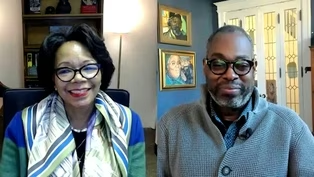
How The Henry Ford is celebrating the legacy of Dr. Martin Luther King, Jr. over the holiday weekend
Video has Closed Captions
Clip: S54 Ep2 | 10m 20s | Programming will include plays, musical performances, conversations, and more. (10m 20s)
Providing Support for PBS.org
Learn Moreabout PBS online sponsorship
- News and Public Affairs

Top journalists deliver compelling original analysis of the hour's headlines.

- News and Public Affairs

FRONTLINE is investigative journalism that questions, explains and changes our world.











Support for PBS provided by:
American Black Journal is a local public television program presented by Detroit PBS