
Trump escalates Venezuela confrontation with oil blockade
Clip: 12/17/2025 | 8m 57sVideo has Closed Captions
Trump escalates Maduro confrontation with blockade on Venezuelan oil tankers
President Trump continued his rhetorical campaign against Venezuela's President Nicolas Maduro, as a large American Naval force sits in the waters off the coast. The U.S. will actively blockade and seize vessels it had already sanctioned, a move some critics have called an act of war. Nick Schifrin reports and Geoff Bennett discusses the latest with David Smilde.
Problems playing video? | Closed Captioning Feedback
Problems playing video? | Closed Captioning Feedback
Major corporate funding for the PBS News Hour is provided by BDO, BNSF, Consumer Cellular, American Cruise Lines, and Raymond James. Funding for the PBS NewsHour Weekend is provided by...
Trump escalates Venezuela confrontation with oil blockade
Clip: 12/17/2025 | 8m 57sVideo has Closed Captions
President Trump continued his rhetorical campaign against Venezuela's President Nicolas Maduro, as a large American Naval force sits in the waters off the coast. The U.S. will actively blockade and seize vessels it had already sanctioned, a move some critics have called an act of war. Nick Schifrin reports and Geoff Bennett discusses the latest with David Smilde.
Problems playing video? | Closed Captioning Feedback
How to Watch PBS News Hour
PBS News Hour is available to stream on pbs.org and the free PBS App, available on iPhone, Apple TV, Android TV, Android smartphones, Amazon Fire TV, Amazon Fire Tablet, Roku, Samsung Smart TV, and Vizio.
Providing Support for PBS.org
Learn Moreabout PBS online sponsorshipGEOFF BENNETT: President Trump today continued his rhetorical campaign against Venezuela's President Nicolas Maduro, as a large American naval force sits in the waters off the coast.
Mr.
Trump sent a social media broadside last night against Maduro, which he reiterated today.
The U.S., he says, will actively blockade and seize vessels it had already sanctioned, a move some critics have called an act of war.
Nick Schifrin starts our coverage.
NICK SCHIFRIN: In the Caribbean sea, U.S.
troops at the ready for a new mission with more targets, American-sanctioned Venezuelan oil tankers.
Last night on TRUTH Social, President Trump promised a -- quote -- "total and complete blockade of all sanctioned oil tankers going into and out of Venezuela."
DONALD TRUMP, President of the United States: Just a blockade?
Not going to let anybody going through that shouldn't be going through.
NICK SCHIFRIN: Already last week, the Coast Guard and military boarded and seized a tanker.
There are more than 30 such tankers off the Venezuelan coast, a ghost fleet of ships that Venezuela has used to evade oil sanctions.
That pressures Venezuela's chief source of revenue.
There are estimates that 90 percent of the economy is based on oil exports.
And U.S.
officials believe challenging that weakens Maduro's grip on power and could force him to step down.
QUESTION: So how far would you go to take Maduro out of office?
DONALD TRUMP: I don't want to say that, but... QUESTION: But you want to see him out?
DONALD TRUMP: His days are numbered.
MAN: A blockade is an act of war.
NICK SCHIFRIN: But on the Hill today, Democrats demanded that Congress vote on and reject direct military action against Venezuela.
SEN.
RICHARD BLUMENTHAL (D-CT): My preference would be that there would be a better leader than Maduro in place.
But that's not to say we can displace him by military means.
NICK SCHIFRIN: A blockade also opposed today by Mexican President Claudia Sheinbaum.
CLAUDIA SHEINBAUM, Mexican President (through translator): We reiterate Mexico's position according to our Constitution of nonintervention, no foreign interference, self-determination of peoples, and peaceful resolution of controversies.
NICK SCHIFRIN: But President Trump is making clear another U.S.
priority, the U.S.'
historic interest in Venezuelan oil and gas.
The country has the world's largest oil reserves, which the U.S.
helped develop exactly one century ago.
But former leader Hugo Chavez kicked out some U.S.
and other foreign energy companies before his death in 2013.
Today, only Chevron remains.
And Trump yesterday wrote that the U.S.
"will not allow a hostile regime to take our oil, oil, land or any other assets, all of which must be returned to the United States immediately."
DONALD TRUMP: You remember they took all of our energy rights, they took all of our oil from not that long ago, and we want it back, but they took it.
They illegally took it.
NICK SCHIFRIN: To that, Maduro accuses the U.S.
of resource colonialism.
NICOLAS MADURO, Venezuelan President (through translator): We tell the people of the United States our truth, and it is very clear imperialism and the Nazi fascist right-wing wants to colonize Venezuela to take our wealth, oil, gas, gold, iron, aluminum, and other minerals, not blood for oil, not war for oil.
The claims about drug trafficking are fake news, a lie, AN excuse.
NICK SCHIFRIN: For years, the U.S.'
pressure on Maduro was political, but now the U.S.
is treating his regime as a national security threat and possible military target, raising the stakes even higher.
For the "PBS News Hour," I'm Nick Schifrin.
GEOFF BENNETT: For one perspective on the latest Trump administration move against Venezuela, we turn to David Smilde, professor and chair of the sociology department at Tulane University.
He has written extensively about Venezuela for over three decades.
Thanks so much for making time for us.
DAVID SMILDE, Tulane University: Thank you.
GEOFF BENNETT: You have called this latest move to block Venezuelan oil exports misguided, at best.
Why, especially when the administration makes the case that this is the best way to pressure the Maduro regime?
DAVID SMILDE: Well, I think this will indeed pressure the Maduro regime.
The problem is that these kind of sanctions, these kind of sectoral sanctions on Venezuela affect the entire economy.
So it will affect the people even more than they affect Maduro.
And this is what we have seen in -- since 2017, we have had sanctions, and they have affected Maduro, but they have actually strengthened his hand vis-a-vis the population.
Basically, it gives him more control, more discretional control over what resources do flow in.
And we have seen this in the case of Cuba as well.
Over a half-century of sanctions have actually solidified the Communist Party there.
And so I think it's deeply misguided in that way in terms of trying to generate some kind of change.
And it also is going to have a huge humanitarian impact.
I mean, Venezuela's oil is the heart blood of the economy.
And this could end up generating a famine in Venezuela.
GEOFF BENNETT: Well, a question about the overall strategy, because for years U.S.
policy has rested on this idea that economic pain would trigger an internal revolt, especially within the military.
Why hasn't that happened?
DAVID SMILDE: It does cause economic pain.
But that economic pain is distributed across the whole country.
And the people that are most able to withstand that pain are precisely Nicolas Maduro and the people around him.
No, he's very good at divvying up rewards and making sure that they get the best of everything, while everyone else in the country suffers the sanctions.
That essentially sort of increases -- if you want to think about this way, increases Maduro ratio of power over the population.
So it's not going to lead to change.
GEOFF BENNETT: And when President Trump frames Venezuela oil as U.S.
oil on U.S.
land how does that rhetoric strike the ear of the Venezuelan public?
DAVID SMILDE: Well, it's really puzzling to understand what he actually means by this.
No, it's -- there's no jurisprudence in Venezuela or the United States that would suggest that the oil belongs to anybody other than the Venezuelan people.
And this is something that is sort of the center of Venezuelan culture.
I have been surprised just today with my colleagues, my Venezuelan colleagues, discussing with them how many of them who are fervent government opponents are outraged by this, by this entire discourse.
No, this is what Chavismo has been saying for 25 years, has been saying -- if the U.S.
criticizes democracy or human rights in Venezuela, they will always say it's about the oil.
The United States even -- really wants the oil, even when it was not about that.
And so now Trump comes along and says, well, it really is about the oil.
I mean, you can't imagine a discourse that fits better with Chavismo's whole idea, what they have been saying for 25 years.
GEOFF BENNETT: If sanctions and threats can't produce the desired result, what does history tell us has a better chance of working in a case like Venezuela?
DAVID SMILDE: I think all of this pressure that President Trump has put on Maduro and on Venezuela is real pressure, they are feeling real pressure, could be used to try and negotiate, to try and negotiate.
The thing is simply negotiating Maduro's exit is probably not going to work.
No, people tend to think, oh, this is a criminal government, so just pay him off and get him to leave and to do that.
But these people really think that they are the bearers of Hugo Chavez's.
And they want to -- and they see that as an anti-imperialist revolution.
So they really want to see this, see this government continue.
I think some kind of negotiation that not only provides for their safety and their exit, but also for the continuation of Chavismo, perhaps some sort of co-government during a couple of years, there's a number of proposals that are circulating that I think could be difficult.
They would be difficult.
There's no guarantee that they will work.
But compared to what is being proposed from the Trump administration, I think they would be much better ways to go.
GEOFF BENNETT: So, bottom line, when Americans hear that the Trump administration is exerting more pressure on Venezuela, what can the American people realistically expect in terms of outcome?
DAVID SMILDE: I don't expect any real outcome.
I think, in terms of if they're going to go forward with this kind of blockade of sanctioned oil vessels, this could cause a humanitarian catastrophe within Venezuela and we will be seeing images of that.
If there's some sort of effort at a military strike, I think minimal military strikes of the type that are being discussed would not lead to democracy.
I think they would lead to chaos, some kind of chaos like we see in Haiti right now, because there's so many armed actors within Venezuela that have their hands in illicit markets that -- and who are compromised, who are compromised by human rights abuses or corruption or other crimes, who really fear a transition.
So I think you would see some sort of chaos if that happened.
The one possibility is if President Trump could use all this pressure to try to negotiate some sort of reasonable transition that would have to include Chavismo in some way.
GEOFF BENNETT: David Smilde, the professor at Tulane University, thanks again for your time this evening.
DAVID SMILDE: Thank you
Ben Greenberg reflects on past trauma after Brown shooting
Video has Closed Captions
Clip: 12/17/2025 | 8m 23s | Son of Louisville mayor reflects on past trauma after Brown University shooting (8m 23s)
Colorado becomes refuge for Texas trans teen seeking care
Video has Closed Captions
Clip: 12/17/2025 | 8m 39s | Colorado becomes refuge for Texas family seeking gender-affirming care for trans teen (8m 39s)
Dem, GOP lawmakers on uniting to force vote on ACA subsidies
Video has Closed Captions
Clip: 12/17/2025 | 8m 56s | Democratic and GOP lawmakers on uniting to force vote on ACA subsidies (8m 56s)

GOP proposal would steer money into health savings accounts
Video has Closed Captions
Clip: 12/17/2025 | 5m 58s | What to know about the GOP proposal to steer money into health savings accounts (5m 58s)
News Wrap: Bondi Beach suspect faces 15 counts of murder
Video has Closed Captions
Clip: 12/17/2025 | 5m 36s | News Wrap: Bondi Beach shooting suspect charged with 15 counts of murder (5m 36s)
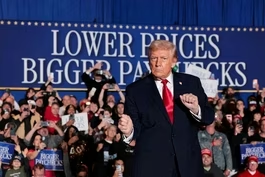
Trump gets his worst economic ratings ever in new poll
Video has Closed Captions
Clip: 12/17/2025 | 5m 38s | Trump gets worst economic ratings ever in new poll as Americans worry about affordability (5m 38s)
Providing Support for PBS.org
Learn Moreabout PBS online sponsorship
- News and Public Affairs

FRONTLINE is investigative journalism that questions, explains and changes our world.

- News and Public Affairs

Amanpour and Company features conversations with leaders and decision makers.












Support for PBS provided by:
Major corporate funding for the PBS News Hour is provided by BDO, BNSF, Consumer Cellular, American Cruise Lines, and Raymond James. Funding for the PBS NewsHour Weekend is provided by...