
City Officials Make the Case for Johnson’s Budget to Fund Youth Services
Clip: 11/12/2025 | 8m 50sVideo has Closed Captions
Budget hearings at City Hall are set to wrap up this week.
Much of the debate over Mayor Brandon Johnson's budget proposal centers around his plan to impose a head tax on large companies. He said that would generate $100 million to fund violence prevention and youth employment programs.
Problems playing video? | Closed Captioning Feedback
Problems playing video? | Closed Captioning Feedback
Chicago Tonight is a local public television program presented by WTTW
WTTW video streaming support provided by members and sponsors.
City Officials Make the Case for Johnson’s Budget to Fund Youth Services
Clip: 11/12/2025 | 8m 50sVideo has Closed Captions
Much of the debate over Mayor Brandon Johnson's budget proposal centers around his plan to impose a head tax on large companies. He said that would generate $100 million to fund violence prevention and youth employment programs.
Problems playing video? | Closed Captioning Feedback
How to Watch Chicago Tonight
Chicago Tonight is available to stream on pbs.org and the free PBS App, available on iPhone, Apple TV, Android TV, Android smartphones, Amazon Fire TV, Amazon Fire Tablet, Roku, Samsung Smart TV, and Vizio.

WTTW News Explains
In this Emmy Award-winning series, WTTW News tackles your questions — big and small — about life in the Chicago area. Our video animations guide you through local government, city history, public utilities and everything in between.Providing Support for PBS.org
Learn Moreabout PBS online sponsorship>> Budget hearings at City Hall are set to wrap up this week and it appears there's no easy way to bridge the city's nearly 1.2 billion dollar shortfall.
>> Much of the debate over Mayor Brandon Johnson's budget proposal centers around his plan to impose a so-called corporate head tax on large companies.
The plan expected to generate 100 million dollars to fund violence, prevention and youth employment programs.
Nearly 59 million of that would go to the city's Department of Family and support Services.
So joining us now with more our Angela Greene, commissioner of the city's Department of Family and Support Services and Kathy Kulick, deputy Commissioner of Youth Services.
Thanks to both for joining us.
Welcome to Chicago TONIGHT, Commissioner Green.
I know you've only been on the job for 3 long but remind us how these programs are funded until this point.
Historically, our youth development programs have been funded through our city budget.
>> And now we're looking at other revenue streams because we need sustainable revenue source for these programs that we know that work.
Why hasn't city budget been sustainable until this point?
For this particular need for differently.
And obviously we see that there's a budget shortfall and we have to bring other revenue streams in order to to meet that me.
So we've had historic of money in our poll as an example, you get some example.
The impact of thank you, Commissioner Green.
So I think it's important to note that the one-time investment we had from the American Rescue Plan Act.
>> Allowed us to pilot programs like the youth interventions pathway that will be funded by this corporate tax and programs like that are essential in our city one because it keeps us in compliance with CPA with the consent decree for CPD.
But also serves as a diversion deflection model across the city.
It also allowed us to pilot a program called my time my future safe spaces where youth are able to coming invite their peers and planned events and engage in safe spaces with trusting adults.
It also allowed us to expand on existing programs like our service coordination and navigation program model that really takes youth of highest promise and connects them with wrap around services so they can be the best that they can be.
So, you know, all of these programs continue to contribute to the 60 year low that we're seeing in violates this Commissioner Greene said, it is vital that we find a way to sustain.
And I do want to get to more into some of that programming that you mentioned and how it works.
And the results that we that we are hearing about it.
But Commissioner Green and we don't have to spend a whole lot of time on this because it's not technically your department, why it had to like there's is there no other way to generate this revenue to fund these programs.
Well, I will say leave that to elected find other ways to generate the funding.
But the reason why we really need this money, you know, we know that our corporations see the federal tax break.
>> And the same time we're seen, many of our families struggle with food, insecurity with a pause and possibly even with health care access might be another issue.
So.
We actually need everyone to kind of join in and support our most vulnerable populations.
And our youth diversion program youth employment program really helped support our youth of high promise.
Those that are trying to really gauge and move through our city and find a way forward.
And so this is a way that our corporations can take part in that we need that support.
It's not really charity.
it's not even a penalty is really investing back into the city that has so much promise.
And then also actually investing in their future workforce.
>> Because health may become the next CEO or the social influencer right?
>> Commissioner who live or deputy commissioner who look, you are proposing 48.9 million dollars alone for youth employment programming.
How would that work?
>> Yeah.
that's a great questions.
So we have 5 program models for youth employment along with city, city sister city agencies.
We from one of the largest youth employment summer programs where just this year alone had over 53,000 you apply for one summer, Chicago jobs and we were able to hire more than 31,000 of those.
You so just being able to like Commissioner Green just said, just invest in our to be able to make sure that they have the skills to support the emotional and mental illness that they need to have him playing overall.
We know violent crime is down.
23% homicides down 29% in overall shootings in the city down.
36%.
>> What do we know about the impact of youth programming on public safety?
But also the economy and the young people who get those jobs.
>> We definitely know that the programs that we have actually give youth a divert, be able to divert from system involvement.
We know that giving them positive outcomes and positive outlet for them to be to get involved in helps to reduce violent crime.
We saw from United States Joint Economic Commission report.
They studied the youth that were involved in employment programs here in the city and that 43% of those that were involved in employment.
Actually, we're less likely be involved in a type of violent crime.
Almost 80% of them were not involved any shooting arrested for anything of that nature.
So we see from the data that it actually works to that point.
You know, another 5.2 million you are proposing in this budget that would go towards violence reduction funding.
Why such a big difference?
>> In the 48.9, nearly 50 nearly 49 million versus the 5 million for violence reduction.
Yeah, well, we see that there's a lot of efforts happening in the CBI community right now that focus on adults.
So we want to just make sure that we're doing our part in again, investing in the U.
>> And having some type of programs and models that mirror what's happening in the CBI community.
For those that are 18 and under.
So, you addition to the 48 million, I think it's important to note that even employment programs to help reduce giving an opportunity to pick up a are asking them to put down the gun is what it's about.
>> A city report one that you all of the summer youth impact report that you all just released last month shows that over the summer more than 31,000 youth were employed through D S S S jobs.
Also finding another 2.84 million hours of work.
Experience 30.8 million dollars were provided for youth aged 16 to 24 youth service program and also served over 108,000 residents for more than 150 community-based organizations.
Citywide.
Commissioner or deputy commissioner.
What are the long-term returns for investing in youth employment?
That's when we get the long run.
Yeah.
I think that the first thing that we would get is just youth that are more prepared for the workforce.
We had 95% of our youth said that they now feel that there's somebody that can you.
>> Be successful in a job.
It also allows us to just have a safer community when when the city is safe for everybody wins businesses.
When residents when youth when and they're set up for success.
>> We also think the skills that developing specially equipped safe spaces, we're seeing youth actually organize become community organizers.
They're leading.
They are engaging other youth in positive activities.
And so see what has come out of that.
They're feeling safe in their communities.
These are positive outcomes that sometimes you have a dollar amount to because the impact is as long-standing.
And to be clear, these programs that you mentioned, for example, the service coordination, navigation programs can community safety, engagement, peacekeeping program, the youth interventions pathway that you mentioned earlier.
>> Does the city partner with community-based organizations to to grant this money out to supply this programming?
That's that is mainly what we do is we we fund community-based organizations that our position best to serve our youth to meet them where they are.
>> And then we work with them to be able to make sure that those dollars that they're being good stewards of those dollars and that funding, it's just create as much impact across the city as they can.
>> All that said, of course, you got to pay for Commissioner Green, how how else could corporations contribute if not ahead, just last week on this program, the Hospitality Business Association of Chicago says that many of those corporations are already contributing to the mayor's employment programs some of them obviously opposed the head tax.
How else could they be supportive of Chicago's youth?
We definitely are.
Corporations continue to be a part employing are you throughout summer youth program and there are other ways that could become corporate sponsors of our programs that there >> Actually ways that you left.
Yes, you mentioned earlier that 53,000 youth that applied, have more slots will be the higher those individual.
So there's this after opportunity for them, connect at a strong level with us, OK, of course, we'll let we'll keep an eye on this as the budget process continues.

Coin Enthusiast Shares Some of His Collection With Neighbors
Video has Closed Captions
Clip: 11/12/2025 | 4m 49s | A local collector changed his plans for a treasure hunt when immigration raids ramped up in Chicago. (4m 49s)
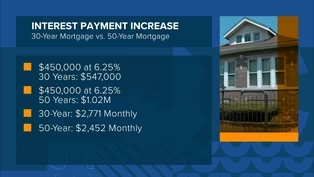
Trump Proposes 50-Year Mortgage. A Look at the Pros and Cons
Video has Closed Captions
Clip: 11/12/2025 | 5m 30s | The president hinted on his social media platform that he may push for 50-year mortgages. (5m 30s)
Providing Support for PBS.org
Learn Moreabout PBS online sponsorship
- News and Public Affairs

Top journalists deliver compelling original analysis of the hour's headlines.

- News and Public Affairs

FRONTLINE is investigative journalism that questions, explains and changes our world.











Support for PBS provided by:
Chicago Tonight is a local public television program presented by WTTW
WTTW video streaming support provided by members and sponsors.