
Walter Isaacson on 'The Greatest Sentence Ever Written'
Clip: 6/24/2026 | 7m 15sVideo has Closed Captions
Walter Isaacson on what he calls 'The Greatest Sentence Ever Written'
Ahead of America's 250th anniversary, author Walter Isaacson has turned his attention to a single sentence in the Declaration of Independence. Judy Woodruff spoke with Isaacson about the enduring power of those words and his new book, "The Greatest Sentence Ever Written." It’s part of her series, America at a Crossroads.
Problems playing video? | Closed Captioning Feedback
Problems playing video? | Closed Captioning Feedback
Major corporate funding for the PBS News Hour is provided by BDO, BNSF, Consumer Cellular, American Cruise Lines, and Raymond James. Funding for the PBS NewsHour Weekend is provided by...
Walter Isaacson on 'The Greatest Sentence Ever Written'
Clip: 6/24/2026 | 7m 15sVideo has Closed Captions
Ahead of America's 250th anniversary, author Walter Isaacson has turned his attention to a single sentence in the Declaration of Independence. Judy Woodruff spoke with Isaacson about the enduring power of those words and his new book, "The Greatest Sentence Ever Written." It’s part of her series, America at a Crossroads.
Problems playing video? | Closed Captioning Feedback
Where to Watch PBS News Hour
PBS News Hour is available to stream on pbs.org and the PBS app.
Providing Support for PBS.org
Learn Moreabout PBS online sponsorshipGEOFF BENNETT: Ahead of America's 250th anniversary, author Walter Isaacson has turned his attention to a single sentence in one of the nation's founding documents.
Judy Woodruff speaks with Isaacson now about the enduring power of those words for her series Crossroads: America at 250.
JUDY WOODRUFF: People line up to see it, the Declaration of Independence, protected behind bulletproof glass inside the National Archives, the faded nearly 250-year-old document that is America's defining statement of purpose.
For Walter Isaacson, one line stands out.
He calls it the greatest sentence ever written, the title of his most recent book.
That sentence: "We hold these truths to be self-evident, that all men are created equal, that they are endowed by their creator with certain unalienable rights, that among these are life, liberty, and the pursuit of happiness."
WALTER ISAACSON, Author, "The Greatest Sentence Ever Written": Maybe I shouldn't write a really big long book.
I should just do the most important sentence and I should explain it very succinctly, how we should all rally around it.
JUDY WOODRUFF: Isaacson and I recently discussed the many meanings behind those words at the Larz Anderson House in Washington, D.C., home to the Society of the Cincinnati, the nation's oldest patriotic organization formed just after the Revolutionary War.
Do you truly believe it is the greatest sentence ever read?
WALTER ISAACSON: If you look at that sentence, it creates something new on the face of the earth, a country that's power comes from the consent of the government, that respects individual freedom, but also respects the idea of having common values and common ground and diversity.
And the world had not seen a place like that.
And it becomes a mission statement around the world, as more and more countries sort of embrace the idea of democratic freedom.
JUDY WOODRUFF: But it's also full of contradiction, because for them saying all men are created equal, there was an inherent contradiction there, because all people living at that time were not equal.
WALTER ISAACSON: There's a deep contradiction in the sentence and a contradiction in the way America was founded, and our narrative is how we resolve that contradiction.
When they wrote that sentence, it clearly was aspirational, because one-fifth of the people living in the colonies were enslaved.
And even Thomas Jefferson, when he's drafting the sentence, his valet, he's enslaved.
So Jefferson has to get over these contradictions.
And so do we, as a country, as, over the course of generations, we have lived up to the promise in fits and starts.
JUDY WOODRUFF: Do you believe the founders understood at the time what a big contradiction it was?
WALTER ISAACSON: The founders fully understood that slavery was a contradiction.
Jefferson writes denunciations of slavery in his first draft of the declaration, and then they have to take some of them out because the South Carolina delegation won't put up with it.
And, certainly Franklin, John Adams, they all understand that there's this contradiction, but they're setting the nation on a course, a course that has this definite problem from the very beginning, and each new generation has to wrestle with it.
JUDY WOODRUFF: Did they have an inkling at the time of the consequences of what they were doing when they drafted this?
WALTER ISAACSON: They absolutely knew they were creating two great ideals for a nation.
One is a nation based on individual liberty, but in which you share common ground in the rights of everybody, secondly, a diverse nation where you don't impose a religion or a creed or a way of thinking.
You have to remember every nation up until then pretty much had either been ruled because of the divine right of kings or the sword of conquerors.
They had tended to be ethnic nationalist nations.
But, in Philadelphia, you have a great diversity.
You have Anglicans and Quakers and Moravians and Jews and slaves and freed slaves and Presbyterians.
And they're saying, we're a new type of nation, in which diversity can be part of our strength.
JUDY WOODRUFF: You used a word or the term common ground just now, although the word common is hardly in the document.
Where did that notion of common ground come from?
WALTER ISAACSON: Common ground comes from John Locke, who says, we can all have private property, but when you have disparities of wealth, sometimes people who own property should put things in the common.
That's why you have Clapham Common, or here you have Boston Common and Cambridge Common, is where people without property, known as commoners, could graze their sheep, bury their dead, plant their gardens.
But it becomes a symbol for larger things, where we put schools in the common, we put the fire department in the common, we put police in the common, libraries in the common.
They're writing the Declaration to say, here's our common values.
But they also say, we're creating a nation where everybody has a right to life, liberty, and the pursuit of happiness.
So we have to create the type of society that allows a land of opportunity, that allows some common ground in which we can all flourish.
And that became known as the American dream.
JUDY WOODRUFF: And as you write, over time, though, this has changed.
WALTER ISAACSON: Nowadays, we have lost the notion of a common ground of information.
We all go to our different ends of the talk radio dial or down different rabbit holes on the Internet.
Likewise, we sometimes lose that notion that, in order to have an American opportunity, an American dream, we need to have things in common.
If you look at the idea that all men are created equal, and you realize it doesn't really describe the way it was in 1776.
But you think of it as a forcing mechanism.
Four score and seven years later, Lincoln invokes it, as he's burying 7,058 young men who died to make the sentence more equal.
At the Seneca Falls declaration, they invoke it.
Dr.
King invokes it in one of his last speeches.
Lyndon Johnson invokes it when he signs a civil rights law.
So it's a sentence that keeps pushing us forward, even though our progress comes in fits and starts.
JUDY WOODRUFF: As you look at what the founders ultimately wrote in this sentence, was there something you would change?
WALTER ISAACSON: I'm an editor.
I love editing.
What if I had been in the room, and I went word through word, even words like self-evident, which seemed a bit inflated to me, and then I realized Franklin is talking about a very specific type of truth.
All of those words are carefully chosen.
I can't see I'd change any one of them.
JUDY WOODRUFF: Even coming from an editor?
WALTER ISAACSON: Even coming from a longtime editor.
JUDY WOODRUFF: Walter Isaacson, thank you for talking with us.
WALTER ISAACSON: Judy, great.
Thanks.
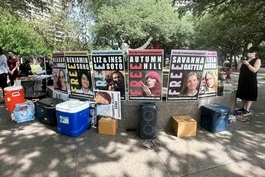 New
NewAnti-ICE protesters sentenced to decades in prison
Video has Closed Captions
Anti-ICE protesters sentenced to decades in prison in latest crackdown on dissent (5m 24s)
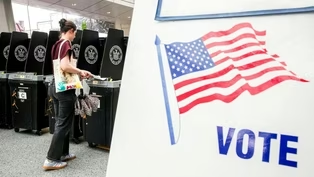 New
NewHow Trump is trying to reshape how elections are run
Video has Closed Captions
How the Trump administration is trying to reshape how elections are run (5m 19s)
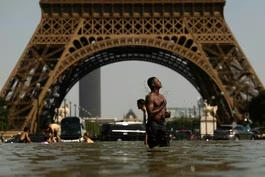 New
NewMillions in Europe face record-breaking heat wave
Video has Closed Captions
Millions in Europe face extreme temperatures from record-breaking heatwave (5m 34s)
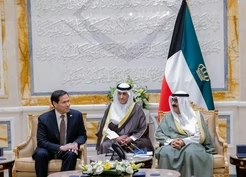 New
NewNews Wrap: Rubio meeting leaders across three Gulf nations
Video has Closed Captions
News Wrap: During Gulf nations tour, Rubio stresses Strait of Hormuz must remain open (5m 37s)
 New
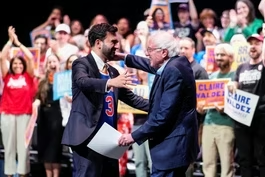
NewProgressive victories signal mood of some Democratic voters
Video has Closed Captions
Progressive victories signal mood of some Democratic voters ahead of midterms (6m 13s)
 New
NewTop military commander resigns following clash with Hegseth
Video has Closed Captions
Another top military commander resigns following clash with Hegseth (6m 8s)
 New
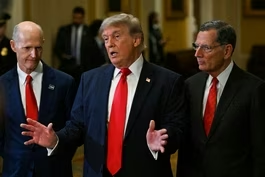
NewTrump scraps housing bill signing to press GOP on SAVE Act
Video has Closed Captions
Trump scraps housing bill signing to pressure Senate GOP on SAVE Act (5m 1s)
 New
NewWhat's in the housing bill that Trump refused to sign
Video has Closed Captions
What's in the housing affordability bill that Trump refused to sign (6m 21s)
Providing Support for PBS.org
Learn Moreabout PBS online sponsorship New Episode
- News and Public Affairs

Today's top journalists discuss Washington's current political events and public affairs.
 New Episode
- News and Public Affairs

FRONTLINE is investigative journalism that questions, explains and changes our world.
 New Episode

 New Episode
 New Episode
 New Episode
 New Episode
 New Episode
Support for PBS provided by:
Major corporate funding for the PBS News Hour is provided by BDO, BNSF, Consumer Cellular, American Cruise Lines, and Raymond James. Funding for the PBS NewsHour Weekend is provided by...