
Dana Williams of Detroit Employment Solutions Corporation discusses future of AI at Detroit Policy Conference
Clip: Season 10 Episode 32 | 6m 12sVideo has Closed Captions
One of the panels focused on the impact of artificial intelligence in the business environment.
One Detroit contributor Zoe Clark of Michigan Public sits down with President and CEO of Detroit Employment Solutions Corporation Dana Williams to discuss the future of artificial intelligence.
Problems playing video? | Closed Captioning Feedback
Problems playing video? | Closed Captioning Feedback
One Detroit is a local public television program presented by Detroit PBS
Dana Williams of Detroit Employment Solutions Corporation discusses future of AI at Detroit Policy Conference
Clip: Season 10 Episode 32 | 6m 12sVideo has Closed Captions
One Detroit contributor Zoe Clark of Michigan Public sits down with President and CEO of Detroit Employment Solutions Corporation Dana Williams to discuss the future of artificial intelligence.
Problems playing video? | Closed Captioning Feedback
How to Watch One Detroit
One Detroit is available to stream on pbs.org and the free PBS App, available on iPhone, Apple TV, Android TV, Android smartphones, Amazon Fire TV, Amazon Fire Tablet, Roku, Samsung Smart TV, and Vizio.
Providing Support for PBS.org
Learn Moreabout PBS online sponsorshipWell, you're here today at the conference and you've been talking about artificial intelligence.
One of the real focuses though, is on human-centered AI.
- Yes.
- What does that mean?
- So it does sound a little bit strange, right?
Digital technology plus people, but people really is the special sauce.
And we can have all these tools that are wonderful, that can make our jobs easier, that can make our life easier.
But if they're not designed in ways that people can actually use them easily day to day, if folks don't understand the basics of how to use them, if we don't take a step back and think about now how does this technology improve an entire work process, it's not gonna be adapted or adopted the way that it really should be.
And so that's one of the things that we focus on at Detroit Network.
- Give me an example of what this looks like in practice.
- Yeah.
So a couple of things.
So we serve about 80,000 Detroiters a year.
Now, sometimes that's just them coming in to use our computers, right to do the very standard job search online.
30,000 of those customers though come to us and need an actual service of some kind.
They sit down and talk to a career coach.
And about 10,000 of those individuals really have some complex barriers that might be stopping them from going to work.
And those are things like transportation and childcare, sometimes even housing.
And what we're also determining is that at the very baseline, it's actually digital access and skills.
Because today, if you don't have the tools or the understanding to pay your bills online, to order food, right, it really is stopping you from living.
And so that's where the human-centered approach is so important for us.
When we design our systems and our processes to serve Detroiters, we're keeping the person's experience at the core.
- There's certainly though, I think, for folks when they hear AI, right, there can be some concerns about what that looks like.
Tell me about how you're interacting with them?
So as an organization, so DESC, we're actually the nonprofit that helps to run all of the systems and interacts with our partners and our community agencies.
So for us, we have to take a step back and say, what are the types of guidelines and protocols that are going to one make sure our data is safe and that are gonna allow our people to feel safe using the product.
It can create templates for us to do a lot of our work better and faster, but we have to be careful about what we put in those templates, right, no personal identification information.
We're not putting social security numbers into AI to run queries, right?
But knowing that in advance and setting those guidelines is an example of the way that we're thinking about how we both integrate AI in serving our Detroit customer.
- Do you think folks are thinking enough about those guardrails day to day?
- No.
(laughs) - Tell me how you really feel honest about it.
(both laughing) - So, as DESC, we knew as the leadership team that we had employees that were engaging with the tools.
We could tell, right?
Not that they were bad.
And people were honest about it, hey, I'm going to utilize the tool to help me develop this new template, or to help summarize some of our data to create reports.
All good stuff.
And as we thought about it, we then said, okay, just like we have a standard IT policy that we've got policies that guide how the way that we talk to people, this needs one too.
(laughs) - Yeah.
Yeah.
- And luckily, one of our employees actually raised his hand with a personal passion for it.
And so went out and got a certification that we helped to cover the cost for and came and brought that information back to our organization.
And so that was step one is establishing those guidelines.
- I am curious about how you see the, I mean, all of us are wondering about the future of AI, right?
How are you thinking about the future, particularly in your work that you do?
- So one thing that I find really interesting, there is data now that is saying that the youngest generation working, so that generation Z is actually more fearful of using AI than those of us, I include myself in the, I'll say, more experienced generations.
We've been through a lot of economic change.
We've been through technology changes.
Now, lots of times I'm a part of the generation that remembers when wireless internet started, right?
I just throw that dial up - AOL dial-up... - Sound in my... - Exactly.
Exactly.
So we've done this a number of times.
They haven't... They were born into technology and haven't been through this yet.
And so as we think about how we prepare Detroiters for jobs, we have to keep that in mind at the same time.
One, the generational differences of adoption of technology and AI specifically, but then also making sure that people have the foundational skills to even understand it.
- Yeah.
- Right?
There are things that we take for granted.
Those of us that are more comfortable using technology overall.
We know the type of prompt to put into Google to get the right search term.
We know that the three dots in the upper right hand corner probably mean a menu.
Those are things that if you've never interacted with the systems and just like AI are gonna make it even harder for you to both obtain and keep a job in the future.
- Yeah.
So some of this sounds like too, the ability for it to be full of equity.
- Yes.
- And making sure that everyone sort of has a seat at this futuristic table that you're talking about.
- That's exactly right.
So we've embedded, thanks to some special grants, we are building digital coordinators into our service system for Detroit residents so that they can understand at the frontline level what people are asking for in terms of skills and where we can connect them to resources that already exist here in the city to help build up those skills so that they're ready to hit the ground running with AI and anything else.
- [Zoe] Yeah.
(crowd murmuring)

Bedrock CEO Jared Fleisher discusses growth and development in Detroit at Detroit Policy Conference
Video has Closed Captions
Clip: S10 Ep32 | 5m 38s | Bedrock CEO Jared Fleisher sits down with One Detroit to discuss expansion and development. (5m 38s)
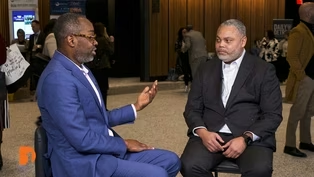
Eccalon CEO discusses moving company to Michigan at Detroit Policy Conference
Video has Closed Captions
Clip: S10 Ep32 | 4m 49s | Founder and CEO André Gudger sits down with One Detroit to discuss the city’s opportunities. (4m 49s)
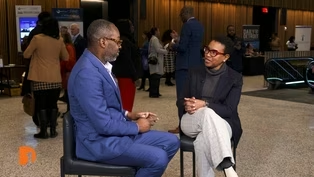
Video has Closed Captions
Clip: S10 Ep32 | 4m 32s | Vice President of Program Sarida Scott talks about the crucial role of philanthropy in Detroit. (4m 32s)
Providing Support for PBS.org
Learn Moreabout PBS online sponsorship
- News and Public Affairs

Top journalists deliver compelling original analysis of the hour's headlines.

- News and Public Affairs

FRONTLINE is investigative journalism that questions, explains and changes our world.












Support for PBS provided by:
One Detroit is a local public television program presented by Detroit PBS