
Dec. 1, 2025 - Full Show
12/1/2025 | 26m 49sVideo has Closed Captions
Watch the fill Dec. 1, 2025, episode of "Chicago Tonight."
A look at where the negotiations over the city budget stand. And how local advocates are commemorating World AIDS Day.
Problems playing video? | Closed Captioning Feedback
Problems playing video? | Closed Captioning Feedback
Chicago Tonight is a local public television program presented by WTTW
WTTW video streaming support provided by members and sponsors.
Dec. 1, 2025 - Full Show
12/1/2025 | 26m 49sVideo has Closed Captions
A look at where the negotiations over the city budget stand. And how local advocates are commemorating World AIDS Day.
Problems playing video? | Closed Captioning Feedback
How to Watch Chicago Tonight
Chicago Tonight is available to stream on pbs.org and the free PBS App, available on iPhone, Apple TV, Android TV, Android smartphones, Amazon Fire TV, Amazon Fire Tablet, Roku, Samsung Smart TV, and Vizio.

WTTW News Explains
In this Emmy Award-winning series, WTTW News tackles your questions — big and small — about life in the Chicago area. Our video animations guide you through local government, city history, public utilities and everything in between.Providing Support for PBS.org
Learn Moreabout PBS online sponsorship>> Hello and thanks for joining us on Chicago tonight.
I'm Brandis Friedman.
Here's what we're looking at.
>> I think there's been a lot of misinformation about the options that are included in this budget.
>> The latest on Chicago's budget negotiations with the city's budget director.
And as the Trump administration chooses not to commemorate World AIDS Day, a look at where prevention efforts stand.
>> First off tonight, faith leaders are pushing back on rising property tax bills.
It comes after a recent study revealing 9 neighborhoods on Chicago's south and West sides where the median residential property tax bill increase by more than 50%.
Clergy members today called out the impact.
They say these increases will have on residents who can least afford it.
>> These astronomical property taxes.
They're not just numbers, but actually we see them as eviction notices.
These numbers translate to foreclosure.
It translates homelessness translate to displacement and the destruction of generational wealth.
>> The clergy members are calling for immediate relief for impacted homeowners and answers from the Cook County Assessor and Board of Review.
For the first time in 24 years.
Cook County's Circuit court has a new chief judge at the helm.
Judge Charles Beach.
The second took the oath of office today.
>> We will not achieve perfection.
What we will strive consistency and integrity.
We will be guided by the wisdom our history incurred by the purchase justice, fairness and kindness.
France.
Work begins now.
>> Feature places.
Chief Judge Timothy Evans who'd been in the position since 2001 during his remarks.
Beach echoed some of the lessons learned from previous chief judges and outlined his own governing principles of justice, fairness and kindness to others.
Beach was elected to the role back in September.
Defeating Evans by a vote of 144 to 109.
Chicago's winter overnight parking ban is officially in effect.
That means parking is restricted from 03:00AM to 07:00AM.
across parts of the city's 107 miles of Main Street.
So be sure to check for those posted signs the Department of Streets and Sanitation says the overnight parking ban allows snow removal crews to plan and execute operations more efficiently.
The ban remains in effect until April.
First.
Whether or not there's snow on the ground.
And city crews may need it tonight because another couple of inches are expected to fall in the Chicago area.
The National Weather Service says we can expect one to 3 inches and has issued a winter weather advisory through midnight.
This after historic snowfall over the weekend.
8.4 inches reported O'Hare on Saturday, setting a new record for a single bays snowfall in November.
Guess what Weather Service says after moderate temperatures on Wednesday.
It's going to get me really cold later this week.
Yes, that sarcasm highs between 8 and 16 degrees.
Wind chills, 10 to 20 degrees below 0.
Up next, there is a showdown brewing at City Hall over the budget city budget director and at Guzman is here to talk about it right after this.
>> Chicago tonight is made possible in part why the Alexandra and John Nichols family.
The Pope Brothers Foundation.
And the support of these donors.
>> The clock is ticking as Chicago City Council has just a month to pass a budget for 2026. last month, the City Council's finance committee refused to advance Mayor Brandon Johnson's proposed spending plan.
A major sticking point centers around a plan to impose a so-called head tax, a large companies with the Thanksgiving holiday over the pressure is on to reach a deal before the end of the year deadline.
So joining us now is and that Guzman, budget director for the City of Chicago.
Welcome back.
Thank you for joining us.
Thank you for having So second year in a row, it's coming down to the wire.
Remember talking to you about this just a year ago.
>> What did you see is the main sticking point here?
>> You know, I think there's a lot of discussions around.
How do we appropriately fund government.
How do we make sure that services that are critical to the day-to-day lives of residents of the city of Chicago businesses in the city of Chicago as well as people who come to visit our city every single day.
How do we ensure that were properly providing for those while also ensuring that our city stay safe, that we provide ample opportunities for those who want to move live and work here.
And so those are really important conversations that are happening and that we need to happen.
And unfortunately, the city of Chicago because municipality have very limited options around what it is that we can produce as it relates to revenue to support those services.
So before the Thanksgiving holiday, you in the mayor, you charged older people who oppose the mayor's budget to present to come up with one of their own.
>> Have you heard or reviewed any of those proposals?
Alleged proposals?
>> So you know, what we have heard are sort reactions to what the mayor has proposed rate.
So we've had alders who've asked us to look at things slightly Just things.
Could we do it this way instead of that way?
All right.
There, you know, tell us more about the work that we did over the last several 7 months to 8 months, looking at operations.
How do we make efficiencies?
Tell us why we can't get more of those savings into next year's budget as opposed to future your budget.
So those are the conversations that are happening.
As I said before, you we welcome those conversations.
We've been having those conversations, frankly, all year.
Obviously a little bit more pronounced in acute now that we're sort of down to the wire.
But that's really what we've heard from.
This isn't the first time we've asked Alders for their idea is this isn't the first survey that we've put out holders this year.
But I think the urgency of the moment upon us.
Given that we do have a statutory deadline.
So then does it feel like from older people who oppose the budget, you're only getting criticism and no ideas.
No suggestions?
Well, I well, I will say that, you know, I I'm a lawyer by trade.
So I a person that likes to solve problems.
Right?
Eye looks to sort of sit down and see, you know, where is their movement?
Where is there room for for us to come to a compromise rather than just identifying the problem.
Right.
And so for me, we have had really good conversations, helping people understand how we got to where we were in the budget that we did present.
And we have seen some movement once know some of that understanding.
Was there something sort of groundwork was laid?
a little bit of an understanding of like, okay.
Now I understand why this is the option that you put before us and city council.
We still had others who is continually pushed back.
And again, I always how would you like us to resolve that issue?
If you don't like what's before you, how would you like to see?
You know, we keep hearing efficiencies.
We keep hearing cuts.
But what we don't hear are specific cuts.
We don't hear.
What are you willing to, you know, go back to your residents and say we're going to do a little bit less of that next year.
>> So one of those older people, Alderman Bill Conway who voted no on the mayor's revenue package.
He argued 2 weeks ago for implementing more cuts that were outlined in that report from the accounting firm, Ernst and Young.
Let's take a look.
>> And that's why we have to be official with taxpayer dollars.
And the report adds some clear place to do that.
For example, Fleet optimization the average car.
The owned by the city is driven 7,000 Miles a year, 7,000 miles a year.
And Ernst and Young said we get 29.6 million inefficiency in year one.
There's 3 million of that in the budget procurement.
Only 51% of the stuff that we buy goes through the procurement.
department.
They identified 55 211 million dollars of savings.
We can get through that.
Only 10 million dollars in this budget.
>> you've said that the some of the cuts that are recommended in that report will take years to see some of those savings.
>> Say more, please And you know, I've I've sat across Vice Chair.
>> Conway and have always said if you have questions, if you want to dig deep, my door is always open.
My phone is always add on.
Turned on.
I'd be happy to walk you through what that report actually says in that report.
It never says what year one pages it all.
It says in the first year of full recruitment, this is what you could expect.
There's a lot groundwork that we have to lay to get to your one and a lot of those recommendations because they're a new way of operating for the city of Chicago.
They're absolutely right you know, if we had fleet optimization and we had a lot of the groundwork in place right now for 12 months of the year, we would be able to recoup potentially 20 million dollars in savings.
But there is a ton of ground work in how we shift, how we operate to get there.
And those are the conversations that we have with our departments.
We sat down after every single option was put on the table.
said, do you have the things in place to actually get to that level of savings?
Is our year one for this 2026.
Or is year one 2027 2028.
What are the technology that we need to have in place people to track our fleet to be able to understand what the actual utilization is year-over-year.
What is the performance that our departments are having?
As I said to the altar during the budget hearing about procurement departments don't have the same procurement authority as the procurement department.
It's not as if they're all out there buying the same things.
City Council or the last 30 to 40 years has given very specific and limited authority to other departments under city ordinance to pick your specific and limited items within their departments that have nothing to do with what procurement services has.
And as I said to City Council, we can we can delve into why this body gave those departments specific Cuban authorities.
But that's going to take time.
And it's also going to take time to shift our operations and our systems to be able to get more towards what we think is best practice.
So another point of discussion was the mayor has said that he would veto any budget that cuts the Chicago Police Department at 2 billion dollars that we is there.
No way that budget could be trimmed without reducing officers because he's expressed, obviously that that is important that that does not happen.
>> Yeah.
So I think it's important to note that, you know, CPD is about.
>> 1,1500 less officers today than it 4 years ago.
And, you know, in this budget, what we have done is worked really claw, particularly with the superintendent and his senior staff to understand what are your hiring goals based on the coverage that you need today, too.
Both staff the district, the fact that we do have a lot of people who are on medical leave, the fact that we do have a lot of protests that happened in our city right now.
The fact that we do have a lot of special events that require police presence and we're working towards making sure that we're recovering more of those dollars.
But we don't have that system in place today.
And so with all of that forgot, we all signed a consent degree, right?
it ended going get that right.
And the consent decree isn't just about civilian positions is about how the police department and the officers themselves their operations.
And so with all of that conflict, worked really closely with superintendents telling in his senior staff to understand what is a reasonable amount of hiring that you're going to do to keep up with that level of attrition that you have and make making sure that where we are today, we're not going below that.
We froze all of the other positions.
So we've already implemented cost savings on budget in 2026. below what their actual position vacancy count is.
So we've taken all of that into account and we've put in front of city council, a management ordinance where we're sharing responsibility that says we're going to be up front with you where we've told you how much over time that we're going to limit them to.
And we're going to force them to come back to you if they need to go over that we put in front of quarterly and monthly budget monitoring reports that CPD has to get used to city council on a monthly and quarterly basis.
And we also have asked in that ordinance that they also update you on the implementation of the medical audit so we can get officers back in 2 into their their work that we hired them to do.
They have a transition report on civilians Ation that's do next year so that we can get more officers away from doing administrative tasks.
And they also have to report out on a quarterly basis on an early warning system which ultimately helps us actually reduce the number of settlements and judgments, which is another big sticking point in this budget as well.
So we're putting all of these things in front so we can start to shift how CBD operates shift, how we budget for then.
But it won't be done overnight.
It because it didn't come.
didn't get like You didn't write that this problem.
The shortage overnight, OK, that's what we'll have to leave it.
Obviously we'll be keeping an eye on this the next couple of weeks.
>> City of Chicago budget director has been thank you so much for joining us again.
Thank you.
>> Up next, a look at how local advocates are commemorating World AIDS Day.
For the first time since 1988.
The U.S.
is not publicly recognizing World AIDS Day.
This follows significant cuts and structural changes to both domestic and global HIV and AIDS funding since President Trump assumed office which the United Nations warns is causing significant global risk.
Public health officials say in Chicago alone more than 22,000 people are living with HIV AIDS and more than 700,000 Americans have died from the disease since 1981 joining us with more are Dr.
Maya Green, founder of Nexus Medical Care platform specializing in HIV prevention and treatment under Onyx Health.
Collective.
She's also on the board of County Health and Hospital Systems.
Doctor Hofstra has as a professor of medicine and the Infectious Disease Fellowship program director at the University of Chicago.
>> Also practicing physician at Howard Brown Health.
And Hernandez.
I can talk to you guys, the executive director of on Chicago, an organization that advocates for the Latinx LGBTQ+ community.
Welcome back, everyone.
Thank you for joining us.
Thank Thank you.
advance for someone ask, you know, we've celebrated this day has been commemorated as World AIDS Day since 1988, what does this day mean to you?
we'll start with you first place.
I believe day is a remembrance.
The >> individuals whose lives we lost.
Many years ago.
And those who are still fighting for equity still fighting for health care.
So fighting for equal opportunity.
And so that what today means for men, Dr hasn't.
>> Yeah, I mean to echo that, I think it's understanding where we came from and the work that still left to do commemorating our past, but also looking forward to the future and trying to figure out how to develop a future that is free of, you issues that are obstacles of our patients where they should be axing care of those who the axing prevention back to green.
>> And it's about continuing to move the needle in the direction of our individual lives missions, but moving collectively.
Also at a time like this today is about resilience.
>> So let's talk about that.
What was your reaction when you learned that the Trump administration wouldn't be acknowledging World AIDS Day?
Well, as the politics of memory, right?
So I wasn't shocked.
I was disappointed like historically things like this, depending on who's in power federally these days will start to drop off.
It's the politics of memory, but it's too changed in near tip because if you stop commemorating it, you get to rewrite the narrative.
Historically poor resources back in cause disruption.
Doctor Hauser, what does it say to you that the administration has made this choice?
>> I think it is again, not surprising based on the actual actions of this administration.
I think.
It is completely is heartening and again, quite unprecedented.
But we are living in ongoing unprecedented times.
I think really shows the cards of restoration really not caring about the people living with HIV.
Are those what appear to be not just in the United States but globally as well?
The law.
>> And I echo the same feelings as Doctor Green.
It's.
Rewriting of the narrative.
It's rewriting of history and it's in or in the individual's our communities that disproportionately are affected by virus.
done intentionally.
Doesn't unfortunately surprise.
>> Dr Oz far.
That's the president's emergency plan for AIDS relief.
in the president isn't.
It stands for whoever's in the White House that the U.S.
is global HIV AIDS program.
It is reported to be winding down with plans to shutter over the next couple of years.
Help us understand how fighting HIV AIDS abroad impacts us here.
I mean, we live in a global society pathogens infections, HIV other emerging pathogens don't have passports.
They don't observe borders.
>> Ignoring outbreak or some sort of major pathogen that might be emerging in another part of the world just because it's not in our border yet is quite foolish and really short-sighted PEPFAR has saved million, 10's 100's of millions of lives globally with a act done by George W Bush and as cited as one of the most powerful and productive.
I'm sort collaboration a globally that we've seen to date and it's not just shuttered.
It was completely upright, stopped and was only after active isn't actually a chart include pregnant persons.
I understand the implications of HIV and pregnancy globally.
It's windy.
Finally, we started the program in its shell, but it tantamount to complete destruction quite literally, wiping out tire generation people with preventable deaths across the world.
>> Meanwhile, as Chicago's been dealing with, we know and aggressive immigration enforcement over the last few months under the Trump administration.
How would you say Operation Midway Blitz has impacted the Latino in the LGBTQ+ community with getting access to health care?
Yeah, I'd say it has affected the community dramatically.
>> We knew.
Hair, right.
Having to leave your home and the fear of leaving your home, even if you are documented, there's still the fear of you're going to be targeted.
And so individuals are less likely to seek care.
And so it also is up to the organizations that are doing the work in partnership with Healthcare partners on how do we access these individuals?
And so we will see an impact on how the ice raids in the city affected how individuals engage with health care professionals.
Our young Latino men, particularly vulnerable, vulnerable to new HIV infections.
Yes, tell so Latino and black right?
Make up majority of.
New HIV infections in the city and globally and throughout the United States.
And so what we are seeing right.
These individuals are And so the younger the more younger populations are the ones that are coming up with new diagnosis.
so it has to be targeted towards them because we are seeing individuals and and the compounding factors, right.
That also play in that if you're younger, right, education, your immigration status, housing, food, insecurity, all that plays a part when it comes to brand individual's health.
And so we are seeing younger individuals with diagnosis.
Dr Greene, World's a date World AIDS Day was created as a way to remember and honor the lives that lost to the epidemic.
>> But what do you think people, especially those who don't have, you know, that living memory of what happened in the 80's?
What are they losing or what might be not understand about what happened at that time.
>> When don't understand is my biggest fear.
I think what we're going to see the lives lost than destruction, not only for generation, but for generations to come.
There's decades of steady.
And when it looks like after you ostracize certain communities.
And so after you do with this during initial impact, but it's the mental bio, psycho social impact that it's going to have decades on our children's children.
Right.
That immediate pain of live lives lost.
We talk about it, how it how it was so terrible generations here and don't know it.
I actually don't want them to ever find out.
And that's why it's important okay right now to reverse what's being done.
It's a pain.
I wouldn't want anybody to ever now.
Doctor Hauser, how would you say that the funding cuts under the Trump administration have impacted your work?
>> Greatly.
I mean, and and our our story is is not unique.
We've been seeing, you know, I get hundreds of millions of of illegal cuts to research to Cranston contracts that are, you know, supporting the work of how to reduce new infections, had a link folks to care by preventive services, implement those across the country.
These are intentional cuts.
It is our intent.
There is major intention and what they're trying to dismantle here and what is going to happen is again, and life lost.
It said nothing short of a genocide really freaking out.
People living with HIV.
How would you compare the cuts of today and the Trump administration to the Reagan administration's handling of it?
Maybe I think Reagan just ignored Reagan administration did not say the word AIDS side.
They just pretend it didn't happen.
This is far more intentional.
And former city us says.
>> You know, actual active destruction of of, you know, decades of work.
>> That shown to be, you know, again, a hugely successful in preventing new diagnoses.
This is this is, you know, the work of this administration is far more harmful.
Then what the Reagan administration have done for years prior in meanwhile, what makes you hopeful about the activism of the advocacy?
And today I'd say the younger folks and their drive to.
>> Push the needle forward, even though now we're seeing the cuts, the younger individuals are being creative.
How do we ensure that our communities have access testing to prevent end to treatment?
So seeing be the drive of younger activists really?
Gets me go really quickly before we run out of time, how you reading World AIDS Day.
>> I mean, resilient, intentional and dismantling the structural and intent of other entities to stop funding spent the day teaching medical students and seeing patients, including it's my way of service and how we can continue push needle forward yeah.
>> Keep on fighting.
I think that's how I will commemorate this day is to keep on my advocacy and make sure that our communities are quick to continue fighting for plant.
>> That is a good way to do it and where we'll have to leave it.
Dr.
Maya Green, Dr Newhouser and Manuel Hernandez.
Thanks, everyone.
Thank And that is our show for this Monday night.
You can stream Chicago tonight on our W T Tw YouTube channel every evening and catch up on any programs you may have missed and join us tomorrow 5, 30 10.
Now for all of us here Chicago tonight.
I'm Brandis Friedman.
Thank you for watching.
Stay healthy and safe.
It >> Closed captioning is made
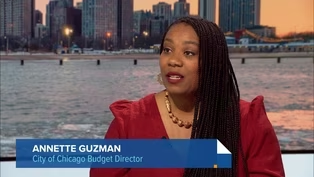
Chicago's Budget Director on Where Negotiations Stand
Video has Closed Captions
Clip: 12/1/2025 | 11m | Annette Guzman, Chicago's budget director, on the latest proposal for next year's city budget. (11m)
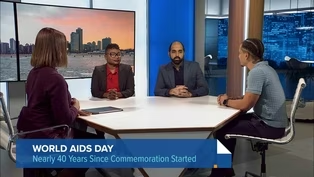
How Chicago Advocates Are Marking World AIDS Day
Video has Closed Captions
Clip: 12/1/2025 | 10m 12s | Chicago advocates are commemorating World AIDS Day. (10m 12s)
Providing Support for PBS.org
Learn Moreabout PBS online sponsorship
- News and Public Affairs

Top journalists deliver compelling original analysis of the hour's headlines.

- News and Public Affairs

FRONTLINE is investigative journalism that questions, explains and changes our world.










Support for PBS provided by:
Chicago Tonight is a local public television program presented by WTTW
WTTW video streaming support provided by members and sponsors.