
Dec. 16, 2025 - Full Show
12/16/2025 | 26m 48sVideo has Closed Captions
Watch the Dec. 16, 2025, full episode of "Chicago Tonight."
We investigate major lapses in patient safety at Roseland Hospital. And are legal challenges ahead for a new law protecting immigrants?
Problems playing video? | Closed Captioning Feedback
Problems playing video? | Closed Captioning Feedback
Chicago Tonight is a local public television program presented by WTTW
WTTW video streaming support provided by members and sponsors.
Dec. 16, 2025 - Full Show
12/16/2025 | 26m 48sVideo has Closed Captions
We investigate major lapses in patient safety at Roseland Hospital. And are legal challenges ahead for a new law protecting immigrants?
Problems playing video? | Closed Captioning Feedback
How to Watch Chicago Tonight
Chicago Tonight is available to stream on pbs.org and the free PBS App, available on iPhone, Apple TV, Android TV, Android smartphones, Amazon Fire TV, Amazon Fire Tablet, Roku, Samsung Smart TV, and Vizio.

WTTW News Explains
In this Emmy Award-winning series, WTTW News tackles your questions — big and small — about life in the Chicago area. Our video animations guide you through local government, city history, public utilities and everything in between.Providing Support for PBS.org
Learn Moreabout PBS online sponsorship>> Hello and thanks for joining us on Chicago tonight.
I'm Brandis Friedman.
Here's what we're looking at.
>> Awt Tw news investigation into major patient safety citations at Roseland Hospital including multiple best.
Your divisiveness and your real challenge.
Are not welcome.
>> A legal challenges might lie ahead for a new law, limiting federal immigration enforcement in Illinois.
It's a system when that grocery stores and tech companies built together, it learns from every purchase.
And why some customers buying the same items at the same grocery store.
>> paying different prices.
>> First off tonight, as Customs and Border Patrol agents returned to Chicago along with their chief Greg Bovino to re upped their immigration operations.
Governor JB Pritzker says he believes the state is better prepared.
Now, then when operation Midway Blitz began a couple of months ago.
>> We also have a population that is knows how to react when their community is being invaded.
And we've seen people step up again, I'm so proud of the people of Illinois for doing as they have, which is to protect their neighborhoods, but for its were also says the state has some new laws to better protect residents that didn't exist when immigration raids began in September.
>> So far, the governor says the federal agency has given his office.
No notice that agents would be returning immigration rights advocates and rapid response teams report ICE presence in the Little Village neighborhood this morning and others say several people were picked up today in Cicero Brighton Park and back of the yards.
For more on this story, please visit our website.
A stinging defeat for Mayor Brandon Johnson as a rival city budget proposal.
Advances the members of City Council's finance committee passed the proposal.
22 to 13 today aiming to bridge those billion dollar budget gap without hiking taxes on large companies.
The plan calls for 473 million dollars in new taxes and relies on 35 million in revenue from advertising on city, light poles and other public places.
It also calls for the city to collect an additional 89 million from residents the city ambulance payments, utility bills, red-light camera tickets and other debt.
The mayor is rejecting the proposal to increase the city's debt collection efforts.
There are just 14 days left before the deadline to avoid an unprecedented shutdown of city government.
Neighbors living near the future.
Illinois quantum Microelectronics They deserve a vote on whether the facility is built.
We do not want to be displaced by rising rents property taxes speculative investors.
>> Bind up our homes.
We do not want to show the higher energy bills for facility that will consume enough power to serve over 200,000 homes.
>> The group Southside Together says it's gathered over 300 petition signatures to place a referendum on the March 2026.
Ballot in certain precincts so that residents can vote on whether elected officials should halt construction.
Residents say the park's approval process hasn't included the community and they have concerns over rising energy prices, affordability and environmental remediation.
Illinois residents buying health insurance through the state's marketplace are getting more time to sign up.
Officials with get covered.
Illinois.
>> Extending the open enrollment deadline to December 31st.
The coverage will begin January 1st.
Residents also have until January 15th to sign up for coverage that would take effect February.
1st, consumers will likely see a spike in the cost of their plans as Congress has so far failed to extend federal subsidies that are set to expire at the end of the year.
Check out our website for information on free enrollment support.
A troubling pattern at a far South Side hospital.
That's right after this.
>> Chicago tonight is made possible in part why the Alexandra and John Nichols family.
The Pope Brothers Foundation.
And the support of these donors.
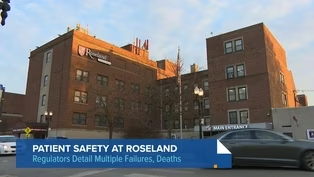
>> A troubling pattern of lapses in patient care at a local safety net hospital, including multiple resulting in deaths.
That's the finding of a new W t Tw News investigation into Roseland Community Hospital on the far South Side.
In one instance, a patient who regulators say the hospital failed to properly monitor and keep from leaving is now charged with murder.
Please be aware.
This story also includes discussion of suicide or Nick Bloomberg joins us now with more.
tell us the details of that case will bring us.
We spent several weeks going through hospital regulatory reports.
Police reports court filings and more to learn about the case of a south suburban man named Paul Patton.
>> Now, according to records we obtained, he called 9-1-1 in October during a heated argument with his wife to Lola Patton said he'd been drinking heavily and was worried he might harm himself or his wife.
He was taken by ambulance to Roseland Community Hospital, regulatory reports show a patient clearly matching Patton's description was taken to the emergency department.
Now since Patton said he was suicidal, there are a number of steps that regulators and experts say should be taken to ensure his safety.
That includes taking him to a private area, putting one-on-one monitoring in place as well as the suicide assessment.
The report we obtained shows none of those things happened.
Now after about an hour and a half documents show Patton left the hospital returned home and got into another argument with his wife.
Prosecutors say he then fatally stabbed his wife while she was on the phone with 9-1-1, Patton now faces 2 counts of first-degree murder.
His attorney did not respond to a request for comment and we were unable to get in contact with anyone from the Patton family.
Nick, what kind of consequences could the hospital face for failing to monitor a suicide patients?
What Rosen has already been hit with what's called an immediate jeopardy finding that is the most serious possible citation under federal guidelines.
It means a healthcare facility failed in a way that that did or was likely to cause serious harm.
And that needs immediate correction.
Now W T Tw News and ProPublica previously reported on those kinds of citations and other neglect allegations at Roseland in the 3 years since that story records we obtained from the state public Health Department show Roseland has received at least 4 more immediate jeopardy citations, including in Patton's case.
Now, in another instance, regulators say the hospital failed to properly stabilize a pregnant patient before transferring her to another hospital.
She subsequently lost that baby.
Another case revolves around someone being treated for a possible drug overdose who was discharged after becoming hostile and left unattended in a waiting area for several hours.
Despite some staffers warning they appeared unwell.
Now the 4th case involves a person with mental illness who was discharged to the wrong location and whose legal guardian wasn't properly notified of their treatment.
And then what do community members hope to that?
There's a petition with more than 1500 signatures.
It was launched by a neighborhood activists calling for a new hospital CEO and leadership.
They also want the state to step in and provide some oversight here as well as for the community to have a say in any potential leadership changes through an advisory board or something similar like that.
And we should note Brandis that Rosen did not respond to multiple requests for comment.
Some concerning issues there.
Nick Lambert, thank you.
Thank you.
And you can read next full story on our website.
It's all at W T Tw Dot com Slash news.
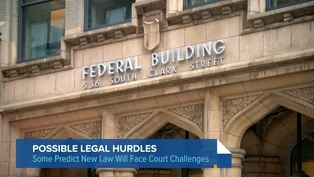
>> A new Illinois law is barring federal immigration officials for making civil arrests in or around court houses, hospitals, college campuses in daycares.
It also provides legal steps for people who believe their constitutional rights were violated during an immigration arrest to sue federal agents.
Well, it's already in effect.
Some are certain that the law itself will be headed to court.
Joining us now via zoom for more on the legal questions around this measure, is Chicago Kids, College of Law professor Harold Krantz.
Harold, Welcome back.
Thank you for joining us.
My pleasure.
So what is the likelihood that federal agents will actually he this Illinois law?
They actually won't arrest people outside or around or in court houses.
>> Well, they can arrest individuals around courthouse, but they have to be a traditional work But obviously what the legislature trying to do is head office collision a classroom scenes ICE agents are Border Patrol agents coming into the court disrupting court nations and grabbing individuals who were there to testify.
This obviously undermining the sanctity of Illinois's justice system and under our system settles in this country, Illinois has a right to make sure that locus of power, the court system, state government is free to function and therefore, Illinois isn't excellent argument that the Illinois was indeed constitutional because the federal government can not just roll for functions of state government such as judicial system.
>> Ok, so let's say more about that as you said, federal government officials under the Trump administration, they argue that this law violates the supremacy Clause of the Constitution.
Even Illinois Democrats acknowledge that this law is probably going to be challenged in court.
Will this hold up when that happens?
>> I think this part of the long.
Well, I think other parts may not think is balance here between the supremacy Clause which says it's lot.
is superior to state But the same time the 10th Amendment of our Constitution cruisers to the state's ability to have the essential functions of government ones operate and to sure while FOX.
So Mister is judicial warrant.
Ice officials cannot go around and grab people away from the courthouse.
>> Republican state Senator John Curran went as far as to say that this is going to get set aside by the U.S.
Supreme Court.
Do you think it'll get that high?
>> Was there some other states to have some So there are a couple of cases that are now percolating.
So I'm not surprised that this will judicial challenge the surprising that didn't see judicial challenge.
And I think the federal courts will have difficult job accommodate supremacy clause with the right of the states to to govern themselves.
In this particular instance, I think there's such a tradition of preserving the integrity viability of the state judicial system that it goes too far forward.
Federal agents without a warrant to come and grab somebody disrupting the federal the state judicial system itself.
So I think it will be challenging for the record.
I think ultimately what he's a very good chance of prevailing as to the other states with similar laws.
So the other states with similar laws, California and New York, they also have laws that restrict civil immigration arrests at courthouses.
>> What we know about what happened when when those laws were challenged.
>> There's been one additional decisions so far in the order, all but settled district courts that court held the state was with within its rights to preserve integrity of judicial system.
Of course, that's going to be appealed to the court of appeals.
So it's early stage of the litigation.
sure that this will follow suit.
>> Now, this law, because you also you mentioned, you know, there are other parts that may or may not hold up in court.
also opens the door to litigation against federal officers are federal officials who, quote, knowingly violated constitutional rights during civil immigration enforcement operations.
One critique is that this could have unintended consequences for local law enforcement.
What could that look like?
>> Well, much of the consequences for local law enforcement per se.
But I do think the consequences several lawns and and our pretty great.
And I think that this part of this part of law will be more difficult to Basically, Congress has created system for individuals to sue, multiply that the Constitution watched by state officials, but they haven't done so But on the other Congress has given way of the subcommittee of the Senate government.
you, federal officials make the kind of comprehensive study of weird to a while.
So those were not to allow federal And so I think they're going argue that means the federal government argues that Congress already considered issue and he's not permitted in this particular instance so that the state effort to give a remedy to individuals who have been injured previously by actions of these federal will be preempted by federal That's my prediction.
I think it may be another close but as a results will, there may be no kind of damages liability for people who are injured by unconstitutional conduct by these federal officers.
We've seen that with detentions seen that with people getting knocked over in the streets by Border Patrol is used stations.
And again, it seems unclear that they're going to have a that that federal government he this state cause of action to go forward.
I think the recourse will be to file actions before federal court against the federal officials.
But that remains to be seen.
And that's going to be teed off for the occasion as well.
Okay.
So additionally, this law requires public colleges and universities, hospitals, childcare facilities to set up policies.
>> For dealing with immigration enforcement and it mostly prohibits some of them from disclosing the immigration status students, patients, parents and children.
What policies restricting federal immigration enforcement are already in place for these areas.
These places >> it's tough to lines.
Me of the sanctuary litigation that Chicago was well done a number of years ago.
first Trump administration because the wind to be forward there is that local law cannot be to do cannot be forced to cooperate with federal immigration but they can't impeach So these policies and structures as long as they don't say, you can't ignore request from the federal government.
I awful.
And they're saying basically you can't knowingly disclose this information came to public register of this information.
if there is a judicial subpoena for the information's, then the hospitals in the educational systems would have apply.
So within that light, I think that this is similar to the sanctuary city litigation, Chicago And so the line to be drawn again is that the hospitals and the educational institutions don't have to go out of the way to help federal immigration authorities.
But they can't block a legitimate judicial subpoena.
At the same time.
>> Okay.
That's that's what we'll have to leave.
But obviously we will keep an eye on this one and C how it plays out in court if and when that day comes, we'll have you back then.
Harold Cribb, thanks again for joining us.
>> All right.
Take care grams.
Same to you.
>> Up next, how instacart's AI pricing could be inflating your grocery bill.
Grocery shoppers may want to check their receipts the next time they order from Instacart.
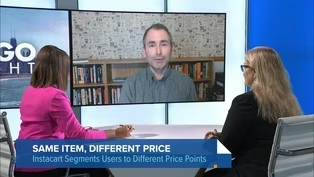
The new study shows the same items bought from the same grocery store using the Instacart app could have several different prices.
The research from Consumer reports, Groundwork, Collective and more perfect Union found that the company made pricing decisions based on third-party information about users, shopping behavior.
On average, a family of 4 that used Instacart for groceries could see yearly expenses increased by nearly $1200 due to so-called surveillance based pricing.
Joining us now to explain our Clare Johnson, assistant professor of law at the University of Illinois, Chicago and Zoom, Eric Gardner, business reporter for More Perfect Union.
That's a nonprofit education advocacy and journalism organization focused on the working class.
Thanks to both for joining us.
So, Erick, you worked with, as we mentioned, Consumer reports and groundwork collective on this study for 6 months.
What did you find out about how companies are charging consumers for groceries?
>> Yeah, that's a great questions.
So what this really story set out to do was try to figure out is insecure, charging people, different prices different items.
And to kind of answer that question, we did, you know, big test of about 400 individuals, 427.
We all got on my same time identified the same 20 items into the same store.
Same location and loaded them up in the basket.
And at the end of because took screenshots of everything and tracked how much everything costs people are charged and with pretty widespread as you described there, especially with the system is puts people into what we're calling pricing groups.
So that means when you look and Instacart for reason you're assigned to different price group and to give people a sense of what that gap is.
Some tests of 7 different price groups, distinct ones where everyone was charged the same amount for the same product and on the low and some folks paid $114 for the 20 items and on the high but $124.
My.
And we reached out to inspect comment and they claim that is all random testing that retailers are doing around, trying to find optimal price points for items.
But as we started this investigation, we realize that they haven't an extensive patent portfolio basically breaks customers down into different buying behaviors, purchasing patterns, kind of more or less.
This whole profile about who you are and then assigns of the different social groups.
>> So, yeah, what you're referring to is the sophisticated customer segmentation technology.
What does that mean for shoppers to be grouped this way?
>> Yeah, I think what it means is that, you know, I think there's this idea with an America that when you go shopping, especially something like groceries, that you're paying a price that the retailer kind identified to kind of get people in the door in.
Unfortunately, as time to be involved in technology is involved.
It's could be further from the truth.
You really kind of encased in COVID mass testing all times to understand what is the maximum amount of profit in a company or perfect price point to extract the maximum loan amount of profit online.
It's done and individual level as you start researching investigating the phone actually in stores as well store level meeting for a team that has 100 teen for 100 stores.
They may be running the different price tests across each individual start a kind of determine the optimal price point.
>> I'm Claire, as Eric says, no.
The report found that Instacart is using third-party information to do this sort of pricing.
This customer segmentation into different groups.
Different price points.
For example, a dozen Lucerne eggs sold for 5 different prices ranging from 3.99 to 4.79 on Instacart all of the same Safeway store in Washington, D.C., that happens revealed that algorithms were being based on would be based on customer shopping behavior to addressed those prices rather than demographic information like race or gender.
How are these different house?
One legal and the other one is not >> well, so they always say that if you don't know what the product is, you are the product.
So we know the is being collected and sold.
Sort of threw out the ways that we use the Internet and that we interact with with various companies.
So we know that the 3rd party companies are selling some of the from a consumer protection standpoint.
We have laws both at the federal and state level to protect consumers from this kind of misrepresentation and this kind of deceptive advertising.
One of the biggest concerns that I saw in the report is that there are sort of false discounts, that it was stating that the original price of something was 5.39, but Instacart was offering it for 3.99 And that's illegal under the Illinois Deceptive Trade Practices Act.
And it also violates the Federal FTC Act which protects consumers against unfairness in the marketplace.
So from a consumer protection standpoint, this Instacart.
And if they're colluding with these retailers, they're engaging deceptive practices that allow them to get a leg up over other vendors who might be being fair in the marketplace and being transparent about their pricing.
So even though it is not that sort of demographic based algorithm which is illegal, right, you can't change prices for someone based on, you know, their gender or or or, you race any of that stuff.
>> Even though it's not that if there's a chance, it sounds like that this is still illegal and violation.
It could certainly violate consumer protection statutes.
However, we also know that there's bias built into algorithms, right?
So even if something is not at an individual level identifying someone by race or gender or age.
Deb, geographic areas can be proxies.
Also, if we know sort of the general credit score of a neighborhood that could be a proxy for race as well.
Some of these data points that are happening at the aggregate level that more perfect union noticed.
And that may still be engaging in discriminatory practices out through the algorithm.
>> Eric customers.
You know, we already pay surveillance or algorithm based pricing for airplane tickets, hotels, large events like concerts.
But researchers surveyed more than 2200 people and found that 72% of people who have used Instacart in the previous year did not want the company to charge different users, different prices for any reason.
What makes it different?
You know, why might people respond differently over groceries versus airline tickets or hotel prices?
>> Yeah, I think there's something visceral around groceries, right?
Like when it comes to airlines or movie tickets for concert tickets, like there's always the option for the argument people make.
We don't need to do that.
You take a train.
You can take a pass.
But when it comes to food bank, there's no other option you have to eat.
And so I think when people find out people are being charged, different amounts for the same products at the same time kind of gets that kind of the core of unfairness kind of practice should be adopted.
>> Claire can state and federal governments could they regulate surveillance pricing?
Is there something they need to be doing in response to this new information?
Monday, Pecan in New York just past an anti anti surveillance pricing and algorithmic Lee place price law.
However, that's a disclosure based law.
And so it doesn't really have any teeth.
You can't sue under it if you're harmed.
It requires the disclosure by retailers.
If they're if they're setting an organized price, however, the or marketplace and fair trade is premised on this idea that consumers should have enough information that they can vote with their feet.
And as pointed out, that's really difficult when it comes to groceries.
And so if the prices themselves or deceptive and misleading then I think we can look at things like the unfair and deceptive acts and practices laws that exist at the state level.
And again, the FTC act at the federal level that prohibits unfair and deceptive marketing or if that's where we'll have to leave it.
This is fascinating.
I'm dying to know what what retailers know about me, but we'll have to leave it there for now.
Eric Garner in Clear Johnson.
Rabbi, thank both for joining Thanks for having me.
>> Thanks for having And that is our show for this Tuesday night before we go, a word about our colleague, Fletcher Garrett Fletcher died yesterday after being hospitalized.
Most of this month.
Fletcher was a maintenance engineer here at W T Tw.
That means he helped keep all of our equipment up and running so that we can bring you Chicago tonight and everything else we do here at W T Tw beyond his outstanding work and work ethic.
Fletcher was a genuinely warm and caring person, a friend to everyone.
He met.
Our thoughts are with his mother, sister, extended family and many friends.
And of course, we will miss you.
Fletcher.
And join us tomorrow night at 5, 30 10.
We'll have the latest on where contentious city budget negotiations stand as a possible Chicago government shutdown creeps closer.
Now for all of us here at Chicago Brandis Friedman, thank you for watching.
Stay healthy and safe and have a good night.
>> Closed caption News made possible by Robert a cliff and Clifford law Chicago, personal injury and wrongful death.
How a Murder Raises Questions About Roseland Hospital
Video has Closed Captions
Clip: 12/16/2025 | 3m 26s | A WTTW News investigation revealed a troubling pattern of lapses in patient care. (3m 26s)
Instacart’s AI Technology is Hiking Prices as Much as 20%: Report
Video has Closed Captions
Clip: 12/16/2025 | 8m 12s | The report said customers are “unknowingly part of widespread AI-enabled experiments.” (8m 12s)
New Law Limits Federal Immigration Enforcement in Illinois
Video has Closed Captions
Clip: 12/16/2025 | 7m 49s | Critics complain the law will be overturned by the courts. (7m 49s)
Providing Support for PBS.org
Learn Moreabout PBS online sponsorship
- News and Public Affairs

Top journalists deliver compelling original analysis of the hour's headlines.

- News and Public Affairs

FRONTLINE is investigative journalism that questions, explains and changes our world.










Support for PBS provided by:
Chicago Tonight is a local public television program presented by WTTW
WTTW video streaming support provided by members and sponsors.