
Detroit Future City Report
Clip: Season 49 Episode 23 | 9m 58sVideo has Closed Captions
Detroit Future City Report | Episode 4923/Segment 1
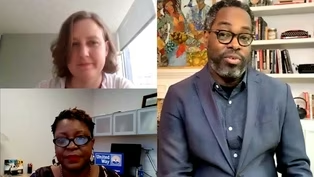
Detroit Future City is out with its annual report on the state of economic equity in Detroit. The bottom line: the economic opportunity gap remains for Detroiters and people of color. In fact, the gap is even wider in certain areas. The report cites inequities in income for Detroiters, due to disparities in education and employment. Stephen spoke with Detroit Future City CEO Anika Goss.
Problems playing video? | Closed Captioning Feedback
Problems playing video? | Closed Captioning Feedback
American Black Journal is a local public television program presented by Detroit PBS
Detroit Future City Report
Clip: Season 49 Episode 23 | 9m 58sVideo has Closed Captions
Detroit Future City is out with its annual report on the state of economic equity in Detroit. The bottom line: the economic opportunity gap remains for Detroiters and people of color. In fact, the gap is even wider in certain areas. The report cites inequities in income for Detroiters, due to disparities in education and employment. Stephen spoke with Detroit Future City CEO Anika Goss.
Problems playing video? | Closed Captioning Feedback
Where to Watch American Black Journal
American Black Journal is available to stream on pbs.org and the PBS app.
Providing Support for PBS.org
Learn Moreabout PBS online sponsorshipThe new report suggests that we still have these tremendous gaps in opportunity, in outcomes for people of color here in Detroit.
Tell us what the picture looks like in 2021.
One thing to think about is that the state of the equity report, the way we've organized it this time it is a picture pre-COVID.
And so people need to keep that in mind.
So the data is what did Detroit look like in the context of the region prior to COVID?
And I think that that's really important because we are under the impression or the narrative right now is that everything was great and then COVID hit and wiped everything out.
And I think what we'll find, the numbers that are gonna come out for '20 and '21 then later this year in '21 and in '22 are gonna be really bad.
They're going to show further job losses, further losses in small business, but we now know that we're starting with much larger gaps.
We also really, really wanted to focus this report on opportunity.
And the reason that we focus so closely on opportunity for middle-class is because at Detroit Future City we really believe that this can't be a poverty narrative.
This can't be a narrative that just says, "Are we ticking up slowly against the poverty barometer without any opportunity for people to go someplace else once they reach a certain income level?"
And I really feel like now that we're seeing some of these income gaps between Detroit and the region, some of it echoes what we've said in previous reports, Some of it is new information, I think now we can really say, people will end up staying poor forever, unless we begin to really create some of these opportunities.
Give us some of the highlights, I guess, of this report that might stand out from previous reports.
I mean, I get that the trend line is consistent, but what's new on this one?
Yeah, so for this report, we actually start the report with an analysis of the region, and the region is growing and was doing really, really well pre-COVID.
And that's really important and that's a sign of opportunity for us, right?
Because if you can build, if you have a strong region to anchor from, you can only grow from there.
I think one of the primary things that we really looked at from previous reports to this report that where we saw significant change and that was new for us was entrepreneurship.
We've reported before that we were concerned that entrepreneurs are not growing in Detroit.
And so we really doubled down on this, this time including looking at the average loan size.
So this to capital and the inequity between Detroit small businesses with staff and suburban small businesses with staff, the loan value is about $1,000 more per average loan.
And that is a significant problem.
It's new data.
It's something that we just found and we hadn't reported on before.
The other thing that we should look at in terms of jobs and job opportunity, we really spent a lot of time looking at transportation and commute time.
And so we even came up with a customized indicator that would track commute time for your personal automobile as well as public transportation.
And we really wanted to include that because cost burden which is something that we've reported on before, is really high.
And commute times should be included in your overall costs for whether or not you can actually afford to live where you live and work, where you work.
The final thing that I really wanna say is that there is some good news from this.
So it's not a complete bad news report.
There are two areas that have shown significant growth, particularly when the public sector, the city, the state, the county, and the private sector, private business private industry are working together.
So CTE Certifications, a Career in Technical Education, those numbers have almost doubled just in a very short period of time, just in a year.
The other thing that we should be paying attention to is infant mortality.
Just in one single year it's gone from 16% to 11%.
Now it's still too high.
11% is twice the national average.
But if in a year they could change those numbers, imagine what they could do for any of the other indicators.
What do we need to be doing?
As you pointed out, the numbers are gonna get worse because of COVID.
You know the devastation that all of us have experienced here in Detroit is gonna show up in every assessment of 2020 and 2021.
So, we'll be further behind.
Yeah.
What are the things we should be doing in anticipation of those numbers which reflect the reality that people are living right now.
So one of the things that we really wanna focus on, and there is a set of recommendations.
This report just doesn't throw a terrible data news at you and say, you know, go for it.
We actually come up with a set of recommendations of things that we really want people to focus on and where we believe at DFC, where we can make change and move forward.
And one of those is combining, which is a big issue in this report, the combination of education, employment, and wealth, right?
Income and wealth.
And those three actually go together significantly.
And then I would also then add health and housing to that.
But what we've learned from this is that there is such a gap, Stephen, in education.
So the average jobs in Detroit, the only jobs that have been growing in Detroit are low-wage jobs for jobs in Detroit.
The jobs in the region are middle wage jobs.
Now you could say, "Well a low-wage job is better than no job."
But if those are the only jobs that are growing, right then that's going to be problematic for everyone.
That seem to be trapping people in poverty, right?
Exactly, exactly.
Trapping people in poverty.
And furthermore, if our education attainment is so low and when I say majority Detroiters, and when I say majority, I mean like 78% of Detroiters do not have at least an associate's degree.
Then we need to have new jobs without needing a degree.
On the other side of that, we have got to really be pushing for higher education attainment, community college, CTE, four-year college because the average wage is double.
It's $17 an hour if you don't have a degree.
It's $32 if you do have a degree.
It's slightly lower if you're African-American and it's extremely lower if you're a woman, which is a whole other conversation because the majority of of households in Detroiters are single women.
And so if they're making $11 less than a white man in Detroit, then that's a whole other issue that we need to talk about around wage parity.
And then the final thing that I really feel like is going to be critical for us unless we change this trajectory is how we look at our neighborhoods.
We have to begin to see the value of middle-class neighborhoods, places where people can grow because if we are able to slow this tide, change this trajectory, create new middle-class jobs, middle-wage jobs for Detroiters, the first thing that they're going to do is move out of Detroit.
So middle class households, in particular black middle-class households are not seeing Detroit as a place to raise their family.
And that is hugely problematic for a city that's 78% black.
And the only neighborhoods that are growing right now are also white, upper middle-class households.
So we need to be able to focus on that trajectory as well.
Video has Closed Captions
Clip: S49 Ep23 | 10m 29s | Discover Your Spark | Episode 4923/Segment 2 (10m 29s)
Providing Support for PBS.org
Learn Moreabout PBS online sponsorship New Episode
- News and Public Affairs

Top journalists deliver compelling original analysis of the hour's headlines.

- News and Public Affairs

FRONTLINE is investigative journalism that questions, explains and changes our world.
 New Episode
 New Episode
 New Episode
 New Episode
 New Episode
 New Episode
 New Episode
 New Episode

 New Episode
 New Episode
Support for PBS provided by:
American Black Journal is a local public television program presented by Detroit PBS