
Favorite food stories: Coney dogs, “Food Roots,” Detroit style pizza
Season 10 Episode 49 | 26m 46sVideo has Closed Captions
The origins of coney dogs, Billy Dec’s Filipino “Food Roots” and the evolution of Detroit style pizz
We’re serving up some of our favorite stories about food. We’ll take you to some Michigan restaurants that offer different versions of the iconic Coney Island hot dog and talk with restaurateur Billy Dec about his documentary, “Food Roots,” which focuses on the culinary heritage of the Philippines. Plus, we’ll show you how Detroit style pizza has become popular around the world.
Problems playing video? | Closed Captioning Feedback
Problems playing video? | Closed Captioning Feedback
One Detroit is a local public television program presented by Detroit PBS
Favorite food stories: Coney dogs, “Food Roots,” Detroit style pizza
Season 10 Episode 49 | 26m 46sVideo has Closed Captions
We’re serving up some of our favorite stories about food. We’ll take you to some Michigan restaurants that offer different versions of the iconic Coney Island hot dog and talk with restaurateur Billy Dec about his documentary, “Food Roots,” which focuses on the culinary heritage of the Philippines. Plus, we’ll show you how Detroit style pizza has become popular around the world.
Problems playing video? | Closed Captioning Feedback
Where to Watch One Detroit
One Detroit is available to stream on pbs.org and the PBS app.
Providing Support for PBS.org
Learn Moreabout PBS online sponsorship- Coming up on "One Detroit," it's all about food.
We'll take you to some Michigan restaurants that offer different versions of the iconic Coney Island hotdog.
Plus, we'll talk with restaurateur Billy Dec about his documentary, "Food Roots," which focuses on the culinary heritage of the Philippines.
And we'll show you how Detroit style pizza has become popular around the world.
It's all coming up next on "One Detroit."
- [Narrator 1] Across our Masco family of companies, our goal is to deliver better living possibilities and make positive changes in the neighborhoods where we live, work, and do business.
Masco, a Michigan company since 1929.
Support also provided by the Cynthia and Edsel Ford Fund for Journalism at Detroit PBS.
- [Narrator 2] The DTE Foundation is a proud sponsor of Detroit PBS.
Through our giving, we are committed to meeting the needs of the communities we serve statewide, to help ensure a bright and thriving future for all.
Learn more at dtefoundation.com.
- [Narrator 1] Nissan Foundation and viewers like you.
(gentle music) (gentle music continues) - Hi, I'm Zosette Guir.
Just ahead on "One Detroit," we're serving up some of our favorite stories about food.
We'll hear from restaurateur Billy Dec about the food culture of the Philippines and his new Detroit restaurant.
And we'll visit some local restaurants that are putting their own unique touch on Detroit's signature pizza style.
But first up, when it comes to foods that are truly Detroit, the Coney Island hotdog has to be near the top of the list.
There's a lot of history behind Coney Island hotdogs, but did you know this iconic dish is served differently in cities around the state?
From Detroit, to Jackson, to Flint, Coney dogs have their own distinctive taste.
One Detroit's Bill Kubota reports on the Coney's popularity in Michigan.
(soft music) - [Bill] Coney, Coney, Coney, Coney, Coney.
Truly Detroit, right?
Let's serve up things Detroiters might not know about the Coney Island hotdog, updating a story from Detroit PBS almost 10 years ago.
- [Narrator 3] I know you know about those two Coneys right there at Michigan and Lafayette, the Lafayette and the American, iconic Motor City cuisine.
- Iconic and I don't use that word very often 'cause some people overuse it, but it really is.
- [Narrator 3] Grace Keros is the third generation owner of American Coney Island.
Grace's grandfather, Gust, actually started it all down on Michigan Avenue back in 1917.
- [Bill] Gust, Greek immigrant came through Ellis Island, stopped in Coney Island, New York, ate a hotdog there, sold them here, giving us the Detroit style Coney.
But in Michigan, Detroit style isn't the only one.
- I lived in Detroit for eight years, but Flint Coney is the best.
- See how delicious that is?
- I like 'em, but they don't like me.
(Magda laughs) - [Bill] The Flint style Coney, at Starlite Coney Island since 1966 in Burton, just east of Flint, and Gillie's on the northern edge of the city since 1985.
- [Interviewer] How's everything taste so far guys, okay?
- Awesome.
- Eaters here say Flint Coney sauce is meatier and Detroit sauce is soupy.
- The chili sauce is better down there.
- Yeah.
- This is a lot drier.
It's got a lot better flavor.
- People from the Detroit market really don't understand our Coneys.
I think obviously ours are a lot better.
Flint Coneys are Flint Coneys and people from this area know and understand Flint Coneys.
- Dave Liske wrote the book, "The Flint Coney: A Savory History."
- The Coney became as big as it was because of the auto workers.
So the two work hand in hand.
- Flint, the vehicle, city, General Motors factory town, assembly lines, making cars and Coneys.
- It's kind of an assembly line, it really is.
There was times, you know, back in the day we would serve three, 4,000 people a day, and it was one guy stay in the station, does his job, another guy in the station, and it would just get shoved down the line and it has to be timed perfectly too.
So you need hot food to go out hot.
- In this area, when I was young there was lots of Coney Islands.
- Flint Coneys, some running 24 hours right next to the car plants, like the factories, the Coneys have dwindled, although a few still going strong.
- Everybody knows what a Coney island is.
So it describes the type of business you are, but you don't pay a franchise fee.
- [Bill] David Gillie got his start working at Starlight.
He ran a Coney in nearby Clio in the 1970s before building a new place in Mount Morris.
- Everybody says, why don't you just use your name.
It's Gillie, but Gilley's in Texas was big back then.
And he goes, yeah, that's cool.
- [Cowboy] Welcome to Gilley's.
The world's largest nightclub.
- You a real cowboy?
- The eighties.
The era of the urban cowboy.
- Well, it depends on what you think a real cowboy is.
- [Bill] No mechanical bull at this Gillie's, no beer or barbecue, but plenty of Coneys.
- This guy come to me with, you know, I've been tearing down ponderosas and I have a whole bunch of country western multi decor you might like.
Oh yeah, that sounds cool.
- Gillie, he recently retired, but he likes to visit.
His restaurant lives on because he sold it to his employees.
The origins of the Flint Coney starts not in Greece, it's Macedonia, immigrants from the same part of Europe.
- The Balkan Wars of 1908 to 1913, decimated the area.
Greeks and Macedonians were leaving in droves, just going wherever they could.
- The original Coney Island started, it was my husband's uncle, George Brenov.
- [Bill] George Brenov and another Macedonians, including one named Simion Brayan came to the US and headed west.
Before he reached Flint, he had a hot dog in Rochester, New York.
- And then he had another one in the Buffalo area and didn't really like it, said it was tasteless, thought he could do better and based it on a Macedonian stew.
- [Bill] According to Dave Liske, the Flint style Coney appeared in the early 1920s and it seems Macedonians here knew little about the Greeks and their Coney Islands down in Detroit.
- [Interviewer] You got a lot of sauce on yours, huh?
- Absolutely.
- The way you like it, huh?
- Absolutely.
- Did you order extra sauce?
- Yes, we always do when we come here.
- The topping is brown beef heart that's spiced with cumin and paprika and chili powder, and some minced onion in there as well.
And then just topped with yellow mustard and chopped onions.
- [Bill] He said beef heart, ground beef heart.
- It's ground smaller than a hamburger, but it's still firm because it's that heart muscle and if you took hamburger and grounded it that small, it'd turn to mush.
And it sounds bad to say beef heart, but people don't realize beef heart is your only organ in your body that is a muscle, and it's a really lean, solid muscle meat.
- [Bill] That beef heart, common in Detroit style Coney sauce too.
Maybe you knew that.
Detroit style, Flint style, a preference, probably just what you're used to.
Then there's Lansing, a bipartisan approach to these contrasting Coney cultures.
- We offer both the Detroit version Coney and the Flint version.
- Dominic Migaldi runs Sparty's Coney Island.
- You know, being the halfway point, we get people coming from Flint, coming from Detroit, you know, it's really about 50/50 between the two, honestly.
- We got our world's famous Detroit Coney Island sauce and our famous Flint meaty sauce.
And even for the customers, they want 'em mixed together, we call it a Saginaw so.
- Saginaw?
Lest we forget Jackson, Michigan and the Jackson style Coney.
Down by the train station, there's Jackson Coney Island and Virginia Coney Island.
- Come here often?
- Oh yeah?
Like every day.
- Every day?
- Every day.
- [Bill] Jackson, birthplace of the Republican party and some might say the birthplace of the Michigan Coney, a few years before the Coney Island appeared in Detroit.
- 1914 is the year that we officially considered the Virginia Coney Island to come into existence.
- [Narrator 1] b Joe Matthews owns Virginia, Coney Island where the original owners came from Macedonia too.
A few stores over, the competition.
- [Brittany] I got three guys coming back.
- [Bill] Jackson Coney Island, where Brittany Craig is in charge.
- Thank you.
- [Bill] Long ago, both Virginia and Jackson were owned by the same family.
- I've heard all kinds of different stories.
I wasn't here in 1914, so I can't confirm any of 'em.
(Brittany laughs) - From what I understand, the documentation was destroyed at City hall when they had a fire, like, years ago.
- [Bill] Compare this to Detroit with this iconic Lafayette and American Coney Islands, originally owned by Greek brothers turned rivals.
- That's the similar story that we had here, yes.
The Macedonia brothers apparently could not see eye to eye on whatever the issue was.
So the one left and started the other one.
- [Bill] The Coney sauce here, a two step process.
- [Joe] We'll take some meat, drain some of the juices, put it in.
- [Bill] Getting the consistency right is key.
- [Joe] And we mix it up.
- [Bill] The Jackson Coney tastes a lot like Flint according to Coney advocate, Dave Liske, who leaves us with some sage advice.
- It's just, it's a state of mind.
I eat Coneys all over the country.
Have the Coney that you like, but also enjoy the other ones just like you would with pizza and hamburgers.
When in Flint have a Flint Coney, when in did Detroit have a Detroit Coney.
When in Jackson, same thing.
- A documentary on PBS titled "Food Roots" follows restaurateur Billy Dec as he travels to his mother's native Philippines to explore his family's traditional recipes and reconnect with his Filipino heritage.
One Detroit's Chris Jordan spoke with Dec about the documentary, the importance of food in Filipino culture and his new downtown Detroit Restaurant, Sunda New Asian.
(soft music) - Tell me about the documentary, about "Food Roots."
- Yeah, you know, it started just completely organic in a really unique way.
I always loved the food that my lola, is grandma in the Philippines, raised us on.
But you know, as we grew up, going back and forth to the Philippines or just growing up in a household with Filipino food cooked 24/7 and Tagalog spoken, I began to push away from it.
When I was in middle school, high school, there was a lot of bullying and other things, pressures to make you fit in.
And in my mind, I just knew that I always wanted to go back to the Philippines to learn those recipes that I wasn't ever there for.
You had to be present, they're not written down, they're story.
And so one day, two of my last three elders died on the same day and I dropped everything, 'cause I only, I knew there was one last remaining elder of that generation, and I just went to go search that out.
And I actually asked these shooters and editors, could they come with me so that, I wasn't writing things down, I wasn't consumed with documenting, I just wanted to be present and they could capture it.
And who, but a Detroit native, Doug Blush, who's a three-time Oscar winning executive producer and editor saw the footage and he was like, we can make something really wonderful about this.
Especially with this new director who was an Emmy winning Filipino director named Michele Josue that had done "Matt Shepard Is a Friend of Mine" and "Happy Jail", and some other really wonderful things.
They were like, listen, there's something going on that you're not talking about as we look at this footage, there's something you're skating around.
And it was just that they had saw some things I'd been wrestling with from, you know, family and emotion, and darkness, and you know, things lost, and they said, they started talking to me and my chef, and my sister and my, you know, my family, and captured all of this story that starts with food, but then it dives down to your roots, your culture, your heritage, your story, your lineage, your identity.
They're just master storytellers and they knew how to take what was really there and create something meaningful for all.
- Your newest restaurant is the Detroit location of Sunda, which has just recently opened.
Why did you end up picking Detroit as the new location for Sunda?
- Yeah, the foundation really, is that so many Michigan folks have been in Chicago for good portions of their lives, and then so many went back to Detroit or the suburbs of Detroit especially.
And they were constantly hitting me up to tell me I needed to come to Detroit.
And again, I just always wanted to go to cities where I felt it was on the up and up.
Like, we get offers for New York, LA, Miami, Vegas, but there are other offerings there and we watched the data points of what we thought was gonna pop, and Detroit was off the chart.
It was like, you know, all of the signs were there, the city was like us against everybody.
Everyone's supporting, everyone's so supportive.
I've lived there for, like, months, building and getting it ready and training and I've just fallen in love with the city.
People couldn't be kinder.
- How would you describe Filipino food and what makes it so unique as a cuisine?
- The most amazing, distinctive characteristic of Filipino food is that it's always evolving.
There's 7,641 islands in the Philippines and that has been, you know, influenced by so many different cultures and countries, whether you know it's Spain, or China, or Mexico, Japan, India, Malaysia, the US, Africa, you name it.
I think the Kamayan feast is like one of the best examples of a Filipino food experience because you're literally getting on a banana leaf lined table, sometimes we do 'em on these tables behind me, the 40 foot table of banana leaf and then all the procession, the chefs come out with all the, you know, dozen or so pieces that create this gigantic island feast.
But we also do it on a nice butcher block at your table customized with this big, of course, the foundation of the culture and the genre of food is the rice.
And then we put the crispy pata confit pork shank, my favorite, right, in the middle.
And then street food is really popular throughout Southeast Asia, especially in the Philippines.
And then so you'll have like skewers of garlic, shrimp and you know, chicken inasal and all of these, which is a great lemongrass, achiote type grilling chicken that is one of my personal favorites.
And then you have longganisa, which is the sausage that you saw in the documentary as well.
And lumpia, this Chinese inspired, lumpia Shanghai, which is this Chinese inspired Filipino egg roll with pork, shrimp, you know, vegetables.
All the things that my lola used to make for us as afterschool snacks.
It's just a feast.
And the Kamayan meal to this day is really special because you're usually having it with your friends and family.
Kamay means hand, we're eating with our hands.
And it means, from the stories that we're told, that when the day ended and the doors closed, we could go back to the ways in which our ancestors ate on the banana leaves with our hands.
And we will once again, it doesn't matter where in the world you are from, be connected through food.
- And you can stream "Food Roots" on pbs.org and the free PBS app.
Let's turn now to Detroit style Pizza, which first came on the scene in 1946.
Now the square pies are showing up in restaurants across the country and the world.
One Detroit's Bill Kubota shows how Detroit style pizza has evolved from a simple pepperoni and brick cheese recipe to now include a variety of toppings and flavors.
(soft music) - [Bill] Detroit Pizza, but this is New York, Manhattan, Chelsea.
Detroit style pizza, I guess so, but how can that be?
- It's funny to talk about how it wasn't even that long ago that it wasn't available and now it's, like, international.
There's places in South Korea and Barcelona.
- [Bill] All this from a tavern on Detroit's east side, Buddy's Rendezvous, 1946.
Almost 10 years ago, Detroit PBS told the story about our pizza cut into squares.
- Everybody, "Square pizza?"
- Square.
They make a square pizza and that was weird.
- Are these people crazy?
- No one even heard of square, it was unheard of.
- You fell in love with it, it was great.
- But there's purists that will come in and say, nope, cheese and pepperoni, original sauce, that's it.
- Detroit style pizza is gonna be something when every time you take a bite you're gonna taste every product that's on there.
- It became sort of the Detroit style as they're referring to it now, but it's actually Sicilian style, that originated in Detroit.
- [Bill] A decade later, the Detroit style pizza story, it's gone worldwide, thanks in part to this little warehouse in Roseville and a world champion pizza maker, Shawn Randazzo.
In 2012, he entered a pizza competition in Las Vegas - And he told me that if he made 30th place he would be happy, and know it's a good recipe, and we would go on to be Detroit Style Pizza Company, and that's when he won first place.
- [Bill] Then Randazzo and his mother Linda, started the Detroit Style Pizza restaurant.
Shawn died of brain cancer in 2020, but he'd already been selling pre-seasoned Detroit style pizza pans.
Pans that opened up the market for pizza makers everywhere.
- A little bit before he passed away he told me, Mom, I'm so excited.
He's like, Detroit style pizza's like this and within a year or so it's gonna be like that and he was right.
- [Bill] The company shipping department, pans going out nationwide, Europe, Asia, a constant flow.
- Korea, Kuwait, other countries, a lot of countries.
I can't even remember them all.
Ireland I wanna say.
- [Bill] Here at the Michigan and Trumbull Pizza kitchen in Detroit, Shawn Randazzo's pans hot at work.
- Yeah, sure, what would you like?
- [Bill] Owner Kristen Calverley, tell us how it all came to this.
- There was a party store in Berkeley, Michigan called Mr.
Jay's.
So that's my very first pizza memory and then we were like a Jet's family.
(Kristen laughs) It was just, like, my parents were going out on the weekend and we had a sitter and we got Jet's delivered.
- [Bill] Several years ago, Calverley and her partner started Michigan and Trumbull Pizza in Pittsburgh, introducing Detroit style to Western Pennsylvania.
- We kind of wanted to do an homage to Detroit and Detroit baseball.
So all of our pizzas are named after Detroit landmarks.
And then the overarching, Michigan and Trumbull is our biggest sort of nod to the city.
Conventional toppings are great, but we're trying to do more interesting flavor combinations and unique toppings.
- [Bill] The Werner vegan, the Bagley chorizo, the Farnsworth Fungi with goat cheese and arugula, that's Calverley's partner in Detroit area native, Nathan Peck at work.
- He's the driving force behind the menu, and he does all of the prep every single day and there's no one that's ever made pizza here other than him since 2017, which is kind of wild.
- [Bill] Pittsburgh, home till it wasn't because of an opportunity to come back that was four years ago.
- And it wasn't until we found the location near the intersection of Michigan and Trumbull that we seriously started considering moving.
- [Bill] Michigan and Trumbull at Michigan and Trumbull, the corner where Tiger Stadium used to be.
But it got expensive so Michigan and Trumbull now at Holden and Lincoln, near Henry Ford Hospital in the Motown Museum.
- Probably like 35 minutes.
- [Bill] Whereby all appearances, business is great.
In Hamtramck, another Detroit style pizza story, Detroit PBS's own Fred Nahhat, he likes pizza, checking out Amar, home of the ghost pepper pizza.
- A lot of choices.
- A lot of choices.
- What's say, the most popular?
- The most popular is gonna be your naga or the tandoori.
Those are our bestsellers, they have the best flavor, most Bangladeshi inspired.
- Our pizza slogan is Amar Pizza is your pizza.
And that translates into my pizza is your pizza.
- [Bill] Khurshed Ahmed and his son Akeel run Amar.
Khurshed came to Hamtramck from New Jersey, but it was a visit to Bangladesh where someone tried to cure his pizza cravings.
- He took me to the place that sells pizza and I'm like, this isn't pizza, but that's what they called it.
It was similar to it, but it kind of made me wonder, hey, you know, we could probably do something.
Take traditional American pizzeria and use Bangladeshi flavors to incorporate 'em today.
- [Bill] Here's the naga, chicken, red onion, cilantro and naga hot pepper sauce.
- Definitely not a tomato sauce.
It's awesome.
It has a sweet taste to it.
I think it's probably some of the onions, but the sauce comes through.
Definitely some spice there, definitely some spice there.
- The pizzas we have are the pizzas for the most part, we've always had.
- [Bill] Amar has conventional pies, even Chicago deep dish.
They sell a few, but the Bangladeshi Detroit style is the draw, thanks to the special pizza pans.
- [Akeel] And it has a lot of flavor in it too so.
- Yeah, the older it gets, the better it cooks.
- Yeah.
- But just the basic in that square pan, Detroit style, coming up from there, you could be creative whether it's a sauce, whether it's sauce free, depending on the type of cheese, real melty or more like a feta or whatever, I think it's an exciting thing.
- Another one that's not as popular, but is definitely is inspired by Bangladeshi flavors is the dry fish pizza.
- [Bill] In Bangladesh, fish, a dietary mainstay and dried fish, very popular.
- If they like fish, they'll try it out.
If you don't like fish, you're not gonna like the pizza.
- Hmm, that's good.
If this is an acquired taste, I've acquired it.
- I've had nothing but positive feedback.
Everyone that comes here, they always come back, and that's one of the best feelings, you know?
If they were just coming here one time and never coming back, then I wouldn't be in business for 14 plus years.
- The thing that stands out is innovation.
What are we famous for?
Little Caesar's, first pizza maker to give you two, Domino's, 30 minutes.
The Detroit Pan with Buddy's, and some of the bigger ones.
You know, Jet's I think was probably the first on the app.
Everybody doing something to be competitive so they can stick with it, that's a Detroit thing.
- [Bill] Now, time for the Detroit style with the even hotter ghost pepper on it.
- I'm waiting for the fire.
Yep, there it is.
It's delicious, I'd also say it's exhilarating, like, it gets you that hot pepper buzz.
All right, I'm going for two.
- And the toppings you can get creative with, but if you can create a sauce that has a taste that, you know, you want, you could use it on pizza.
- Are you guys gonna?
Thank you.
The ghost pepper.
That's good, I was more afraid than I needed to be.
- [Bill] Are there other Bangladeshi flavored pizza places in Bangladesh or the east coast where many Bangladeshis live?
- Probably is now, but we were the first ones in the country.
- [Bill] Amar has one other outlet in suburban Troy.
Around here, it's hard not to be inspired by the success of the Little Caesars, the Domino's, the Jet's.
So what about Amar?
- That's the ultimate goal to have it spread out through the country, but the step by step, you know, one step at a time, we'll get there.
This is the next generation of pizza and Detroit style pizza, I think.
- That'll do it for this week's show.
Thank you for watching.
Head to the "One Detroit" website for all the stories we're working on.
Follow us on social media and sign up for our newsletter.
(soft music) - [Narrator 1] This program is made possible in part by Timothy Bogert Comprehensive Planning Strategies.
Across our Masco family of companies, our goal is to deliver better living possibilities and make positive changes in the neighborhoods where we live, work, and do business.
Masco, a Michigan company since 1929.
Support also provided by the Cynthia and Edsel Ford Fund for Journalism at Detroit PBS.
- [Narrator 2] The DTE Foundation is a proud sponsor of Detroit PBS.
Through our giving, we are committed to meeting the needs of the communities we serve statewide to help ensure a bright and thriving future for all.
Learn more at dtefoundation.com.
- [Narrator 1] Nissan Foundation and viewers like you.
(soft music) (soft music continues) (bright music)
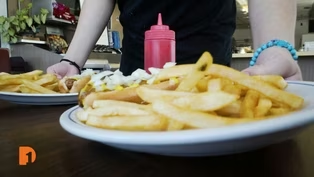
From Detroit to Jackson to Flint, Coney dogs have their own unique origin stories
Video has Closed Captions
Clip: S10 Ep49 | 8m 15s | A dive into the origins of Coney Island hot dogs. (8m 15s)
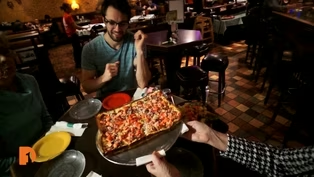
The next generation of Detroit style pizza
Video has Closed Captions
Clip: S10 Ep49 | 8m 45s | Next generation of Detroit style pizza brings new flavors to the city’s signature style. (8m 45s)
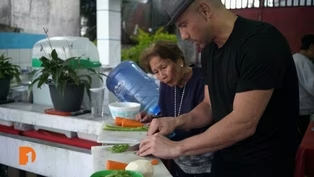
Restaurateur Billy Dec’s Filipino “Food Roots” and Detroit restaurant
Video has Closed Captions
Clip: S10 Ep49 | 5m 43s | A look at “Food Roots” followed by a conversation with restaurateur Billy Dec. (5m 43s)
Providing Support for PBS.org
Learn Moreabout PBS online sponsorship New Episode
- News and Public Affairs

Top journalists deliver compelling original analysis of the hour's headlines.
 New Episode
- News and Public Affairs

Today's top journalists discuss Washington's current political events and public affairs.
 New Episode
 New Episode
 New Episode
 New Episode
 New Episode
 New Episode
 New Episode
 New Episode
Support for PBS provided by:
One Detroit is a local public television program presented by Detroit PBS