
Granting pardons in Michigan, the state of homelessness among young people
Season 10 Episode 23 | 26m 46sVideo has Closed Captions
An in-depth look into pardons and sitting down with Covenant House Michigan.
One Detroit presents a special report on the formerly incarcerated who are pardoned in Michigan and how it impacts them professionally and personally. Plus, we’re checking in with Covenant House Michigan about the state of homelessness among young people and what the organization is doing to address the problem.
Problems playing video? | Closed Captioning Feedback
Problems playing video? | Closed Captioning Feedback
One Detroit is a local public television program presented by Detroit PBS
Granting pardons in Michigan, the state of homelessness among young people
Season 10 Episode 23 | 26m 46sVideo has Closed Captions
One Detroit presents a special report on the formerly incarcerated who are pardoned in Michigan and how it impacts them professionally and personally. Plus, we’re checking in with Covenant House Michigan about the state of homelessness among young people and what the organization is doing to address the problem.
Problems playing video? | Closed Captioning Feedback
How to Watch One Detroit
One Detroit is available to stream on pbs.org and the free PBS App, available on iPhone, Apple TV, Android TV, Android smartphones, Amazon Fire TV, Amazon Fire Tablet, Roku, Samsung Smart TV, and Vizio.
Providing Support for PBS.org
Learn Moreabout PBS online sponsorship- [Narrator] Coming up on "One Detroit," we'll have a special report on the formerly incarcerated who are pardoned and how it impacts them professionally and personally.
Plus, we'll check in with Covenant House Michigan about the state of homelessness among young people, and what the organization is doing to address the problem.
It's all coming up next on "One Detroit."
- [Announcer] Across our Masco family of companies, our goal is to deliver better living possibilities, and make positive changes in the neighborhoods where we live, work, and do business.
Masco, a Michigan company since 1929.
Support also provided by the Cynthia and Edsel Ford Fund for Journalism at Detroit PBS.
- [Announcer] The DTE Foundation is a proud sponsor of Detroit PBS.
Through our giving, we are committed to meeting the needs of the communities we serve statewide to help ensure a bright and thriving future for all.
Learn more at dtefoundation.com.
- [Announcer] Nissan Foundation, and viewers like you.
(upbeat music) - [Narrator] Today, we're taking an in-depth look into pardons for the formerly incarcerated.
Here in Michigan, the governor has the power to grant pardons, which removes a conviction from a person's record.
According to the National Restoration of Rights Project, Michigan ranks in the bottom fourth of all states granting pardons.
"One Detroit" Contributor Mario Bueno and Senior Producer Bill Kubota talked with criminal justice experts and the formerly incarcerated about how pardons can help relieve the stigma of having a criminal past.
(upbeat music) - I spent 25 years on the bench.
- [Mario] Professor Donald Sheldon's criminal justice class at the University of Michigan Dearborn.
He's talking about his previous position as a Washtenaw County Circuit Court judge.
- Making a decision that may result in locking a person up in a cage for years ought to be hard.
On the other hand, making a decision that might release a dangerous criminal back on the public to commit more violent acts ought to be hard.
- [Mario] I'm in class too, along with another one of Sheldon's former students, Professor Aaron Kinzel.
- Where a lot of my family were actively involved in criminal behavior, seeing violence in the home, watching violence in my community.
- [Mario] Kinzel's young life?
At 18, charged with attempted murder and other crimes.
Both of us have done prison time, both of us now holding graduate level degrees.
- Rehabilitation is, in my view, dependent a great deal on education.
I think education of people who are in the criminal justice system is the best way to bring them out of the criminal justice system.
You are my exhibit number one, and number two is Aaron Kinzel.
- I think that was what really drew him to me as a potential lecturer here was the fact that, you know, I have this unique perspective of corrections that the average individual, like we value that in like a lot of like law enforcement classes, for example.
- Or business.
- Or business, you have entrepreneurs- - If you've actually done it, then it speaks volumes.
- So who better to teach about, you know, corrections, juvenile delinquency than someone that actually has lived it?
I've also studied it at the graduate level as well, but like this is something I intimately know.
- [Mario] For Kinzel, support from Shelton helped in his pursuit of his doctorate.
- Academia tends to be a closed society.
It is populated primarily by people who don't look like you, who don't come from the background that you do, who don't really look like our society.
It's by people who have spent their entire life in academia.
You come in with that scarlet C for convict and you need a champion if you're going to find a place in this academic community that is not receptive to you.
- [Mario] Aaron Suganuma, he felt the pain of that scarlet letter C.
- So I will say that one of the schools, I ended up withdrawing my application for one of the graduate schools because there were so many layers to the records that they wanted from the different courts and jurisdictions and all that kind of stuff.
- All pertaining to your felonies?
- Correct.
- [Mario] Suganume will get his master's in social work from Eastern Michigan University.
Now he's working at the Washtenaw County Sheriff's Office, coordinating programs helping prisoners with their reentry.
- At the age of 22, at a time when I was having a lot of struggle in my life, I participated in an armed robbery and ended up going to prison for four and a half years.
- And how old are you today?
- I'm 42.
- You're 42.
So that was 20 years ago.
- That's correct.
A lot of my life ended up revolving around drugs and just trying to self-medicate, probably, you know, depression and anxiety.
- Despite his advanced degree, he still found his past holding him back.
He applied to the state of Michigan for a pardon, asking the governor to remove his criminal convictions from the books.
When was the application actually?
That's when I applied, January 3rd of '23.
- Really?
- I put together what ended up being a pretty significant packet.
My references, accomplishments, those kinds of things, explanations of my offenses, what's been done since I submitted that to the parole board, and that ends up getting reviewed by the parole board.
So I applied January of '23.
I didn't hear back from them until, oh, I don't know, I feel like it was like a year or something like that.
- [Mario] Governor Gretchen Whitmer granted his pardon last year.
Before the pardon, his felony record stopped him from traveling overseas, and it restricted him from some of the things he liked to do in his family life.
- With my record, I wouldn't be able to be a chaperone for my daughter's school trips, right?
Anytime that I wanted to get involved with anything, the school's gonna do a background check.
When I'm sitting at the bus stop talking to all the other dads and parents about the different things that they're getting involved in.
Oh, we're gonna go to the zoo, or we're gonna go to the library with the kids, you know, next week, and those kinds of things.
And inside, you know, I'm excited, but at the same time, I'm also seeing the things that I'm not able to do in terms of full participation in my kids' lives.
- We really have to question what we're doing when we send people to prison for a long time in the first place.
And then, you know, burden them with all of these limitations on how they can engage in civil society after that point.
- Michigan State University Law Professor Quinn Yeargain supports pardons like Suganuma's.
He sees it as a part of a toolkit that can help remove that scarlet C. A pardon?
Something only the governor's empowered to do.
The most recent Michigan pardon came in October 2025 for Lue Yang, a Lansing area Hmong refugee detained by immigration and customs enforcement.
He'd been convicted of attempted home invasion in 1997, when he was 19.
Since then, Yang has become a community leader, and is president of the Hmong Family Association of Lansing.
Records show earlier this year four other pardons were granted along with four commutations.
The difference between pardons and commutations, what is the difference?
- Well a pardon is usually something that totally wipes away conviction.
The legal force of the conviction.
It's not always a statement that somebody is innocent, but it's a statement that the conviction no longer stands.
A commutation is usually something that eliminates the rest of somebody's sentence or eliminates a condition of the sentence or something like that.
So somebody could be released from prison with a commutation, but the conviction could very well still be on their record.
- [Mario] While pardons made at the federal level by Presidents Biden and Trump have become controversial because of their political implications, it seems there's less talk about pardons at the state level these days.
The Restoration of Rights Project based in Washington DC has been looking at data from across the country rating states by the frequency of their pardons.
- In a typical year, it's probably fair to say that, you know, we have a couple thousand pardons, perhaps.
Some states are, you know, not contributing to that at all.
And some states are, you know, churning out several hundred a year depending on, you know, a whole bunch of different variables.
- And where does Michigan fall on that spectrum?
- Very low, there are some pardons in Michigan, but it really doesn't stack up compared to the number of people who are incarcerated in Michigan under, you know, state criminal charges.
It's a drop in the bucket.
- The Restoration of Rights Project puts Michigan at the bottom fourth of the scale when granting pardons.
The Michigan Department of Corrections reported that more than 200 pardon applications have been received in the past seven years Whitmer has been in office.
Of those, a total of 14 pardons, including Lue Yang, have been granted.
Meanwhile, thousands of Michiganders continue to carry the stigma of being a convict long after they're out.
The governor declined to speak to us, but I did talk with Pete Martel, a law school graduate now on leave from a public policy and sociology PhD from the University of Michigan Ford School.
Who makes the litmus test for those like yourself that are just trying to move on, move forward?
- Yeah, it's really a cultural kind of sociological question about who has power to prevent people from moving.
You're always going to get to some points, some intersections where somebody's directing traffic and says, "Not you."
Or "I need you to pull over so I can check you out a little bit more."
- You were 19, going on 20 when you committed your crime.
Who was Pete Martel in 1994?
- 1994, I was two years out of high school.
I graduated with a 1.05 GPA, so I felt like there was no way I could go to college.
So I was working as a welder.
We were putting in between 80 and, I don't know, 110 hours a week.
And that was pretty much my life at that time.
I was also involved in some small time crime stealing things, stealing like radar detectors and car stereo systems.
And then it got larger, like some small construction equipment.
We had some people that we could sell it to.
- [Mario] Martel's crimes escalated when he held up a convenience store.
- After the armed robbery, some police caught us, they caught up to us.
We started shooting at the police officers.
Nobody was injured.
We were eventually captured and taken in.
- Okay, and so you get sentenced.
- Yeah.
- What was the sentence?
- Five to 15 years.
- Five to 15.
In the first year you're in, you try to escape.
- Yeah, so wasn't there long, wasn't interested in sticking around long.
I felt like the winter was coming on.
I wanted to go snowboarding.
There were concerts I wanted to see.
- This is the mentality.
- Yes, it sounds like a joke as I say it now, but that is how I thought back then at 20, maybe I was 21.
- [Mario] When he got out of prison, he excelled as an undergraduate with a strong grade point average doing well on his law school admissions test.
When he applied to law school, there was a problem.
- And then they said, "No, it's not your numbers, your numbers are fine, it's your felony convictions."
- [Mario] He tried Wayne State, he got in and he did well there.
- And I didn't take the bar exam until February of '17.
Took the bar exam, passed the bar exam, and then I was waiting on character and fitness.
And from the time that I applied for character and fitness for admissions to the bar, about two years had passed.
I ended up withdrawing.
So they didn't say no.
- So wait a minute, so you withdrew?
- I withdrew.
I felt like I was on parole and I was waiting through this process.
And then I found out after my first informal interview, not only was there going to be a formal interview with the full committee, but also I was probably gonna have to go to the board of law examiners for another review.
- [Mario] Martel will become a visible criminal justice advocate supporting causes like second look legislation seeking to reduce prison sentences.
- We know that most of our long time imprisoned people, most of those people who are over 50, which is most of our people in prison should not be there.
- That's right.
- [Mario] Martel worked on legal issues concerning the incarcerated when in early 2023, Michigan Supreme Court Justice Kyra Harris-Bolden asked him to join her as a court clerk.
Pushback followed, at the time, her fellow Justice Richard H. Bernstein quoted in the Detroit News said he was disgusted by Martel's hiring and talked about it to WWJ radio news.
- [Richard] Once you decide that you're going to shoot at police, I think that no matter what you do in terms of like, you know, your redemption or those kinds of things, there's lots of other opportunities.
- So first of all, what does a second look like?
And I'm speaking of those who are paroled.
- An honest, sincere ability to earn a living out here, to have a family, to reintegrate into society, to work an honest day's job.
- How did it feel to hear at that time?
- Yeah.
- Someone of his stature to be disgusted that you were appointed?
- It was certainly upsetting, no question about that.
I was also, it happened so quick, I was still very much in the whirlwind pinching myself, this can't be true.
- That you were appointed?
- Here I am reporting to work, getting my security clearance to go to work at the Michigan Supreme Court.
- [Mario] The highest court in the state.
- [Pete] Yeah, yeah, there I was in the court thinking about like, wow, how many years ago was it that I was in solitary confinement sending letters to this place?
- So the adrenaline numbed the pain of it.
- Yeah.
- [Mario] Martel had the job two days when he walked away.
He didn't want to be a distraction, he says, - You know, when we're talking about somebody who has reformed themselves such that, you know, now graduated from law school and getting a prestigious position as a clerk to a state Supreme Court justice, it's hard to imagine in many ways a better success story.
If we believe in the system and we think that the system can work, how is that not the system working?
If somebody in that kind of situation still faces limitations and still faces pressure, social pressure to not have a certain type of job, then who among us is capable of the kind of reformation that we're idealizing and we're talking about.
- Do you regret resigning?
- No.
- No?
- No.
Not at all.
- Do you feel and think and believe that you earned that opportunity?
- I finished law school, I was well into a top ranked PhD program.
I felt like I could bring some tools to that.
- Do you think it's important for people like yourself to be represented in spaces like the Michigan Supreme Court?
- Yes, absolutely.
- So if given the opportunity again, would you take it?
- I wanna say yes, - You'd consider it.
- Well I also wanna say Justice Bernstein's made it pretty clear if ever I wanted to do that, he would hire me.
He feels bad about what happened.
- Yeah, I was wrong though.
- [Mario] Michigan Supreme Court Justice Richard Bernstein's change of heart, it came in time.
He got to know Pete Martel, and he'd done his homework.
- You know, I think what really occurred was spending a lot of time with returning citizens.
That's what changed it.
This happened like three years ago.
So a lot happens in three years, and when you spend a lot of time with people who are trained citizens, you realize, wow, you know, these are some really good people, and that ultimately no one should be defined by one thing they've done in their life.
- You have an abundant amount of experience with those charged and convicted.
So tell us your perspective and the sense that you had, the thought you had of actually even entertaining the idea of hiring a felon.
- Well my perspective was, and I think that this is the biggest challenge to overcome, but I think the key is is that if I can overcome it, I think every other employer can overcome it.
And I think when people hear violent crime, they react in a certain type of a way.
And I was one of those people that just, you know, had that kind of feeling that like, oh my God, this is a violent offender.
But what I wasn't focused on and what I wasn't thinking about was the fact that people change.
People truly change.
- For Aaron Suganuma, one of the seven who've received pardons in the past year and a half, he's thinking of others like him who would benefit too.
And I think you've been freed now.
How can we realistically apply that to many others that may be deserving as you are?
- Yeah, I mean, the reality is that I'm terribly grateful for what the governor has done for me and my family, right?
This is huge.
One of my hopes is that we will have the opportunity to continue, you know, expanding opportunities for more people getting expungements, more people possibly to get pardons and those kinds of things because it's a level of relief I don't think that people quite understand.
- The whole idea of pardons and expungements is that you reward people for doing good work.
You reward people for turning their life around.
- [Mario] Justice Bernstein wants to see more pardons and more expungements, another way to remove criminal histories in public records.
A few years ago, Michigan adopted the Clean Slate Act, allowing for more expungements overseen by the state courts.
There are expungement clinics to help the formerly incarcerated.
There's a formal process that wipes some records clean.
Those with certain lesser nonviolent misdemeanor and felony convictions seven to 10 years past automatically qualify.
Many thousands have received expungement so far.
But for those with more serious violent crimes, they won't be eligible unless the rules change, or more pardons can be issued by the governor.
- And you have to do pardons as much as possible.
I think that there's no downside to giving good people a second chance.
We believe in second chances.
You've gotta give people expungements and you gotta give people pardons because they're gonna run into the same problem that we had with me is that they're gonna run into someone that's just gonna see the violent act and isn't gonna see the person as a whole.
- [Mario] Justice Bernstein said some of the positions he's taken regarding returning citizens could be used against him when he's up for reelection.
He expects there to be claims he's soft on crime, but he said something needs to be done to make the process better.
- I think a lot of politicians are simply uninterested, uninterested in doing anything to actually get at the roots of crime and to engage in any sort of honest conversation about what is happening in our criminal justice system.
And if we were talking about solutions, more commutations, more pardons absolutely should be things that we should talk about much more seriously.
Automatic process whereby, you know, somebody who has been convicted of at least certain types of crimes and has, since being released from prison for a certain amount of time, has not engaged in crime again, that it's difficult to imagine why that person should still be burdened with having a felony on their record or something like that.
That's a tough conversation to have.
It's a conversation that I would like us to be able to have as a country without devolving into inflammatory rhetoric or anything like that and fearmongering, but fearmongering sells, and fearmongering buys votes at the same time.
And I'm not optimistic about our ability to have that conversation.
- When we talked to Pete Martel earlier this year, he was with the American Friend Service Committee fighting for change in Michigan's prison system.
He's now doing legal work on a lawsuit concerning videotaped strip searches at the Michigan Department of Correction's women's prison.
You don't have a burning desire to get that felony taken off of you through a pardon?
Have you considered it?
- I've thought about it a little bit.
I also feel like I've been through that process so much, I'm just tired of explaining again and again and again about what I did, how sorry I am for what I did.
And I guess there's a real part of me that feels like it's in the past, let it be in the past.
- [Narrator] And we have an update to this story.
Hmong refugee Leu Yang, who was pardoned by Governor Whitmer in October, was released from federal custody on Wednesday.
Yang had been detained by immigration and customs enforcement in July.
Michigan Congressman Tom Barrett was among those who advocated for his release and was there when Yang was reunited with his family.
- So glad you're back.
- [Narrator] Let's turn now to the efforts to end and prevent homelessness among young people.
Covenant House Michigan serves young adults ages 18 through 24 who are homeless or survivors of human trafficking.
The organization provides shelter, educational, and vocational programs, and wraparound services.
"One Detroit" contributor Stephen Henderson of "American Black Journal" sat down with Meagan Dunn, the CEO of Covenant House Michigan, and one of the agency's residents, Layla.
(upbeat music) - I think of nonprofits as often filling kind of critical gaps that exist either in government or other institutional kind of gaps.
But this is a particularly important gap to fill.
And Covenant House does it in such a vibrant and creative way that it just, it has always stood out to me.
- Thank you for that acknowledgement.
Nonprofits are on the ground, so we are, you know, serving our community's most vulnerable every single day, 365 days a year.
And at Covenant House, the way that we approach our work is through unconditional love, absolute respect, and relentless support.
So before a young person can even start their journey towards ending their experience with homelessness, we start with those three principles because that's what most of us need in order to have the confidence to thrive and succeed.
And once we can establish that trust, the trusting relationship, and when a young person feels safe enough, then we get them on their journey.
The outcome is stable housing.
The outcome is that they can go on to live independently, but the journey to get there starts, again, in those first few hours that they arrive at Covenant House.
We then can help them, you know, from a mental health standpoint, you know, over 75%, not just of Covenant House residents, but 75% of young people in general that are experiencing homelessness also experience some issues around mental health challenges.
- Sure, sure.
So Layla, you're one of the people who is part of the Covenant House family.
Tell us a little about how you came to be at Covenant House and what you found since you've been there.
- Not to get too deep into the story, but it was definitely something that I was looking for in an emergency.
I really needed help at the time and I didn't really know where to turn.
You know, it goes with the codependency of, you know, just being younger and everything.
And so when you don't have that, you know, you don't know where to go.
So it definitely helps being there.
It gives you a place of stability, and I really like that.
- How did you even hear about Covenant House- - A Google search really.
It was a very quick moment that it wasn't no plans or anything.
I'm grateful that they were able to take me in as fast as they did.
- Yeah, yeah, and so when you get there to Covenant House, talk about the kind of things that you found and the kind of support that you felt they were able to give you.
- One of the biggest support is really just it being a place for you to be able to build up your strength again.
Again, it's the stability that they offer to be able to just build up from the ground, especially when you often don't have anything when you're there, when you start.
Another thing is definitely their mental health.
I love my counselor there.
So there's someone that you can talk to too when you need to vent because it could be a lot.
- Yeah, yeah.
When you think about when you'll leave Covenant House, what do you think the most important thing you'll kind of take with you from that experience?
- Really I'd say that I could do so much more on your own.
You get to realize your own strength because, you know, essentially you are on your own.
They look for you to build yourself up.
And so you get this confidence of you can do it, you know, and it's not as hard and, you know, from nothing, you can have everything, so definitely.
- Meagan, this has gotta be- - Oh my gosh, I gotta pull it together.
- Really great for you to hear, but I mean, this is exactly the sort of path that you're trying to establish for sure for these young people.
- Absolutely, I mean, our goal is to help eliminate all barriers in order for a young person to feel and be successful, and in the end, that's what they deserve.
- [Narrator] That'll do it for this week's "One Detroit."
Thank you for watching.
Head to the "One Detroit" website for all the stories we're working on, follow us on social media, and sign up for our newsletter.
(upbeat music) - [Announcer] Across our Masco family of companies, our goal is to deliver better living possibilities, and make positive changes in the neighborhoods where we live, work, and do business.
Masco, a Michigan company since 1929.
Support also provided by the Cynthia and Edsel Ford Fund for Journalism at Detroit PBS.
- [Announcer] The DTE Foundation is a proud sponsor of Detroit PBS.
Through our giving, we are committed to meeting the needs of the communities we serve statewide to help ensure a bright and thriving future for all.
Learn more at dtefoundation.com.
- [Announcer] Nissan Foundation, and viewers like you.
(upbeat music) (bright music)

How Covenant House Michigan is addressing homelessness among young people
Video has Closed Captions
Clip: S10 Ep23 | 4m 26s | One Detroit contributor Stephen Henderson talks with Covenant House Michigan’s CEO about its service (4m 26s)
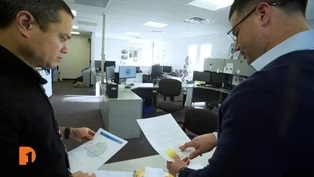
Michigan ranks in the bottom fourth of states granting pardons, but some want to see that change
Video has Closed Captions
Clip: S10 Ep23 | 18m 34s | One Detroit is taking an in-depth look into pardons for the formerly incarcerated. (18m 34s)
Providing Support for PBS.org
Learn Moreabout PBS online sponsorship
- News and Public Affairs

Top journalists deliver compelling original analysis of the hour's headlines.

- News and Public Affairs

FRONTLINE is investigative journalism that questions, explains and changes our world.












Support for PBS provided by:
One Detroit is a local public television program presented by Detroit PBS