
How Chicago Advocates Are Marking World AIDS Day
Clip: 12/1/2025 | 10m 12sVideo has Closed Captions
Chicago advocates are commemorating World AIDS Day.
Chicago doctors and advocates discuss the current state of AIDS treatment and prevention efforts on World AIDS Day.
Problems playing video? | Closed Captioning Feedback
Problems playing video? | Closed Captioning Feedback
Chicago Tonight is a local public television program presented by WTTW
WTTW video streaming support provided by members and sponsors.
How Chicago Advocates Are Marking World AIDS Day
Clip: 12/1/2025 | 10m 12sVideo has Closed Captions
Chicago doctors and advocates discuss the current state of AIDS treatment and prevention efforts on World AIDS Day.
Problems playing video? | Closed Captioning Feedback
How to Watch Chicago Tonight
Chicago Tonight is available to stream on pbs.org and the free PBS App, available on iPhone, Apple TV, Android TV, Android smartphones, Amazon Fire TV, Amazon Fire Tablet, Roku, Samsung Smart TV, and Vizio.

WTTW News Explains
In this Emmy Award-winning series, WTTW News tackles your questions — big and small — about life in the Chicago area. Our video animations guide you through local government, city history, public utilities and everything in between.Providing Support for PBS.org
Learn Moreabout PBS online sponsorshipFor the first time since 1988.
The U.S.
is not publicly recognizing World AIDS Day.
This follows significant cuts and structural changes to both domestic and global HIV and AIDS funding since President Trump assumed office which the United Nations warns is causing significant global risk.
Public health officials say in Chicago alone more than 22,000 people are living with HIV AIDS and more than 700,000 Americans have died from the disease since 1981 joining us with more are Dr.
Maya Green, founder of Nexus Medical Care platform specializing in HIV prevention and treatment under Onyx Health.
Collective.
She's also on the board of County Health and Hospital Systems.
Doctor Hofstra has as a professor of medicine and the Infectious Disease Fellowship program director at the University of Chicago.
>> Also practicing physician at Howard Brown Health.
And Hernandez.
I can talk to you guys, the executive director of on Chicago, an organization that advocates for the Latinx LGBTQ+ community.
Welcome back, everyone.
Thank you for joining us.
Thank Thank you.
advance for someone ask, you know, we've celebrated this day has been commemorated as World AIDS Day since 1988, what does this day mean to you?
we'll start with you first place.
I believe day is a remembrance.
The >> individuals whose lives we lost.
Many years ago.
And those who are still fighting for equity still fighting for health care.
So fighting for equal opportunity.
And so that what today means for men, Dr hasn't.
>> Yeah, I mean to echo that, I think it's understanding where we came from and the work that still left to do commemorating our past, but also looking forward to the future and trying to figure out how to develop a future that is free of, you issues that are obstacles of our patients where they should be axing care of those who the axing prevention back to green.
>> And it's about continuing to move the needle in the direction of our individual lives missions, but moving collectively.
Also at a time like this today is about resilience.
>> So let's talk about that.
What was your reaction when you learned that the Trump administration wouldn't be acknowledging World AIDS Day?
Well, as the politics of memory, right?
So I wasn't shocked.
I was disappointed like historically things like this, depending on who's in power federally these days will start to drop off.
It's the politics of memory, but it's too changed in near tip because if you stop commemorating it, you get to rewrite the narrative.
Historically poor resources back in cause disruption.
Doctor Hauser, what does it say to you that the administration has made this choice?
>> I think it is again, not surprising based on the actual actions of this administration.
I think.
It is completely is heartening and again, quite unprecedented.
But we are living in ongoing unprecedented times.
I think really shows the cards of restoration really not caring about the people living with HIV.
Are those what appear to be not just in the United States but globally as well?
The law.
>> And I echo the same feelings as Doctor Green.
It's.
Rewriting of the narrative.
It's rewriting of history and it's in or in the individual's our communities that disproportionately are affected by virus.
done intentionally.
Doesn't unfortunately surprise.
>> Dr Oz far.
That's the president's emergency plan for AIDS relief.
in the president isn't.
It stands for whoever's in the White House that the U.S.
is global HIV AIDS program.
It is reported to be winding down with plans to shutter over the next couple of years.
Help us understand how fighting HIV AIDS abroad impacts us here.
I mean, we live in a global society pathogens infections, HIV other emerging pathogens don't have passports.
They don't observe borders.
>> Ignoring outbreak or some sort of major pathogen that might be emerging in another part of the world just because it's not in our border yet is quite foolish and really short-sighted PEPFAR has saved million, 10's 100's of millions of lives globally with a act done by George W Bush and as cited as one of the most powerful and productive.
I'm sort collaboration a globally that we've seen to date and it's not just shuttered.
It was completely upright, stopped and was only after active isn't actually a chart include pregnant persons.
I understand the implications of HIV and pregnancy globally.
It's windy.
Finally, we started the program in its shell, but it tantamount to complete destruction quite literally, wiping out tire generation people with preventable deaths across the world.
>> Meanwhile, as Chicago's been dealing with, we know and aggressive immigration enforcement over the last few months under the Trump administration.
How would you say Operation Midway Blitz has impacted the Latino in the LGBTQ+ community with getting access to health care?
Yeah, I'd say it has affected the community dramatically.
>> We knew.
Hair, right.
Having to leave your home and the fear of leaving your home, even if you are documented, there's still the fear of you're going to be targeted.
And so individuals are less likely to seek care.
And so it also is up to the organizations that are doing the work in partnership with Healthcare partners on how do we access these individuals?
And so we will see an impact on how the ice raids in the city affected how individuals engage with health care professionals.
Our young Latino men, particularly vulnerable, vulnerable to new HIV infections.
Yes, tell so Latino and black right?
Make up majority of.
New HIV infections in the city and globally and throughout the United States.
And so what we are seeing right.
These individuals are And so the younger the more younger populations are the ones that are coming up with new diagnosis.
so it has to be targeted towards them because we are seeing individuals and and the compounding factors, right.
That also play in that if you're younger, right, education, your immigration status, housing, food, insecurity, all that plays a part when it comes to brand individual's health.
And so we are seeing younger individuals with diagnosis.
Dr Greene, World's a date World AIDS Day was created as a way to remember and honor the lives that lost to the epidemic.
>> But what do you think people, especially those who don't have, you know, that living memory of what happened in the 80's?
What are they losing or what might be not understand about what happened at that time.
>> When don't understand is my biggest fear.
I think what we're going to see the lives lost than destruction, not only for generation, but for generations to come.
There's decades of steady.
And when it looks like after you ostracize certain communities.
And so after you do with this during initial impact, but it's the mental bio, psycho social impact that it's going to have decades on our children's children.
Right.
That immediate pain of live lives lost.
We talk about it, how it how it was so terrible generations here and don't know it.
I actually don't want them to ever find out.
And that's why it's important okay right now to reverse what's being done.
It's a pain.
I wouldn't want anybody to ever now.
Doctor Hauser, how would you say that the funding cuts under the Trump administration have impacted your work?
>> Greatly.
I mean, and and our our story is is not unique.
We've been seeing, you know, I get hundreds of millions of of illegal cuts to research to Cranston contracts that are, you know, supporting the work of how to reduce new infections, had a link folks to care by preventive services, implement those across the country.
These are intentional cuts.
It is our intent.
There is major intention and what they're trying to dismantle here and what is going to happen is again, and life lost.
It said nothing short of a genocide really freaking out.
People living with HIV.
How would you compare the cuts of today and the Trump administration to the Reagan administration's handling of it?
Maybe I think Reagan just ignored Reagan administration did not say the word AIDS side.
They just pretend it didn't happen.
This is far more intentional.
And former city us says.
>> You know, actual active destruction of of, you know, decades of work.
>> That shown to be, you know, again, a hugely successful in preventing new diagnoses.
This is this is, you know, the work of this administration is far more harmful.
Then what the Reagan administration have done for years prior in meanwhile, what makes you hopeful about the activism of the advocacy?
And today I'd say the younger folks and their drive to.
>> Push the needle forward, even though now we're seeing the cuts, the younger individuals are being creative.
How do we ensure that our communities have access testing to prevent end to treatment?
So seeing be the drive of younger activists really?
Gets me go really quickly before we run out of time, how you reading World AIDS Day.
>> I mean, resilient, intentional and dismantling the structural and intent of other entities to stop funding spent the day teaching medical students and seeing patients, including it's my way of service and how we can continue push needle forward yeah.
>> Keep on fighting.
I think that's how I will commemorate this day is to keep on my advocacy and make sure that our communities are quick to continue fighting for plant.
>> That is a good way to do it
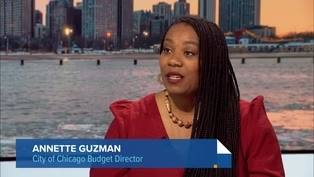
Chicago's Budget Director on Where Negotiations Stand
Video has Closed Captions
Clip: 12/1/2025 | 11m | Annette Guzman, Chicago's budget director, on the latest proposal for next year's city budget. (11m)
Providing Support for PBS.org
Learn Moreabout PBS online sponsorship
- News and Public Affairs

Top journalists deliver compelling original analysis of the hour's headlines.

- News and Public Affairs

FRONTLINE is investigative journalism that questions, explains and changes our world.











Support for PBS provided by:
Chicago Tonight is a local public television program presented by WTTW
WTTW video streaming support provided by members and sponsors.