
How conversations impact the lives of senior citizens and their caregivers
Clip: Season 10 Episode 35 | 6m 4sVideo has Closed Captions
One Detroit explores the impact of compassion, conversation and community on seniors and caregivers.
Our ongoing series on caregiving explores how conversations have an impact on the lives of senior citizens and their caregivers. One Detroit contributor Sarah Zientarski visited American House Livonia to talk with staff and residents about relationships created through interaction and dialogue. They share how meaningful relationships can lift spirits, restore purpose and transform quality of life.
Problems playing video? | Closed Captioning Feedback
Problems playing video? | Closed Captioning Feedback
One Detroit is a local public television program presented by Detroit PBS
How conversations impact the lives of senior citizens and their caregivers
Clip: Season 10 Episode 35 | 6m 4sVideo has Closed Captions
Our ongoing series on caregiving explores how conversations have an impact on the lives of senior citizens and their caregivers. One Detroit contributor Sarah Zientarski visited American House Livonia to talk with staff and residents about relationships created through interaction and dialogue. They share how meaningful relationships can lift spirits, restore purpose and transform quality of life.
Problems playing video? | Closed Captioning Feedback
How to Watch One Detroit
One Detroit is available to stream on pbs.org and the free PBS App, available on iPhone, Apple TV, Android TV, Android smartphones, Amazon Fire TV, Amazon Fire Tablet, Roku, Samsung Smart TV, and Vizio.
Providing Support for PBS.org
Learn Moreabout PBS online sponsorship(upbeat music) - What compels you about caregiving and being around these senior citizens?
- Being with the residents just gives you purpose.
It makes you appreciate their life that they've been through.
They share their stories, they share their history.
You become their family.
And I always say this, I can teach somebody accounting.
I can teach somebody how to go out and market, but I cannot teach somebody to really love a senior and have that compassion.
So that's just, it's in me.
That's just what I love to do, and I love to be with the residents.
- Oh, I get a lot of wisdom.
I get stories every day of them from their childhood.
It's always a interesting day here in American House.
It's never a dull moment.
They keep me on my feet and keep me busy daily.
- Is there a therapeutic element to conversing with people and storytelling, and just being able to be in a community like this?
- Oh, I definitely think there is a therapeutic because if you're a senior and you're at home all by yourself, not socializing, just sitting down, watching TV, coming into a community where there's life, and it's constant activities, and there's people around to speak to, I have seen residents come in who need a lot of services provided to them, and in six months from now, they don't need those services provided anymore, because they're active again.
They're engaged in the community, they have friends.
So the socialization part of it is absolutely impactful.
- Sharing their stories brings life to them.
If they're able to express their selves, that helps a lot.
They like to be heard and you just have to have a little patience and listen.
- What is the magic that happens when you slow down, and you really sit down and hear a resident's story?
- I'm in awe of their stories.
It amazes me.
One of our residents, I sat and listened to him talk, and found out that he actually had lunch with Rosa Parks.
I kind of hear and kind of learned different stories that they might not have shared before.
- It means a great deal that somebody is interested in my life as much as I'm interested in their life.
But yeah, it's important.
It kind of gives you a little bit of a boost in your self-esteem, you know, when people listen, and they're really listening.
- I believe talking out your problems, talking out, being happy, being sad, talking in general with people, helps them and helps you.
That's just how God made us.
(laughs) - What makes a good caregiver here at American House?
- One thing, you have to listen to the person that you're caring for.
And sometimes that's difficult, because as you get older, sometimes we repeat stories or things, you know, over and over, and that could be very frustrating.
But I don't see that here.
- Being able to just be a part of the journey and knowing that you're making an impact on their life.
Somebody might be having a really sad day for whatever the reason is, and knowing that you just sit for 20 minutes with that resident, and talk to them, and you change their frown to a smile, and it just makes you feel good.
You, it makes them feel good.
- What can you say about how just important caregivers are to our society in order to succeed?
- Caregivers are probably the most undervalued part of the society, and they are so valuable to the residents.
I mean, they do the little tiny things, just if you dropped your remote, can you come pick it up?
I mean, things that we take for granted that we can do is something big to the resident and the caregivers provide that little touch all the way to the hugs, to the love.
Some of our residents do not have family.
Some of our residents have outlived their friends.
They need somebody that just genuinely loves them.
And that's the important role of the caregiver.
They become their family, they become their trusted confidant.
They're there to encourage the residents, and they deserve all the praise in the world.
- We need more great caregivers, because we're the, well, I guess I'm in that group now.
(laughs) We're the aging people, so they have to take care of us, and having a good attitude while doing it.
- What do you think about someone who may be aging, who is living alone, but doesn't wanna come to a community like this?
What would you wanna say to them?
- It'll be okay.
Come in, check it out, meet some new friends.
Once you get meet new people and form the friendships and bonds, everything will fall into place.
- How do you see their quality of life change as they accept that care in?
- Oh, it's amazing.
People that come into the building who are very hesitant to be in a senior home, they don't wanna be with all the walkers and wheelchair people, come out, you know, the first few weeks.
Sometimes they're, you know, in their apartment.
They don't wanna come out and participate.
And then once you do that, and they start participating activities, they're coming down to the lunchroom.
They start to have best friends at their table, and they're the social butterflies at the building.
They're everywhere in anything.
- I adapted pretty well.
I think that close-knit helped me to center myself and stay centered.
- How do you see the spirit of residents get lifted from when they're maybe not conversing as much to when they are getting more talkative?
- Oh, it's very, very, very beneficial.
It keeps them stimulated, keeps their mind going.
It keeps them engaged with other residents, and I see that it tends to make 'em more happy when they're around friends, and engaging, and laughing, and it lifts my spirits as well.
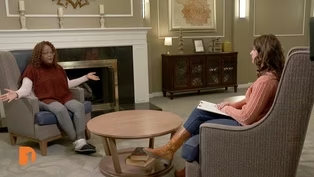 New
NewMetro Detroit seniors share their stories
Video has Closed Captions
Clip: S10 Ep35 | 9m 35s | Seniors living in metro Detroit share their stories with Sarah Zientarski. (9m 35s)
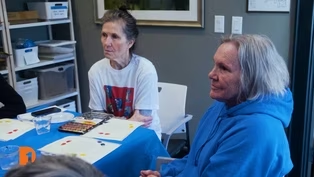 New
NewThe therapeutic benefits of storytelling for seniors
Video has Closed Captions
Clip: S10 Ep35 | 18m 41s | Research shows deeper conversations and storytelling helps senior citizens and their caregivers. (18m 41s)
Providing Support for PBS.org
Learn Moreabout PBS online sponsorship
- News and Public Affairs

Top journalists deliver compelling original analysis of the hour's headlines.

- News and Public Affairs

FRONTLINE is investigative journalism that questions, explains and changes our world.












Support for PBS provided by:
One Detroit is a local public television program presented by Detroit PBS