
How Karen Batchelor made history after researching her family tree
Clip: Season 10 Episode 51 | 7m 23sVideo has Closed Captions
One of the segments in “Destination Detroit” features genealogist Karen Batchelor.
While exploring her ancestors’ history, genealogist Karen Batchelor learned one of them fought in the American Revolutionary War. She became the first African American member of the Daughters of the American Revolution nearly a half century ago. Her story is featured in our “Destination Detroit” documentary.
Problems playing video? | Closed Captioning Feedback
Problems playing video? | Closed Captioning Feedback
One Detroit is a local public television program presented by Detroit PBS
How Karen Batchelor made history after researching her family tree
Clip: Season 10 Episode 51 | 7m 23sVideo has Closed Captions
While exploring her ancestors’ history, genealogist Karen Batchelor learned one of them fought in the American Revolutionary War. She became the first African American member of the Daughters of the American Revolution nearly a half century ago. Her story is featured in our “Destination Detroit” documentary.
Problems playing video? | Closed Captioning Feedback
Where to Watch One Detroit
One Detroit is available to stream on pbs.org and the PBS app.
Providing Support for PBS.org
Learn Moreabout PBS online sponsorship(bright music) - My grandparents came here in 1917 and they settled in Hamtramck.
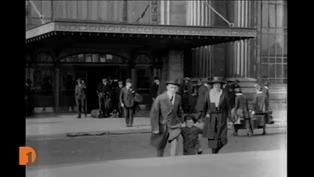
I have a picture of them that shows them at the Detroit train station on the day that they got there from Georgia.
And I guess there must have been photographers around.
And they, oh, we'll take your picture and commemorate this, that.
So they, for whatever reason, they weren't wealthy or anything, they had this picture taken and my Aunt Mary standing on a stool looking like shocked at it all.
But that's how my dad's side of the family got here.
- [Zosette] Karen Batchelor's dad would become a prominent doctor in Detroit.
He trained at Wayne University's medical school during World War II.
- I became a mom in August of 1975, and it was around that time after my son was born that I realized, wow, I don't know a lot about our family history.
And within 10 months, going to the Burton Historical Collection at Detroit's main library and writing off to a historical society in Erie, Pennsylvania where my maternal great-grandmother had come from, I was able to put together enough facts and found a revolutionary war patriot.
It was William Hood.
He fought in the battle of Fort Freeland where they came to the rescue of a fort that had been taken over by the British.
And that kind of got me started.
This is my great great-grandmother.
And her family line takes me back to 1630 in this country.
My genealogy mentor took me aside and said, I really think you ought to apply to DAR, Daughters of the American Revolution.
Mom talked about how she had been to a concert in DC when she was a student at Howard was 1939.
And it was when Marian Anderson had to sing on the steps of the Lincoln Memorial because she had been denied access to use DAR's Constitution Hall, which was a concert venue and still is.
- [Announcer 3] 75,000 masks before Lincoln Memorial to hear Marian Anderson, colored contralto make her capital debut at the great Emancipator shrine.
Refusal of the DAR to let her use their hall, found a countrywide controversy.
- [Interviewer] What was the image for a lot of people, what the DAR?
- Well, certainly in the black community, you know, people did ask me, why would you wanna join a group like that who had discriminated against us?
And here's what I would say was the reason.
When I was 14, ninth grade, I integrated a school in Detroit, and it was on the east side.
I had to take a bus an hour and a half each way.
And my parents wanted me to do this.
And this was part of their way, is that this was the year after the Civil Rights Act, and I was to integrate this school.
There were four of us kids at the school, and we weren't in class with one another.
None of the black kids were together.
There were no black teachers.
It was probably one of the loneliest years of my life.
It was the first time I ever got called the N word.
And I remember after a couple weeks, getting home from one of those days, and I was sobbing, and I asked my parents, why are you making me do this?
And dad said, and I will never forget this, it has been maybe my mantra through all the years since.
But he said, "Because somebody has to."
(bright music) - [Interviewer] Tonight we present a landmark in television entertainment.
- [Zosette] 1977, the year the mini series roots premiered on network television.
Suddenly Americans started doing their own genealogy research.
- In July of the 1977, two women at the Ezra Parker chapter of DAR in Royal Oak, Michigan.
They were inviting me to apply to them and become a member.
They were going to sponsor me.
- [Zosette] Applications to other chapters ignored.
But Karen was in.
It made local headlines and the New York Times front page.
- [Announcer 4] So join us for Good Morning America.
- [Zosette] Then national Television - On ABC.
- There were a lot of news stories.
I did a lot of interviews that this was the beginning of a lifetime journey for me doing family history.
And then these two pictures are Aunt Clara.
So the first person I started talking to about the family history, and she was the self-appointed family historian, whether you wanted to listen to her or not, and I wish I had listened more intently.
I get a lot of satisfaction from going through historic records and finding a clue and seeing what more I can find about a family history.
Remember, I started off not knowing much other than what we talked about at the dinner table.
And now I've been able to go back to 1630 in this country.
I have eight Revolutionary War patriots.
It's beyond my wildest dreams.
- [Zosette] A half century later, Batchelor's still digging into her family's past.
- Grandma kept me going on the research and she lived to be 97.
And every time we talked, she would end the conversation with, "And I saw people hanging from a tree."
And in fact, I was able to document later that there was a lynching in her area in Georgia when she was a young teenager, that no black people would've been at the lynching unless they were the target.
But she would've seen the aftermath of this.
And she always talked about it.
But I was able to document later what she probably had seen.
Family history is no longer something that you could call a hobby as it was when I first started.
It is a cultural imperative.
The more that we know about ourselves, the more we understand how we are an integral part of the fabric of this country.
I mean, I'm more American than apple pie.
And I think it's important for our children to understand this, because they may not be learning it in school, and it may not be available as readily available today as it was last week.
But the fact is, we know more about who we come from now than we knew in my grandmother's generation and certainly in my parents' generation.
So this is a journey.
 New
NewVideo has Closed Captions
Clip: S10 Ep51 | 5m 14s | “A Fortune of Sand” is a drama set in 1920s Detroit when the automobile industry was booming. (5m 14s)
 New
NewA look at the upcoming Museum of Detroit Electronic Music
Video has Closed Captions
Clip: S10 Ep51 | 6m 26s | Plans are underway for a museum that preserves Detroit’s legacy as the birthplace of techno music. (6m 26s)
 New
NewA preview of our new “Destination Detroit” documentary
Video has Closed Captions
Clip: S10 Ep51 | 3m 2s | Ahead of America’s 250th anniversary, Detroit PBS will premiere “Destination Detroit” on June 22. (3m 2s)
Providing Support for PBS.org
Learn Moreabout PBS online sponsorship New Episode
- News and Public Affairs

Top journalists deliver compelling original analysis of the hour's headlines.
 New Episode
- News and Public Affairs

Today's top journalists discuss Washington's current political events and public affairs.
 New Episode
 New Episode
 New Episode
 New Episode
 New Episode
 New Episode
 New Episode
 New Episode
Support for PBS provided by:
One Detroit is a local public television program presented by Detroit PBS