
How The Henry Ford is celebrating the legacy of Dr. Martin Luther King, Jr. over the holiday weekend
Clip: Season 54 Episode 2 | 10m 20sVideo has Closed Captions
Programming will include plays, musical performances, conversations, and more.
For the Martin Luther King, Jr. holiday, The Henry Ford in Dearborn is hosting a full weekend of programming to celebrate Dr. King's legacy and birthday. Host Stephen Henderson speaks with The Henry Ford's Vice President and Chief Marketing Officer Ellen Hill Zeringue about the activities taking place from January 17 to 19.
Problems playing video? | Closed Captioning Feedback
Problems playing video? | Closed Captioning Feedback
American Black Journal is a local public television program presented by Detroit PBS
How The Henry Ford is celebrating the legacy of Dr. Martin Luther King, Jr. over the holiday weekend
Clip: Season 54 Episode 2 | 10m 20sVideo has Closed Captions
For the Martin Luther King, Jr. holiday, The Henry Ford in Dearborn is hosting a full weekend of programming to celebrate Dr. King's legacy and birthday. Host Stephen Henderson speaks with The Henry Ford's Vice President and Chief Marketing Officer Ellen Hill Zeringue about the activities taking place from January 17 to 19.
Problems playing video? | Closed Captioning Feedback
How to Watch American Black Journal
American Black Journal is available to stream on pbs.org and the free PBS App, available on iPhone, Apple TV, Android TV, Android smartphones, Amazon Fire TV, Amazon Fire Tablet, Roku, Samsung Smart TV, and Vizio.
Providing Support for PBS.org
Learn Moreabout PBS online sponsorship- Welcome to "American Black Journal."
I'm your host, Stephen Henderson.
The nation is gonna pay tribute to Dr.
Martin Luther King Jr.
on Monday, January 19.
This is the federal holiday that recognizes his contributions to civil rights, social justice, and of course, community service.
The Henry Ford in Dearborn is celebrating Dr.
King's legacy with a full weekend of activities from January 17th to the 19th.
I got all of the details from the Henry Ford's Vice President and Chief Marketing Officer, Ellen Hill Zeringue.
It's great to have you here on "American Black Journal."
Thanks for joining us.
- Thank you for having me.
- Yeah.
So let's talk first about this holiday, and I guess what it means at the Henry Ford.
I think when a lot of people think of the MLK holiday, they think of the Wright Museum in midtown Detroit.
But it's just as important at a place like the Henry Ford.
Tell us why.
- Absolutely.
First of all, we're thrilled to be able to once again, commemorate the amazing legacy of Dr.
King.
And when you think about Dr.
King, he was just an ordinary person who did extraordinary things.
And that's what we do at the Henry Ford.
We tell those stories of amazing innovators, and he aligns no different than the Rosa Parks bus that we have, or the Kennedy limousine that we have, or the other stories of innovators and amazing people who just did, ordinary people who just did extraordinary things.
And it's also an opportunity for us to really highlight one of our collecting categories, which is social transformation, and the impact that Dr.
King had on changing the trajectory of our country.
It's very important from an innovation standpoint, a history standpoint, and that's what we do with the Henry Ford.
- Yeah, yeah.
So what will that look like on the 17th through the 19th?
- We've got a wonderful program, three days of programming, which as you mentioned, will start on the 17th.
On the 17th we will start with, we're going to have a play called "The Beginnings of the Boycott."
And the significance of this play is that it tells the background story of arranging and organizing the movement and the boycott surrounding when Mrs.
Parks refused to give up her seat.
And on December 1st, 1955 when she was arrested, we know that that first boycott had over 40,000 Blacks who decided not to ride the buses.
But after that, there was so much more significant planning because that one day was great, but it didn't have the impact, the full impact.
So "The Beginnings of the Boycott," which was written by one of my colleagues, X. Alexander Durden, really tells a story of that background story of organizing, and also highlights that moment where they appointed Dr.
King to be the leader of that boycott and that movement.
Following that, we'll also have, on the 18th, we'll have musical performances.
We'll have Ashley Baylor, who's a local soprano.
We'll have Sean Burden, who's a pianist, so we'll have music happening.
And also on the 18th, we will have Dr.
Jeanne Theoharis.
And Dr.
Theoharis is a world-renowned bestselling author, New York Times bestselling author.
And she wrote the book, "King of the North," that's her most recent book.
And the "King of the North" really highlights the impact of Dr.
King and his advocacy in the north.
When we think of Dr.
King, we think about the south.
But really, he was very instrumental in many movements in the north.
And Dr.
Theoharis is a strong advocate for telling that story.
So on the 18th, she will sit down with our curator of Black History, Amber Mitchell, and we'll have a conversation about her book, but also about the overall impact of Dr.
King in the north.
- Yeah, that's a great segue to my next question, which is about the significance of Dr.
King's work and his legacy here, specifically in Detroit.
I'm not sure how many people know of his visit here, the time he spent in Grosse Pointe, and the things that he learned about his struggle and his work from seeing what people here were dealing with.
- Absolutely.
There's so many significant ties with Dr.
King and the city of Detroit.
One thing that I learned very recently is that the "I have a Dream" speech, which obviously became very famous in Washington D.C.
but he first did it here in Detroit, but it was also taped by Berry Gordy.
And so you have that Motown connection where you can get the recorded version of the "I Have A Dream" speech, and there's that tie with Motown and Berry Gordy and then Berry Gordy's another visionary African American.
And also we know that Dr.
Theoharis, again, is just such a strong advocate about telling the story and making sure that people understand the rich history and legacy and tie Dr.
King had to Detroit, but just the overall impact throughout the north.
- Yeah, yeah.
What do you hope that people who visit the museum over the three days, are able to kind of take away from not just Dr.
King and the holiday, but also this sense of place with regard to Dr.
King being here in southeast Michigan?
- Stephen, we're really fortunate to Henry Ford that we're in a position where we can really celebrate this important moment and Dr.
King.
And so what I hope people get from being here is a renewed sense of inspiration.
This is a tough time for many in our country right now.
And it was a tough time then.
And Dr.
King, the organizers, many other civil rights advocates, the advocates fought against what was a very challenging environment in our country.
And so I hope that people will learn, I hope that they will be inspired, and I hope they will understand that it took the work of ordinary people.
And these were young people, Stephen.
These were not people in their 50s and 60s.
These are people in their 30s.
And in many instances, people in their teens, college students who just did what they could do in their own personal capacity to try to affect change.
And I think what's really special about the days that are coming up for the King holiday is that on Monday, January 19th, the museum will be free admission.
So everybody can come.
And on that day, we will have for the first time on display, the chair that Dr.
King was sitting in on the day that he heard Lyndon Johnson's speech, "We Shall Overcome," which was signaling the impending signing of the Voting Rights Act.
- [Stephen] Yeah.
- So that chair will live on in the Jackson Home, which you know is a recent acquisition that we've acquired here that will open this summer.
But the opportunity to just sort of get a glimpse of that chair and understand the magnitude of that moment, all the work that Dr.
King and his advocates and civil rights partners were doing in that very moment, he heard the President of the United States signal to him.
And we have that chair.
And when I see that chair, I am reminded of not only the great works of Dr.
King, but again, what ordinary people can do to affect change in our country.
- Yeah, yeah.
And again, you're ahead of me.
I was gonna ask you to talk about the Jackson Home and, - Sure.
- And how significant that will be, not just for the museum, but for this connection between Dr.
King and his work and his legacy and Detroit.
We have this home.
- Yeah.
- That was really his home in many ways, in Selma.
And it's gonna live on in Dearborn.
- Certainly, the home was Dr.
King's home for a very short period of time in 1965.
He needed a place where he and his colleagues could come together to organize.
And organizing a movement, I'd like to say, is not just a simple thing.
People think nowadays that you can put something on Facebook and say, "Meet me at the corner with 10 people with signs," and it's a movement.
That is not what they had to do.
They had to think about moving mass numbers of people in the Selma to Montgomery marches, mass numbers of people, getting them food, getting them, getting messages out, getting people from all across the country.
And so in this home, he asked Dr.
Sullivan and Richie Jean Jackson if he could use their home as a safe haven, as a headquarters, so that he and other members of his team could compose parts of the Voting Rights Act, could rest.
And I think, again, you think about Dr.
Sullivan Jackson and Mrs.
Richie Jean Jackson, that they were ordinary people, opened up their home, and they gave people food, hospitality, a place to sleep.
She answered the phone for Dr.
King when President Johnson would call him.
They together created a safe haven for the important work that had to be done.
- Yeah.
- So we are thrilled to have the Jackson Home at Greenfield Village opening this summer.
- Yeah, yeah.
And we'll have to spend some time before that opens again, talking about that painstaking work that you guys are doing, which I think is fascinating, right?
You didn't just move the home here.
You are trying to recreate the home as it was when Dr.
King was living there.
I just can't imagine the fascination and, - Yeah.
- And again, the attention to detail, and tedious work that's going on there.
- Yeah, absolutely.
8,000 artifacts.
- Yeah!
- And I would encourage people, Stephen, before we leave, that if you want more information on all of our events that are happening during the King holiday weekend, go to thf.org.
But again, I really want people in this moment to know that we are here to help to inspire, to remind people of what we can do as a people, as a country, and that bring your family and friends, come out and really be intentional this year when other institutions across the country are being challenged with their opportunity or their abilities to be able to tell and preserve some of these stories.
Our doors are open.
- Yeah.
- So join us throughout the weekend and throughout the year, because we hope to inspire people.
- Yeah.
Okay, Ellen Zeringue, great to have you here again.
Thanks for joining us, and we will look forward to the Martin Luther King holiday weekend at the Henry Ford.
- Thank you so much.
Video has Closed Captions
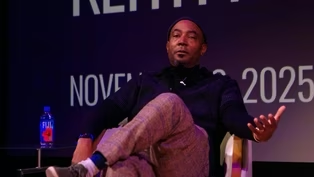
Clip: S54 Ep2 | 11m 17s | A look at award-winning cartoonist Keith Knight's appearance at the Charles H. Wright Museum. (11m 17s)
Providing Support for PBS.org
Learn Moreabout PBS online sponsorship
- News and Public Affairs

Top journalists deliver compelling original analysis of the hour's headlines.

- News and Public Affairs

FRONTLINE is investigative journalism that questions, explains and changes our world.












Support for PBS provided by:
American Black Journal is a local public television program presented by Detroit PBS