
Iconic hug photo from 1948 World Series, preserving the contributions of women jazz artists in Detroit
Season 54 Episode 6 | 26m 46sVideo has Closed Captions
A pivotal moment in the history of baseball and the Detroit Women in Jazz Oral History Project.
ow a 1948 photo of two baseball players hugging after a World Series victory became a symbol of racial harmony and unity. Plus, American Black Journal looks at an oral history project that’s preserving the legacies of Detroit’s women jazz artists.
Problems playing video? | Closed Captioning Feedback
Problems playing video? | Closed Captioning Feedback
American Black Journal is a local public television program presented by Detroit PBS
Iconic hug photo from 1948 World Series, preserving the contributions of women jazz artists in Detroit
Season 54 Episode 6 | 26m 46sVideo has Closed Captions
ow a 1948 photo of two baseball players hugging after a World Series victory became a symbol of racial harmony and unity. Plus, American Black Journal looks at an oral history project that’s preserving the legacies of Detroit’s women jazz artists.
Problems playing video? | Closed Captioning Feedback
How to Watch American Black Journal
American Black Journal is available to stream on pbs.org and the free PBS App, available on iPhone, Apple TV, Android TV, Android smartphones, Amazon Fire TV, Amazon Fire Tablet, Roku, Samsung Smart TV, and Vizio.
Providing Support for PBS.org
Learn Moreabout PBS online sponsorship- Just ahead on "American Black Journal," we'll have the story of how a 1948 photo of two baseball players hugging after a World Series victory became a symbol of racial harmony and unity.
Plus, we'll tell you about an oral history project that's preserving the legacies of Detroit's women jazz artists.
Don't go anywhere.
"American Black Journal" starts right now.
- [Announcer] Across our Masco family of companies, our goal is to deliver better living possibilities and make positive changes in the neighborhoods where we live, work, and do business.
Masco, a Michigan company since 1929.
Support also provided by the Cynthia and Edsel Ford Fund for Journalism at Detroit PBS.
- [Presenter] The DTE Foundation is a proud sponsor of Detroit PBS.
Through our giving, we are committed to meeting the needs of the communities we serve statewide to help ensure a bright and thriving future for all.
Learn more at dtefoundation.com.
- [Announcer] Also brought to you by Nissan Foundation, and viewers like you.
Thank you.
(bright upbeat music) - Welcome to "American Black Journal."
I'm your host Stephen Henderson.
We're more than a month away from the start of the major league baseball season, but today, we're bringing you a story about a pivotal moment in the history of America's favorite pastime.
The year was 1948.
The World Series matchup was between Cleveland and Boston.
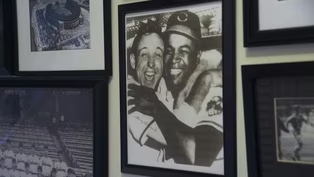
Cleveland came out on top, but it was a locker room photo of victorious teammates, Larry Doby and Steve Gromek, sharing a hug that grabbed even more attention.
One Detroit's, Bill Kubota, explains in this report.
- [Bill Kubota] Troy, home of the National Polish-American Sports Hall of Fame.
It's ballot counting time for this year's inductees.
- A number of individuals from Hamtramck in Detroit got together to form the organization, and Stan Musial was our first inductee.
- [Bill Kubota] That was 52 years ago.
Stan the Man, one of the greatest hitters of all time, from Pennsylvania.
But there's representation from around here, Hamtramck, and baseball in particular.
- Art Pinky Deras, who's considered the greatest little leaguer of all time.
- [Bill Kubota] Art Deras, great pitcher, great hitter too.
His Hamtramck team won the national championship in 1959.
Then there's Tom Paciorek.
On several teams in his 18 years in the majors, in the seventies and eighties.
- I think one of the really neatest pieces we have in our Hall of Fame is the Jersey, a Cleveland Indians jersey, back when they were the Indians, of Steve Gromek.
- [Sports Announcer] Johnny Sain and Steve Gromek, two right-handers, will face each other today in the fourth game of the World Series of 1948.
- [Bill Kubota] A record setting crowd in Cleveland, eyes on Gromek, a good pitcher among greats.
The rocket arm future Hall of Famer, Bob Feller, Bob Lemon, also destined for the Hall of Fame, and up and comer, Gene Bearden.
Gromek, an occasional starter, surprised some when he was picked for such a crucial game.
Nearly eight decades later, "Detroit Free Press" columnist, Neil Rubin, has been recounting his story.
- I knew Steve Gromek's name basically tied to those 48 Indians.
Then over time, as I lived here, I learned that he was a Hamtramck guy, 'cause Hamtramck has a huge athletic tradition and a big baseball tradition.
- [Sports Announcer] Steven Joseph Gromek, 28-year-old right-hander, of Polish ancestry, entered pro ball as an infielder in 1939.
- I've personally done a lot of research on Steve Gromek.
He's one of my favorite Hamtramck-born major league players.
Very interesting guy, great family.
- [Bill Kubota] The Hamtramck Historical Museum just got this photo album from one of Gromek's sons.
Pictures from Hamtramck Day at Briggs Stadium, when Cleveland came to play the Tigers.
And here's a news photo with Gromek and Cleveland teammate, Larry Doby.
- Yeah, it's such a great photo.
I mean, especially for the time period and how race relations were.
It's such an an iconic photo, you know- - 1948 baseball had only been integrated for two seasons.
Larry Doby was the second Black man to play major league baseball.
- [Bill Kubota] And Doby, the first in the American League.
As Cleveland won game four, the photo of Doby and Gromek made the papers across the country.
- So there's the picture, signed by our dad and Mr.
Doby.
And you know, when I saw this picture, for years, I thought it was a huge group in the locker room, just everyone mulling around, but then an associate of mine's wife found the picture of them here.
See, the two of 'em are standing alone in the locker room.
Nobody else is around 'em.
So this is just the two of 'em, embracing.
You know, so it's not like the ah (mutters indistinctly) It was like a real hug.
- [Bill Kubota] Steve Gromek's boys, quite young during their dad's playing days, but the photo always set prominently among the sports trophies, a happy moment recorded for history, but for Steve, not without consequences.
- He doesn't even think anything about this picture.
They didn't pose for it, it was spontaneous, but he gets home after the season.
He's back in Hamtramck, seeing old friends, and some people wouldn't talk to him.
They were so appalled by this photo of a White man and a Black man that people he had known for decades froze him out.
- [Bill Kubota] A January Sunday in Royal Oak, Pastor Jeff Nelson with the first United Methodist Church, and a sports fan, he's been thinking about that photo with Doby and Gromek.
- I've been holding this story since Neil shared it with me, knowing that it's the kind of story that needs to be told.
To be a servant of Christ is defy gravity, and defying gravity changes the world, and we need images of what that new world might look like.
Here's an image that defied the gravity of its day.
Meet Larry Doby and Steve Gromek.
It combines all my favorite things.
It's got baseball, it's got social justice and doing the right thing, and it's just a great human story, and it's local, and I just think that's pretty cool.
This snapshot defied the gravity of a racially segregated world, and I'm here today to tell you, that picture made neither of these men popular.
- He came home and his friends, old teammates, didn't wanna talk to him, and it's because after that World Series win, took a picture with his arm around Larry Doby, and during the time that it was, people saw that and were like, "Nope."
- Gromek found hate mail waiting for him in his mailbox, and longtime friends who would no longer have a drink with him at the bar.
One former buddy, even quipped, "Man, why couldn't you just shook his hand?"
- There was a lot of fallout in 1948.
- (laughs) And you look at that photo and go, "Yeah, I'm not talking to that guy anymore."
That's weird to me, and I mean I'm sure there's probably a stronger word than weird, but like weird is the best thing I can think of right now.
- [Sports Announcer] And that brings to the plate, Larry Doby, Doby who's had four out of 11, hitting a 364, currently the leading hitter in the series.
- You think about it now and it's like how could this happen back then?
It's like, oh, very simply, they did not want someone like this to be here.
It kind of makes your head hurt, 'cause you try to think about like, why does that make sense?
- It's interesting because in our family, we just saw two ball players and it was a World Series.
- In Hamtramck, my dad, he would go and play baseball wherever there was a game.
He used to play, you know, with the Black players too.
You know, they had great baseball players too.
So my dad would play with everyone when he was there, you know, in Hamtramck, - [Sports Announcer] One to nothing, Cleveland.
Last half of the third inning.
An overhand fast ball, swung on, hit high and deep in the right center field.
The ball is going, going, it's gone!
- Even to Larry Doby, where they added him to this team, and if you add a player like that who helps your team get over the hump, but in sports, like is literally a win-loss business.
Wouldn't you wanna do everything you can to win?
- [Sports Announcer] Larry Doby just teed off for the first home run of the 1948 World Series, and the Indians lead two to nothing.
Lou Boudreau is up, right hand- - [Bill Kubota] Cleveland these days, the team, they're the guardians now.
Around progressive field, some heroes victorious in 1948, cast in bronze, Rapid Robert Feller, player manager Louis Boudreau, and Larry Doby.
At the Baseball Heritage Museum, a small Doby display with artifacts from the Newark Eagles.
Doby's negro league team before coming to Cleveland in 1947, just 11 weeks after Jackie Robinson joined the National League's, Brooklyn Dodgers.
Doby, the second one in.
Have we forgotten?
Who doesn't know about it?
- Not so much Clevelanders, but when we get people from the West Coast, or even you know, a couple states out of Ohio, yeah, people are surprised to hear about Larry Doby's story and his place in American League baseball history.
- [Bill Kubota] The effort to not be forgotten.
December, 2023, a Congressional Gold Medal Ceremony.
Although Larry Doby died in 2003, his likeness joins Roberto Clemente and Jackie Robinson as just the third baseball player to receive the honor.
- The photo was a huge deal to Larry Doby's family to the point where his son insisted that it be on his Congressional Medal.
And he was told, "Oh no, we don't put two people on that side of the medal.
That's just for the honoree."
And he said, "Well that's a very nice policy and if you don't use that photo, there's not gonna be a medal."
- The names that I heard in my house were the guys who looked out for him, the guys who made what he did possible.
That was Steve Gromek, that was Joe Gordon, that was Jim Hegan, that was Bob Lemon.
Those guys accepted him and they were lifelong friends, and I'm just sorry I didn't get to meet some of them to thank 'em for their friendship.
- Here is a replica of the Congressional Gold Medal.
It really has a nice message on the back too.
It says, "We are stronger together as a team, as a nation, as a world."
- And I thank all you guys from the bottom of my heart.
(audience applauds) - [Bill Kubota] Steve Gromek died in 2002, but some of the Gromek family attended the ceremony, including Steve's wife, Jeanette Gromek, age 99.
- And it turned out great because my mother was still alive, and that was really- - My mother was still alive too.
- Huh?
- My mother was still alive too.
- Oh.
(laughs) - Why are you gonna say, "My mother?"
What about my mother?
Our mother.
- [Bill Kubota] Jeanette Gromek died last February, her husband probably not destined for the Hall of Fame in Cooperstown, but he's cast in history in a way few other ball players will ever be.
- [Sports Announcer] In the ninth inning of the fourth World Series game of 1948.
Mr.
Gromek is firing the ball a lot harder and faster, and more deliberately in this half inning than in any so far.
The pitch, there's a drive to right field, and it goes right to Kennedy.
(audience cheering) Cleveland wins.
(audience cheers) And the margin was Larry Doby's home run.
- He couldn't have written a script.
People wouldn't believe this if somebody's writing a movie, or how they say, oh that's too unbelievable.
You know, you can't make that story up.
(audience cheers) - Because it wasn't game seven, it wasn't the last game of a World Series, but Steve Gromek, he understood what the photo showed that moment of joy, but he also came to understand what it represented.
That was important to him also.
- He could have very easily said, "It's never gonna happen again.
No more pictures of me and my teammates of different races, never."
So the fact that he leaned in was the mark of a standup guy, and I mean, people throw this term around a lot, but like, that's like what an ally looks like.
That's someone who has his back.
- I just think that it's a story that Detroiters in particular need to know and be proud of, and just kind of own.
- Let's continue to be a movement that defies the gravity.
If these two guys could do it, a local kid from just down the street, then maybe we can do it too.
Let us pray.
Gracious God, we thank you for this chance to be together here this morning and how this film and this moment... - Up next, a look at the women who helped shape Detroit's jazz legacy.
But first, here's a clip of a conversation with Detroit Tiger's legend, Willie Horton, from a 1992 episode of "Detroit Black Journal."
- There were a number of key people, men in particular, who played important roles in your life, gave you guidance.
And that's kind of what your message is all about today too.
- That's what it's about.
You know, all I'm doing is giving back to society what it gave to me, 'cause I look at life that it's not none of mine to keep, and I'm very fortunate I feel like that, that I can look back and say thanks to the Ryan Thompson, the Judge Keefe and the Sam Bishop, Judge Damon Keefe- - Sam Bishop at Northwestern?
- I tell you, it's unreal.
It can go on, and you know, through all of these people of learning and bringing up that they taught me about, never forget the road that you cross.
And what they did taught me, always respect of where you're going in the future, and how you do that, recognize where you came from.
So it always stayed that way because my role model at the time, coming up, they let us recognize the people in the city.
Like my dream of being a Charlie Primus basketball player, - [Interviewer] Who was a great basketball player at Wayne Stanley.
- Oh, I'll tell you, Johnny Klein- - Jumping Johnny Klein.
- You got Chief Henry, which is the second deputy chief of the east operation that we used to go with lunch bucket and watch him play ball, him and Freddie Snowden.
They used to play, one was second base, one was shortstop.
That was the good old days.
We recognized what we had and so we can understand what's down on (indistinct) as the profession, and then we going outside.
- You know, what's important too is that these were Black men in the Black community who were role models for young boys like you back then.
- That's true, and that's just part of life, and it's more as a concept I'm trying to do today as what I'm doing at the Police Athletic League.
It's more like a team type concept as the wheel, the spokes type of concept that's linking to make something happen, because the future is our grandkids and their kids.
- Destination Detroit is an ongoing project of Detroit PBS.
Explores the region's rich history and the people who helped shape it.
Detroit's music legacy is an important part of that history.
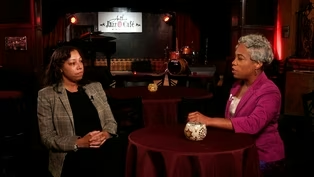
"American Black Journal" contributor, Cecilia Sharpe of 90.9 WRCJ, spoke with oral historian, Veronica Johnson, about her project with the Detroit Sound Conservancy, which chronicles the stories of the women who have influenced the city's jazz culture.
Take a look.
(buoyant music) ♪ The rhythm, exciting melodies ♪ - Jazz in Detroit is more than music.
It's a living archive of resilience, rhythm, and roots.
For generations, the city has been a magnet for jazz musicians.
Now, Veronica Johnson is documenting stories of women who shaped Detroit's jazz scene and beyond, voices often left out of the spotlight.
She is interviewing the musicians and sharing their stories.
What sparked your interest in jazz?
- Well, actually, my interest in jazz goes back to college.
I just became just really, I guess, enamored with the music itself, the history of it, you know, the culture, you know, just how important this music is to the foundation of Black American music.
- What inspired you to take a closer look at the women in jazz, and to collect their oral histories?
- I started doing all this research, and I realized like, wow, who is covering the current female Detroit musicians that are all here, kind of carrying on this lineage?
So that's kind of what really inspired me to wanna dig deeper and tell their stories.
- [Cecilia Sharpe] Those stories are part of the growing oral history collection in Detroit Sound Conservancy's Digital Archives.
- [Cecilia Sharpe] So far, dozens of jazz musicians have participated in the project.
- I basically interview everybody from straight ahead, the great female jazz group from Detroit, great drummer, Gayla McKinney, Alina Moore, piano player.
I've interviewed a lot of vocalists, like Naima Shamborguer or Ursula Walker, Kate Patterson, Taslimah Bey, great ragtime pianist.
So that's just a few, but there's plenty of people I've interviewed so far.
- [Marion Hayden] So my father would make sure - You partnered with the Detroit Sound Conservancy on this oral history project.
How did the collaboration come together?
- So I've always been connected to Detroit Sound Conservancy in some form or fashion.
So when I started my world history project, like several years ago, I did start off kind of going with Detroit Sound Conservancy.
So now we're working to, like I said, archive and digitize these oral histories for the world to see.
- [Cecilia Sharpe] The public will be able to listen to them at detroitsound.org.
- [Cecilia Sharpe] Partnering with Johnson on the oral histories is just one way the Detroit Sound Conservancy is helping preserve music history.
Michelle Mama Jahra McKinney, Director of Collections, explains.
- Well we do it especially through place keeping.
So an example would be us rehabilitating the Bluebird Inn.
We do it through actual archiving and preserving, which we are taking in the collections of musicians and people who create around the music, and we make them accessible, and digitize them, or whatever we have to do so that people from years later can come and see, "Wow, this is great.
This happened in Detroit?
This person did that?"
We create educational resources and collaborations, so that's especially gonna show up when we get into the Bluebird Inn.
- Tell us a little bit about the Bluebird Inn.
- Well the Bluebird Inn is an iconic, historic jazz club, and it's just a little neighborhood bar.
And that place became a haven, because at that time, it was a lot of segregation in the city of Detroit, and there were places where Black folks could go and Black folks could not go, and it was a place where you could have Sunday brunch, and you could see your neighbors, and you could feel safe, and you could be your Black self.
(laughs) - Unapologetically.
- Unapologetic, yes.
- Without fear.
- Without fear.
- [Cecilia Sharpe] For generations, Detroit has drawn artists from all over, some just passing through, but many staying for good.
The city is also home to the world's largest free jazz festival, the Detroit Jazz Festival, drawing hundreds of thousands of attendees each year.
♪ It's time for you to get up and show the world ♪ ♪ What we have in store - How do women shape the jazz culture in Detroit?
- They had a great impact on it.
And you know, that kind of stuff that you can hear that's toe tapping, and you can sing along with it, and remember the melody, and be humming it to yourself, that was made more possible by women singing in jazz, to me, the storytelling.
♪ All of me ♪ Why not take all of me ♪ Can't you see, I'm no good without you ♪ - When we think about that Detroit sound, what is it about the sound of Detroit that makes it so unique?
- It still comes out of community.
Actually, not even community, family-hood.
That's what, to me, is what makes the communication, and the mentorship, and the passing things down that Detroit musicians do.
It has extended worldwide.
And so not only is it a sound, it's a feeling, it's a feeling of connectedness in a family-hood, and somehow that's embodied in the music.
(passionate jazz music) That Detroit sound that was in the really basic music that was there, created by the jazz musicians, the improvisation, the African rhythms that are embedded in it, all of that context is still going on and created that Detroit sound between the love that is in that music.
It's pure love.
- What made Detroit a destination for jazz?
Or was jazz the destination for the people?
- Detroit, as a destination for musicians, it always has been, because of the music that they brought as they migrated North.
But at the same time, it's all also about the connections.
Like Marcus Belgrave, he was just coming through Detroit with Ray Charles, and he said, "Oh, I love this city."
Yeah, and people taking him under their wing and talking to him, and he left Detroit and he came back, and he said, "I can't leave this place."
He didn't wanna leave.
- What is it that you hope that people walk away with after hearing some of these stories?
- Well, I just really want people to realize how, like, you know, their work ethic, the resiliency of these women.
You know, like again, a lot of the women I've interviewed, some in their seventies and eighties, still performing.
So it just goes to show how much they love music and I just want people to realize, like that obviously, women have as much of an influence and impact on Detroit jazz as the male counterparts.
So I just want people to see the breadth and depth of these women and what they've done, and what they've accomplished throughout their years.
(passionate jazz music) (crowd cheers) (crowd applauds) - That's it for us this week.
You can find out more about our guests at americanblackjournal.org, and you can connect with us anytime on social media.
Take care and we'll see you next time.
(bright music) - [Announcer] Across our Masco Family of Companies, our goal is to deliver better living possibilities and make positive changes in the neighborhoods where we live, work, and do business.
Masco, a Michigan company since 1929.
Support also provided by the Cynthia and Edsel Ford Fund for Journalism at Detroit PBS.
- [Presenter] The DTE Foundation is a proud sponsor of Detroit PBS.
Through our giving, we are committed to meeting the needs of the communities we serve statewide to help ensure a bright and thriving future for all.
Learn more at dtefoundation.com.
- [Announcer] Also brought to you by Nissan Foundation, and viewers like you.
Thank you.
(bright music)
Iconic hug photo from 1948 World Series, a symbol against racism
Video has Closed Captions
Clip: S54 Ep6 | 12m 18s | The story behind an iconic photo of two baseball players hugging after the 1948 World Series. (12m 18s)
Oral history project preserves the legacy of Detroit women in jazz
Video has Closed Captions
Clip: S54 Ep6 | 9m 48s | Oral historian Veronica Johnson discusses the Detroit Women in Jazz Oral History Project. (9m 48s)
Providing Support for PBS.org
Learn Moreabout PBS online sponsorship
- News and Public Affairs

Top journalists deliver compelling original analysis of the hour's headlines.

- News and Public Affairs

FRONTLINE is investigative journalism that questions, explains and changes our world.












Support for PBS provided by:
American Black Journal is a local public television program presented by Detroit PBS