
A look at a Detroit PBS event highlighting the voices, experiences and needs of caregivers
Clip: Season 54 Episode 15 | 11m 20sVideo has Closed Captions
ABJ features discussions between caregivers, experts and journalists on the realities of caregiving.
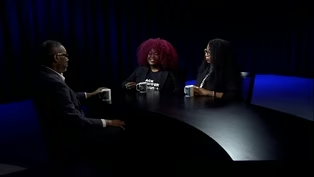
We’re featuring a portion of the recent Detroit PBS event lifting up the voices, experiences and needs of caregivers. Host Stephen Henderson moderated the discussions at "Detroit PBS & The Caring Community" held at St. Patrick Senior Center in Detroit. The program brought together caregivers, experts, and journalists for an engaging conversation about the realities of caregiving.
Problems playing video? | Closed Captioning Feedback
Problems playing video? | Closed Captioning Feedback
American Black Journal is a local public television program presented by Detroit PBS
A look at a Detroit PBS event highlighting the voices, experiences and needs of caregivers
Clip: Season 54 Episode 15 | 11m 20sVideo has Closed Captions
We’re featuring a portion of the recent Detroit PBS event lifting up the voices, experiences and needs of caregivers. Host Stephen Henderson moderated the discussions at "Detroit PBS & The Caring Community" held at St. Patrick Senior Center in Detroit. The program brought together caregivers, experts, and journalists for an engaging conversation about the realities of caregiving.
Problems playing video? | Closed Captioning Feedback
How to Watch American Black Journal
American Black Journal is available to stream on pbs.org and the free PBS App, available on iPhone, Apple TV, Android TV, Android smartphones, Amazon Fire TV, Amazon Fire Tablet, Roku, Samsung Smart TV, and Vizio.
Providing Support for PBS.org
Learn Moreabout PBS online sponsorship- For the past year, Detroit PBS has produced stories and events that lift up the voices, experience and needs of caregivers.
Recently, I hosted an event called Detroit PBS and the Caring Community at St.
Patrick's Senior Center in Detroit.
The program brought together caregivers, community leaders and experts for an engaging conversation about the realities of caregiving.
Here are some highlights from those discussions.
This is my first time here at the St.
Patrick Senior Center.
Maybe there's other folks in the audience for whom that's also true, and certainly I think there are people watching who have not been here before.
So give us just a thumbnail sketch of what you do here and why the work is important.
- Well, I would say St.
Pat's is a great place to be, and we service over 3,000 older adults a year, and I am ecstatic that I've had the pleasure to be a large part of that.
Our organization was founded by Sister Mayor Watson, and if, to take over after a nun, (participants laugh) means that it also becomes your life mission.
And I made a promise to her that I was gonna take care of her seniors, and I try my best to do that.
They are an extension of my family.
I have a very small family.
I grew up with just my mother and her two parents.
I have two children, so we take care of one another, and my seniors have adopted my family just as they have adopted them.
And it's so many older adults, they're alone.
Sometimes you still have family and you're alone, and that's very hard to deal with.
You know, when something happens, the first thing we say is, do you have any kids?
And sometimes you do, but it doesn't matter if they, if you don't see them.
It doesn't matter if the only thing that they wanna see you is when you get your check or trying to find money when sometimes you're struggling to take care of yourself.
So my staff and I have a wonderful, hardworking staff.
There's a great support system here from the staff and from the senior members themselves, they're community.
They look out for one another, they take care of one another.
They bring each other food, meals.
Someone's missing, they go looking for them, and it's very important to have that space to help make sure that you're okay.
You have to be okay also as a caregiver.
It is very overwhelming and hard not to lose yourself, because often there's financial sacrifices that you have to make and you have to make a decision.
Sometimes you make those sacrifice and you can't afford it.
Not everyone is blessed to be able to pay someone to do the things that need to be done.
You have to find a way to, like, I'm a caregiver for my mother.
She wanted to come here today, was not able to.
And being an only child, mother and daughter, sometimes you're going at it, you going at it nonstop because they don't want to have you tell them nothing.
(participants laugh) And, you know, with me, it's like, mama, I do this for a living.
I've been doing this for 27 years.
It doesn't always matter, but you have to figure out, how can I still say what I need to say?
Because we wanna make sure that you understand how it's really supposed to go.
But then, and my mother was a professional.
She graduated from Harvard, she worked for the City of Detroit.
In her life, she had to come to grips that the life that she knew was no longer the life that she has.
- One in five people are caregivers in this state.
We all know it's a far bigger number than that.
A lot of people don't call themselves caregivers, but they are.
So we decided this is, we've been actually working on caregiving for about four or five years too, right?
During the pandemic is when we started.
And it matters to me.
I took care of my father for the last 10 years or so of his life, brought him close to to where I live and was there as often as I could be.
Wish I had been there more often.
And I wish I had the support and the knowledge to take advantage of the services that are available to us that people do not know about.
So again, we taught, we built the partnerships, we built connections with the wonderful people (indistinct) and her whole team here at St.
Patrick and all the great people, the organizations are represented downstairs, and they helped us decide what stories we cover.
We've done things on dementia care, respite care, the shortage of, as (indistinct) says, of paid care, care workers, and on and on and on.
And they also said that people aren't getting prepared for end of life.
We call it planning.
We like to call it life planning instead, it's so less gloomy, and how we, how they should get, make their wishes known, because once you get incapacity when you're 18, it doesn't matter if you're 18 or 58 or 88, if you haven't done the planning, you, it's hard for the, the, the doctors, the lawyers, your family to be able to make sure that the wishes, your wishes are carried forward.
So you gotta get it in writing, you gotta get it signed.
You gotta work with attorneys to make it happen, otherwise, the burden of your families is horrific, 'cause they, they're guessing what you wanted, and if you don't have it in paper, even if they know what you wanted, it may not be enforceable.
So we talked to the wonderful Antonia Harbin there, and she, and she said, "Get it done, and get it done now.
- Now.
Now (laughs) right?
Ericka, it was really interesting to hear you talking with your mother about how you had come to the decisions that you've made and doing the things that that you've done.
I wonder if you can go back to the first conversation you can remember about that with your mom, 'cause I think that for a lot of folks is the hesitation.
Like, how do I start that, that talk with my parent about these things?
You know, how do I get that door open?
- So my mom is one of seven children.
It's six girls, one boy.
So during Christmas dinner one night, my cousin was kind of teasing me like, "Did you get your mom's business right?
'Cause we got our mom's business right."
And I'm like, "What kind of business you talking about?"
(Stephen laughs) And so she was like, "You know, her will and trust and life, end of life planning."
And I'm like, "Tell me more."
And because it's six girls, they're so competitive that they're offspring, we are all, me and my cousins, I love them, but they troll me, I troll them.
It's just our relationship.
I don't know.
I'm closer with my friends.
I don't know, whatever.
(participants laugh) So she wouldn't tell me.
She was like, "Here's the card."
And so I was like, "Okay."
So that card sat, it was a magnet, and it sat on our refrigerator for years, and it just was like right here, like get it done, get it done, get it done.
And I was like, "I wanna ask her like more questions, but I know she's not gonna tell me."
So I saw, I think it was like a Facebook post or something, and it was like, "Log on at 7:00 on April 30th and we'll tell you about life planning."
And I put it in my phone, my calendar, the reminder came on and I didn't ignore it.
And so I logged on, and when I logged on, I recognized the presenter.
So I was like, "Oh, okay, thank you."
And so I listened and I learned about life planning and then I called her.
I had her number, I called her afterwards, and I was like, "Can we talk more about this?"
And she's like, "Absolutely."
And so it was at Christmas 15 years ago.
- You discovered people were happy to share stories that their kids never heard.
And you kind of go, why not?
Well, the kids didn't know what to ask or maybe the subjects didn't really feel that comfortable sharing with their own children, but they'd talk to somebody else, and that was kind of a clue that, you know, when you make documentaries, people tell you stuff.
And then the other thing, my daughter was working at the StoryPoint Northville for Sabrina, and she'd come and tell me all these amazing stories of the residents there.
And we also had a project called Destination Detroit where we talked to people about why they came to Detroit.
So I was hearing all these stories and we gotta converge all this stuff together to record some history and help some people.
- [Stephen] Yeah.
- People that like telling stories, I thought it's gotta be the case that this is good for them physically, mentally, and looked it up, and that was the case, and we interviewed some professionals about that.
- Yeah, yeah.
Sabrina, tell us about StoryPoint and the work that you do there.
- Sure.
So StoryPoint is a assisted living and memory care community in Northville, and my job as their Life Enrichment Director is to plan their day-to-day activities.
So I like to say I have the best job, I have the fun job 'cause I get to plan, like I said, all the fun stuff that they do every day.
Yeah.
- And tell us about the approach, I guess, at StoryPoint, and the role that this kind of storytelling plays in that community.
- Yeah.
So StoryPoint has a philosophy, we call it 1,440.
So there's 1,440 minutes in every day, and we need to make those minutes count.
So my job is to create experiences for them to make those minutes count.
So I look for... When I'm talking to them and asking them about their life, I'm asking questions that will lead me to what can I plan for them?
It can be as simple as I took an outing to the Motown Museum.
I had a lifelong Detroiter, huge Motown fan, never had been to the museum.
So why not take a day, take them to the Motown Museum?
And she sang and she laughed and she talked about the neighborhood and it was a great experience for her.
And it can be a little bit more meaningful.
I had a resident turn 100 last year.
She was my very first centenarian.
(Sabrina laughs) And all she wanted to do when I asked her what she wanted to do for her birthday is she wanted to watch her wedding video from 1955.
And I'm thinking, how in the world do I take a video from 1955 and convert it to work in 2025?
But I figured it out (laughs) and we got her to watch her wedding video.
There was no sound.
It was all in black and white, but it was absolutely amazing.
And she had her glass of champagne and her chocolate cake and she did pass a few months later, so it was really special for me to give her that last opportunity that she asked for.
- Yeah.
And you can see the entire caregiving program at detroitpbs.org.
 New
NewA Spotlight on National Black Maternal Health Week
Video has Closed Captions
Clip: S54 Ep15 | 12m 48s | A talk with the Birth Center Equity CEO and founder of the Michigan Chamber for Reproductive Justice (12m 48s)
Providing Support for PBS.org
Learn Moreabout PBS online sponsorship
- News and Public Affairs

Top journalists deliver compelling original analysis of the hour's headlines.

- News and Public Affairs

FRONTLINE is investigative journalism that questions, explains and changes our world.












Support for PBS provided by:
American Black Journal is a local public television program presented by Detroit PBS