
Nov. 24, 2025 - Full Show
11/24/2025 | 26m 48sVideo has Closed Captions
Watch the Nov. 24, 2025, full episode of "Chicago Tonight."
What exactly is a consent decree and how does it work? Plus, what the push for police reform looks like at the neighborhood level.
Problems playing video? | Closed Captioning Feedback
Problems playing video? | Closed Captioning Feedback
Chicago Tonight is a local public television program presented by WTTW
WTTW video streaming support provided by members and sponsors.
Nov. 24, 2025 - Full Show
11/24/2025 | 26m 48sVideo has Closed Captions
What exactly is a consent decree and how does it work? Plus, what the push for police reform looks like at the neighborhood level.
Problems playing video? | Closed Captioning Feedback
How to Watch Chicago Tonight
Chicago Tonight is available to stream on pbs.org and the free PBS App, available on iPhone, Apple TV, Android TV, Android smartphones, Amazon Fire TV, Amazon Fire Tablet, Roku, Samsung Smart TV, and Vizio.

WTTW News Explains
In this Emmy Award-winning series, WTTW News tackles your questions — big and small — about life in the Chicago area. Our video animations guide you through local government, city history, public utilities and everything in between.Providing Support for PBS.org
Learn Moreabout PBS online sponsorship>> Hello and thanks for joining us for this W T Tw News special.
I'm Nick Blumberg.
Brandis Friedman has the evening off.
Tonight we're focusing on local policing.
>> Chicago police were found routinely violated black and Latino residents.
Constitutional rights.
We explain exactly what the consent decree is and how it works.
>> And the community officers really want the same thing.
>> Chicago's police oversight board taps a new leader as it works to choose the new head of the city's police misconduct agency.
And what the push for police reform looks like at the neighborhood level.
We hear from local police district council members.
We'll kick things off right after this.
>> W T Tw News coverage of policing and police reform is supported by the Joyce Foundation.
>> We focused a lot on efforts by the city, the police department and the community to forge a better relationship and work together to build a safer city.
One thing we've been following closely is the consent decree that the Chicago Police Department has been working under.
We thought it would be a good idea to take a step back and explore exactly how the consent decree works.
Here's Heather Sharon with the latest edition of our series W T Tw News explains.
>> The Dash cam video of the murder of Laquan McDonald capture.
One of the darkest moments in the 119 year history of the Chicago Police Department.
>> In response, Mayor Rahm Emanuel promised there would be, quote, no u-turns on the road to reform.
But since city officials into the 2019 police consent decree agreement, that effort has hit pothole after pothole.
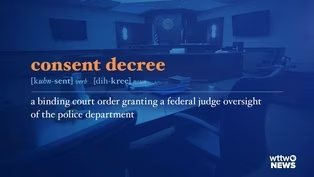
The consent decrees of finding court order granting a federal judge oversight of the department.
It was designed to correct the problems outlined by an investigation by the Justice Department chiefly that Chicago police were found with routinely violated black and Latino residents.
Constitutional While a consent decree can be a powerful tool to reform police departments.
It's complicated.
Here's how it's supposed to after Trump administration wash their hands of the reform effort and 2017, the Illinois Attorney General's office in a coalition of countries for format sued the city to force changes to how the police department operates.
That agreement requires the Chicago Police Department to change the way it trains supervises and disappoints The department must come up with new policies which are evaluated by the judge at 3 levels.
Preliminary compliance means officials who finalized written policies addressing its failures.
Secondary compliance means a majority of officers have been trained on those new policies.
Full compliance means that the department has demonstrated that it can follow those rules over a period of time under the judge's oversight.
Progress is monitored by independent team of experts on policing reform appointed by the judge to be their eyes in the years since it was put in place.
The consent decree has been expanded 3 times to address new scandals and allegations of misconduct and is set to expand again to include track steps.
Originally city officials had end of 2024 to comply with the consent decrees.
552 paragraphs.
It didn't happen now.
The consent decree which is expanded to 714 paragraphs.
I'm counting on expire until at least 2027 giving the city more time to fully comply with its requirements and convince the federal judge the problems won't reoccur at the same time, police union leaders say the consent decree has made it tougher for officers to enforce the law and apprehend criminals by imposing a layer, your honors in on everything they do.
>> After making only incremental progress during the years of the consent decree.
Some are concerned that the opportunity lasting reform is slipping away.
And city officials haven't yet demanded police brass us.
The city's reform push might not have pulled a U-turn.
>> But it's still far from the finish line.
>> And you can watch more in our W T Tw News explains series on our website while you're there, you can also check out a special section of our website, exploring policing in Chicago.
That's a W t tw dot com slash policing.
Up next, a look at efforts to bridge the gap between the community and police.
Chicago's police oversight board has a new leader.
Military is now the president of the Community Commission for Public Safety and Accountability.
The 7 person commissions, responsibilities include helping set policy for the Chicago Police Department.
Reviewing CPD is budget and working with the Department on community policing programs.
The commission is also charged with selecting the next chief administrator of the Civilian Office of Police Accountability, Copa the agency tasked with investigating misconduct by Chicago police officers has been without a permanent leader since February.
And joining us now is for military president of the Community Commission for Public Safety and Accountability.
Welcome back to the program.
Thank you so much for having Absolutely as so.
As we mentioned, you're leading the commission during its work to help choose a new leader for Copa.
Briefly, remind us what that what Kopas role is.
Yes.
So we see the work of Copa extremely important.
When we think about police oversight, right and accountability.
>> And so Copa is the investigatory body that investigates police involved shootings, anything that deals with excessive misconduct, excessive force, even if someone is hurt significantly or dies in police custody.
So they are responsible for doing those investigations.
And following those investigations, they provide recommendations on their Whether there needs to be disciplinary action and what that does Larry Action needs to look like.
>> Have yet interviewed the 5 finalists.
>> We have done our first round of interviews and so we will be going into a second round.
But unlike the initial search that paid plenty of people are familiar with in the superintendent.
This is unique because we get to choose the finalist.
And so we will not be announcing any nominees as we did previously in the superintendent search that led to Superintendent Snelling.
So you won't hear about this until we settled on a final candidate.
>> And as to that final candidate, are you still on track to send nomination to city council by the end of this year?
>> Yes, we are still on track.
Proud to say that we are still on track.
We've been working diligently with our search and internally with managing all of the commissioners schedules to meet that deadline.
So we're really excited about what's to come schedules something juggle.
I can imagine with that large of a body.
>> You know, so Chicago this this late summer and fall saw a massive surge in federal immigration agents.
lot of advocates were concerned that Chicago police may have violated the welcoming city ordinance by facilitating immigration enforcement.
You know, should that be borne out?
Does that further set back efforts to build trust between residents and CPD?
>> Yeah, I would proud to say we have not heard of any engagement from the department related to that.
And we've been forthcoming accountable in addressing those concerns.
We brought out the deputy chief to speak about the work of the department.
>> And their role as it relates to the welcome City City ordinance and ensuring that they are not engaging that activity because we do understand the impact that that can have it.
So we definitely encourage those who if they have those concerns to share those concerns, if you've seen things share them with because we want to ensure that our department is adhering to that welcome City ordinance.
of the folks he's raised concerns is the 12th District Police Council chair Arctic and Taro.
>> He called for a public hearing to port investigate interactions between the CPD and federal immigration and Border enforcement agencies since January 2025.
>> And also requested the testimony of Superintendent Snelling and the 22 district commanders to talk about compliance with the welcoming city ordinance or those hearings that you anticipate holding necessarily?
>> Well, actually have a meeting planned with the Secant arrow to have a conversation to just gain understanding of his findings in ensuring that whatever we convene, whether it's a hearing or even going a step further than that, making sure that we're all in alignment and understanding what impact we're seeking to have and making sure we have the right people at the table to have that conversation.
So we have an upcoming hearing.
Still more to come about that and we invite you all to participate.
Absolutely.
know a lot of eyes will be on that, including You know, there's been a significant increase in police use of force against Chicago.
And since 2022.
>> Attorney General Kwame Raoul is office recently warned that that could threaten already slow process of full compliance with the consent decree deep to share those concerns?
Well, I would say I would have to do more research on the findings that Attorney General Raul has come up with because I'm not well-versed in that.
>> But if that is, in fact, the case, of course, that would write any sort increase of any type of force from the department can impact that.
And so we are significantly concerned about that.
And we hope that if he did these things are happening, that those issues are raised with us so that we can partner with the department to address these concerns.
And also with our of other body of Copa, right?
If they have these cases on their roles in a properly investigating those issues.
>> You know, earlier this year Ccps a raised what you called significant and consequential objections to a proposed police policy allowing officers to continue making so-called pretextual traffic stops.
Things like expired tags are broken.
Tail lights for folks who aren't familiar with those stops.
What concerns you about that proposed policy?
>> So with the policy, I think.
We are at a place where we're developing out something that many people assumed was already in place.
And so we currently have a position on certain types of restrictions, which, again, with this process, we're now looking at putting traffic stops in to the consent decree.
So the largest pieces making sure that the commission maintains its authority of policymaking because once something is in the consent decree, we sort of lose out on that authority.
But we're pleased that the department has agreed.
I am T and others who are at the table to keep us with our current role so that we can make sure that we're elevating not only the commission's position, but also the positions of community voices.
Yeah, I mean, it's has there been any progress in the intervening months on that policy that that you can share with us?
>> Nothing be on the existing policy that is out there.
We're continuously gathering feedback.
So we do welcome everyone across the entire city to weigh in on that.
>> And we're also continuing our conversations right with the int.
Of course, we can't go into much detail about that, but it's still this push of getting it across the finish line into the consent decree.
But that's where we are now.
There is a draft policy available for people to review.
We welcome all insights and feedback are related to that.
We also have a feedback form and we encourage all Chicagoans to make sure that they're weighing in on their thoughts related to this particular policy.
Yeah, certainly something I know a lot of residents feel strongly about.
>> You know, you took over as president last month, although certainly been working with the commission for for quite some time.
What's the transition been like for you?
>> I think the transition has been a bit seamless, right?
I think Anthony and the former president, we worked well together.
I was his vice president for awhile.
We both started out on the interim together.
So it's been a bit seamless.
We recently also elected my vice president commissioner on Hill moving every whoa.
So we had our first meeting together.
This what last week.
So I think it's been pretty seamless of a transition.
I'm just excited too, implement some of my vision for the rest of my tenure that I have on this commission, which looks like connecting a lot of these different agencies and bodies who influence the overall public safety and accountability landscape because I believe a lot of what we're hearing, though.
We may not have authority in some of those areas.
We definitely can influence to ensure that we're meeting the needs of the community where those bodies may not have the same level of oversight military.
Congratulations on the new role.
Thanks for joining us.
Thank you.
And up next, how police district councils are working to re imagine community policing.
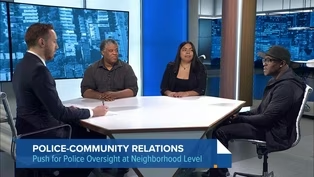
>> The push for police oversight is also a neighborhood level effort with the help of police district councils.
They work with each of the city's 22 police district.
Hearing out residents, public safety concerns and advocating for accountability.
The first-ever members were elected in 2023. giving everyday people more of a say and how policing is done.
But progress has been made since then.
Here to discuss that and more are Dion McGill, a member of the 7th Police District Council, which includes South side neighborhoods like Englewood in Auburn, Gresham, Elly on by a in a member of the 10th Place Police District Council, which includes Westside neighborhoods like North Lawndale and Little Village and Sedrick Hawkins and outreach specialist at Community Violence Prevention organization, CRED.
We also invited the Chicago Police Department to join us, but they declined.
But we thank you all for being here on the program.
like to start with you, please.
You know, from your perspective over the last 2 years, what kind of the difference do you think these councils have made in terms of accountability and pushing police reforms.
I think a very unique thing about our district council says that we're responding to.
>> The contents of citizens at a hyper-local level.
So I think that's very unique in the sense where they didn't have the outlet to be able to voice concerns anywhere else.
So they would have to go to the police station.
We would see people going to city council during public comment during committees to be able to voice some of their concerns.
But now they can actually find this in their district where they're able to give us to concerns what they imagine.
Public safety looks like.
And what the past 2 years have looked like in the 10th Police district has become us being advocates for people have been impacted by violence, ensuring that agencies like Copa that are local police department is present at these meetings.
I think this power to that because that didn't exist before.
Yeah, it's an organized way for folks to voice their concerns.
Dion, same question to you.
How do how do you view the last couple of years?
>> It's it's been an adventure.
>> We're at the beginning of a very long road, in my opinion.
But it's been great and it's not are known, as Ali said, to be able to for the community, be a bridge builder, you know, between between the community and district specifically.
But we're very far away because we really should need a middleman to that kind of an engagement interaction, rain and so.
We're doing great is every day almost like, you know, 1000 Miles.
But there's 1000 more to go.
And so we're we're making it You know, Cedric CPD works with multiple community violence, intervention Partners, including organization.
>> But the Trump administration has been cutting funds for violence, prevention efforts like yours.
Are you concerned that could slow down some of the progress Chicago's made on public safety?
>> So, yes, I am because so that that could slow down some things growth.
But I'm not does it.
We can make it happen.
One thing about it.
We have been shot Chicago.
That collaboration has helped us to be able to get a reduction all the way across the city.
You know, right now to see these like 30%, 30 40% decrease.
You know, so collaboration works think about it is we comes down to it.
With the police a lot of a lot of that historic, you know, individuals come straight out the world.
You know, they're to to hate or to not light.
The police, you know, so in this situation, you know, we just going to have to keep engaging and keep on, you know, collaborating lead helping them to be able to understand how to have a professional understanding with the community.
and in terms of that coordination, you know, working with with the police department trying to improve community relations.
>> What sort of worked as your organization do?
What's that day to day?
Look like?
So.
day today with police.
And no, that's not.
That's no such thing a think about it is we do have professional understand it with law enforcement, meaning that they understand what we're doing our job and we understand when they're doing there's, you know.
>> We do have coordination meetings where we do try to bring community awareness together as a whole, you know, don't leave together.
So just things like that would be able to help.
I do more.
>> Leon, you one of 2 city employees detained during an immigration raid last month.
What was that experience like for you?
>> Wow.
It's been about a month.
Yeah.
And like centric crime has decreased here in city of Chicago.
The 10th district has been leading the way amazing violence.
Intervention organizations are doing the work.
So I do want to highlight that new life centers and lots of Chicago.
You can and a lot local organizations are developing new like urban But as the Chicago and I have never felt unsafe or like I had and the past 2 months when Border Patrol was terrorizing my community.
I was unlawfully detained.
I was held for 7 plus hours.
My family, my team, my colleagues to know where I was.
No one knew where I was.
It took them about an hour and a half to realize that was missing.
My car was abandoned.
as someone who is a U.S.
citizen, someone who does have a lot of privilege and I got to go back home.
It's been a very difficult experience because my uncle, 4 days before Tamala vendor, what's also unlawfully detained and he continues to be in a detention center in Michigan.
I'm glad you asked that question because it's not for today to highlight that even though there's been a lot of amazing things happen your community here in Chicago.
The presence of ice of Border Patrol and our community has harmed U.S.
has terrorized and it's going to impact our children for generations.
We have 3, 8, year-old speaking about their families being detained, that when they hear whistles, they know that that might mean their parents might not come home.
And, you know, I want people to pay attention to what's happening here in Chicago.
I also am very happy that our district councils have come together to the man for a hearing.
I know we formally requested that presidents and I want to see that because people deserve to know we are hearing it on the ground that they want to know what CPD collaboration looks like.
If any to see if we are following the guidelines of the welcoming city ordinance.
And this will all lead to a safer Chicago.
Once we have those answers.
>> You know, Dion, in addition to federal Immigration Agency know pretty aggressively targeting Chicago in recent months.
We're also waiting on a Supreme Court decision about the legality of possibly deploying the National Guard here.
Do you think increased federal law enforcement presence or military presence?
Does that somehow play into residents?
Perception of of Chicago's on police officers?
Oh, absolutely.
I absolutely.
And I'm a former National Guard personnel.
>> I think the idea that Chicago communities don't Federal forces, they don't need to be in on Mike coming in the point our neighborhoods like just the idea of it like.
Blows my mind.
And of course, it's kind make people people in Chicago.
I think people in my community, you know, you look at the system as one unified thing.
And if you look one person in a uniform with a you know that kind clouds are.
Opinion of everyone, you know, including CPD and unfortunately with ICE being in our communities, it destroys trust.
And a big part of our work is to build trust.
And it's just every backwards step we take just makes it harder for us to do our work and makes our communities less safe.
Most importantly.
>> You know, Cedric, you were previously incarcerated and released after year sentence was commuted.
How does your own perception of law enforcement changed over the years?
So for me?
>> My assessment have chains.
Drastically due to due to the work, you know, and not only just a word, but no one today just be an open-ended.
And knowing that, you know, every want to tell me, you know, individuals that have these jobs, a look at Rios, they owe him so you're going to have some good.
You're going to have some since I've been home.
You dealing with law enforcement collab law enforcement.
I have still seen that.
You're going to have some individuals that don't live with what we do and you want to have some individuals that don't care for what we But you also want to have some individuals that care about everything you're doing because you're trying to help the community.
You know, so since I've been say >> is is trying to get better is sing like he's trying to get better is still a lot of work to do because like I say, police and the communities like historic on fleet.
So I would say just.
>> We really, really need to make sure that we do have the National Guard come here because we are ready in a predicament where only half Chicago interest Acpd only 30% of Chicago trust Acpd.
>> Then we're going.
I'm going to go back once you the National Guard's because now you've got a lot 2 different type of law enforcement ways understand.
Yeah.
>> You know, Dion, we've got about a minute left.
Cpd had a community policing policy for decades that focuses on making sure it's the same officers.
Same supervisors consistently policing the same part of the city.
Does that, you idea of community policing meet the needs of the residents that you hear from know, I think when I talk about community policing, when the District Council talk about policing and what super tennis now in talks about are very different things.
I think he thinks means pop ups.
Officers on bicycles, occasional conversations.
When I talk about community policing, I'm talking about community having a stake deciding how the commutes are.
Please before a pan is put to paper having community members at those tables and then they need to be holding those people accountable and deciding for themselves what safety and their communities look like.
that is community policing.
I think ultimately people are afraid of this phrase of community power over policing.
But that's what we really All right.
That's where we'll have to leave it for this evening.
Dion McGill, Ellie and buying a and Cedric Hawkins, thank you all for sharing your insights.
We appreciate it.
And we're back to wrap things up right after this.
>> Chicago tonight is made possible in part why the Alexandria and John Nichols family.
The Pope Brothers Foundation.
And the support of these donors.
>> And that's our show for this Monday night.
You can stream Chicago tonight on our W T Tw YouTube channel every evening and catch up on any programs you may have missed and join us tomorrow night at 5, 30 11.
Look at the Chicago Park district's priorities as the agency unveils its budget proposal.
Now for all of us here in Chicago tonight, I'm Nick Lumber.
Thank you for watching.
Stay healthy and safe and have a good night.
>> Closed caption News made possible why Robert, a cliff and Clifford law Chicago, personal injury and wrongful death.
gives back to its

Chicago's Police Oversight Board Taps New Leader
Video has Closed Captions
Clip: 11/24/2025 | 8m 6s | Remel Terry is now the president of the Community Commission for Public Safety and Accountability. (8m 6s)
What the Push for Police Reform Looks Like at the Community Level
Video has Closed Captions
Clip: 11/24/2025 | 11m | District Police Councils work in each of the city's 22 Chicago Police Department districts. (11m)
WTTW News Explains: How Does Chicago’s Police Consent Decree Work?
Video has Closed Captions
Clip: 11/24/2025 | 3m 17s | The consent decree is a binding court order granting a federal judge oversight of CPD. (3m 17s)
Providing Support for PBS.org
Learn Moreabout PBS online sponsorship
- News and Public Affairs

Top journalists deliver compelling original analysis of the hour's headlines.

- News and Public Affairs

FRONTLINE is investigative journalism that questions, explains and changes our world.











Support for PBS provided by:
Chicago Tonight is a local public television program presented by WTTW
WTTW video streaming support provided by members and sponsors.