
Nov. 5, 2025 - Full Show
11/5/2025 | 26m 50sVideo has Closed Captions
Watch the Nov. 5, 2025, full episode of "Chicago Tonight."
Community outcry after ICE agents pull a teacher from a day care. And state lawmakers approve at $1.5 billion transit funding bill.
Problems playing video? | Closed Captioning Feedback
Problems playing video? | Closed Captioning Feedback
Chicago Tonight is a local public television program presented by WTTW
WTTW video streaming support provided by members and sponsors.
Nov. 5, 2025 - Full Show
11/5/2025 | 26m 50sVideo has Closed Captions
Community outcry after ICE agents pull a teacher from a day care. And state lawmakers approve at $1.5 billion transit funding bill.
Problems playing video? | Closed Captioning Feedback
How to Watch Chicago Tonight
Chicago Tonight is available to stream on pbs.org and the free PBS App, available on iPhone, Apple TV, Android TV, Android smartphones, Amazon Fire TV, Amazon Fire Tablet, Roku, Samsung Smart TV, and Vizio.

WTTW News Explains
In this Emmy Award-winning series, WTTW News tackles your questions — big and small — about life in the Chicago area. Our video animations guide you through local government, city history, public utilities and everything in between.Providing Support for PBS.org
Learn Moreabout PBS online sponsorship>> Hello and thanks for joining us on Chicago tonight.
I'm Nick Blumberg.
Brandis Friedman is on assignment.
Here's what we're looking at.
No child should ever be terrorized in their school.
It gets pushed back after immigration agents detain a day care teacher in front of children.
Chicagoland Transit is getting a massive overhaul in the wake of a 1.5 billion dollar funding package.
And a new book makes the case for a constitution that was intended to be amended.
First off tonight, community members and politicians slam an immigration raid this morning where armed agents pursued a teacher into a Northside daycare removing and detaining her in front of children.
>> The chaotic scene played out at the right today, sold daycare near Addison and Western supporters say the teacher had a work permit and agents did not present a warrant.
>> What has happened today is domestic terrorism.
It is a violation of our rights.
It is a violation of these children's rights is a violation of these teachers, right to have a right to work in this country and care for our most vulnerable kids.
>> The federal judge is ordering Trump administration officials to address, quote, unacceptable conditions at the ice processing center in Broadview.
The ruling comes after hours of testimony today from detainees who complained of overcrowding, a lack of bedding and inadequate food and water.
The site operates as a processing facility where detainees are expected to spend a matter of hours before moving to a detention center.
But the lawsuit brought by the MacArthur Justice Center and the ACLU of Illinois claims people have been kept in broadview for up to a week or more.
The federal government denies anyone's constitutional rights have been violated.
Agents trying weapons on protesters.
Elected officials detained without explanation and tear gas used without warning.
Those are just some of the incidents.
Witnesses said they'd experienced during a separate hearing in another federal court room over whether immigration agents should be restricted in their use of riot control measures against protesters and journalists with a temporary block on the use of things like pepper and tear gas set to expire.
federal judge Sarah Ellis held a day-long hearing on whether to extend the order.
Federal attorneys strenuously denied witnesses claims saying protesters are exceeding the bounds of peaceful speech.
Democrats around the country are celebrating yesterday's election results which saw gubernatorial wins in New Jersey and Virginia and Democratic Socialist Zohran Mamdani elected New York's mayor Governor JB Pritzker today said all the winners have something in common.
The candidates kept the focus on President Donald Trump's policies and voters pocketbooks.
They talked about affordability and didn't just talk about it.
They actually acted upon it, propose things.
>> And are getting things done.
And I'm really I'm proud of that fact.
I think that is what the Democratic Party is all about delivering for the people.
>> Up next, looking at how Springfield shored up the finances of area transit agencies.
>> Chicago tonight is made possible in part why the Alexandria and John Nichols family.
The Pope Brothers Foundation.
And the support these don't.
>> Illinois lawmakers signed off on a sweeping 1.5 billion dollar transit package that reshaped how CTA Metra and pace are run and funded.
The plan creates the new northern Illinois Transit authority to oversee the transit agencies which critics say have long failed to coordinate their service and meet writer needs the measure also fills looming budget gaps by redirecting 860 million dollars in motor fuel sales tax to transit using some 200 million dollars in interest from the state's road fund and raising nearly 480 million dollars through a quarter percent.
Rta sales tax sales tax hike, rather in the Chicago area.
Lawmakers say the overhaul is needed to keep trains and buses running as federal COVID aid rise up and ridership remains below pre-pandemic levels.
Joining us to discuss more are state Senator Ron believe chair of the state Senate Transportation Committee believe is a Democrat who represents much of the West Ridge neighborhood.
State Representative Dina Delgado, whose constituents makeup Westside neighborhoods like Austin, Belmont, Craigan and Portage Park.
On Zoom.
We have state Senator Don DeWitt, the Republican spokesperson for the Transportation Committee.
He represents Saint Charles as well as state Representative Travis Weaver representing Peoria.
Thank you all for joining us tonight.
We appreciate Senator, limit like to start with you.
You know, this bill passed in the small hours of the morning, but it came after years of negotiations.
Multiple versions of the bill you've talked about not just preventing the fiscal cliff.
The system was facing that really trying to transform the system.
How do you feel about where you landed on revenue?
Is there sufficient money coming in to be able to do that?
Absolutely.
We took what the Chicago much putting CM planning did in their report.
>> Convening stakeholders meeting reported Charles Hunley.
The governor, he took over 40 hours of testimony from constituents, stakeholders, municipal leaders put that all together in legislation that had robust reforms to address the lack of integration to the silos that exist terms of service plans and capital plans and so much more.
And we also provided that transformational investment of 1.5 billion dollars to ensure that we have a safe, reliable, accessible system for several decades to come, because that was always the goal to make sure we're not just doing a Band-Aid solution, preparing ourselves for a world class system for the future.
>> Senator, do with this deal, you know, avoided some of the proposed revenue streams that had gotten pushback, things like taxes.
For online deliveries are new speed cameras among others.
What's your reaction how transit will be funded under this new measure?
>> Well, Tom, thanks for having First of all, I think the package that has put been put together will be sufficient ends resolving issues that been in place for quite some time that have caused a lot of grief and aggravation for legislators in Springfield, as well as the transit riders here across the Chicago Metropolitan Area.
I represent an area in the western suburbs.
3 of my counties k McHenry DuPage are all members of the RTA region.
Out here in the western suburbs.
We from the very beginning, felt very strongly about equity in voting for the Collin County members of the RTA region and equality and how those revenues were going to be generated in order to solve this fiscal cliff.
The cliff of eventually dropped to a little over 200 million dollars.
Within the last 30 days.
There's close to a billion and a half dollars in new revenue that are being generated as part of this process.
A lot of that money is to start improving the system that we already have to make it more cohesive to make it safer.
We feel that the revenue stream that little bit too strong and a little bit too emphasis was put on taxpayers.
They took some of our Republicans on our side of the aisle felt numbers like the road fund tax where there's significant dollars sitting in that fund with interest being We appreciate the fact that those dollars were taken.
There was other sources of a couple of 100 more million dollars from governor's rainy day fund.
Those were Pope road.
No one was interested in pursuing that aspect.
So I on balance, it's not bad.
But I think suburban shareholders through tollway revenues and through the RTA increase that will be coming down the pike in another year.
I he's done a good job to create a revenue stream that hopefully can get the job done to provide the system.
>> Representative Delgado, some of your Republican colleagues toward the end of the session asked you to hold off, perhaps it, you know, start talking again in January because this bill is somewhat complex and as a senator to it mentioned, because the the fiscal cliff estimate had been lowered.
Why did you think it was urgent to get it passed during the veto session?
>> think there's a couple of really important things that need to be focused on.
We talk about the timing.
I think sometimes people talk about numbers on a spreadsheet and thank that.
While this isn't something that's urgent.
Well, when you've lived through service cuts before, you know that that's really impactful.
You're talking about people's jobs because that means that folks are going be getting pink slips.
But it also was important for us to think about the pair transit system.
And I think that often gets forgotten in these conversations, the rep and tap program which stands for Rideshare Access Program and Taxi Access Program.
Those programs that were on the chopping block that we're going to go away in April if we didn't do something right away.
And so making sure that we take care of some of those populations that rely the most on transit and also thinking about how do we prepare a transit agencies to be able to put forth the best possible service in the coming >> Representative Weaver, you know, with this bill will have 15% of that gas tax money.
10 1% of the road fund interest directed downstate, you know, certainly a large portion of the population here in northeastern Illinois.
Do you think that's a fair split where things ended up?
>> No, I absolutely do not.
And it's interesting discussion to be having.
Now after in the previous segment we heard Governor Pritzker talk about how he says the Democrats win with a focus on affordability.
Well, Illinois Democrats just took a 200 million dollar problem and threw 2.5 billion dollars.
And I don't know how that create affordability for people here in Illinois and people that I represent and the greater pure area got absolutely robbed on this.
Historically, the road funds foot has been about 55% downstate 45% for Chicago.
And now that 85%, Chicago only 15% for downstate where the vast majority of our road miles or I, I would guess off.
90% of our road mileage probably is in downstate districts like my Yeah.
We're going to getting 15% of that road fund from the sales tax.
So it's really a sad day.
It's really unfortunate that people that I represent were robbed the of 1.1 billion dollars.
I understand the need absolutely do.
And especially for Representative Delgado is senator, though the to want to support this because it helps the people that they represent.
But at at the cost of the people that I represent, I could never imagine asking the people of Chicago to bail out Peoria's Citylink bus system.
I would never ask that.
You are never expected.
I would expect that people their ride that it supported in the community to be on the hook for funding So I think it was really enforce a really sad.
It's another reason we have so much to visit and the state.
When you see the people in downstate the Phillies with a program like this to bail out Chicago land without any operating boost.
There's no fix for overtime.
There's no I dress in the low fares and have not been raised in the last 15 years.
Nothing to address crime on the tracks.
That's where we should have started come into the piggy Downstate Illinois >> Representative senator, you know about that, the the criticism that the central and southern Illinois communities are effectively subsidizing local transit.
>> With all due respect to the representative could not be more false.
One, the original request an operational dollars from downstate transit agencies was 80 million and operational funding.
We put 129 Million.
Plus another 20 million in capital funding.
Number 2, we fully funded a quad cities to Chicago rail project that they have been working on for decades at that to the tune of 475 million dollars.
also funded the next phase in a project from Peoria to Julia to Chicago, interconnectivity as part of this process.
So to say that we have not included funding for downstate Transit for all.
54 down say transit issues that serve 95 counties.
His false number one, number 2.
Cliff number of 200 million except fare increases and also a cut to the wrap and tap program that people with disabilities rely on.
I don't accept that.
I believe we need to certain stabilize the system prior requiring any fare increases.
And we cannot reduce service for people disabilities.
On top of that, we are asking them the new agency to make sure we introduce a new comprehensive safety strategy smarter connectivity that all costs money.
So to say that the clip was 200 million and then put more mandates without and then except fare increases cuts to people disabilities is not something that we did and will never do.
And that's why we passed a bill that we did with the bipartisan support and super majorities.
>> Senator, do it.
You know, you mentioned the governance structure here.
This new board has 5 directors appointed by the governor, 5 by the mayor, 5 by Cook County Board.
President fined by the collar County Board executives.
You know, supporters Chicago and Cook County.
That's where a majority of the rides are happening with.
What's your reaction to the government's there?
>> Well, our concern regarding governance has to do more with the fact that 19 of these new 20 need to board seats.
The northern Illinois Transit agency seats will be appointed by Democrats.
More importantly, and more significantly majority voting requirements that currently exist, that the RTA here in Chicago.
I was in our team member for 5 years from 2013 to 2018.
All of their action requires a two-thirds majority vote in any aspect regarding capital requires a 75% vote.
Those requirements are now out the window.
There is language that will give 15 members.
In our view and perspective.
Signed by the mayor, the county board president and the governor, 15 of those members will now be able to dictate to the suburbs.
What are fair schedules are going to look like what our service levels are going to look like.
And they're going to be able to take those dollars that currently funds suburban Metra and Pace bus service and divert them were really want them to go.
We believe the majority of that money is going to end up in Chicago to bail out the CTA that has exhibited nothing but fiscal malfeasance for decades.
They haven't touched their fare structure since 2018.
And now miraculously, when people start talking about fare increases being part of solving the fiscal cliff issue.
What what comes out of the bill affair freeze until after the next election.
Not to mention the fact that total increases are not going to be implemented.
That's going to fund capital for the tollway system.
I understand.
it's going to freeze those increases until after the election.
So none of our friends in the city are going to have to answer the question.
Why are you raising taxes on residents of Chicago?
>> Representative Bell about 20 seconds left, but I think it when we made these appointments when we decided what this was going to look like in terms of the need to board representation.
We wanted to make sure that we were creating those appointments based on office is not on people.
>> In the future, we can't predict what's going to happen, but we wanted to the appointment structure.
Similarly to what we have done with see map in the past.
worked very well in see map.
And so we think this is a great way for us to remake the transit agencies.
All right.
Well, much more to talk about in the coming months.
But for now, we thank you all for being here.
>> Representative Delgado Senator, believe Representative Weaver and Senator to it.
Thank you all.
Up next, changing the Constitution may explain right after this.
It always in.
Earlier today.
The U.S.
thank you.
Court heard arguments from the Trump administration over the sweeping tariff powers at claims the court has become a focal point in the battle over executive power and how to apply the Constitution with many of its members arguing for strict deference to the documents.
Long-dead framers.
But as historian and author Jill, the Poor argues in her new book, We The People, The U.S.
Constitution was meant to be amended, even though it's become almost impossible to do so.
And I think Joe Laporte joins us now.
She's a professor of history and law at Harvard University and a staff writer for The New Yorker.
Thank you for being here.
We appreciate it.
Thanks so much from So Supreme Court justices earlier today appeared fairly skeptical that President Trump has these pretty expansive tariff powers.
Did that surprise you given the Broad de France this court has shown to presidential power?
I think it surprises most people who are watching the court so closely remains to be seen, of course, with the decision will be.
And I think it's really worth pulling back and asking ourselves.
How did we get to a moment where >> the nation is on tender they've opinion by the Supreme Court.
Even just the fact that normal opinions are moving oral arguments are.
Suspect tickle the way, right, the people listening to them for them so closely, follow them online isn't all to American constitutional history.
because you could argue they're both good this absolutely well.
You're right that at the time the Constitution was ratified in the math required to get an amendment passed by enough states was was workable.
>> Why has it gotten so difficult to change the Constitution?
Now?
>> Well, when the framers met in Philadelphia in 17, 87, they knew from the beginning that they were gonna have an amendment provision in the Constitution.
That's why they were there.
But the the articles of Confederation, an amended bill and you should kind of question how should we work this out mathematically?
And they came up with the rule that we have an article 5 of the Constitution to amend the Constitution requires a two-thirds super majority in both houses of Congress and then ratification by 3 0th, 3 fourths of the states.
That is effectively impossible in our political moment.
With course Congress can do hardly anything.
One way to think about that when the framers meant there were no political parties in the United States, nor did they anticipate that there ever would be their theory of Republicanism of their whole notion of the system of government.
They were erecting was hostile to political parties and think the Republicans of could survive with political parties.
So they really couldn't anticipated the kind of polarization that the country is an hour that it was in before the Civil War say yeah, well, you know, part of the genesis of this book is a project you and your students undertook to research the history of >> all the various proposed amendments found that history wasn't well documented.
You've not got ahold database of them.
What kind of a range of amendments did you find?
>> Yeah.
So we put together practical, the amendments project funded by the national down for the humanities and it's free in online and anyone can look at and you can put in a topic and pull up all that proposals that have ever been made introduced on the floor of Congress or and petitions to Congress to amend the Constitution and, you know, there are thousands and thousands and thousands of these.
>> you know, some of the ones that evergreens that keep coming up and up and up single six-year presidential term.
That was proposed very early on reform that just kind of never got enough steam.
The first time that anyone proposed abolishing the Electoral College in a serious way with 18.
0, 3, That has been unpopular fairly steadily.
Icarus American history.
You know, there are moments eras in American history where there some kind of >> wild-eyed wide eyed proposals, the progressive people wanted to abolish the Senate.
>> So the it's it's a whole world of constitutional ideas that we have forgotten.
And, you know, they're filled ideas.
Maybe they're worth forgetting from the he's going to have a story and they're not worth were getting really We need to archive them.
We need be able to study them.
But there's a lot to be discovered in the patterns.
What parts of the country want, which things and at which time?
>> Well, you know, a lot of conservative legal scholars and judges, including many of the Supreme Court justices subscribe to this idea of originalism.
We should be deferring to the framers, but for a lot of American history wasn't even possible for most people to get their hands on the kinds of writings and notes from the conventions that the original list site.
>> Yeah.
So the original is is a pretty consistent mode of judicial interpretation.
And I think defensible is that.
But it is not original.
Among the many things that is not it's not original.
It's there's no evidence that the framers of the Constitution intended for the Constitution to be read in this way, that there was no commandment from on high that that shelled defer to notes on the constitutional convention or to the Federalist Papers or the notes of the ratifying conventions, the kinds of things that originals actually use exclusively to interpret the meaning of the Constitution actually are really not available in any meaningful way, searchable way until digitization.
There's a reason.
regional isn't doesn't emerge until the 1980's.
It kind of depends on did.
It is a shun of sources not just printing, but there was part availability yet.
Can you get James Madison's notes?
Easily could be a tricky thing.
write that the article 5 that allows for amendment says it's often a sleeping giant woken by war.
>> Hasn't woken up in decades.
What do you see in our current political moment that might wake up?
Is there anything?
>> think there's actually a lot of conversation about what happens because for long stretches of American history, Constitution has been effectively an amended bill is when the people can't amend the Constitution, the Constitution is going to change one way or the other in 5th this moment.
Right now, the Supreme Court has the only capacity to change the Constitution and something the court shouldn't have that capacity in some way to review congressional laws did make the kinds of determination that that the court is making.
You know, as we speak about executive acts, but not counter veiled by a power that the people hold.
That lack of balance as we see the kind of problems with the lack of separation of some proper separation of powers, cause a lot of disequilibrium in the system and also contributes to with the framers expected it would contribute whose should insurrection Arie politics live.
People don't have this peaceable the meal.
You're this power to amend fundamental law by constitutional amendment.
They get restless and we're living in an era of of of great deal of political violence a great kind of insurrection, airy.
Feel to our politics day today.
the Constitution isn't working as it's intended, is there any argument toss it out and start over?
>> That's the question people have asked across American history it emerges time and time again and you know, I've been going around the country talking to people about amending the Constitution.
What that means.
It has been historically this always comes up in the Q and A and often just put it to a vote in the room.
Do you think we should keep the constitution and, you know, fix it repaired if it needs repair or should we start again?
Audiences are overwhelmingly in favor of the Constitution that we have a. Enforcing hoping that it can realize its promises.
Maybe that requires amendment.
Maybe it doesn't.
Maybe that requires, you know, making different arguments to the Supreme Court.
But >> there's there's a not too constitutional veneration, which I think the framers were terrified of, that.
That would be a problem.
>> But there's a lot of dedication to the Constitution.
>> We've got about a 30 seconds left.
You know, you've been teaching Harvard for more than 2 decades.
What do you make of the current administration's efforts to to sort of single out higher education to punish some ways?
>> I think it's it's it's a lot of posturing.
It has dire consequences for medical research.
And I'm proud that my university has not caved to that pressure thus far.
In spite of all that it has cost the university.
Well, Jill, up or congratulations on the book and thank you for joining us.
Thanks so much for having me again.
The book is called We the People a history of the U.S.
Constitution.
We're back to wrap things up right after this.
And that's our show for this Wednesday night.
Check out our website for our Chicago area.
Holiday events Guide from Light shows and plays to sing Alongs and festive pot pups.
We've got you covered.
>> You can find it all at W T Tw dot com slash holiday events.
Join us tomorrow night at 5, 30 10 now for all of us here at Chicago tonight, I'm Nick Blumberg.
Thank you for watching.
Stay healthy and safe and have a good night.
>> Closed captioning is made
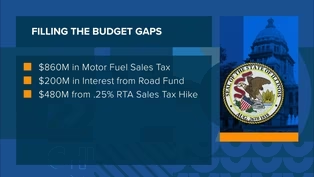
Illinois Lawmakers Approve $1.5B Transit Funding Bill
Video has Closed Captions
Clip: 11/5/2025 | 12m 40s | The sweeping transit package reshapes how CTA, Metra and Pace are run and funded. (12m 40s)
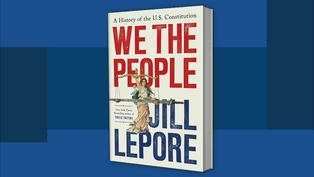
New Books Says US Constitution Was Intended to Be Amended
Video has Closed Captions
Clip: 11/5/2025 | 8m 22s | Historian and author Jill Lepore explores the U.S. Constitution in "We the People." (8m 22s)
Providing Support for PBS.org
Learn Moreabout PBS online sponsorship
- News and Public Affairs

Top journalists deliver compelling original analysis of the hour's headlines.

- News and Public Affairs

FRONTLINE is investigative journalism that questions, explains and changes our world.










Support for PBS provided by:
Chicago Tonight is a local public television program presented by WTTW
WTTW video streaming support provided by members and sponsors.