
Oral history project preserves the legacy of Detroit women in jazz
Clip: Season 54 Episode 6 | 9m 48sVideo has Closed Captions
Oral historian Veronica Johnson discusses the Detroit Women in Jazz Oral History Project.
Oral historian Veronica Johnson has partnered with the Detroit Sound Conservancy to create the Detroit Women in Jazz Oral History Project. The project digitizes and archives interviews with women in Detroit’s jazz scene. One Detroit contributor Cecelia Sharpe of 90.9 WRCJ talks with Johnson about the women who have shaped Detroit’s jazz scene and how their stories are being preserved.
Problems playing video? | Closed Captioning Feedback
Problems playing video? | Closed Captioning Feedback
American Black Journal is a local public television program presented by Detroit PBS
Oral history project preserves the legacy of Detroit women in jazz
Clip: Season 54 Episode 6 | 9m 48sVideo has Closed Captions
Oral historian Veronica Johnson has partnered with the Detroit Sound Conservancy to create the Detroit Women in Jazz Oral History Project. The project digitizes and archives interviews with women in Detroit’s jazz scene. One Detroit contributor Cecelia Sharpe of 90.9 WRCJ talks with Johnson about the women who have shaped Detroit’s jazz scene and how their stories are being preserved.
Problems playing video? | Closed Captioning Feedback
How to Watch American Black Journal
American Black Journal is available to stream on pbs.org and the free PBS App, available on iPhone, Apple TV, Android TV, Android smartphones, Amazon Fire TV, Amazon Fire Tablet, Roku, Samsung Smart TV, and Vizio.
Providing Support for PBS.org
Learn Moreabout PBS online sponsorship- Destination Detroit is an ongoing project of Detroit PBS.
Explores the region's rich history and the people who helped shape it.
Detroit's music legacy is an important part of that history.
"American Black Journal" contributor, Cecilia Sharpe of 90.9 WRCJ, spoke with oral historian, Veronica Johnson, about her project with the Detroit Sound Conservancy, which chronicles the stories of the women who have influenced the city's jazz culture.
Take a look.
(buoyant music) ♪ The rhythm, exciting melodies ♪ - Jazz in Detroit is more than music.
It's a living archive of resilience, rhythm, and roots.
For generations, the city has been a magnet for jazz musicians.
Now, Veronica Johnson is documenting stories of women who shaped Detroit's jazz scene and beyond, voices often left out of the spotlight.
She is interviewing the musicians and sharing their stories.
What sparked your interest in jazz?
- Well, actually, my interest in jazz goes back to college.
I just became just really, I guess, enamored with the music itself, the history of it, you know, the culture, you know, just how important this music is to the foundation of Black American music.
- What inspired you to take a closer look at the women in jazz, and to collect their oral histories?
- I started doing all this research, and I realized like, wow, who is covering the current female Detroit musicians that are all here, kind of carrying on this lineage?
So that's kind of what really inspired me to wanna dig deeper and tell their stories.
- [Cecilia Sharpe] Those stories are part of the growing oral history collection in Detroit Sound Conservancy's Digital Archives.
- [Cecilia Sharpe] So far, dozens of jazz musicians have participated in the project.
- I basically interview everybody from straight ahead, the great female jazz group from Detroit, great drummer, Gayla McKinney, Alina Moore, piano player.
I've interviewed a lot of vocalists, like Naima Shamborguer or Ursula Walker, Kate Patterson, Taslimah Bey, great ragtime pianist.
So that's just a few, but there's plenty of people I've interviewed so far.
- [Marion Hayden] So my father would make sure - You partnered with the Detroit Sound Conservancy on this oral history project.
How did the collaboration come together?
- So I've always been connected to Detroit Sound Conservancy in some form or fashion.
So when I started my world history project, like several years ago, I did start off kind of going with Detroit Sound Conservancy.
So now we're working to, like I said, archive and digitize these oral histories for the world to see.
- [Cecilia Sharpe] The public will be able to listen to them at detroitsound.org.
- [Cecilia Sharpe] Partnering with Johnson on the oral histories is just one way the Detroit Sound Conservancy is helping preserve music history.
Michelle Mama Jahra McKinney, Director of Collections, explains.
- Well we do it especially through place keeping.
So an example would be us rehabilitating the Bluebird Inn.
We do it through actual archiving and preserving, which we are taking in the collections of musicians and people who create around the music, and we make them accessible, and digitize them, or whatever we have to do so that people from years later can come and see, "Wow, this is great.
This happened in Detroit?
This person did that?"
We create educational resources and collaborations, so that's especially gonna show up when we get into the Bluebird Inn.
- Tell us a little bit about the Bluebird Inn.
- Well the Bluebird Inn is an iconic, historic jazz club, and it's just a little neighborhood bar.
And that place became a haven, because at that time, it was a lot of segregation in the city of Detroit, and there were places where Black folks could go and Black folks could not go, and it was a place where you could have Sunday brunch, and you could see your neighbors, and you could feel safe, and you could be your Black self.
(laughs) - Unapologetically.
- Unapologetic, yes.
- Without fear.
- Without fear.
- [Cecilia Sharpe] For generations, Detroit has drawn artists from all over, some just passing through, but many staying for good.
The city is also home to the world's largest free jazz festival, the Detroit Jazz Festival, drawing hundreds of thousands of attendees each year.
♪ It's time for you to get up and show the world ♪ ♪ What we have in store - How do women shape the jazz culture in Detroit?
- They had a great impact on it.
And you know, that kind of stuff that you can hear that's toe tapping, and you can sing along with it, and remember the melody, and be humming it to yourself, that was made more possible by women singing in jazz, to me, the storytelling.
♪ All of me ♪ Why not take all of me ♪ Can't you see, I'm no good without you ♪ - When we think about that Detroit sound, what is it about the sound of Detroit that makes it so unique?
- It still comes out of community.
Actually, not even community, family-hood.
That's what, to me, is what makes the communication, and the mentorship, and the passing things down that Detroit musicians do.
It has extended worldwide.
And so not only is it a sound, it's a feeling, it's a feeling of connectedness in a family-hood, and somehow that's embodied in the music.
(passionate jazz music) That Detroit sound that was in the really basic music that was there, created by the jazz musicians, the improvisation, the African rhythms that are embedded in it, all of that context is still going on and created that Detroit sound between the love that is in that music.
It's pure love.
- What made Detroit a destination for jazz?
Or was jazz the destination for the people?
- Detroit, as a destination for musicians, it always has been, because of the music that they brought as they migrated North.
But at the same time, it's all also about the connections.
Like Marcus Belgrave, he was just coming through Detroit with Ray Charles, and he said, "Oh, I love this city."
Yeah, and people taking him under their wing and talking to him, and he left Detroit and he came back, and he said, "I can't leave this place."
He didn't wanna leave.
- What is it that you hope that people walk away with after hearing some of these stories?
- Well, I just really want people to realize how, like, you know, their work ethic, the resiliency of these women.
You know, like again, a lot of the women I've interviewed, some in their seventies and eighties, still performing.
So it just goes to show how much they love music and I just want people to realize, like that obviously, women have as much of an influence and impact on Detroit jazz as the male counterparts.
So I just want people to see the breadth and depth of these women and what they've done, and what they've accomplished throughout their years.
(passionate jazz music) (crowd cheers) (crowd applauds)
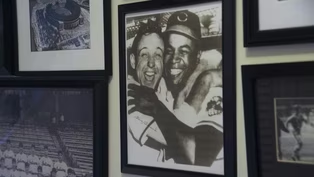
Iconic hug photo from 1948 World Series, a symbol against racism
Video has Closed Captions
Clip: S54 Ep6 | 12m 18s | The story behind an iconic photo of two baseball players hugging after the 1948 World Series. (12m 18s)
Providing Support for PBS.org
Learn Moreabout PBS online sponsorship
- News and Public Affairs

Top journalists deliver compelling original analysis of the hour's headlines.

- News and Public Affairs

FRONTLINE is investigative journalism that questions, explains and changes our world.












Support for PBS provided by:
American Black Journal is a local public television program presented by Detroit PBS