
Rea Tajiri on telling her story in caregiving film “Wisdom Gone Wild,” a look at expert caregiving panel
Clip: Season 10 Episode 34 | 16m 31sVideo has Closed Captions
“Wisdom Gone Wild” documents the story of a daughter caring for her mother with dementia.
“Wisdom Gone Wild” is a documentary about a daughter’s journey caring for her Japanese American mother with dementia. As part of our caregiving initiative, Detroit PBS presented a screening of the film at the Michigan Theater followed by a panel discussion featuring filmmaker Rea Tajiri and experts on caregiving and dementia health. One Detroit’s Bill Kubota sat down with Tajiri to learn more.
Problems playing video? | Closed Captioning Feedback
Problems playing video? | Closed Captioning Feedback
One Detroit is a local public television program presented by Detroit PBS
Rea Tajiri on telling her story in caregiving film “Wisdom Gone Wild,” a look at expert caregiving panel
Clip: Season 10 Episode 34 | 16m 31sVideo has Closed Captions
“Wisdom Gone Wild” is a documentary about a daughter’s journey caring for her Japanese American mother with dementia. As part of our caregiving initiative, Detroit PBS presented a screening of the film at the Michigan Theater followed by a panel discussion featuring filmmaker Rea Tajiri and experts on caregiving and dementia health. One Detroit’s Bill Kubota sat down with Tajiri to learn more.
Problems playing video? | Closed Captioning Feedback
How to Watch One Detroit
One Detroit is available to stream on pbs.org and the free PBS App, available on iPhone, Apple TV, Android TV, Android smartphones, Amazon Fire TV, Amazon Fire Tablet, Roku, Samsung Smart TV, and Vizio.
Providing Support for PBS.org
Learn Moreabout PBS online sponsorship(intriguing music) (gentle music) - [Rea VO] Throughout our lives, I always had questions about Rose's past that she would never answer.
(bells chiming) (Rose vocalizing) - "Wisdom Gone Wild" is a film about caregiving.
- So I (indistinct).
- It's about Mom, particularly my story caregiving my mother over 16 years.
My mother had dementia.
And I wanted to make a film that was as accurate a portrayal as I could muster that was both observational, but also a little bit poetic, and that centered my mother as a character.
- [Rea VO] A window opened up, I slowed down to embrace the dream logic.
Listening, she began to answer.
My experience of spending time with my mom was kind of, after a while, it become kind of like going on a stream of consciousness through her life.
And she would kind of go sometimes backwards in time.
And I got to know different people that she grew up with.
Or sometimes she would be talking to her sister who had passed away or another sister who had passed away.
- Helen, are you there?
Now, who could bring in the brown rice from your pack?
Helen.
Helen is going to do that.
- Sometimes I really learned things that she had never told me about, and I kind of tried to fact check them and say, "Well, did she go to school over here?
Did this happen?"
So that was really interesting.
Sometimes it didn't seem like she was making sense, but she was actually making sense in her own way.
- That's the way it was.
- They did, huh?
- We went crazy, we went crazy, we went crazy.
We wanted our children to know that.
Now you know how we felt.
- It seems that it's inevitable that all of us are going to have to find, you know, we have to tap into something in ourselves.
We will all become caregivers at some point in our lives or be taken care of.
And it may be your parents, it may be someone else, maybe a friend.
And so somehow, like, you know, this has to become part of our, has to be normalized as part of our culture.
I know it's very much part of Asian culture, but in the US it's something that we don't necessarily think of.
It's like, oh, this a burden.
But really, we've to find a way to kind of embrace this as a process, yeah.
- They're having fun without their mothers.
- [Rose] Oh boy.
- Following the showing of the film, "One Detroit's" Bill Kubota moderated a panel discussion that featured the filmmaker and three local experts on caregiving and dementia health.
Here's a portion of that conversation.
- Rea, talking about this film, making the film, you know, how it came about probably a while ago.
How does this all get started?
- So, as I said, you know, I was a caregiver for my mom.
This was going back to actually ancient history, 1997.
I was on the eve of a really nice success.
I was gonna go to the Venice Film Festival.
And my mom and I had a discussion on one day, she was gonna help me out, a poor filmmaker couldn't afford.
She was gonna put in on her credit card so I could fly out to the Venice Film Festival.
And then she said, "We'll discuss it more tomorrow."
I called her the next day and suddenly she didn't recognize my voice, and she had no recollection of the conversation.
So I knew something was wrong.
And, anyway, we worked out the details.
I went, but the whole time I was there I knew something was wrong, and that was the first indication.
Anyways, fast forward over, you know, the next two to three years she developed and then she finally was diagnosed with dementia.
And I was flying back and forth a lot.
In the beginning, my friends would say, "Oh, you should really make a movie out of this."
And I really didn't want to because I thought, "Well, this is so personal."
I wasn't ready, you know?
I wasn't ready to do that.
But then, you know, as years went by, I would take photos, I would have little video clips on my phone.
I was kind of, you know, showing things to family members who wanted to kind of update.
So I developed this archive of really, you know, like a lot of little clips here and there.
And then I started to realize like, you know, there really isn't anything out there that really shows what it's like to be a caregiver.
And there's nothing that I really relate to in terms of the media or the depictions or the conversations around dementia.
A lot of it was around tragedy.
And, you know, of course, there's loss in this process, and, of course, there's hardship, but there's also other aspects to this.
For lack of a better word, I hate this word, but sometimes I'll have to use it like humanizing, right?
It's like something that really puts us in touch with the cycles of life, loss, aging, but also connection and really starting to come to terms with what your parent or your loved one has been, what they've been through throughout core course of their life.
And I wanted to, you know, try to encapsulate some of these things, these experiences that I was witnessing.
I wanted to find a way so that people wouldn't necessarily be instantly like, "Oh my God, that's so awful."
You know, "That must just be so hard."
And I kind of got tired of, you know, getting that response from people.
I just wanna say, "No, it's part of life actually."
- Well, I'm interested in the three of you up here watching this what you thought.
- Okay, so I actually have different feelings when I watch it a second time.
So I think it's a very gentle and honest way to approach caregiving.
It's just daily life.
Sometimes we feel it's repeated and we might get bored, but just it's real life.
Everybody's gonna have aging.
But I see Rose, you really enter her inner world and respect her.
So she keep her personality, identity, and she's dignity.
So I really love the movie.
- [Rea] Thank you.
- I think I was also struck by the idea that you presented of change being part of life.
And I think that's something that I see a lot of my patients and their families struggle with, is they're holding on this idea that people stay the same.
And that's, you know, if we're talking even outside of dementia, other medical diseases, other things in our life, none of us stay the same.
And I think Rose's story was really interesting because of some changes that were forced upon her.
And I think the thing that really stuck out in my mind was that image of, well, this was her name, and then this was her name, and then this was her name, and this was the name that she gave herself as she was becoming this new person.
And so, you know, the scene of her talking about you have to learn about yourself, right?
And that has really stuck with me and this idea of change being a process that we can't escape, but we can learn how to kind of deal with and manage, and it's part of what we try and help people do.
But it doesn't necessarily mean it's an easy thing as I'm sure many of us know.
- For me it was very raw and very unapologetic view on caregiving.
Not only from your aspect, but from your mom's aspect as well.
Just even something so simple as you walking into the room and opening the blinds in the morning.
For me, that was my routine with my father.
But just seeing that brought me back all to those days of caregiving for him, the years that he was, you know, bedbound.
And, again, just offering that type of dignity to your mom, it was just beautiful.
- Caregiving, you know, is kind of part of our culture as Asian Americans.
And, you know, sometimes I think about, well, maybe at least with my family, but Shaista you were talking a little bit about that.
We all were, but talk about that a little bit.
- I think one of the things that, you know, as my journey as a caregiver evolved and what I had seen was that especially within my own community, it was all laid on the, you know, eldest daughter especially, although I have a brother who was four years younger, it was all going to be on me.
And for me it was just a perfect storm of things that happened.
First, my father was diagnosed with a debilitating neurological condition, and at the same time my mother-in-law came to live with me from India.
And it was just these challenges that I had to face day to day and contacting local senior care companies to help with the day-to-day activities was not only something that was so foreign to them, but it was very difficult for me as well.
I had to contact, you know, I contacted another local group and they were like, "Well, why don't you contact your local mosque or temple or gurdwara."
And I was like, "Well, I did, that's why I'm coming to you to ask for a resource."
And they had nothing.
And it wasn't until, to be honest, my best friend who's sitting here in the audience, it was somebody in her community who was looking for work and by chance was a CNA who was able to place with my mother-in-law.
So that woman spoke the same language, she could cook the same similar foods for her.
And she was able to fit the role that I could not as I was trying to balance both households and three small children.
But again, it usually falls on, especially within our culture, it's the, you know, eldest daughter.
- It's something I was thinking about a lot how dementia culturally fits within Asian American communities or kind of in Asian cultural context.
And it's always tough to say, right, BEcause it's not a monoculture, there's all different types of people and cultures and things, but my experience and I think, you know, Shaista's experience speaks to that too, tends to be limited to family, right?
And particularly on the oldest, especially oldest daughter or daughter-in-law.
And I think one of the things that, especially in the kind of day and age we live in where family's not all together, they might be farther apart, is that network sometimes needs to be broader or larger.
And I think about potentially the stigma that might also go along with having problems with behavior or thinking skills or memory skills and how that might also be a part of some of our cultural context and that disconnect there of saying, "Well, it's in our culture to take care of our elders and to look out for family, but maybe not necessarily to involve other people in your community."
And I think that's something that I know I think about a lot in my practice, especially in this day and age as something that we should be maybe hoping to change a little bit.
- Yeah, I think there are many stigmas in the (indistinct) communities, like roles.
Like Rose, she refused to take so many medicines, which is vitamins, and I think people just don't want to go to doctor.
And also all the caregiving happens mostly very quietly at home and the family caregiver wouldn't like go outside to seek support even though they have maybe challenge balancing their family and work.
I think it's not a option or choice, it's responsibilities to taking care of the elderlies in the family.
And therefore we do see, like ACAs daily work.
We serve lots of immigrants, families, Asian families, but we do see their big burden, like due to the cultural barrier, language barrier, they kind of feel the resource available is not accessible.
It's kind of gap.
So I think it's challenge for them, just don't know where to seek for help.
And so I think based on a lot of things (indistinct) did, we're trying to help create things like, it's not one person's responsibility or just a sister.
And it could be teamwork, like it could be efforts from the whole community so that we have more resources put together for those caregivers and those who need to be taken care of.
- I'd like you to talk a little bit more about what you've done with your organizations, you know, and how that came about and where it's going.
- So I started this company in 2014 when my father was diagnosed with a debilitating neurological condition.
At the same time, as I said, my mother-in-law had come to live with me from India.
My husband decided right at that time that he had to go and do a fellowship in critical care.
So, you know, to balance both households and three small children, he was like, "Why don't you contact one of these local senior care companies?
And they'll help, you know, with ummi," and I did.
And unfortunately they just could not meet those unique challenges that she was facing.
Language, of course, the food was one of the biggest thing, language and food.
And with my parents language was not an issue.
They had immigrated here in 1973=74, but the cultural nuances were far greater.
So in 2014, I quit my job as a clinical research coordinator at Providence Park in neurological sciences.
And I started this company not having a business background whatsoever, but just knowing that I could not be only person in this situation.
There had to be others.
- Are we seeing more, you know, culturally specific companies along your lines?
I'm under the impression not that much of that going on.
- No, we were the first agency here in the state of Michigan and still in others.
There's one out in New York that's catering to the Russian community, the elderly Russian community.
But the idea for Apna Gharz, now Sukoon Care is to be kind of an umbrella for all elderly ethnic minorities.
We want everybody to come here to get the information that is needed to care for their loved one, again, to allow them to age in place with dignity and respect.
But yes, we are the only agency at this point in time.
We have calls from, you know, other people in other states, but unfortunately we're not there yet.
We hope to be.
But what we do offer those individuals is if we can send referrals for live-in caregivers.
Those caregivers can live in with your parents and that allows them also, you know, the freedom to stay in place.
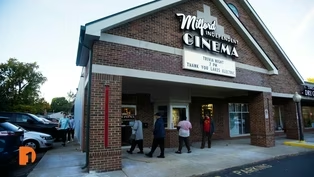
How one community rallied to save their hometown movie house
Video has Closed Captions
Clip: S10 Ep34 | 6m 52s | One Detroit visited the cinema last year and has this report on its history and operations. (6m 52s)
Providing Support for PBS.org
Learn Moreabout PBS online sponsorship
- News and Public Affairs

Top journalists deliver compelling original analysis of the hour's headlines.

- News and Public Affairs

FRONTLINE is investigative journalism that questions, explains and changes our world.












Support for PBS provided by:
One Detroit is a local public television program presented by Detroit PBS