
Stories from our Destination Detroit series
Season 11 Episode 6 | 26m 46sVideo has Closed Captions
A look at Michigan’s Chaldean history, the legacy of Detroit radio station WCHB and more.
We’re featuring stories from our Destination Detroit project. We’ll hear how Chaldean Americans found success in the city and how an African American family made radio broadcasting history. Plus, we’ll tell you about people who migrated to Michigan from eastern states, Dearborn mayor tells the story of his family’s immigration and the past and future of Detroit’s Chinatown.
Problems playing video? | Closed Captioning Feedback
Problems playing video? | Closed Captioning Feedback
One Detroit is a local public television program presented by Detroit PBS
Stories from our Destination Detroit series
Season 11 Episode 6 | 26m 46sVideo has Closed Captions
We’re featuring stories from our Destination Detroit project. We’ll hear how Chaldean Americans found success in the city and how an African American family made radio broadcasting history. Plus, we’ll tell you about people who migrated to Michigan from eastern states, Dearborn mayor tells the story of his family’s immigration and the past and future of Detroit’s Chinatown.
Problems playing video? | Closed Captioning Feedback
Where to Watch One Detroit
One Detroit is available to stream on pbs.org and the PBS app.
Providing Support for PBS.org
Learn Moreabout PBS online sponsorshipComing up on One Detroit, stories from our Destination Detroit series, we'll hear how Chaldean Americans found success in the area.
Also ahead, an African American family makes radio broadcasting history.
Plus, we tell you about people who migrated to Michigan from eastern states.
Dearborn's mayor recalls how his family settled in that city and the past and future of Detroit's Chinatown.
It's all coming up next on One Detroit.
Across our Masco family of companies, our goal is to deliver better living possibilities and make positive changes in the neighborhoods where we live, work, and do business.
Masco, a Michigan company since 1929.
Support also provided by the Cynthia and Edsel Ford Fund for Journalism at Detroit PBS.
The Debt Foundation is a proud sponsor of Detroit PBS.
Through our giving, we are committed to meeting the needs of the communities we serve statewide to help ensure a bright and thriving future for all.
Learn more at DTB Foundation.
Nissan Foundation, and viewers like you.
Hello, Im Zosette Guir, and this is one Detroit.
Our Destination Detroit series tells the stories of the people who came to Southeast Michigan and helped shape the region's rich and diverse history.
We're sharing some of these stories on this episode of One Detroit.
First up, Chaldeans who are Christians from Iraq have lived in this area for more than a century.
One Detroit's Bill Kubota spoke with a member of the Chaldean community, Jane Shallal, about her family's local business and her career as a police officer, attorney and community leader.
Jane Shallal checking in on a Troy nonprofit helping people in need.
I've been like with this organization for like 35 years.
Another food distribution day.
Most of the people here that work at the United Community Family Services are Chaldean or Iraqi or refugees themselves.
Shalom recently retired as CEO of United Community Family Services, called the Chaldean Ladies of Charity when it started more than 60 years ago.
This is a nonprofit agency established by 20 women.
They started it in 1961.
Back then, we were helping new immigrants come to the United States and get them resettled.
But as a refugee started coming in, we started responding to their needs.
There's been a big influx of Ukrainian refugees, Afghan refugees, and of course, still Iraqi refugees, and it's not limited to refugees.
The post nine over 11 conflict in Iraq brought a more recent wave of Chaldeans.
Shallals Chaldean American stor goes back a half century before that.
So my dad was from Texas.
It's a small village in Iraq.
There's like 4 or 5 villages north of Baghdad that most of the Chaldeans come from.
My dad was 13 years old and he told his mom that he was going to America.
As he shall all spent time in other countries before making his way to the U.S.. Arriving in Detroit in the 1950s, he worked in the grocery business.
He definitely had that business sense and that entrepreneurship skill.
Chaldeans owned a lot of stores in Detroit.
They still do.
That's how Chaldeans came to the United States.
They came here because they knew there were other Chaldeans here, number one, that could speak their language, and number two, that could help them get their businesses started.
So a lot of Chaldeans went on to buy their own businesses.
So it was like a pathway to success.
Jane Shallal, born in Iraq, she, along with her mother and siblings, joined her father in Detroit in 1960.
Her citizenship ceremony made the newspaper.
Around that time, her father bought his own grocery store.
It was four star supermarket on Jefferson in Detroit.
Our entire family worked there.
Even I worked there as a little kid.
The family would own more stores around town.
Although some of the bigger supermarkets and chain stores left to like Farmer Jacks, Chatham, Wrigley's, the Chaldean State and the supermarkets were basically the only food centers for the residents of Detroit.
In the late 70s, shell finished college.
I was going to go to law school and then I don't know.
I was surrounded by police officers at the time because I was getting my degree in criminal justice.
And they go, you should be a cop, Jane.
And so I said, no, I don't know.
I'm going to law school.
They said no.
So they dared me, okay, to apply to the Detroit Police Department.
I was the first Chaldean police officer.
The first, she says, man or woman?
I think that because there were more women coming into the police department.
It was more acceptable.
But yeah, for the Chaldean community, that was a shock.
Shallal would go to law school, worked as a prosecutor, an assistant U.S.
attorney, and as an administrator with the Attorney Grievance Commission.
She'd lead the Associated Food Dealers of Michigan, looking out for local grocers, many owned by Chaldeans.
Of course.
A lot of Chaldeans move to where their churches are, you know, because they're very religious and they're very faith oriented.
So the Mother of God Church was the original church.
And so people started moving to Southfield.
Chaldean churches are Catholic of the eastern right, similar to Roman Catholic, but with different rituals and traditions.
Chaldean population grew, and then there was other churches in Oak Park, West Bloomfield, other areas.
Then you saw a large population going to the east side like Sterling Heights, Warren, Shelby Township, because the population keeps growing and it's a very strong faith based population.
There's concern some Chaldean culture could be lost.
Scholz heard it from Iraqi refugees.
When they come over here, I was surprised to see about how many Chaldeans didn't speak Chaldean.
The Chaldean language goes back before the time of Christ.
More often, Chaldeans now speak Arabic, as so many have spent years in Arab speaking countries before getting here.
The Arabic people do not understand Chaldean.
It was mostly a language spoken in the home, and it's been preserved that way.
And it's actually on the National Geographic's endangered language list.
What has been lost?
Detroit's called the in town on the northeast side.
For quite a few years.
It was flourishing all along Seven Mile Road.
There were a lot of Chaldean businesses, markets and coffee shops, things like that.
In recent decades, residents and businesses slipped away off to the suburbs.
These days, 187,000 Chaldeans live in the region, according to the Chaldean Community Foundation, more than anywhere else in the U.S.. Nationwide, there's about a half million now.
There's a big population in San Diego, California, and they've also expanded with the same businesses.
They have a bunch of retail stores out there, too, and then also they expand it to Phoenix, Arizona.
There's a big hellion population in Arizona as well.
And they also have the same type of businesses.
Next up, we have a conversation with two members of the family who made radio broadcasting history.
With the creation of WCHB and WCHD radio stations.
WCHB was the nation's first African-American owned and operated radio station built from the ground up and WCHD which later became WJZZ, was the first jazz radio station.
One Detroit's Bill Kubota has the story.
Motown founder Berry Gordy his family came to Detroit from Georgia in the 1920s, around the same time Doctor Haley Bell arrived.
Grandpa Bell came to Detroit in 1923.
He's from Brunswick, Georgia.
He was born in 1895 and Mary Bell, his wife.
She was born in Lebanon, Tennessee, which is outside of Nashville, in 1900.
Another great Migration story Annette Bass came to Michigan Central last year to tell us about Bell Broadcasting for our Destination Detroit project.
Grandma Bell said they put three cities in a hat and one was Texas.
I think the third one was West Virginia in Detroit was second.
So they drew Detroit twice.
So they decided to come to Detroit.
Three decades later, Doctor Bell, a successful dentist, had saved up to build a radio station, partnering with sons in law Wendell Cox and Robert Bass, WCHB 14:40 a.m.
first broadcast November 7th, 1956.
What many researchers and historians argue if there had not been WCHB that launches in 1956, there would not be a Motown Records.
Coming to you live from WCHB.
It's most definitely the jolting JOE getting down to the nitty in this Detroit city.
And I can remember Berry Gordy coming over to my house when we lived down Lafayette Park back in the 60s, with 2 or 3 for 45 in his hand, asking my father, Doctor Bass, can you please see if you can get these on the air next week for.
Me if they were airworthy?
Eric Bass said WCHB would play them first before the other Detroit stations would get a chance.
Doctor Bell was a dentist.
He set up his dental office in Hamtramck.
Doctor Cox, my office, set up his office down the street near Holbrook, my grandfather's office near Caniff.
And when my father got out of the dental school, he set up shop in my grandfather's office, also on Joseph Campbell.
So all three of them operated there.
Three black dentists servicing the 90% population of Polish people back in the 50s and 60s.
Doctors Bell, Bass and Cox owned the first black owned radio station in the USA, built from the ground up.
Then my grandfather, he wanted to get into broadcasting because Detroit's black population was booming in those days.
It was growing exponentially.
Great migration brought a lot of black people from the South to Detroit, and there was no television, no radio targeting them specifically.
He applied for a FCC license for a building permit to build a station in Detroit to to target the black audience.
He was denied multiple times back in the 50s.
The Federal Communications Commission wouldn't let them in Detroit, but they got the okay in Inkster, west of the city.
Annette Bass, husband Bobby Bass, along with brother Eric Bass, became Bell Broadcasting executives.
With few family members left.
And that's trying to preserve the Bell broadcast legacy.
All those are archive boxes down there.
Those are all family members.
I mean, these are files.
Those are employee files over there.
When my husband passed in 2013.
He left.
Me with all this material, most of it he inherited from his grandmother's.
WCHB Detroit soul radio.
The soul of the city 1440 WCHB And it covered the news for the black audience.
June of 63.
Martin Luther King did his first version of I Have a Dream.
It was two weeks after Medgar Evers was assassinated.
And they had a march in Detroit.
Because I remember I got tired of walking.
My dad put me on his shoulders and we walked from, like, the boulevard all the way to Jefferson.
That was a long way.
And then after the march, everybody went to Cobo Hall, and that's when he first did his first version of I Have a Dream.
WCHB there to put it on the air.
And so his plantation background gradually gave way to urban industrial life.
Well, this is pretty unique, man.
My grandfather couldn't have pulled us off any other place, in my opinion.
Detroit was a once in a lifetime deal, you know, that's why I come to Detroit.
We probably wouldn't have enjoyed this success anywhere else.
Wow.
Radio talent then in binders.
Now, 60 years later.
Who are they?
Annette bass wants to put names to the faces.
I said if anybody recognizes.
Yeah, please write their name down.
You know.
I have people there.
Some of them.
Now, check this dude out.
This cat named Robbie Dee.
He was a white jock, obviously, that worked for back in the 60s.
Time magazine featured Mr.
Hip Lip Robbie D in 1967.
WCHB, Rocking Robbie D, What's Happening for you?
This is WCHB about the and proudly serving all together Detroit land 1440 minutes a day.
One of the things was shut your trap, sit on my lap and hail my rap baby.
That was a little.
You say that now.
Now he is working for a black owned and operated radio station in the mid 60s.
Man, this cab was ahead of the time.
Bell broadcasting put FM station WCHD on the air in 1960.
Not many FM listeners.
Then WCHD played jazz in.
Annette's late husband Bobby helped run the operation, gathering a faithful audience.
That's why you have to have people who are really locked into that.
That was Bobby strength.
Bobby really understood jazz music.
There was another jazz station in Connecticut programed by pianist Dave Brubeck of Take Five fame called WJZZ, but in the early 70s it gave up its call letters, and Bell Broadcasting took them, renamed WJZZ, with the station's marketing man, Eric Bass, helping roll out their iconic logo.
I saw that, said Bobby, that's it.
That's the radio station that that that's who we want to be.
That's what we want people to see, WJZZ and think about Detroit.
And it was so prolific that when it hit, we said, we're going to put this on hats.
We're going to put it on shirts.
We're going to put it on billboards.
At WJZZ Detroit Jazz 106.
By the 1980s, jazz radio evolved into smooth jazz, with WJZZ on top.
Recognized nationally for its programing and tie ins with the likes of concerts at Shane Park and the Detroit Jazz Festivals.
That's from 81.
There was always a smooth jazz show it down at the Fox, a smooth jazz show down the orchestra hall, a smooth jazz function here, smooth jazz funk until the format became until it didn't generate enough money.
Then they made it overnight.
Gone.
Radio and transition.
Bell broadcasting forced to adapt.
So small, independently owned families like mine you had to do 1 or 2 things.
You either had to get bigger to compete or they want to squeeze you out.
And we hung out.
We hung for a long time and competed.
Bell broadcasting sold its stations in 1998, but the history still here with Annette Bass sorting it out.
This family was very unique.
They were like radio royalty.
That's what I consider them.
Radio royalty.
Detroit PBS produced an hour long documentary titled Destination Detroit, which highlights our regions history and its connection to the nation's evolving story.
The film features interviews with more than 60 people.
It can be viewed at Detroit, PBS.org, Detroit, or on the PBS app.
Here's a preview.
Detroit's iconic train station at Michigan Central.
Full of history.
American history.
It's been called.
The Ellis Island of the Midwest.
My family came to Detroit via my grandmother.
Everybody comes from somewhere.
And she came from Natchez, Mississippi.
She came on train.
People gathered at the train station to share their migration stories.
My grandparents were born in Fort Time in Germany, and my dad was actually born there as well.
And they immigrated to Detroit in 1954.
So I'm first generation American on my dad's side.
I came as a refugee from Burundi.
I've been here since November 2015.
Detroit PBS presents Destination Detroit Stories from people who came here and built the Motor City.
Troy, we always think about its population loss, and it's lost more population than any other city.
It grew faster than any other city in the country.
It becomes this major city that's growing so fast because of the automotive industry.
And the African-American population in Detroit skyrockets.
New travel, luxury in every Ford car.
Detroit was fast and wide.
Both of my grandfathers felt that it was imperative to get somewhere.
That was hustle and bustle.
The legacy of the American auto worker carries on to this day.
I come from labor laborers in my blood.
It comes from the history of my family.
My grandfather and my mom's family.
They come over here in 1974, at the time of the Lebanese Civil War was about to start, but also for the opportunity pursuing the American Dream.
America at 250.
Our country's anniversary.
A time to look to the future and reflect on our past.
My mother's family is from Zacatecas, Mexico.
You know, this neighborhood has been revitalized many times over by new families coming in.
They don't know any of this.
We have to tell our own story.
After the war, about 100,000 Holocaust survivors come to the United States, and about 4000 of them settle here in Michigan.
It was a ship.
Queen Elizabeth, and it took us about five days to get to New York.
Finally, I got to Detroit.
I felt better, much better there.
So my father, he was a South Vietnamese military personnel.
He came to Michigan in 1975.
We are nomadic beings.
We've always been moving, and so we're moving in search of opportunity.
We're moving in search of liberation and freedom.
We're moving in search of a pursuit of excellence.
One of the stories in the Destination Detroit documentary focuses on the settlers who migrated to Michigan from New England and upstate New York in the 1800s.
They were known as Yankee Yorkers, and many of them had a huge influence on politics and economics in the Detroit area.
The Erie Canal opened Detroit to more people out east.
Most of Detroit and Michigan's early Euro-American settlers trace their origins to New England and upstate New York.
And it is no coincidence that we have in the Detroit metropolitan area, a number of communities whose names can also be found in upstate New York Utica, Troy, Farmington, Livonia, Rochester all of those communities were named for the points of origin for the people who settled there early on.
People often talk about the importance of Yankee Yorker culture in early Michigan.
One Yankee yorker sitting pretty.
Hazen Pingree, Detroit mayor and Michigan governor in the 1890s, hailing from the state of Maine.
Individuals who trace their origins to that migration thread control the city well into the late 19th century in terms of politics and economics.
One example is the Joy family.
James Joy, one of the movers and shakers that helps to create Michigan's early railroads.
The Michigan Central Railroad, makes a fortune in railroads.
He originated from New Hampshire.
His son Henry, born Joy, is one of the founders of Edison Company and the founder of Packard Motor Company.
Here's one family whose name is very familiar to Detroiters there's Joy road, after all.
People still have recollections of the Packard plant and where it sat up on East Grand Boulevard and the railroad, the Michigan Central Railroad depot.
That was the railroad that James Joyce started.
But this is a family that was very influential well into the 20th century.
Another segment in the documentary features Dearborn, mayor Abdullah Hammoud, sharing how his family settled in the city that's home to the Ford Motor Company.
It also has the largest concentration of Arab Americans in the US.
Dearborn sits right on the border of Detroit.
It's home to Ford Motor Company and the first Arab American majority city in the United States.
My grandfather and my mom's family, they come over here in 1974, at the time when the Lebanese Civil War was about to start, but also for the opportunity at pursuing the American dream.
My mother was about four years old.
She came over here and obviously entered the school system at the time.
And for my grandfather, just a regular laborer, while waiting for a job on the line, found a job at a local bakery making $50 a week.
And it was that that kind of held him over until you found a good paying job on the line.
Dearborn is home to about 110,000 people, the fastest growing city in Michigan, according to the last decennial census, about 12% growth.
50% of the residents here are foreign born after the war in Iraq.
You saw a large migration of Iraqi nationals to southeast Michigan.
And so we have a large Iraqi American community with the civil strife that is persistent in Yemen.
You see a large Yemeni migration.
And within the Dearborn community, in particular amongst the large Arab American communities, the largest, I would say, is about the Lebanese and the Yemeni community.
And then you kind of have the Iraqi community and then a scattering of Syrian, Palestinian, Jordanian going across the Middle East and North African border.
My father's story slightly different.
He came over here in the early 80s.
Born and raised in Saudi Arabia, although Lebanese, ultimately my father for most of my young age was a trucker delivering the seats for the F-150, the best truck in America.
I have to say that I also believe it because I drive one.
Let's turn now to Detroit's Chinese community.
Many of the city's first Chinese residents arrived at the turn of the last century in this story from Destination Detroit.
Sandy Fat of the Detroit Chinatown Vision Committee talks about the legacy of the city's Chinatown and her efforts to preserve and revive the neighborhood.
You look at all of the people in Detroit.
Almost all of the business and restaurants were all Cantonese because they all came from canton, China.
The history of the Chinese in Detroit starts here.
Central United Methodist Church, downtown on Woodward.
Central Methodist Church had these missionaries that came to canton, China, invited the Chinese people to come to, and the church would help them get established.
So in the late 1800s, Chinese people started coming.
The city gave them this area by third and Michigan for their community.
And by the 1930s and 40s, there were like 4000 people living in Chinatown.
And then in 1960, they decided to build the Bagley Road exit off of the lodge.
So they were saying, they have to move you for urban development.
The end for the next Chinatown at Cass and Peterborough.
Inevitable.
It tried hanging on, but by the 80s most of the original residents were gone.
We were living in the suburbs, doing what all immigrant families wanted for their children to get educated, get good jobs, start their own businesses and move to the suburbs.
In 2023, one of the last historic Detroit Chinatown buildings was demolished.
Asian American groups and community leaders are now planning what might be a pan-Asian cultural district in the future.
You can't make up for what you didn't do before, but you can make up for what you're going to do now.
And that's what we're trying to do, is revitalize how neighborhood that's been basically abandoned, honoring our ancestors and the work and the risks that they took, especially these women that were not valued then and come over to this country and raise all of these children that became the Chinese population in Detroit.
Again, you can see the Destination Detroit documentary at Detroit PBS dot org slash Destination Detroit, or on the PBS app.
That will do it for this week's show.
Thank you for watching.
Head to the One Detroit website for all the stories we're working on.
Follow us on social media and sign up for our newsletter.
Across our Masco family of companies, our goal is to deliver better living possibilities and make positive changes in the neighborhoods where we live, work and do business.
Masco, a Michigan company since 1929.
Support also provided by the Cynthia and Edsel Ford Fund for Journalism at Detroit PBS.
The Dty Foundation is a proud sponsor of Detroit PBS through our giving.
We are committed to meeting the needs of the communities we serve statewide to help ensure a bright and thriving future for all.
Learn more at Dty Foundation.
Nissan Foundation.
The Corporation for Public Broadcasting and viewers like you.
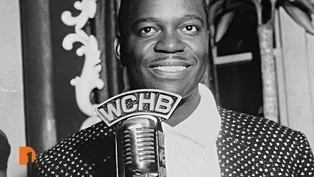
A look into the history of the family who created WCHB radio
Video has Closed Captions
Clip: S11 Ep6 | 7m 42s | Family members talk about the history and legacy of Detroit radio station WCHB. (7m 42s)
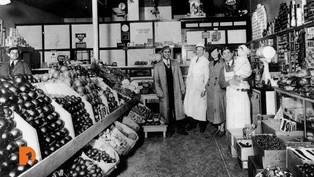
Michigan’s Chaldean history, Jane Shallal shares her family’s story | Destination Detroit
Video has Closed Captions
Clip: S11 Ep6 | 5m 50s | In this Destination Detroit segment, we share stories of Chaldeans who made the area home. (5m 50s)
Providing Support for PBS.org
Learn Moreabout PBS online sponsorship New Episode
- News and Public Affairs

Top journalists deliver compelling original analysis of the hour's headlines.
 New Episode
- News and Public Affairs

Today's top journalists discuss Washington's current political events and public affairs.
 New Episode
 New Episode
 New Episode
 New Episode
 New Episode
 New Episode
 New Episode

 New Episode
 New Episode
Support for PBS provided by:
One Detroit is a local public television program presented by Detroit PBS