
The therapeutic benefits of storytelling for seniors
Clip: Season 11 Episode 5 | 7m 19sVideo has Closed Captions
Research shows deeper conversations and storytelling helps senior citizens and their caregivers.
Our special episode on caregiving explores the therapeutic impact of storytelling on senior citizens and their caregivers. Research shows better health outcomes for the elderly who openly reflect on their life stories, as well as for listeners hearing those stories. One Detroit senior producer Bill Kubota spoke with experts and staff at senior living facilities about the benefits.
Problems playing video? | Closed Captioning Feedback
Problems playing video? | Closed Captioning Feedback
One Detroit is a local public television program presented by Detroit PBS
The therapeutic benefits of storytelling for seniors
Clip: Season 11 Episode 5 | 7m 19sVideo has Closed Captions
Our special episode on caregiving explores the therapeutic impact of storytelling on senior citizens and their caregivers. Research shows better health outcomes for the elderly who openly reflect on their life stories, as well as for listeners hearing those stories. One Detroit senior producer Bill Kubota spoke with experts and staff at senior living facilities about the benefits.
Problems playing video? | Closed Captioning Feedback
Where to Watch One Detroit
One Detroit is available to stream on pbs.org and the PBS app.
Providing Support for PBS.org
Learn Moreabout PBS online sponsorship(upbeat music) - [Sabrina] One of the reasons I continue to show up every day is their stories.
- [Resident] And see?
- Yeah.
- [Bill] Sabrina Seymour, Life Enrichment Director at StoryPoint Assisted Living in Northville.
- [Interviewer] Do you see their eyes light up or?
- I do.
I mean, you see it all over their face.
You hear it in the change of their tone.
I wish people knew what they could learn from our residents, the knowledge that they bring, the life stories that they bring, and their life isn't over.
Because that's my job is to tell them and show them that there's still new things to do and to learn and to see.
- [Bill] Talking story with seniors at StoryPoint, Seymour sees the benefits to her residents and the people who work with them.
There are studies that show that too.
- And so I did some research in the area marrying storytelling in older adults' wellbeing, and the results were profound, I would say.
And the research out there is really compelling to show that older adults need to have their stories heard.
- [Bill] Professor Elizabeth Murphy, a media psychologist and a caregiver herself, she specializes in issues facing seniors.
- Storytelling is a good vehicle to help them look at their lives and create and solidify, crystallize, so to speak, the stories of their lives, so they can look back and say, "I've lived a good life.
This is who I was.
This is who I still am."
- [Bill] In Columbus, Ohio, the Brookwood Point Residences.
Murphy visits with campus director Kristi Sweyer.
- We've talked a lot about happiness and aging well, but one topic is storytelling.
- [Bill] Murphy teaches at Ohio Dominican University nearby, and she's working with seniors here.
- And that's one of the primary goals, I think, is to get people to feel comfortable creating a story.
And we talk about how to do that, the story format, but everyone has a story.
- [Bill] Here, talking and listening, a more resident-oriented approach, Kristi Sweyer says.
- It's now about what is important to the residents and really knowing them.
- [Bill] And you're seeing a difference, do you think, with getting results, or getting a better outcome?
- Absolutely, and I know caregivers are much more effective when they can relate to the resident.
- Some of the feedback I get from programs I do and what my research is that people feel heard, they feel validated.
I had one woman say at one point she felt like she had her 15 minutes of fame.
We remember things better in a story format than just written.
Physiologically, we see a lot of good benefits as well too.
We see stress reduction, we can see boosts in mood, and sharing stories also helps connect bonding, and our brains light up when we hear and relate to someone else sharing a story.
- I think it's really meaningful.
- [Bill] In Massachusetts, Dr.
Annie Brewster's health story collaborative has taken storytelling into the field of medicine at Harvard University.
- I'm so excited for everyone to hear your story - [Bill] Here, an online gathering led by some Harvard medical students.
- There I was a spunky, sassy, talkative young girl growing up in Fruitland, Maryland.
- [Bill] Through finely crafted stories, three storytellers connect their lives to the medical challenges they're facing, - And then, triumphant, awake, alive, we surface.
- Thank you so much, Janet, for sharing your incredible story.
- It's something that people resonate with.
I think it's really meaningful, and I think it really is therapeutic.
We start with the individual who's sharing their story.
It's sort of at the center of this ripple, and they get therapeutic benefit from engaging with their story, from telling it, but then it ripples outwards, and it impacts the people who are receiving that story.
- It's the least that I can give to the future of the medical profession if we influence, three of us, influence a few people, and they influence a few people, then we are doing a service.
- It seems like something that makes perfect sense.
We should be doing this a lot more.
Right?
- I agree with that.
I mean, of course, our whole mission at Health Story Collaborative is just that, to create time and space for storytelling, primarily because we don't do enough of that in this day and age.
And we're doing, you know, with social media so much that is like not really storytelling, but it's sharing, but it's like truncated little media bits.
So our whole goal is to create that time and space.
- You had done some work with seniors.
Tell me about that.
- Yeah, I mean it was sort of a pilot project, and unfortunately, we didn't get funding to take it further, though I think it's so important.
- [Ralph] I had a very good life.
I'm a native Bostonian.
- The reason we came to that, as it intuitively makes sense to me that I think in our culture, in particular, we don't always respect elders.
- [Bill] The disrespect, maybe not listening enough.
A term for that?
It's called ageism.
- Ageism is still out there, and impacts emotional mental wellbeing of older adults.
Even patterns of speech vary a little bit when you see someone interacting with someone that's older.
They kind of go to an elder speak at times.
the voice goes higher, and they interact with them differently than if they were maybe a younger adult or a young person.
- It strikes me this is part of the therapy or therapeutic benefit that maybe could be a more formalized sort of thing that you might see in retirement homes.
- Oh, absolutely.
I think it should be.
I think it should be.
And I think also, not only would it be beneficial for the residents, for the storytellers and the listeners, but also their families that could be invited in to watch or witness, but also the staff.
As a healthcare provider, I've seen that there's so much burnout, and I think it's probably similar in assisted living facilities where there can be burnout.
It would be beneficial to the staff as well in these facilities.
And it deepens relationships.
So even relationships between staff and residents would change hearing each other's stories.
- It's really not that hard to be kind, to just listen, hear, reflect, confirm and validate, and then share.
Share a similar story.
- I think because the age demographic we have, they lived through a lot.
You know, they lived through the Civil Rights Act, they lived through Vietnam, they lived through so many different things that I think can lost in translation almost throughout history.
So having the real world account of what they lived in and what they lived through is really important to document and to ask those questions, like what was it like?
You know, was it like what we read in the history books?
It's like, was it really like that?
Or you know, is it inflated, or is it downplayed from what maybe I learned in school?
So I think documenting it is really important.
And I don't know if we do that enough.
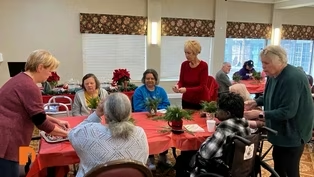
How conversations impact the lives of senior citizens and their caregivers
Video has Closed Captions
Clip: S11 Ep5 | 6m 4s | One Detroit explores the impact of compassion, conversation and community on seniors and caregivers. (6m 4s)
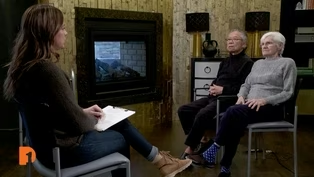
Metro Detroit seniors share their stories
Video has Closed Captions
Clip: S11 Ep5 | 9m 35s | Seniors living in metro Detroit share their stories with Sarah Zientarski. (9m 35s)
Providing Support for PBS.org
Learn Moreabout PBS online sponsorship New Episode
- News and Public Affairs

Top journalists deliver compelling original analysis of the hour's headlines.
 New Episode
- News and Public Affairs

Today's top journalists discuss Washington's current political events and public affairs.
 New Episode
 New Episode
 New Episode
 New Episode
 New Episode
 New Episode
 New Episode

 New Episode
 New Episode
Support for PBS provided by:
One Detroit is a local public television program presented by Detroit PBS