
Arthur Horwitz: The memoir of a second-generation Holocaust survivor
Clip: Season 10 Episode 41 | 10m 36sVideo has Closed Captions
The book details aspects of his life, including the impact of being the son of a Holocaust survivor.
Yom HaShoah, a Holocaust Remembrance Day, begins the evening of April 13. Later this month, journalist and community leader Arthur Horwitz will release a memoir telling his story as the son of a Holocaust survivor, “Dual Identities: Living in Meier’s Shadow.” One Detroit contributor Marty Fischhoff discusses the book with Horwitz, who is a former chair of the Detroit PBS Board of Trustees.
Problems playing video? | Closed Captioning Feedback
Problems playing video? | Closed Captioning Feedback
One Detroit is a local public television program presented by Detroit PBS
Arthur Horwitz: The memoir of a second-generation Holocaust survivor
Clip: Season 10 Episode 41 | 10m 36sVideo has Closed Captions
Yom HaShoah, a Holocaust Remembrance Day, begins the evening of April 13. Later this month, journalist and community leader Arthur Horwitz will release a memoir telling his story as the son of a Holocaust survivor, “Dual Identities: Living in Meier’s Shadow.” One Detroit contributor Marty Fischhoff discusses the book with Horwitz, who is a former chair of the Detroit PBS Board of Trustees.
Problems playing video? | Closed Captioning Feedback
How to Watch One Detroit
One Detroit is available to stream on pbs.org and the free PBS App, available on iPhone, Apple TV, Android TV, Android smartphones, Amazon Fire TV, Amazon Fire Tablet, Roku, Samsung Smart TV, LG TV, and Vizio.
Providing Support for PBS.org
Learn Moreabout PBS online sponsorship(light upbeat music) - [Marty] We are at the Zekelman Holocaust Center in Farmington Hills to talk with Arthur Horwitz, longtime publisher of "The Detroit Jewish News" and esteemed community leader about his memoir, "Dual Identities: Living in Meier's Shadow."
- The dual identities are mine and my mother's little brother.
My mother was a Holocaust survivor.
Her little brother didn't survive.
I am named in his memory.
And as I was looking at all of that, I realized that, you know, there's a story right at the core, and the story relates to my mother, a Holocaust survivor, my father, American born, in fact, born in New Haven, Connecticut, and me as the child of a survivor.
And recognizing as I fought back and looked at other kinds of books that had been written that children of survivors are mostly writing about their parents' stories.
And what I saw was an opportunity to give voice to my own story, to speak for kind of a generation called 2Gs, children of survivors, who sometimes weren't really willing or able to talk about what it was like growing up post World War II America as a child of a survivor.
- [Marty] Just before our interview, Horwitz spoke to a group of eighth grade students at the Zekelman Center.
He recalled rummaging through his mother's wallet as a kid looking for money.
That's when he found a photo that would change his life.
- This guy's in her wallet.
And I asked her, "Who is this?"
I already knew, because growing up in a household as a child of a survivor, you're exposed to this photo.
This is, if you say, is there one image that captures the brutality of the Holocaust, this would be one of those, if not the photo.
- [Marty] The boy in the photo was about the same age as the brother his mother lost to the Nazis.
She had no photos left of her brother, and she would claim this was him.
- So I already knew it wasn't her little brother.
And I said, "It's not your little brother."
She said, "Yes, it is."
I said, "No, it's not.
You said you had no photos of any of your family members."
And by the way, she could name 91 family members who were killed, murdered.
And there were six who survived.
And it was like at that point, Marty, that my mother decided that I would be living two lives, mine, as I mentioned, as related to the title of the book and the one her little brother didn't have.
And from that point forward, my life, my family, my media career was through a filter or a frame of living two lives.
And for a 12-year-old, or for anybody, it's hard enough to live in your own life, let alone two.
- [Marty] And thus, the book's title, "Dual Identities."
While some Holocaust survivors were hesitant to tell their stories, Horwitz remembers his mother, Sally Horwitz, speaking to student groups back in Connecticut, just as he does today.
- My mother would speak about the Holocaust and she would speak to groups of children, school-aged children, you know, in New Haven.
And she would share her story.
And I went back and I looked at some of the scribblings that she had made of her presentations.
And the thing that stood out wasn't the bitterness, it wasn't revenge of clearly from almost being wiped out, you know, having, you know, children, grandchildren, great-grandchildren, you know, who followed her.
It's a miracle in and of itself.
But for her, the key was, this is a great country.
And she would say in her presentations, "You know what?
God bless America.
Don't take freedom for granted, protect our democracy.
Remember that we were all from somewhere else, somewhere originally."
- You spent a lot of time speaking to students here from all over the state.
How did you get involved in that?
- I had been approached by the Zekelman Holocaust Center, it was actually late in 2020, early 2021.
They were putting together a cohort, a first cohort of children of survivors to be trained over a period of several months to present to the thousands and thousands of students who were coming through the Holocaust Center since 2016, when Michigan Governor Snyder signed into law a public act that mandated Holocaust education in public schools.
As these kids were starting to come through, the Zekelman Holocaust Center realized they had a little challenge.
Well, there were fewer and fewer survivors.
So their motive, meaning the Zekelman Holocaust Center, was can we get some of their children and train them, not just to parrot or repeat their parents' stories, but to weave their own stories into it.
So Gina, my wife is also a daughter of a Holocaust survivor.
Her mother was on the Kindertransport.
And I talked to Gina, I said, "Is this something I should do?
I'm not sure I want to go there and dig up some of what's there in my past."
She encouraged me to do it.
It was the most important thing that I've done on a personal level, maybe my entire life 'cause it freed me up.
It gave me the opportunity to both extract what was inside of me, but also it allowed me to honor my mother and her family.
And it allowed me to leave a message of hope, which I thought was really important for these children.
Now, let me tell you about Gogatz.
Gogatz was a foreman, Polish foreman pressed into service by the Germans at my mother's first slave labor camp.
I took after my mother, as she reminded me, she was always pushing the envelope.
She was always taking risks.
She snuck out of her camp, she got caught.
German puts his rifle to her head, that's it.
But no, Gogatz intervenes, pushes the rifle away, says, "She is my best worker.
I need her, I will take responsibility for her."
German could have pulled the trigger twice, once to put a bullet in my mother's head and once to put a bullet in Gogatz's head.
Instead, he hits Gogatz over the head with his rifle butt and goes off, okay.
No Gogatz, I wouldn't be here.
But what's important with Gogatz is he just did the right thing.
Okay, he saw something, he spoke out.
He wasn't a bystander.
- [Marty] After the war, Arthur's mother tried to find Gogatz, but learned he had been killed by the Germans.
- He'd been murdered.
That particular message, and that my mother, when she would present, when I looked through her notes, would bring up Gogatz as an example of somebody who spoke up and spoke out.
There he was, in my mother's writings, there he was in that interview.
He was the ideal person to remind thousands, thousands of children that it only takes one person, and Gogatz saved my mother, which meant by extension he saved me, he saved my siblings, he saved my grandchildren.
And some of them have done things as physicians, et cetera, that have truly saved lives and extended lives.
And here's this guy 80 plus years ago who saved my mother's life, probably couldn't put his finger on a map of Michigan, and we're talking about him.
So that was my message, to try to leave.
Stand up, say when you see something wrong, don't be a bystander.
And if there's one person of all of the people I've spoken with, who in a year, 10 years, 20 years, 30 years, remembers the message of Gogatz and does something that helps repair the world, that helps save lives, then that's both a tribute to Gogatz himself, it's a tribute to my mother.
And it's a tribute to telling the stories to students in hope that someday the dividend will come back and they'll do something not just for somebody who's Jewish, but really beyond for humanity, if you will.
That's the hope, that's Gogatz's hope.
- [Marty] Then Horwitz shows the students a photo of his extended family.
- Because for my mother, on a personal note, this was her revenge.
This was how she fought back in the end against the Nazis, against the Germans, she brought life into the world, children, grandchildren, great-grandchildren, and in my family, three children, seven grandchildren, that was her revenge.
- [Marty] "Dual Identities" is a book about many aspects of Horwitz's life, his childhood, the journalism career that culminated in leading one of the most influential Jewish newspapers in the country and his life as a son, husband, father, and grandfather.
But what we may remember most are the lessons it teaches us about history and what we as people and a nation should never forget.

A conversation with Tyree Guyton, the Detroit-born artist known for creating The Heidelberg Project
Video has Closed Captions
Clip: S10 Ep41 | 5m 26s | Kresge Arts in Detroit celebrates the lifetime achievements of a metro Detroit artist each year. (5m 26s)
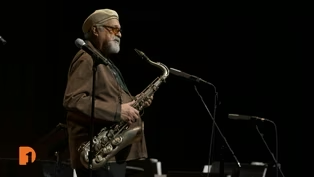
Sitting down with the Artist-in-Residence for this year’s Detroit Jazz Festival
Video has Closed Captions
Clip: S10 Ep41 | 6m 10s | Joe Lovano takes center stage as this year’s Artist-in-Residence for the Detroit Jazz Festival. (6m 10s)
Providing Support for PBS.org
Learn Moreabout PBS online sponsorship
- News and Public Affairs

Top journalists deliver compelling original analysis of the hour's headlines.

- News and Public Affairs

Today's top journalists discuss Washington's current political events and public affairs.










Support for PBS provided by:
One Detroit is a local public television program presented by Detroit PBS