
Sitting down with the Artist-in-Residence for this year’s Detroit Jazz Festival
Clip: Season 10 Episode 41 | 6m 10sVideo has Closed Captions
Joe Lovano takes center stage as this year’s Artist-in-Residence for the Detroit Jazz Festival.
The 47th annual Detroit Jazz Festival takes place at Hart Plaza over the Labor Day weekend. This year’s Artist-in-Residence, saxophonist Joe Lovano, recently held a workshop for music students at Wayne State University. He sits down with One Detroit contributor John Penney of 90.9 WRCJ to talk about growing up in a family of musicians and Detroit’s influence on his career.
Problems playing video? | Closed Captioning Feedback
Problems playing video? | Closed Captioning Feedback
One Detroit is a local public television program presented by Detroit PBS
Sitting down with the Artist-in-Residence for this year’s Detroit Jazz Festival
Clip: Season 10 Episode 41 | 6m 10sVideo has Closed Captions
The 47th annual Detroit Jazz Festival takes place at Hart Plaza over the Labor Day weekend. This year’s Artist-in-Residence, saxophonist Joe Lovano, recently held a workshop for music students at Wayne State University. He sits down with One Detroit contributor John Penney of 90.9 WRCJ to talk about growing up in a family of musicians and Detroit’s influence on his career.
Problems playing video? | Closed Captioning Feedback
How to Watch One Detroit
One Detroit is available to stream on pbs.org and the free PBS App, available on iPhone, Apple TV, Android TV, Android smartphones, Amazon Fire TV, Amazon Fire Tablet, Roku, Samsung Smart TV, LG TV, and Vizio.
Providing Support for PBS.org
Learn Moreabout PBS online sponsorship(lively saxophone music) - I am here today with the artist in residence for the 47th Annual Detroit Jazz Festival, Joe Lovano, it's a pleasure and an honor to be here with you.
- Thank you, John, for me as well.
- Joe grew up in Cleveland in a very musical family.
Father being Big T, Tony who played the saxophone, and his brothers, I guess, were also musicians.
You picked up a saxophone when you were six, it was an alto, you had to grow into the tenor, and your first teacher was your father.
And one of my favorite stories that you told once was how you were one day practicing scales and your father came in and said, "Play them like they're melodies."
- This one day I'm playing, I'm going up and down the line, you know, it's like an exercise.
And he's listening and he was upstairs, he wasn't giving a lesson at the time.
I was in the basement practice.
He comes down with his horn and he said, "Oh yeah, Joey, yeah."
And then he took a major scale and he just played it (harmonizing scale).
He made it sound like a song.
The same notes of the same sequence that I was running around the horn, you know?
And man, that changed everything.
And then he just split.
(lively orchestra music) - You know, you, again, teach at Berkeley and you had a workshop with the kids here at Wayne State today.
What do you want them to take away from this workshop?
- Well, I just like to stress all the time about living in the library, the sounds and spirits of the masters on every instrument, no matter what your instrument is.
Anyway.
If the more you do that, you know where people are from, who they came up with, how old they were on a certain record you love or whatever, you know, it's up to you to create how you discover things.
You know what I mean?
What influences and how your influences can take shape for your, two and four, artistry.
- [John] The career has just been astounding and it's been a real pleasure to listen.
And you have really deep roots in Detroit.
- First of all, I'd just like to say, it's a blessing to live in the world of music and put some ensembles together through the years and develop within the embrace of some amazing masters of the music.
And quite a few of them were Detroit masters, the Jones family, Hank Jones, Thad Jones, Elvin Jones.
I had a chance to be a part of the Thad Jones/Mel Lewis band, and then the Mel Lewis Band when Thad went to Copenhagen, played in "Elvin Jones: Jazz Machine" and toured Europe with him in 1987.
And then he recorded with me on one of my blue note releases, "Trio Fascination" with Dave Holland on bass.
And then Hank Jones documented some recordings on Blue Note.
- You first came to Detroit, I think in '74, I believe.
- 1974, I got the call from Dr.
Lonnie Smith, who was living around the corner from Baker's Keyboard Lounge.
He was looking for a tenor player and played in Cleveland with Lou Donaldson and had heard about me and someone gave him my family phone number and I got the call.
So I flew to Detroit and started to play with him.
And that led to a lot of everything.
- Jason Moran talked about a particular Detroit sound, he described it as like "the Detroit bounce."
What is it?
Is there a Detroit feeling?
- The way I heard everything was through, it was a real like feeling in the beat and the harmony and the execution of ideas that were personal.
There was a certain sweetness in the way Katz played also, it wasn't like an aggressive kind of approach.
(lively orchestral music) - As the artist in residence this year, tell people what you're gonna bring to the festival.
- I'm gonna present my current quartet called the Paramount Quartet with Julian Lage on guitar, brilliant young guitarist, Asante Santi Debriano on bass, who played a lot with Archie Shepp and Randy Weston and others, and Will Calhoun on drums, who's an amazing, explosive, beautiful musician.
- What makes it the Detroit Jazz Festival?
What's unique?
I mean, is it unique?
- Well, it's amazing to have like such an incredible venues to play at and have the audience and have it be a free open festival.
It's one of the most beautiful opportunities for all of us that are on tour all the time to see each other and hear each other and feel the beautiful space and the audiences here in Detroit that are so hip because of the history of the music here.
Arthur Horwitz: The memoir of a second-generation Holocaust survivor
Video has Closed Captions
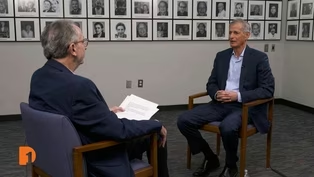
Clip: S10 Ep41 | 10m 36s | The book details aspects of his life, including the impact of being the son of a Holocaust survivor. (10m 36s)
A conversation with Tyree Guyton, the Detroit-born artist known for creating The Heidelberg Project
Video has Closed Captions
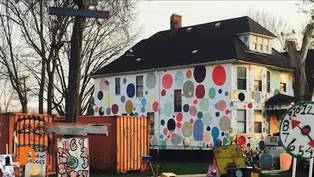
Clip: S10 Ep41 | 5m 26s | Kresge Arts in Detroit celebrates the lifetime achievements of a metro Detroit artist each year. (5m 26s)
Providing Support for PBS.org
Learn Moreabout PBS online sponsorship
- News and Public Affairs

Top journalists deliver compelling original analysis of the hour's headlines.

- News and Public Affairs

Today's top journalists discuss Washington's current political events and public affairs.










Support for PBS provided by:
One Detroit is a local public television program presented by Detroit PBS