
Christopher Street Detroit '72 Pride celebration remembered as catalyst for LGBTQ+ movement in Michigan
Clip: Season 10 Episode 43 | 16m 5sVideo has Closed Captions
Christopher Street Detroit '72 Pride remembered as catalyst for LGBTQ+ movement in Michigan
It’s been more than five decades since Michigan’s first Pride celebration. Last year, One Detroit’s Bill Kubota, Zosette Guir and Chris Jordan examined the state’s contributions to LGBTQ+ history. They hear from people who attended the Christopher Street Detroit ‘72 celebration, learn about the “Come Out! In Detroit” comic book and talk with the nation’s first openly gay elected official.
Problems playing video? | Closed Captioning Feedback
Problems playing video? | Closed Captioning Feedback
One Detroit is a local public television program presented by Detroit PBS
Christopher Street Detroit '72 Pride celebration remembered as catalyst for LGBTQ+ movement in Michigan
Clip: Season 10 Episode 43 | 16m 5sVideo has Closed Captions
It’s been more than five decades since Michigan’s first Pride celebration. Last year, One Detroit’s Bill Kubota, Zosette Guir and Chris Jordan examined the state’s contributions to LGBTQ+ history. They hear from people who attended the Christopher Street Detroit ‘72 celebration, learn about the “Come Out! In Detroit” comic book and talk with the nation’s first openly gay elected official.
Problems playing video? | Closed Captioning Feedback
Where to Watch One Detroit
One Detroit is available to stream on pbs.org and the PBS app.
Providing Support for PBS.org
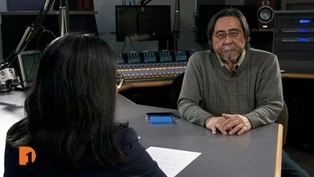
Learn Moreabout PBS online sponsorshipOne of Kubota's special reports for One Detroit examined Michigan's contributions to LGBTQ+ history, as an example of his layered approach to storytelling.
Videographer Chris Jordan and I teamed up with him to produce this in-depth look at local LGBTQ+ milestones, which included the state's first pride march in 1972.
We also spoke with the nation's first openly gay political candidate elected to office.
(bright music) Ferndale Pride 2025, the stretch of Nine Mile Road, helping kickoff Pride month in southeastern Michigan.
It's one of the biggest in the state.
- So we've been doing this for 15 years now.
(bright music) We're considered one of the big six pride events.
And so for me that is kind of our little mark of fame, but we are one of the smallest towns of those big six.
(bright music) And so now we have these opportunities to show all these people who are like you in one setting and just say, it's okay to be you today.
You're gonna find someone else who's like you and you're gonna have a really good time and embrace who you are.
(martial arts sticks soothing) - [Zosette] Jaye Spiro owns a martial arts studio on Nine Mile.
Ferndale Pride is outside her front door.
- It is just baffling to me how much we have been embraced as gay and lesbian people.
You know that these prides are huge now.
(speaking in foreign language) - [Zosette] It started in New York City, 1970, with the Christopher Street Gay Liberation Day march, commemorating the time a year before when demonstrators clashed with police after a raid at the Stonewall Inn, a gay bar in Manhattan.
Pride marches with spread nationwide coming to Detroit in 1972.
- When the idea came to the fore in Michigan to have a pride march and a pride celebration and start having activities, they named it Christopher Street Detroit.
So that's where the name comes from.
I should note that Christopher Street comes from the name of the street that the Stonewall Inn was on, so.
- [Zosette] In Farmington Hills, a history lesson for Pride Month, they're hearing about happenings 53 years ago.
- And part of this early pride week was the opening of Detroit's first LGBTQ Community Center.
- [Zosette] The community center located in the Virginia Park neighborhood.
Tim Retzloff's been collecting this history for years, researching things like this GLF banner, that's for the Gay Liberation Front.
- It's an heirloom for our community.
So it's a really important artifact.
- [Zosette] It's on display at the Detroit Historical Museum for the next few months.
Part of an exhibit about a comic book titled, "Come Out!
In Detroit," in which Retzloff drew from oral histories to recreate Christopher Street Detroit, '72.
- This is my favorite page from "Come Out!
In Detroit," because it goes to show just how many people were there.
This wasn't 15 or 20 people marching downward avenue.
This was many people marching downward avenue.
- We decided this is the way to tell this story.
That's the origin story.
- [Bill] To San Francisco.
- That's what comic books are known for, is the origin stories.
We know where Bruce Wayne and Superman and Spider-Man come from.
It kind of fit into being a comic book that way.
- [Zosette] Come Out!
In Detroit's illustrator is Isabelle Clare Paul.
- I didn't know very much about it at all starting out.
And so getting to do that research and learn that history and have access to all these old stories was really kind of special to me.
Pretty heavy topic, but the best way we can get around it is, you know, bringing an air of joy to it.
This was the same weekend they went to Homer Park.
- It's really strange to get old.
And then what you did in your youth is actually history.
- [Zosette] Susan Swope lives near Gettysburg, Pennsylvania, but she'd been an anti-war activist at the University of Michigan, then studying law at Wayne State University.
- In high school, I realized I was lesbian, but I did not have a word for it.
I thought I was the only one in the world.
That's what it was like growing up in a small town in the '50s and '60.
- At first I was pretty closeted, although I didn't, might not have said I'm a lesbian, it was clear (Jaye laughing) - Lesbianism wasn't really up in the front of people's consciousness.
You know, gay men were much more thought about.
- You know, you're seeking people like you, was it hard, you know, or?
- It was very hard.
Well, it was illegal.
Being gay was actually illegal.
So you had to be very much more secreted and closeted in those days.
I mean, I was a teacher, you know, would you want your children to be taught by gays?
You know, they'll corrupt their minds.
- Having come from the student activist movement against the war, what I understood was the power of acting as a group and of marches and rallies and public protests.
- Our whole generation that came from the Civil Rights movement and the anti-war movement.
I mean, we were dead serious.
The gay and lesbian movement just had a, you know, yeah, we were fighting against oppression and homophobia, but we were also, it was a big party and we were having fun and we were coming out and we were free.
And so it was a very different energy and you can really catch that.
- [Zosette] Merrilee Melvin helped organize the march.
- And it was quite an ordeal to put this together 'cause we were just kind of making it up as we went along.
- Were there other things that you were involved in leading up to the march?
- It was very helpful to find this press release that I wrote.
- [Zosette] "The first line, if Michigan gay activists have their way, Detroit will never be the same again after June 24 and 25."
- So I'm so proud of us.
We were reaching out, this was sent far and wide.
We were encouraging people to come from all over Michigan and from Canada.
- They had matchbooks made, lots of people were still smoking at the time.
That was a way to kind of get the word out.
They had stickers made, they had buttons made, they had t-shirts made.
- So I came up with the idea for our logo, but the idea was a butterfly with an arm and a fist for the body and the head of the butterfly.
And it said, come out!
- My friend Susan Swope asked if they would be willing to pay me $25 a week to be an official event organizer.
And they said yes.
And so I felt like I was the first professional paid lesbian in Detroit.
- [Zosette] Merrilee Melvin gave the marching orders.
- The morning of the march down Woodward from I think maybe Wayne State to Kennedy Square, which no longer exists in downtown Detroit, it was raining, of course.
(Merrilee laughing) - Susan Swope was the one lesbian that we know spoke at it.
- My own personal fear was I was still married, but my husband knew I was a lesbian and we were working through that.
But I hadn't come out to his parents and they lived in Detroit, and I was gonna speak and the TV cameras were gonna be there.
But in the end, what they showed on TV was not the speeches, but the drag queens who had been sitting on the hood of a car and when the car stopped, they slid off the front of the car.
Ha ha.
- Christopher Street was a combination of that, you know, we're here and are like here and we want the laws against us changed 'cause there were still laws against gay men in particular.
- For most of us, you know, we didn't fit in.
So the march was a place where you could celebrate who you were.
- It felt good.
It gave purpose to my life.
I've always wanted to help people.
And here I was helping my own community.
- [Zosette] Another speaker at the March Jim Toy, an Ann Arbor resident active in Detroit.
- This is another great picture of Jim Toy.
This is War, what he looked like at the time.
- [Zosette] Toy already an activist, was part of the Detroit Walk to Freedom March in 1963.
- He heard Martin Luther King give the first version of the Iva Dream speech in Detroit.
- [Zosette] Toy was among those protesting the Vietnam War before Christopher Street.
- They took part in the anti-war movement rally that was held in April of 1970.
And that's where Jim Toy became the first person to publicly come out as gay in Michigan.
- And a lot of people have asked him did you plan to come out in that speech, and he said, well, I wasn't planning to speak and do that that day, but I just decided that's what I would do.
Like just a few minutes beforehand.
- I probably said I, my name is Jim Toy.
I'm 40 years old and I'm a gay man.
Well, I had not thought about the press and the Detroit Free Press and the Detroit News were there and they published articles.
And so I was out.
- [Zosette] Jim Toy died in 2022.
Born in 1930 to a white mother and Chinese father, he grew up in a small town in Ohio.
He married, divorced amicably and found Detroit's gay community, traveling often from Ann Arbor with a friend.
- We called ourselves the Detroit Gay Liberation Movement.
John and I driving in there two and three times a week for meetings in his car, said to each other, you know, this is ridiculous.
Let's start a group in Ann Arbor.
So we did.
- Yeah.
- [Zosette] Toys papers are held in the Bentley Historical Library at the University of Michigan.
The school where he made his biggest mark, advocating for LGBTQ+ students.
In 1971, Toy helped create what was called the Human Sexuality Office.
- They had so many people come after them, including regents.
There were regents that were hell bend on destroying that office.
- [Zosette] That office is considered the first of its kind, now known as the Spectrum Center.
- It's not likely that there was an office anywhere in the world that preceded ours.
And we have never learned that there has been.
- Jim really believed in the power of institutions to change from within.
And he was controversial in this way.
Some of the radicals thought, you've gotta tear the old institutions down.
- [Zosette] Toy kept working, receiving an honorary doctorate from the University of Michigan in 2021.
- No one knows how Jim didn't burn out.
I mean, it was like, it was so draining what he did.
- He was a friend to me, a mentor, somebody who was one of my earliest supporters in running for county commission eight years ago.
- [Zosette] Jason Morgan, an openly gay state representative, first took that office in 2022.
He grew up in a small town north of Bay City, but moved to Ann Arbor.
- Then I found this incredible community in Ann Arbor that wasn't just okay with people being gay, they embraced it and celebrated it and really supported me as just a human being as an individual.
And I would say didn't care if I was gay, but no, they did.
They cared in a really positive way.
- [Zosette] Ann Arbor led the nation, observing Gay Pride Week in 1972.
- And then last but not least in terms of the gay liberation period, Kathy Kozachenko ran as an out lesbian in Ann Arbor in 1974.
- [Zosette] Kathy Kozachenko, ran for city council this and won.
- This is my favorite picture from back in that era.
This is me.
- [Zosette] The first out, out person to win public office in the nation.
- We knew that it was a first, but there's no way that I would've ever thought that I would be talking about it 50 years later.
And in fact, my niece Chelsea called me one day, says, Hey, aunt Kath, do you realize you have a Wikipedia page?
And I'm like, what?
So- - Kozachenko lives in Pittsburgh these days.
- I had no idea that.
When I talk about that time period, people have to remember that what I'm talking about is a very liberal, liberal isn't even the word radical college campus.
So things were different where I was than they were in the rest of the country.
- [Zosette] At U of M, she was another '60s activist, fighting for better conditions for farm workers.
- I found an organization called the Human Rights Party that sort of articulated my passion for economic justice as well as social justice.
- [Zosette] Two human rights party candidates had already won Ann Arbor City Council seats in 1972.
Jerry DeGrieck and Nancy Wechsler would be the first openly gay elected officials who came out after they were elected.
They spearheaded the campaign for Gay Pride Week, but were leaving office as Kozachenko started her city council run.
- Young man, we started talking.
He said, I'm really religious and I'm like, you know, oh, okay.
And he says, but God works in mysterious ways.
I'm gonna vote for you.
And I said, I thank you.
So I had that instance and then I had another less pleasant instance and I knocked on this door and I talked to these two young women and as I was walking away, I could sort of hear them sort of giggling.
One said to the other one, that was her, that was her.
Did you see her looking at you?
Did you see her checking you out?
And I just, but I really wanted to go back and knock on their door and say, it's not like that, you can't transfer the way men react to women with how lesbians relate to women and to relate to each other.
But I wasn't brave enough to do that.
So I just, you know, shook it off and went on to the next door.
- [Zosette] Kozachenko won by 109 votes, an award well-populated by college students.
She served one term.
Since then, there's been more representation in public office.
There's Michigan's Attorney General, and in the state legislature, six representatives and one senator make up the LGBTQ+ caucus.
- We are still at seven today, and that is huge.
That is massive progress for our state.
And most of us didn't run as you know, oh, we're just running as a gay person, we ran as community members stepping up to run and serve everybody in our community.
But it does matter that we are at the table when decisions are being made and that we are represented.
- I started off.
- 50 years later, Kathy Kozachenko has a different mission.
She's following the deportations of hundreds of people to El Salvador, including gay makeup artist, Andry José Hernández Romero.
- It touched my heart and outraged me at the same time.
This has sparked a passion in me.
And it's one way to take a little piece and to say, I'm not gonna forget this man.
- [Zosette] This June, she's working Pride events, like this one in Jamestown, New York, an activist, reactivated today.
- It's really applicable today where it's like you have to take care of each other.
You have to stand up.
You gotta start doing stuff to make things happen, otherwise it's never gonna happen.
And just to say no, hey, you need to treat us better than that.
- And What would you say to someone who is watching and you know, maybe has that similar feeling to when you were younger?
- Find your people and work with them.
Michigan Journalism Hall of Fame inductee Bill Kubota shares his approach to storytelling
Video has Closed Captions
Clip: S10 Ep43 | 7m 39s | His colleagues, members of the Asian American Journalists Association celebrated him (7m 39s)
Providing Support for PBS.org
Learn Moreabout PBS online sponsorship New Episode
- News and Public Affairs

Top journalists deliver compelling original analysis of the hour's headlines.
 New Episode
- News and Public Affairs

Today's top journalists discuss Washington's current political events and public affairs.
 New Episode
 New Episode
 New Episode
 New Episode
 New Episode
 New Episode
 New Episode
 New Episode
Support for PBS provided by:
One Detroit is a local public television program presented by Detroit PBS