
Michigan Journalism Hall of Fame inductee Bill Kubota shares his approach to storytelling
Clip: Season 10 Episode 43 | 7m 39sVideo has Closed Captions
His colleagues, members of the Asian American Journalists Association celebrated him
One Detroit Senior Producer Bill Kubota was inducted into the Michigan Journalism Hall of Fame on April 19 for his contributions to broadcast journalism. In addition to being a producer and director, he is a videographer and video editor. His work includes producing documentaries that elevate issues. We’ll take you to the ceremony where Kubota was inducted and talk with him about his career.
Problems playing video? | Closed Captioning Feedback
Problems playing video? | Closed Captioning Feedback
One Detroit is a local public television program presented by Detroit PBS
Michigan Journalism Hall of Fame inductee Bill Kubota shares his approach to storytelling
Clip: Season 10 Episode 43 | 7m 39sVideo has Closed Captions
One Detroit Senior Producer Bill Kubota was inducted into the Michigan Journalism Hall of Fame on April 19 for his contributions to broadcast journalism. In addition to being a producer and director, he is a videographer and video editor. His work includes producing documentaries that elevate issues. We’ll take you to the ceremony where Kubota was inducted and talk with him about his career.
Problems playing video? | Closed Captioning Feedback
Where to Watch One Detroit
One Detroit is available to stream on pbs.org and the PBS app.
Providing Support for PBS.org
Learn Moreabout PBS online sponsorship- There are plenty of filmmakers maintaining ethical lines seen on places like POV and Independent Lens on PBS.
That's the stuff I like to emulate.
Most of the work I've done from collaborations with some of the people here tonight, and I like to thank them for putting up with me.
(audience laughing) We're storytellers and I still get to be a TV news cameraman and a TV news producer.
Thank you all here tonight for this recognition.
Thank you very much.
(audience clapping) (audience cheering) - What made you pursue a career as a video journalist?
- Well, I wanted to do television.
I started studying that in college at Michigan State, and then I realized there weren't the many jobs back then.
There were just a few TV stations, so I went back to college and got a degree in advertising, but there weren't really that many jobs there either.
But the jobs that were in TV were in TV news mostly.
So I started in Lansing a couple years after I got college and started working as a photojournalist, a cameraman carrying big heavy equipment around.
- Mm-hmm.
- And that's where I started.
And that's when I started finding out that not only do I like shooting stories, I like trying to tell the whole story, you know, not just taking the pictures, but reporting some too.
And I started doing that.
So I was heavy into TV news for eight years.
My last broadcast job at the time was at Channel seven Action News.
And I was sitting in a back room setting up stories, but at the same time I was plotting my escape by starting a video production company with the intent of working for TV networks as a freelance camera man.
And from there I wanted to make documentaries, mostly for PBS.
And that's what we tried to do, and we did a few of those.
- [Zosette] Mm-Hmm.
- Ed hired me to work on programming for One Detroit, and so that's what I've been doing and I've been doing it for almost 10 years now.
- Mm-hmm.
Documentary's a big part of your approach and you of course are a documentary filmmaker in your own right, just to name a few things that you've directed, Lustron, Most Honorable Son, you co-directed The Registry, producing co-wrote Beyond the Light Switch, and not to mention many short form doc pieces that you've produced for One Detroit.
I mean, in all my years of working with you on One Detroit, one of the things I've noticed is that you're always trying to add new layers to your stories.
Layers that viewers might not be aware of.
How do you discover those different layers as you produce a story?
- Well, it kind of started when I worked in local news.
We'd do a story and it'd be a minute 30, if you went two minutes, it was kind of long.
I always wanted to make longer form, which you know, ended up being documentary type of stuff.
Stuff that we do for One Detroit, you know, these stories, we can do seven, eight, sometimes 20 minutes.
How can I tell a story that has more context, more nuance?
And that has to do with more sources.
The context might be historical, and those are the layers.
You look back and you look forward in some of these stories.
And how do you put those into stories?
Like in the one story that we like to talk about a lot around here, this LGBTQ+ story that a history of what happened in Michigan, in Detroit, we got to delve deep into history of the first openly gay elected official in the country was here in Ann Arbor and we found her a tractor down, went to Pittsburgh and interviewed her.
And those are the kind of things that we can add to a story because we have the luxury or the time to go deeper with them.
So we can kind of tell a story from beginning to end that makes sense to a viewer that might know the story fully, but still get something out of it.
Or somebody that knows nothing and Colonel learns something from that.
So that's the value of doing stuff for public TV.
- Mm-hmm.
So Bill, when it comes to doing a story that has a lot of layers, has a lot of nuances, there are a lot of ways you could go, but how do you make the decision about where to focus?
- It's easy to do what people expect you to do.
You're kind of looking sometimes for the story or the point of view that is less heard.
How do you not necessarily amplify it, but at least give it a place in your story that makes you think a little bit more?
- So we've been doing Asian-American Pacific Islander coverage on One Detroit since about 2019 or so, and we've been trying to do a way of storytelling about the Asian American experience here in a different way, in a more holistic way.
Why is that important to you?
- Well, it could be obvious, it's kind of my identity, but I've kind of honestly not thought about my identity that much.
So going past, back in the '80s when I was working in the news and working for other clients, maybe I stood out 'cause I was Asian, Japanese American.
But I kind of wanted to avoid pushing on that.
But then there was a moment where I realized this really needs to be covered in a different way.
And with you too, we saw an opportunity to tell these stories like nobody else does because here we are, we're two Asian Americans watching stuff happen.
So part of that is that because we are able to get into stories in a different way than if we weren't.
We have the reference point being the killing of Vincent Chin back in 1982, which I actually had done stories about way back then.
But here we are looking at this thing decades later, how do we put that into context?
And so many Asian American groups connect with that story.
So we did too.
- How do you find stories that others might overlook?
- I think the key is for, what I get to do is to do, like we said before, we kind of additive.
We can take a story that we know is a story and put it in context.
It might be experts, it might be a second version of that story that adds contrast.
Like the story we did about the proposed concrete crusher in Core City.
We covered that story for two years and we were able to do that because I was given the latitude and the time to keep following it.
And I was collaborating with the filmmaker that kept on top of what was going on so we could run out and cover stuff as it happened.
So we had a story from beginning to end where they started getting together as a community to fight this thing to where they actually stopped it from happening.
And on top of that they changed zoning laws to stop that from happening ever again.
And we're setting a template for other communities in Detroit to fight heavy industry in their neighborhoods.
You know, there's not many other places you'll see anything like that anywhere on television except on shows like ours on public television.
- Mm-hmm.
- That's where our value remained with the viewers that really wanna know what's going on and really care about what's happening in their communities.
Video has Closed Captions
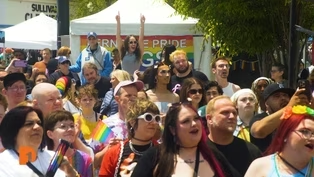
Clip: S10 Ep43 | 16m 5s | Christopher Street Detroit '72 Pride remembered as catalyst for LGBTQ+ movement in Michigan (16m 5s)
Providing Support for PBS.org
Learn Moreabout PBS online sponsorship New Episode
- News and Public Affairs

Top journalists deliver compelling original analysis of the hour's headlines.
 New Episode
- News and Public Affairs

Today's top journalists discuss Washington's current political events and public affairs.
 New Episode
 New Episode
 New Episode
 New Episode
 New Episode
 New Episode
 New Episode
 New Episode
Support for PBS provided by:
One Detroit is a local public television program presented by Detroit PBS