
Destination Detroit, “A Fortune of Sand,” Museum of Detroit Electronic Music
Season 10 Episode 51 | 26m 46sVideo has Closed Captions
A look at our “Destination Detroit” documentary and sitting down with Ruta Sepetys and Adriel Thornt
Our new documentary exploring the history of people who helped shape Southeast Michigan premieres June 22. We’ll preview “Destination Detroit,” which features interviews with more than 60 people, including a local woman who made history after researching her family tree. Plus, a look at Michigan native Ruta Sepetys’ latest novel, “A Fortune of Sand” and the latest on plans for a Detroit Techno Mus
Problems playing video? | Closed Captioning Feedback
Problems playing video? | Closed Captioning Feedback
One Detroit is a local public television program presented by Detroit PBS
Destination Detroit, “A Fortune of Sand,” Museum of Detroit Electronic Music
Season 10 Episode 51 | 26m 46sVideo has Closed Captions
Our new documentary exploring the history of people who helped shape Southeast Michigan premieres June 22. We’ll preview “Destination Detroit,” which features interviews with more than 60 people, including a local woman who made history after researching her family tree. Plus, a look at Michigan native Ruta Sepetys’ latest novel, “A Fortune of Sand” and the latest on plans for a Detroit Techno Mus
Problems playing video? | Closed Captioning Feedback
Where to Watch One Detroit
One Detroit is available to stream on pbs.org and the PBS app.
Providing Support for PBS.org
Learn Moreabout PBS online sponsorship- Coming up on One Detroit.
We'll have a preview of our destination Detroit documentary about the people who help shape southeast Michigan.
Plus we'll hear how a local woman made history after researching her family tree.
Also ahead, Michigan native Ruta Sepetys, talks about her latest novel of "Fortune of Sand," and we'll get the latest on plans for a Detroit techno museum.
It's all coming up next on One Detroit.
- [Announcer 1] Across our Masco family of companies, our goal is to deliver better living possibilities and make positive changes in the neighborhoods where we live, work, and do business.
Masco, a Michigan company since 1929.
Support also provided by the Cynthia & Edsel Ford Fund for journalism at Detroit PBS.
- [Announcer 2] The DTE Foundation is a proud sponsor of Detroit PBS.
Through our giving, we are committed to meeting the needs of the communities we serve statewide, to help ensure a bright and thriving future for all.
Learn more at dtefoundation.com.
- [Announcer 1] Nissan Foundation and viewers like You.
(bright music) - Hi, I'm Zosette Guir.
Just ahead on One Detroit, we'll talk with the author of a new novel, inspired by an often overlooked chapter of Detroit's history.
Also, we'll talk with the founder of the Museum of Detroit Electronic Music.
But first up, as America prepares to observe its 250th anniversary, Detroit PBS is shining a light on our region's history and its connection to the nation's evolving story.
For generations, the resilience and ingenuity of Detroiters have helped transform America.
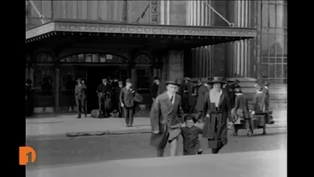
Our new Detroit PBS documentary named Destination Detroit, explores the histories of the people who helped shape southeast Michigan.
It premieres Monday, June 22nd at 9:00 PM.
Take a look.
(bright music) Detroit's iconic train station at Michigan Central, full of history, American history.
It's been called the Ellis Island of the Midwest.
- My family came to Detroit via my grandmother.
- [Zosette] Everybody comes from somewhere - And she came from Natchez, Mississippi.
She came on train.
- [Zosette] People gathered at the train station to share their migration stories.
- My grandparents were born in Fort time in Germany, and my dad was actually born there as well.
And they immigrated to Detroit in 1954.
So I'm first generation American on my dad's side.
- I came as a refugee from Burundi.
I've been here since November, 2015.
- [Zosette] Detroit PBS presents Destination Detroit Stories from people who came here and built the Motor City.
- Detroit, we always think about its population loss, and it's lost more population than any other city.
It grew faster than any other city in the country.
- It becomes this major city that's growing so fast because of the automotive industry in the African American population in Detroit skyrockets.
- [Announcer 3] New travel luxury in every Ford car.
- Detroit was vast and wide.
Both of my grandfathers felt that it was imperative to get somewhere that was hust and busting.
- [Zosette] The legacy of the American auto worker carries on to this day.
- I come from labor, labor is in my blood.
It comes from the history of my family.
- My grandfather and my mom's family they come over here in 1974, at the time when the Lebanese civil war was about to start, but also for the opportunity at pursuing the American Dream.
- [Zosette] America at 250, our country's anniversary.
A time to look to the future and reflect on our past.
- My mother's family is from Zacatecas, Mexico.
- You know, this neighborhood has been revitalized many times over by new families coming in.
They don't know any of this.
- We have to tell our own story.
- After the war, about a hundred thousand Holocaust survivors come to the United States, and about 4,000 of them settle here in Michigan.
- We bought the ship, Queen Elizabeth, and took us about five days to get to New York.
Finally got to Detroit.
I felt better, much better there.
- So my father, he was a South Vietnamese military personnel.
He came to Michigan in 1975.
- We are nomadic beings.
We've always been moving, and so we're moving in search of opportunity.
We're moving in search of liberation and freedom.
We're moving in search of a pursuit of excellence.
- [Zosette] Watch "Destination Detroit" and hear our stories as we commemorate our country's 250th anniversary.
It's right here on Detroit PBS, premiering Monday, June 22nd at 9:00 PM, or stream at any time after that on the PBS app.
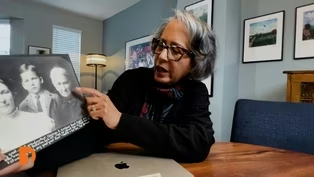
(bright music) ****One of the segments in Destination Detroit features genealogist Karen Batchelor.
While exploring her ancestors' history, she learned that one of them had fought in the American Revolutionary War.
As a result, Bachelor made history when she became the first African American member of the Daughters of the American Revolution, nearly a half century ago.
Here's her story.
(bright music) - My grandparents came here in 1917 and they settled in Hamtramck.
I have a picture of them that shows them at the Detroit train station on the day that they got there from Georgia.
And I guess there must have been photographers around.
And they, oh, we'll take your picture and commemorate this, that.
So they, for whatever reason, they weren't wealthy or anything, they had this picture taken and my Aunt Mary standing on a stool looking like shocked at it all.
But that's how my dad's side of the family got here.
- [Zosette] Karen Batchelor's dad would become a prominent doctor in Detroit.
He trained at Wayne University's medical school during World War II.
- I became a mom in August of 1975, and it was around that time after my son was born that I realized, wow, I don't know a lot about our family history.
And within 10 months, going to the Burton Historical Collection at Detroit's main library and writing off to a historical society in Erie, Pennsylvania where my maternal great-grandmother had come from, I was able to put together enough facts and found a revolutionary war patriot.
It was William Hood.
He fought in the battle of Fort Freeland where they came to the rescue of a fort that had been taken over by the British.
And that kind of got me started.
This is my great great-grandmother.
And her family line takes me back to 1630 in this country.
My genealogy mentor took me aside and said, I really think you ought to apply to DAR, Daughters of the American Revolution.
Mom talked about how she had been to a concert in DC when she was a student at Howard was 1939.
And it was when Marian Anderson had to sing on the steps of the Lincoln Memorial because she had been denied access to use DAR's Constitution Hall, which was a concert venue and still is.
- [Announcer 3] 75,000 masks before Lincoln Memorial to hear Marian Anderson, colored contralto make her capital debut at the great Emancipator shrine.
Refusal of the DAR to let her use their hall, found a countrywide controversy.
- [Interviewer] What was the image for a lot of people, what the DAR?
- Well, certainly in the black community, you know, people did ask me, why would you wanna join a group like that who had discriminated against us?
And here's what I would say was the reason.
When I was 14, ninth grade, I integrated a school in Detroit, and it was on the east side.
I had to take a bus an hour and a half each way.
And my parents wanted me to do this.
And this was part of their way, is that this was the year after the Civil Rights Act, and I was to integrate this school.
There were four of us kids at the school, and we weren't in class with one another.
None of the black kids were together.
There were no black teachers.
It was probably one of the loneliest years of my life.
It was the first time I ever got called the N word.
And I remember after a couple weeks, getting home from one of those days, and I was sobbing, and I asked my parents, why are you making me do this?
And dad said, and I will never forget this, it has been maybe my mantra through all the years since.
But he said, "Because somebody has to."
(bright music) - [Interviewer] Tonight we present a landmark in television entertainment.
- [Zosette] 1977, the year the mini series roots premiered on network television.
Suddenly Americans started doing their own genealogy research.
- In July of the 1977, two women at the Ezra Parker chapter of DAR in Royal Oak, Michigan.
They were inviting me to apply to them and become a member.
They were going to sponsor me.
- [Zosette] Applications to other chapters ignored.
But Karen was in.
It made local headlines and the New York Times front page.
- [Announcer 4] So join us for Good Morning America.
- [Zosette] Then national Television - On ABC.
- There were a lot of news stories.
I did a lot of interviews that this was the beginning of a lifetime journey for me doing family history.
And then these two pictures are Aunt Clara.
So the first person I started talking to about the family history, and she was the self-appointed family historian, whether you wanted to listen to her or not, and I wish I had listened more intently.
I get a lot of satisfaction from going through historic records and finding a clue and seeing what more I can find about a family history.
Remember, I started off not knowing much other than what we talked about at the dinner table.
And now I've been able to go back to 1630 in this country.
I have eight Revolutionary War patriots.
It's beyond my wildest dreams.
- [Zosette] A half century later, Batchelor's still digging into her family's past.
- Grandma kept me going on the research and she lived to be 97.
And every time we talked, she would end the conversation with, "And I saw people hanging from a tree."
And in fact, I was able to document later that there was a lynching in her area in Georgia when she was a young teenager, that no black people would've been at the lynching unless they were the target.
But she would've seen the aftermath of this.
And she always talked about it.
But I was able to document later what she probably had seen.
Family history is no longer something that you could call a hobby as it was when I first started.
It is a cultural imperative.
The more that we know about ourselves, the more we understand how we are an integral part of the fabric of this country.
I mean, I'm more American than apple pie.
And I think it's important for our children to understand this, because they may not be learning it in school, and it may not be available as readily available today as it was last week.
But the fact is, we know more about who we come from now than we knew in my grandmother's generation and certainly in my parents' generation.
So this is a journey.
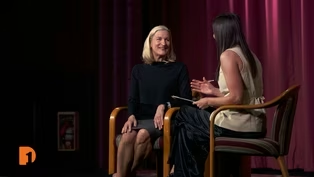
- Let's turn now to a new novel by Michigan native and bestselling author, Ruta Sepetys.
"A Fortune of Sand" is a drama set in 1920s Detroit, when the automobile industry was booming.
The story explores ambition, family loyalty, and the fortunes built and lost during a groundbreaking period in America's history.
One Detroit contributor, Lauren Smith of PBS books, spoke with Sepetys during the author's recent appearance at the Penn Theater in Plymouth.
(bright music) - So tell us all about the book.
What inspired it?
- Oh, what inspired it?
My love for Detroit, also what inspired it is my question.
What determines how history is preserved and recalled.
Many people don't know that Detroit was once considered the Paris of the Midwest.
So I wanted to go back to Detroit's golden age and bring that history out of the dark via story.
- Yes, so it takes place in 1920s, Detroit.
What was different about that time than now?
And how does that sort of factor into the story?
- What surprised me about the '20s, was that the dominant narrative of the '20s that we've accepted flappers and jazz, and you know this, that's not the complete narrative.
And when I started to look into Detroit history, I did find the complete narrative that represented what was happening across the entire country.
And "A Fortune of Sand" follows an automotive family, the Lennox and the youngest daughter, Marjorie Lennox is an aspiring fashion designer.
And this is a very wealthy family who's behaving badly.
- Mm-hmm.
- And gaining a lot of power while doing it.
And Marjorie discovers a web of lies in her own family and then has to face a terrifying truth.
Just how far will an American dynasty go to keep their secrets?
And those were things that I was uncovering about the city of Detroit.
And it was, the story was built with bricks from actual true stories.
- Wow.
And you actually looked into some of the old photographs and researched some of the old articles and papers.
Talk to us about the research process.
- Oh, I love the research process.
So to research this book every morning with my coffee, I read the newspaper from whatever day it was.
But in 1927, the setting for the book, and what I found again was so interesting because the papers in the city of Detroit, so the free press, the News, at the time there was the "Detroit Times," I was reading something, but then when I would go to a newspaper, let's say from Battle Creek or Lansing or Traverse City, there were stories that weren't reported in the Detroit papers themselves.
And keep in mind, during that time, newspapers carried so much power, newspapers, society pages, obituaries- - Mm-hmm, which we talk about in this novel?
- Exactly, right.
And that's where the stories lied.
I did find that obituaries and death notices, people were very particular, but think about it, this was their history.
But in one particular case of something I was researching related to the book, I don't wanna give any spoilers.
Something didn't add up to me.
So I filed a request to get access to a death certificate.
And what was reported on the death certificate is not what was in the obituary.
So people were, there was this great contrast of fortune and facade.
And as a writer and a creative, we need that, right?
We need those opposing forces.
They illuminate each other.
So I really leaned into the fortune and facade of Detroit.
- I love that.
And let's talk a little bit about the title of "Fortune of Sand" and that metaphor.
- Yes.
In the "Fortune of Sand."
So sand, sand is something that we walk on.
Sand is something that we wipe from our shoes, right?
But there's a paradox there.
Sand slips through our fingers.
So it's something that we might disregard, but in a certain situation, sand can become really strong.
You know, sometimes when it's wet or under the right circumstances, we need sand to make glass.
- Mm-hmm.
- And the Lennox family, they run a glass empire.
And glass then is also has these contrasts that if glass can provide protection from the elements, it's something that maybe helps us see.
But it can also become distorted.
- Yes.
- And it can shatter.
And so when I was thinking about it, I thought, oh my goodness, all these contrasts and juxtapositions, I'm gonna try to put those together into a title "A Fortune of Sand."
- I love that so much.
And I thought the book was so great.
It's sort of a mix of historical fiction, but it feels a little gothic to me as well.
It's sort of spooky without there being any real ghosts.
And there's some really interesting, like just Detroit landmarks, there's, you know, the Gross point mansions.
- Yes.
- But then there's also like Eloise Asylum and things like that.
- Yes.
- I think for Detroiters, it's gonna be a fascinating look at a city that maybe you hadn't considered in this way.
- I hope so, because, you know, history can be haunting.
And Detroit during the '20s was a city at war with itself.
This was during prohibition.
And think about what was going on.
But also I want people to know and appreciate Detroit.
Detroit during this time period wasn't looking to the future.
Detroit was creating the future, right?
And so I really wanted people to I don't know, understand Detroit during this age.
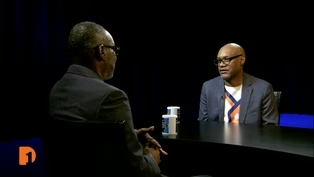
- June is African American music appreciation month, a time to celebrate the contributions and influence of black musicians, composers and songwriters.
Detroit's rich musical heritage includes the creation of techno, by a group of African American teenagers in the early 1980s.
Today, plans are underway to preserve that legacy by establishing the Museum of Detroit Electronic Music.
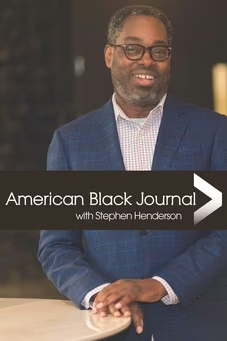
One Detroit contributor, Stephen Henderson of "American Black Journal," sat down with the museum's founder and executive director, Adriel Thornton.
(bright music) - It is really odd in a sense that like this music that was, you know, inspired by like Kraftwerk, and George Clinton and the whole Parliament-Funkadelic and Prince was really was shouldn't have worked here.
Really did.
- Yeah.
- You know, I'm actually happened to be friends with Ralph Hooter from Kraftwerk, and he actually told me, he's like, we did not set out to make dance music.
- Yeah.
- They were just playing with synthesizers and drum machines.
- Making noise.
- Yeah, they were just making noise.
And they were like shocked when Mojo started playing it.
And then there was the city in the U.S.
who was like, just all about it and like dancing to it and making it happen.
And that was Detroit.
- Yeah.
- You know, so it was kind of an anomaly, but thank God, right?
- Yeah, yeah.
And those roots, because now it's so much bigger, right?
It's everywhere.
It literally is all over the world.
- Mm-hmm.
- But those roots are important.
And that's what you're trying to, I think, really celebrate and commemorate in the idea of this museum.
And that's really important to us here.
- Exactly.
So, you know, the idea that this musical genre that was created here by African American teenagers has impacted the world in ways that we still are trying to process.
- Yeah, right.
- You go other places in the world and Detroit is literally a genre of Detroit tech.
There was a genre of music.
- Right, right.
- You go in a record store, there's a Detroit tech section, and we are now, you know, 40 years later recognizing that we need to capture stories.
We need to highlight folks.
We need to make sure that we as a city are protecting that legacy.
- Yeah.
- While paying, you know, homage to what's happening now.
And they're preparing for the future, right?
So the Museum of Detroit, electronic Music, AKA modem seeks to do all of that.
- Yeah.
- Right?
We want to make sure that we honor and preserve the history.
There's a lot of people still in this city, who don't necessarily know that Detroit was created here.
- That we did all of this.
- Or the Detroit was created.
- Yeah.
- And that the branches of those roots have seeped through all the electronic music.
So, you know, our impact on hip hop event.
- Yeah.
- You know, when you talk about a producer like J Dilla.
- Yeah, right.
- One of his electronic music songs, one of his techo songs called Plastic Dreams was like huge around the world.
Right, like one of the biggest songs ever, right?
But he was also one of the most revered hip hop producers.
- Yes.
- On the planet.
- Yes.
- His mentor and the person who taught him what to do was Amp Fiddler.
- Yeah, right.
- Who also crossed those lines.
Right?
- Mm-hmm.
- So that's why for me it was important to say that it was electronic music so that we could cover all of that.
- We can get everything.
- We could get everything.
- Yeah.
- And so it really, really is important, I think, to have a physical institution, a physical place where DPS students can come and see pictures and learn history, and say, oh, my God, those people look like me.
- Yeah, right.
- You know?
- Right.
- And this happened where I'm growing up.
- Yeah, and it happened, this guy was from my neighborhood.
- Yeah, right.
- And so I could potentially do that too.
You know, certainly folks like, you know, Juan Atkins, Rik Davis, you know, when they created Cybotron, were not doing it to have a legacy four years later.
- Right, right.
- You know, they were just being created.
- And you never think about that.
You're just thinking about, Hey, this sounds interesting.
- Yes.
And it was a creative outlet.
- I can make this noise, go with this other noise.
- Exactly.
- Now I got a beat, and- - Exactly.
- I mean, it's an incredible sort of genre and that in terms of the creative force behind it, right?
- 100%.
You know these cats were quite a few, at least at the beginning, we were actually really trained musicians.
- Yes.
- You know, playing bass or guitar or drums.
And when this new technology came out, this was like, oh, wait, let's play around with this.
They still had the the musical knowhow.
- Yeah.
- But really wanted to try interpret it a little differently.
So they really weren't experimenting.
- Yeah.
- And creating something that really they didn't have a basis for, right?
This was like they wanted to sound like.
- Right.
- Somebody else.
- Right.
- They were creating something that was really different and new, but that happened to be something that people, especially in their generation, resonated.
- Yeah, yeah.
- Right?
It resonated with them.
- Yeah.
- And so, I mean, again, when you think about not a happy accident, I don't wanna say it was an accident, but when you really think about like what really happened back then, it was super creative.
- [Stephen] Yes.
- It was underground.
And it was something that again, I think spoke to the African American youth in the city of Detroit.
- Yeah.
- In a way that other stuff was not.
- Yeah, yeah.
So, we're still looking for a place for the museum.
Talk about timeline.
- We are actively looking for sponsors and foundational support.
- Yeah.
- Actually hoping that the city will support it in ways.
But we are looking for a new location.
We were part of the a project that got canceled.
- Yeah.
- Or pause.
- Yeah.
- And so we are looking for perhaps a place that is more central, that maybe makes a bit more sense, right?
(bright music) - That'll do it for this week's show.
Thank you for watching.
Head to the One Detroit website for all the stories we're working on.
Follow us on social media and sign up for our newsletter (bright music) - [Announcer 1] Across our Masco family of Companies, our goal is to deliver better living possibilities and make positive changes in the neighborhoods where we live, work, and do business.
Masco, a Michigan company since 1929.
Support also provided by the Cynthia & Adsel Ford Fund for journalism at Detroit PBS.
- [Announcer 2] The DTE Foundation is a proud sponsor of Detroit PBS.
Through our giving, we are committed to meeting the needs of the communities we serve statewide, to help ensure a bright and thriving future for all.
Learn more at dtefoundation.com.
- [Announcer 1] Nissan Foundation, the corporation, public broadcasting and viewers like you.
(upbeat music) (bright music)
 New
NewVideo has Closed Captions
Clip: S10 Ep51 | 5m 14s | “A Fortune of Sand” is a drama set in 1920s Detroit when the automobile industry was booming. (5m 14s)
 New
NewHow Karen Batchelor made history after researching her family tree
Video has Closed Captions
Clip: S10 Ep51 | 7m 23s | One of the segments in “Destination Detroit” features genealogist Karen Batchelor. (7m 23s)
 New
NewA look at the upcoming Museum of Detroit Electronic Music
Video has Closed Captions
Clip: S10 Ep51 | 6m 26s | Plans are underway for a museum that preserves Detroit’s legacy as the birthplace of techno music. (6m 26s)
 New
NewA preview of our new “Destination Detroit” documentary
Video has Closed Captions
Clip: S10 Ep51 | 3m 2s | Ahead of America’s 250th anniversary, Detroit PBS will premiere “Destination Detroit” on June 22. (3m 2s)
Providing Support for PBS.org
Learn Moreabout PBS online sponsorship New Episode
- News and Public Affairs

Top journalists deliver compelling original analysis of the hour's headlines.
 New Episode
- News and Public Affairs

Today's top journalists discuss Washington's current political events and public affairs.
 New Episode
 New Episode
 New Episode
 New Episode
 New Episode
 New Episode
 New Episode
 New Episode
Support for PBS provided by:
One Detroit is a local public television program presented by Detroit PBS