
Detroit students discuss their school experience
Clip: Season 54 Episode 34 | 6m 19sVideo has Closed Captions
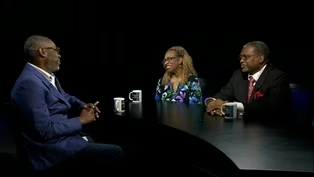
Dr. Omar Hakim of Detroit PBS met with high school students to get their perspectives on education.
We’re featuring a conversation with Detroit high school students moderated by Detroit PBS Vice President of Education Dr. Omar Hakim and recorded at The Skillman Foundation headquarters. The young people talk about their learning experiences, student issues, changes they would like to see in schools, and the future of education.
Problems playing video? | Closed Captioning Feedback
Problems playing video? | Closed Captioning Feedback
American Black Journal is a local public television program presented by Detroit PBS
Detroit students discuss their school experience
Clip: Season 54 Episode 34 | 6m 19sVideo has Closed Captions
We’re featuring a conversation with Detroit high school students moderated by Detroit PBS Vice President of Education Dr. Omar Hakim and recorded at The Skillman Foundation headquarters. The young people talk about their learning experiences, student issues, changes they would like to see in schools, and the future of education.
Problems playing video? | Closed Captioning Feedback
Where to Watch American Black Journal
American Black Journal is available to stream on pbs.org and the PBS app.
Providing Support for PBS.org
Learn Moreabout PBS online sponsorshipAs part of the station's ongoing education coverage, we wanna share a conversation we had with Detroit High School students about their learning experiences, challenges, and hopes for the future.
The discussion was led by Detroit PBS Vice President of Education, Dr.
Omar Hakim.
He met with the students at the Skillman Foundation headquarters to get their perspectives on education.
Take a look.
- We're having a conversation about all things related to school and the future of education.
And so we've got some brilliant, amazing young people here who are excited to share some of their perspectives.
So you bring up the topic of mental health, and I think that's something that came up several times in terms of wanting to talk about what role schools have in supporting students and mental health.
What are some things either that you think schools can do or that schools have done to help support students' mental health?
- At my school they have this club called Big Brother Big Sister.
It's essentially having a senior and basically have like a freshman companion.
Because freshmen is the first time coming to the school.
Like they don't really know what's going on and like they're just fresh to high school.
And essentially, it's like, it's basically just a way to encourage cooperation between students.
- In terms of like when you go to school, like should we be focusing on building strong character traits like empathy and integrity?
Are those skills as important as like the academic learning that you're doing in your classes?
- Yeah, those skills are definitely important because, well, those are basic like human like traits.
Like in order to have empathy, you have to be in someone else's shoes and a robot can't replace that.
But like when you have like a system where people have, you know, empathy or, you know, have those heart to heart feelings or, you know, have those same like experiences or the same out, like same environment as you.
- I would say something that helps mitigate the stress of a strict school is really having someone who cares about you and having someone to talk to.
For me, a lot of the times that's my teachers.
Sometimes I'll have a bad day and they'll see that I'm not to my best performance and they'll try to check up on me or say something that might make my day.
And I feel like that really helps.
And something that's not really talked about is there's people at school who definitely care about you, whether it be your teachers, your friends, or anybody.
Teachers really make or break your day because that's where you're at the most.
- Yeah.
- So if you were to redesign high school today, what would it look like?
Would it be the same sort of like you go to class to class, different teachers?
What are some things that you think could look differently about how we do school today that you have ideas about?
- Well, something that comes to the top of my mind that sounds really exciting is what if we spent the first three years of high school, like that's when you do your learning, but it's tailored to your interests.
And then what if like senior year, you did like a study abroad or a lot of like cool field trips and to like get you excited about, kind of stepping into the world and like maybe you have like a big project that lasts the whole year that you have to go out into the world to actually like come to a conclusion.
- I think when it comes to like real world application, helping them understand that either there's not just like one or two options that you can be in life.
You know, giving that encouragement, helping them find out like what is their why?
Like why do you want to get up every day?
Because I mean, I've read it somewhere that like the academics that we learn in school, it doesn't really apply to the real world.
And as we talk about AI and how the world is changing so fast, it's like, how much is this curricular really impacting our lives today?
You know?
- I would say that my ideal learning space would number one, like have kind of a curriculum tailored to an individual student.
So like say I'm advanced in reading, so I can take like a 12th grade reading class, but I'm still on my grade level in math.
I feel like that's something that could be explored.
And I also feel like, to Ziona's point, I feel like we should have like mandatory service projects and things like that.
I've heard a quote from one of my mentors and he said, "Touch the world, but touch the hood first."
And I feel like that emphasizes prioritizing where you came from.
- Yeah.
- So having mandatory service projects where people can give back to their community, I feel like is very, very important.
- Like service, I never thought that serving my community and like being a part of like a team will be something that I love so much.
Like having those passion projects, having those mentors that actually like feed into you, like help you understand what you wanna do is so important to me.
Like community service.
And like if we have more people who actually take their time to do that, I think the world will actually improve, honestly.
- And the fact that we can even sit here right now and have these sort of important discussions is really a love letter to our city and to our people, especially just to sit here and talk and be a spokesperson for people who don't have that sort of reach and that authority.
And I feel like that's why it's important that we do things like this and especially it be mandatory within schools.
- Mm-hmm.
 New
NewHow the church is supporting Detroit Public Schools Community District students
Video has Closed Captions
Clip: S54 Ep34 | 18m 2s | A look at the role the faith-based community plays in the education ecosystem. (18m 2s)
Providing Support for PBS.org
Learn Moreabout PBS online sponsorship New Episode
- News and Public Affairs

Top journalists deliver compelling original analysis of the hour's headlines.
 New Episode
- News and Public Affairs

Today's top journalists discuss Washington's current political events and public affairs.
 New Episode

 New Episode
 New Episode
 New Episode
 New Episode
 New Episode
 New Episode
 New Episode
Support for PBS provided by:
American Black Journal is a local public television program presented by Detroit PBS