
How the church is supporting Detroit Public Schools Community District students
Clip: Season 54 Episode 34 | 18m 2sVideo has Closed Captions
A look at the role the faith-based community plays in the education ecosystem.
Our "Black Church in Detroit" series examines the role of the faith-based community in supporting students in the Detroit Public Schools Community District (DPSCD). Host Stephen Henderson sits down with Bishop Dr. Corletta Vaughn, pastor of Holy Ghost Cathedral and VP of the DPSCD Board of Education, and the Rev. Dr. Steve Bland Jr., pastor of Liberty Temple Baptist Church and DPSCD Board member.
Problems playing video? | Closed Captioning Feedback
Problems playing video? | Closed Captioning Feedback
American Black Journal is a local public television program presented by Detroit PBS
How the church is supporting Detroit Public Schools Community District students
Clip: Season 54 Episode 34 | 18m 2sVideo has Closed Captions
Our "Black Church in Detroit" series examines the role of the faith-based community in supporting students in the Detroit Public Schools Community District (DPSCD). Host Stephen Henderson sits down with Bishop Dr. Corletta Vaughn, pastor of Holy Ghost Cathedral and VP of the DPSCD Board of Education, and the Rev. Dr. Steve Bland Jr., pastor of Liberty Temple Baptist Church and DPSCD Board member.
Problems playing video? | Closed Captioning Feedback
Where to Watch American Black Journal
American Black Journal is available to stream on pbs.org and the PBS app.
Providing Support for PBS.org
Learn Moreabout PBS online sponsorshipToday, we're continuing our "Black Church in Detroit" series, which is produced in partnership with the Ecumenical Theological Seminary and the Charles H. Wright Museum of African American History.
It's back to school time, and the faith-based community plays a really big role in the education ecosystem.
Here in Detroit, the church supports and advocates for students and families through a partnership with the Detroit Public Schools Community District.
Joining me now is Bishop Dr.
Corletta Vaughn of Holy Ghost Cathedral Church.
She is the Detroit Board of Education's vice president, and she leads the Faith-Based Council.
Also here is the Reverend Dr.
Steve Bland Jr.
He's a senior pastor at Liberty Temple Baptist Church and a Detroit school board member as well.
So Dr.
Vaughn, I wanna start with you.
Tell us about this faith-based council and the work that it does.
- Well, thank you again for the work that you're doing.
- Oh, thank you.
- The Faith-Based Council, when I came on the board eight years ago, existed of about 10 pastors.
The district was just being reconstituted, coming out of emergency management.
And when I came to the board, Dr.
Iris Taylor said to me, "Find a spot where you can really pour into."
And our strategic plan, one of these bullet points is whole child development.
So I said, "Well, I would like to invest there."
She said, "Well, we have a small faith-based council of about 10 pastors."
Because at that time, pastors were really not confident with the district and its district's management.
And so I said, "I'm going to pour my life there."
And so for the last eight years, we have developed partnerships with over 300 pastors and churches, faith-based ministries, nonprofits that actually partner with principals in our schools and provide the soft skills.
Outside of the curriculum, outside of teaching and testings, there are just so many other needs.
So mentoring when you think of a lot of our children that are below poverty level.
- Sure.
- So there's a lot that the faith-based community can do.
We are not necessarily like the business community where we bring money.
- Yeah.
- But we bring human resources.
- Yeah.
- We bring skill sets.
We bring experience.
We bring wisdom.
We bring hugs.
We bring love.
So the faith-based partnership over this last seven and a half years now has been, I think, strategic in working through, particularly during COVID.
- Yeah, yeah.
- And special holidays.
We have a diverse population.
African American, of course, being predominant, but Hispanic, we have Africans, we have people from Ecuador, everywhere you can imagine.
Detroit is a melting pot.
- Yeah.
- And so for a child to see their faith leader in their school- - Yeah.
- to see their priest, their clergymen, their pastor, their rabbi, it is a solace and it helps to create a learning environment for our children.
- Yeah.
Yeah.
Dr.
Bland, do you agree with that assessment of the council?
- Absolutely.
Yes, I have historically served in the role of being a faith-based leader.
I've been doing ministry 42 years and all my years of ministry, I have been a community advocate and somewhat of a social profit, you know, usually speaking to the systems and challenging them in many ways.
My philosophy is the church itself and particularly the Black church is in the community because we understand that the school district is an anchor like the church is an anchor.
And the church helps provide the atmosphere for which children must learn in.
And so for us, the church is more than just children in an academic setting.
It's a freedom issue.
It's a liberation issue, you know, which leads it to being a moral issue.
- Right.
- And so we have to address those issues in our community.
So the wraparound services are not just located within the school.
It's the community.
And so that village, it takes the village to raise a child.
So it's been interesting now in the past year of looking at it from a board member perspective.
I've been on the board the past year, replacing the departure of Angelique Mayberry Peterson.
- Right.
- The death of Irma Clark-Coleman.
And so looking at it from a consensus builder, board member colleague, shaping policy, dealing with tough decisions and budgets, helping to equate superintendents and challenging the things that take place, making critical choices, handling chronic absenteeism, those kinds of things, it's given me a more well-rounded, you know, understanding of the problem dealing with this.
- I'm sure, right?
Seeing on the inside is always different.
Very different from looking from the outside.
- Yeah.
- I wanna have you talk about where we are eight years, Dr.
Vaughn, after really getting the district back.
I think that's how Detroiters feel about it, that it was taken from us.
- Absolutely, absolutely.
- And you can, we could argue all day about why and how that happened, but the truth is that we got it back- - Yes.
- eight years ago and have had that time to try to rebuild.
- Yes.
- Give us a sense of where you think we are and what we've achieved in that time.
- Well, the first thing that we've done, remember when the district was taken from us, you were thinking about 200,000 children that attended DPS.
- Right.
- And now, the rebuilding of it, of course, is repopulating the district.
- Yeah.
- And so that has, that took, first of all, hiring a superintendent.
And so now, it's been nine years.
- It's been nine years for Dr.
Reedy.
- For Dr.
Reedy.
- Yeah.
- So the original seven that were elected had that responsibility.
Also, we were under financial review.
We couldn't make any financial decisions.
We didn't have any budgets.
I watched Dr.
Taylor and I, I do call her name in Memorial because just a week ago- - Yeah.
- She left on the glory train.
- Yes, yes.
- And so we honor her.
I watched her sit with numbers for hours and trying to put a budget together for a district this size.
- Yeah.
- Hiring the right people.
So now, when we look fast forward, we are no longer under financial review.
We have absolute, I would say astounding budget.
Our balances are amazing.
We even have a rainy day fund.
- Right, right.
- And with Detroit Public Schools not being equitably funded- - Sure.
- it is an amazing journey to watch us be able to still do the things that we're doing.
To watch us now with facility master plan, building new schools.
So Pershing is getting a new school.
Cody's getting a new school.
You're talking about a district that was raised, raped, molested, that was violated in the worst of ways where we lost properties, we lost population, we lost our reputation, we lost integrity.
So it's not just what's happening in the classroom.
It's the ecosystem of public education- - Sure.
- that's being rebuilt.
- Yeah.
- So I would say eight years now, we certainly have repopulated.
We're right between 50 and 52,000 students attending.
We, last night- - That's growing.
- That's huge.
- I remember when it had dipped to about 40.
- We were down to 10,000.
- Yeah.
- When we got the district back- - Right.
- nine years ago, we had 10,000 students.
- Right, right.
- So- - Because people had just decided to do something else.
- Well, charters came in.
Schools of choice came in.
People left Detroit.
Neighborhoods destabilized.
- Yeah.
- The economy plummeted.
But even with that, the Lord has been kind to us.
And people have been rebuilding their confidence in the district.
The Detroit Federation of Teachers, our unions for teachers, paraprofessionals, they are now negotiating.
We're settling the negotiations even before the actual previous negotiation expires.
- Right.
Before the contract expires.
- So we're doing some things.
Teachers are getting raises.
- Yeah.
- I remember when I first came in, the starting teacher was at 35,000.
The starting teacher now is 52,000.
So the first year teacher, without any real experience coming out of school, can now earn a decent living.
- Yeah.
- Paraprofessionals are going up, security's going up.
That doesn't mean we're perfect.
- Yeah.
- But I do wanna articulate what we have done.
- Right.
- And the fact that we are now, I believe, headed toward the next three years, the next four years, populating, curing chronic absenteeism, making sure that equitable funding is becoming available.
Prop has just passed.
- Right.
- So that means we can- - More money.
- There's more money.
- Yeah.
- We're paying off the legacy debt.
- Right.
- And Dr.
Vitti has done an amazing job, I think, in responding to the needs of our community and to our children and to our teaching staff.
So I'm excited about where we're going.
And we've got a great board.
- Yeah.
- I do wanna say that when Dr.
Bland came on the board prior to, he was the Baptist Pastor Council, Council of Baptist Pastors, Detroit and Vicinity.
He was the pastor and the president of that.
And I wanted to articulate that because even then, he had a deep concern about public education.
And I think for the first time, the council actually had a committee- - Yeah.
- On public education.
- Yeah.
- So when you combine pastors, I've gone to synagogues and got rabbis.
I've gone to the Catholic archdiocese and got priests.
I've gone to the Hispanics, I've gone to the Buddhists.
I've gone to the Baha'i.
I'm touching everybody.
The Scientologist.
I've even got them in our schools because the school, the church, and the home, these are the three anchors.
- Yeah.
- If you tie them together, then you're talking about whole child education.
- Right, I wanna ask you guys about a social media fervor that has kind of cropped up.
There's a parent who has been really lighting up social media talking about DPC, DPSCD, and she's really critical of the things that her kids wouldn't have in the schools, the things that she sees as problems.
Of course, as you point out, it's never gonna be perfect.
But some of the things that she's pointing to, I think, shock some folks about things that we're still dealing with.
I assume you guys have seen this.
- Well, I personally don't have a lot of time in my schedule to do social media.
- Okay.
- So unfortunately- - But things like conditions in the school.
- But I have listened to public comment.
- Yeah.
Yeah.
- You know, through board meetings, and I have met this wonderful individual- - Yeah, yeah.
- who spotlighted issues.
And see, my perspective, I think the story of DPSCD should not be told through the language of crisis and challenge, but in every crisis and challenge is a golden opportunity.
Sometime though, you need to raise up, you know, the tone and tenor of the community- - Sure.
- so that we know that we're not operating in isolation or in a bubble and be subject to critique.
- Yeah.
- Constructive criticism.
You know, the people you serve me as a pastor, I wanna make sure that I'm meeting the needs of the least of these.
If I'm only looking at the people who are doing well, but not considering the persons who are being challenged- - Who are struggling- - Yes.
You know, the weakest, our part of the fence is the part where changer has a way of entering.
So there are some critical issues.
And while we have a lot of things that are going forward that are doing well, there are some critical issues that are not getting the attention that we need to look at.
I like how Bishop Vaughn used the language of how the district came through a season of abuse.
You know, me coming to Detroit, I had finished pretty much my terminal degrees when I came.
When I got here, I just finished my doctoral degree.
And I was excited about coming to a city where I didn't have to fight racism in the same kind of way I did in my previous pastor because of the majority of Black district and things of that nature.
But I perceive that the abuse victim type mentality is what I saw.
There was a lot of beauty in the district, but sometimes an abuse victim can't see their own beauty.
They cannot understand what other people who didn't grow up or come up in it can see.
- Yeah.
- So sometime it takes persons who can point to some of the things.
And right now, we've gone from emergency management to now we are 83% graduation rate.
You know, that's a big increase.
We are only a percentage away from the national average.
It increases enrollment.
I mean, we have $700 million investment of use.
The crises of COVID gave us ARPA dollars to do infrastructure.
- Right.
- Projects we otherwise wouldn't have had.
Literacy lawsuit give us the ability to do some things to add to Title I, Title II funds.
So every crisis has presented an opportunity.
So my challenge is, is that we ought to embrace community advocates and through social media influence and others and move towards solution building from the crisis that is being done together.
- Yeah.
- There are those who are watching the dismantling of public school education from the federal level, Department of Education, and the likes.
You have even state persons who wanna defund public school education.
So we cannot afford to be competitors.
We have to be companions and see the big picture.
We gotta work together in order to make this a stellar look for the world to see that black children particularly, along with the diverse other populations can learn, right, through a process where we together have turned education forward.
- Yeah, and deserve everything that should be coming to them.
- Absolutely.
- I mean, that's one of the things that we still have to make the argument- - Absolutely.
- for too many times, I feel.
- [Steve] Sure, because we know funding is not equitable.
- Right.
- You know, we are $170 million, probably less than surrounding suburban- - Absolutely.
- schools per student have.
But we are making, as usual, the Black church has a way of taking, you know, the least of these resources and two fish and five loaves, again, to feed thousands.
- Absolutely.
- So we're still doing that miracle.
We still believe- - Absolutely.
- In the miracles of education.
- We're still turning what is a wine, water into wine.
That's the miraculous power- - Right.
- That's what brings faith to this, right?
- Yeah, and concerning the social media- - Yeah.
- thing that's been going on.
A lot of what happens, again, as pastor said, people see what they see in their particular moment of crisis.
- Sure, yeah.
- They don't necessarily understand context.
- How it fits into the- - The larger scale.
And how far we've come.
- Yeah.
- I think what triggered that situation was a parent coming into the district new, made a phone call to a school, and the school is getting ready for the return of students, and it wasn't a quick enough response.
And so I think that what it has done among board members, as well as the superintendent is to say, "Okay, we know what we're doing."
And sometimes we can get siloed.
We know.
We see it because we're in it every day.
- Right.
- But are we as transparent and open in conversation in board meetings?
So it really has shifted in the last month how we approach the board meeting instead of just doing the business.
- Right.
- Challenging, asking questions.
It's not that we don't know the answers, but we want the community to hear the answers.
- [Stephen] So you want them to see the process.
- And to see the process.
So that was really good for us in terms of a trajectory change of how board meetings are conducted.
So it really turned out really good.
- Yeah.
- If we're not communicating the good that we're doing and listening to the things that are challenged, you know, no matter how profitable you are, if you got bad customer service, you're not gonna make that customer- - It's not gonna work.
- You know, if you have people who are good- - You want people to believe.
- You got to have people believe in it.
- Their kids over.
- And bring their children.
- Yes, bring their children.
- Yeah, 'cause that's the meat and potatoes of what we do.
- That is what you're doing, yeah.
- So reputation is important as character when it comes to how we do it.
So we got to hear what people are saying, and then make sure they have adequate access to see transparently the process.
And as Bishop says, sometimes, for instance, as a community advocate, sometimes I would challenge some things that looked one way to me, but as a board member, I understand.
You know, contracts have a vetting process.
You know, things, the wills of budgets, you know, take time.
You know, things that you deal with that appear one way on the outside and you anticipate wanna deal with that.
You got to work in consensus to do that.
- Absolutely.
- I would love to go on for all day with the two of you, but we are out of time.
- Oh my.
- But I'm really glad you came and I'm really glad you're doing the work- - Thank you.
- That you're doing in our schools.
- Thank you.
- Thanks for being here.
 New
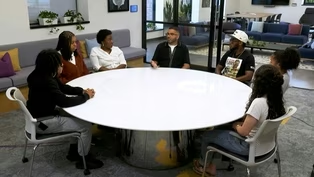
NewDetroit students discuss their school experience
Video has Closed Captions
Clip: S54 Ep34 | 6m 19s | Dr. Omar Hakim of Detroit PBS met with high school students to get their perspectives on education. (6m 19s)
Providing Support for PBS.org
Learn Moreabout PBS online sponsorship New Episode
- News and Public Affairs

Top journalists deliver compelling original analysis of the hour's headlines.
 New Episode
- News and Public Affairs

Today's top journalists discuss Washington's current political events and public affairs.
 New Episode

 New Episode
 New Episode
 New Episode
 New Episode
 New Episode
 New Episode
 New Episode
Support for PBS provided by:
American Black Journal is a local public television program presented by Detroit PBS