
National Black Maternal Health Week, "Detroit PBS & The Caring Community"
Season 54 Episode 15 | 26m 46sVideo has Closed Captions
Eliminating health disparities that put Black mothers at risk and a look at a caregiving event.
During National Black Maternal Health Week, American Black Journal is featuring efforts to address health disparities impacting African American mothers. Plus, we’ll have highlights from a Detroit PBS event focusing on the challenges and rewards of caregiving.
Problems playing video? | Closed Captioning Feedback
Problems playing video? | Closed Captioning Feedback
American Black Journal is a local public television program presented by Detroit PBS
National Black Maternal Health Week, "Detroit PBS & The Caring Community"
Season 54 Episode 15 | 26m 46sVideo has Closed Captions
During National Black Maternal Health Week, American Black Journal is featuring efforts to address health disparities impacting African American mothers. Plus, we’ll have highlights from a Detroit PBS event focusing on the challenges and rewards of caregiving.
Problems playing video? | Closed Captioning Feedback
How to Watch American Black Journal
American Black Journal is available to stream on pbs.org and the free PBS App, available on iPhone, Apple TV, Android TV, Android smartphones, Amazon Fire TV, Amazon Fire Tablet, Roku, Samsung Smart TV, and Vizio.
Providing Support for PBS.org
Learn Moreabout PBS online sponsorship- Just ahead (gentle music) on "American Black Journal", it's National Black Maternal Health Week.
We're gonna talk about efforts to address racial disparities that impact African American mothers.
Plus we'll have highlights from a Detroit PBS event that focused on the challenges and rewards of caregiving.
Stay where you are.
"American Black Journal" starts now.
- [Announcer] Across our Masco family of companies, our goal is to deliver better living possibilities and make positive changes in the neighborhoods where we live, work and do business.
(gentle music) Masco, a Michigan company since 1929.
Support also provided by the Cynthia & Edsel Ford Fund for Journalism at Detroit PBS.
- The DTE Foundation (bright music) is a proud sponsor of Detroit PBS.
Through our giving, we are committed to meeting the needs of the communities we serve statewide to help ensure a bright and thriving future for all.
Learn more at dtefoundation.com.
- [Announcer] Also brought to you by Nissan Foundation, and viewers like you.
Thank you.
(bright music) - Welcome to "American Black Journal".
I'm your host Stephen Henderson.
April 11th through the 17th is National Black Maternal Health Week.
The observance was created by the Black Mamas Matter Alliance.
It's a time to raise awareness and address the systemic inequities and health disparities that disproportionately impact black mothers.
This year's theme is Rooted in Justice and Joy.
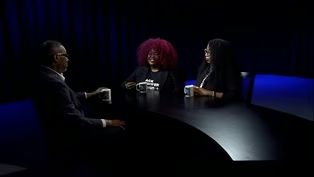
Joining me now to talk about black maternal health is Leseliey Welch from Birth Center Equity, along with Cassy Jones-McBryde from the Michigan Chamber for Reproductive Justice.
Welcome, both of you, to American Black Journal.
- Thank you.
- Thank you.
- Let's start just by talking a little about the issue of black maternal health in the city of Detroit.
This is a, a, a crisis area in, in many ways, and I'm not sure that everyone always sort of takes note of that, but we have a higher incidence of people losing pregnancies here.
We have a higher incidence of people being sick when they are pregnant here.
And because this is a majority African American city, that becomes a black problem.
I'd love to hear from both of you where you feel like we are with that level of crisis.
- Yeah.
I would first emphasize that there... There's nothing inherently wrong with black bodies-- - Right (laughs) - That has produced this problem.
- Right, right.
- So-- - This is about poverty and isolation-- - Yes.
- And underinvestment.
- So we have an inequity in those outcomes, and we also have an inequity in care options.
And we live in a country that has historically disinvested and not repaired the investment in midwifery care, which we absolutely 100% know makes a difference-- - It makes a huge difference.
- In our care outcomes.
And so part of my work is advocating for increased access to midwifery care in our communities because we know it would reduce our instances of preterm birth, of low birth weight, of maternal mortality and morbidity.
It would increase our rates of breastfeeding.
It would increase our experiences of autonomy and respect, and all of those things will empower our families.
- Yeah, yeah.
- That's very true.
I think that there is a need to lift that.
Not only is it because we may, you know, lose our children or, or suffer or step backs when we have to take time off work, but we die a lot in giving birth, black people.
So 80% of the deaths that happen and related to pregnancy are preventable deaths.
That means that we have solutions that we're just not addressing or accessible to those that are the most vulnerable.
So the work that I do is connect the policy aspect and equity and birth equity into every system because we've to justice as everything, and we have to make sure that we have the things that we need to thrive, and access to those things are very important for us.
And that the level of, of, of divestment that we feel in in this work is staggering.
- Yeah.
- People die.
There'll be seven women that will die by sunset today.
And so that's every day someone loses their life and they don't need to.
- Yeah, yeah.
When we think about this, this, this period of time when you try to focus on these things, what are some of the things that you need people to kind of draw out of that focus to, to move in a different direction?
- Hmm.
One of the things that we've just launched at Birth Center Equity is a national 25 year initiative called Beloved Birth 50 by 50.
And the goal of Beloved Birth 50 by 50 is to have 50% of births in the US be attended by midwives by 2050 for all of those reasons we just described, and to influence a culture shift in birth in our country.
So right now we live in a culture of birth that is physician-centric, that is physician-led, that is hospital-anchored and that's rooted in hierarchy, whether it is hierarchy around identity or around credential.
And what we are advocating for and proposing is a culture of birth that is family-centered, that is midwife-led with physician collaboration, that is once again rooted in communities like birth centers, and that honors the inherent value of all people and of all credentials.
- Yeah, yeah.
- And so.
- Yeah.
And there are people working diligently in this work that are making sure that we have the guardrails to care and that's in policy.
So we have the Michigan Momnibus that is still fighting to be fully introduced... Not introduced, but realized.
We have passed the Senate twice and we're looking for House support, and we're confident that it will happen.
We also have organizations like the Well Coalition that work toward water affordability.
That's part of reproductive justice.
- Yes.
- And also we always forget about how people experience their birth while in custody.
There's a prison or postpartum directive that is currently not really fully realized because care is relative to the directive in prisons, and also there's no consistent care and custody while you're fully in custody in your jails.
So our awareness this week is for us to raise the how harm is happening in all systems and making sure that we don't forget the ones that are often left behind that are incarceration.
- Hmm, hmm.
I wanna have you talk just a little more about these, the idea of birthing centers and why that's different from the setting and environment in which we manage maternal health now, and, and what's different about that?
You said something earlier about midwife-led as opposed to physician-led.
Why is that difference important?
- Yes.
So birth centers are homelike places where midwives provide prenatal care, postpartum care, birth care, but also care, we say period to period.
Right?
So reproductive healthcare, GYN care, well woman exams.
And midwifery care is important because midwives approach birth as a normal physiological experience in our life cycles, and it is not overly medicalized.
So in countries that have better birth outcomes than the United States, you see a midwife first unless a physician's care is medically indicated.
Right?
And we know that in our country, upwards of 60%, some say 80, 87% of us could safely give birth with midwives.
Right?
In a community setting.
And so the birth center provides an opportunity, is the only healthcare facility that is uniquely built to center the midwifery model of care, but you can have midwives in hospital and home and in the birth center, but we love the birth center because we feel like it provides the best of all worlds and is also can be a center for community wellness.
- Yeah, yeah.
And, and you've opened a birthing center-- - Yes.
- Recently here in Detroit.
Talk a little about that and where it is.
- So I'm proud to be one of four co-founders of Birth Detroit, along with Char'ly Snow, Elon Geffrard and Nicole White.
We started providing prenatal care in the city actually in pandemic in 2020 in collaboration with Brilliant Detroit in the small clinic, but we then worked to raise money to buy land and to build our brand new birth center, which opened, we cut the ribbon in fall 2024, and our midwives have been catching babies there ever since.
(participants laugh) - When you talk about the sort of systemic, I guess, context for this, I can't help but think of the recent shift in city government here in Detroit and the focus now on all kinds of health-oriented policy that's coming out of this administration, it seems like it would be a boost to the work that you're doing.
- Absolutely.
I'm also the Co-chair of the Detroit Right to Counsel Coalition, and one of the driving agenda items for our beautiful mayor is the housing.
- Yes.
- Is actually important for our families, and it is reproductive justice as well.
If you're not able to have a home to parent, then you're not fully thriving and supporting the way that you are, are, should, I guess, a God given right to have.
And so I think that with housing instability, there has to be data for that, and I'm proud of a study that was co-authored by Dr.
Sealy-Jefferson and other brilliant minds that connect how the illegal eviction crisis in Detroit.
We surveyed over 1,500 black women and we found that over half of them were evicted illegally.
That's a staggering amount, and they were all, you know, with families and care for community.
So that's, it is really a systemic problem that happens in Michigan and primarily in Detroit where there's so many predatory ways that landlords seek to-- - Sure.
- To take domain over your residence and over your lives.
So I'm very proud of the work we're doing in Detroit Right To Counsel, but like all of the movement work, we need funding to, to be sustained.
- Yeah.
Yeah.
I mean, there's something kind of fundamental, I think, about being able to think about maternal health in all of the different contexts that have an effect on it.
You've talked about housing, incarceration, right to counsel.
I mean, all of these things that we do and sometimes do poorly in the city have an effect on maternal health and therefore on a neonatal health and those other things too.
- People don't really think about the connection between all these systems that fail us and how we need to have the fact that they're not built for us originally, and it is hard to work within systems that are not designed for us.
That's why the work of midwifery care and birth workers to make sure that we center the lives and lived experience of the people that we serve in Detroit, the things that we talk about when it comes to disparities that we uplift within this week is also coupled with the joy that we find in the work that we do.
- Yeah.
- I mean, we are survivors because that is the outcome if you survive your birth, and that is the joy that you have, and that should not be the outcome that we looking for, just to survive our experiences.
We should enjoy the entire process, like you said, from period to period and be able to be free of, of obstructive racism and violence, to be free of, of all the systems that we don't fully enjoy.
- Yeah.
- Yeah.
- Yeah.
I do agree.
I tell people all the time, we deserve much more than just to not die.
- Right.
- And to not be sick.
- Right.
- It is one of the-- - This is supposed to be-- - Most sacred-- - One of the most-- - Life experiences.
- Yeah, yeah, yeah.
- And we need to reintroduce and celebrate the communal and sacred nature of birth.
And I think the theme for this week, the Rooted in Justice and Joy, invites us to create futures truly rooted in justice and joy and to do it for ourselves because we cannot wait (laughs) for other folks to take better care of us when we can create the systems of care that we deserve.
- Yeah, yeah.
Okay.
Congratulations on the work for this week, and of course, thanks for being here with us on "American Black Journal".
- Thank you.
- Thank you for having us.
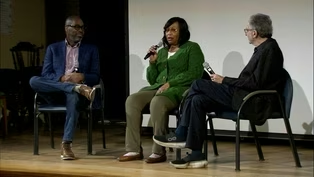
- For the past year, Detroit PBS has produced stories and events that lift up the voices, experience and needs of caregivers.
Recently, I hosted an event called Detroit PBS and the Caring Community at St.
Patrick's Senior Center in Detroit.
The program brought together caregivers, community leaders and experts for an engaging conversation about the realities of caregiving.
Here are some highlights from those discussions.
This is my first time here at the St.
Patrick Senior Center.
Maybe there's other folks in the audience for whom that's also true, and certainly I think there are people watching who have not been here before.
So give us just a thumbnail sketch of what you do here and why the work is important.
- Well, I would say St.
Pat's is a great place to be, and we service over 3,000 older adults a year, and I am ecstatic that I've had the pleasure to be a large part of that.
Our organization was founded by Sister Mayor Watson, and if, to take over after a nun, (participants laugh) means that it also becomes your life mission.
And I made a promise to her that I was gonna take care of her seniors, and I try my best to do that.
They are an extension of my family.
I have a very small family.
I grew up with just my mother and her two parents.
I have two children, so we take care of one another, and my seniors have adopted my family just as they have adopted them.
And it's so many older adults, they're alone.
Sometimes you still have family and you're alone, and that's very hard to deal with.
You know, when something happens, the first thing we say is, do you have any kids?
And sometimes you do, but it doesn't matter if they, if you don't see them.
It doesn't matter if the only thing that they wanna see you is when you get your check or trying to find money when sometimes you're struggling to take care of yourself.
So my staff and I have a wonderful, hardworking staff.
There's a great support system here from the staff and from the senior members themselves, they're community.
They look out for one another, they take care of one another.
They bring each other food, meals.
Someone's missing, they go looking for them, and it's very important to have that space to help make sure that you're okay.
You have to be okay also as a caregiver.
It is very overwhelming and hard not to lose yourself, because often there's financial sacrifices that you have to make and you have to make a decision.
Sometimes you make those sacrifice and you can't afford it.
Not everyone is blessed to be able to pay someone to do the things that need to be done.
You have to find a way to, like, I'm a caregiver for my mother.
She wanted to come here today, was not able to.
And being an only child, mother and daughter, sometimes you're going at it, you going at it nonstop because they don't want to have you tell them nothing.
(participants laugh) And, you know, with me, it's like, mama, I do this for a living.
I've been doing this for 27 years.
It doesn't always matter, but you have to figure out, how can I still say what I need to say?
Because we wanna make sure that you understand how it's really supposed to go.
But then, and my mother was a professional.
She graduated from Harvard, she worked for the City of Detroit.
In her life, she had to come to grips that the life that she knew was no longer the life that she has.
- One in five people are caregivers in this state.
We all know it's a far bigger number than that.
A lot of people don't call themselves caregivers, but they are.
So we decided this is, we've been actually working on caregiving for about four or five years too, right?
During the pandemic is when we started.
And it matters to me.
I took care of my father for the last 10 years or so of his life, brought him close to to where I live and was there as often as I could be.
Wish I had been there more often.
And I wish I had the support and the knowledge to take advantage of the services that are available to us that people do not know about.
So again, we taught, we built the partnerships, we built connections with the wonderful people (indistinct) and her whole team here at St.
Patrick and all the great people, the organizations are represented downstairs, and they helped us decide what stories we cover.
We've done things on dementia care, respite care, the shortage of, as (indistinct) says, of paid care, care workers, and on and on and on.
And they also said that people aren't getting prepared for end of life.
We call it planning.
We like to call it life planning instead, it's so less gloomy, and how we, how they should get, make their wishes known, because once you get incapacity when you're 18, it doesn't matter if you're 18 or 58 or 88, if you haven't done the planning, you, it's hard for the, the, the doctors, the lawyers, your family to be able to make sure that the wishes, your wishes are carried forward.
So you gotta get it in writing, you gotta get it signed.
You gotta work with attorneys to make it happen, otherwise, the burden of your families is horrific, 'cause they, they're guessing what you wanted, and if you don't have it in paper, even if they know what you wanted, it may not be enforceable.
So we talked to the wonderful Antonia Harbin there, and she, and she said, "Get it done, and get it done now.
- Now.
Now (laughs) right?
Ericka, it was really interesting to hear you talking with your mother about how you had come to the decisions that you've made and doing the things that that you've done.
I wonder if you can go back to the first conversation you can remember about that with your mom, 'cause I think that for a lot of folks is the hesitation.
Like, how do I start that, that talk with my parent about these things?
You know, how do I get that door open?
- So my mom is one of seven children.
It's six girls, one boy.
So during Christmas dinner one night, my cousin was kind of teasing me like, "Did you get your mom's business right?
'Cause we got our mom's business right."
And I'm like, "What kind of business you talking about?"
(Stephen laughs) And so she was like, "You know, her will and trust and life, end of life planning."
And I'm like, "Tell me more."
And because it's six girls, they're so competitive that they're offspring, we are all, me and my cousins, I love them, but they troll me, I troll them.
It's just our relationship.
I don't know.
I'm closer with my friends.
I don't know, whatever.
(participants laugh) So she wouldn't tell me.
She was like, "Here's the card."
And so I was like, "Okay."
So that card sat, it was a magnet, and it sat on our refrigerator for years, and it just was like right here, like get it done, get it done, get it done.
And I was like, "I wanna ask her like more questions, but I know she's not gonna tell me."
So I saw, I think it was like a Facebook post or something, and it was like, "Log on at 7:00 on April 30th and we'll tell you about life planning."
And I put it in my phone, my calendar, the reminder came on and I didn't ignore it.
And so I logged on, and when I logged on, I recognized the presenter.
So I was like, "Oh, okay, thank you."
And so I listened and I learned about life planning and then I called her.
I had her number, I called her afterwards, and I was like, "Can we talk more about this?"
And she's like, "Absolutely."
And so it was at Christmas 15 years ago.
- You discovered people were happy to share stories that their kids never heard.
And you kind of go, why not?
Well, the kids didn't know what to ask or maybe the subjects didn't really feel that comfortable sharing with their own children, but they'd talk to somebody else, and that was kind of a clue that, you know, when you make documentaries, people tell you stuff.
And then the other thing, my daughter was working at the StoryPoint Northville for Sabrina, and she'd come and tell me all these amazing stories of the residents there.
And we also had a project called Destination Detroit where we talked to people about why they came to Detroit.
So I was hearing all these stories and we gotta converge all this stuff together to record some history and help some people.
- [Stephen] Yeah.
- People that like telling stories, I thought it's gotta be the case that this is good for them physically, mentally, and looked it up, and that was the case, and we interviewed some professionals about that.
- Yeah, yeah.
Sabrina, tell us about StoryPoint and the work that you do there.
- Sure.
So StoryPoint is a assisted living and memory care community in Northville, and my job as their Life Enrichment Director is to plan their day-to-day activities.
So I like to say I have the best job, I have the fun job 'cause I get to plan, like I said, all the fun stuff that they do every day.
Yeah.
- And tell us about the approach, I guess, at StoryPoint, and the role that this kind of storytelling plays in that community.
- Yeah.
So StoryPoint has a philosophy, we call it 1,440.
So there's 1,440 minutes in every day, and we need to make those minutes count.
So my job is to create experiences for them to make those minutes count.
So I look for... When I'm talking to them and asking them about their life, I'm asking questions that will lead me to what can I plan for them?
It can be as simple as I took an outing to the Motown Museum.
I had a lifelong Detroiter, huge Motown fan, never had been to the museum.
So why not take a day, take them to the Motown Museum?
And she sang and she laughed and she talked about the neighborhood and it was a great experience for her.
And it can be a little bit more meaningful.
I had a resident turn 100 last year.
She was my very first centenarian.
(Sabrina laughs) And all she wanted to do when I asked her what she wanted to do for her birthday is she wanted to watch her wedding video from 1955.
And I'm thinking, how in the world do I take a video from 1955 and convert it to work in 2025?
But I figured it out (laughs) and we got her to watch her wedding video.
There was no sound.
It was all in black and white, but it was absolutely amazing.
And she had her glass of champagne and her chocolate cake and she did pass a few months later, so it was really special for me to give her that last opportunity that she asked for.
- Yeah.
And you can see the entire caregiving program at detroitpbs.org.
And that is gonna do it (bright music) for us this week.
You can find out more about our guests at americanblackjournal.org, and you can connect with us anytime on social media.
Take care, and we'll see you next time.
(bright music continues) - [Announcer] Brought to you in part by Ralph C. Wilson Jr.
Foundation, Impart Alliance, and by... Across our Masco Family of Companies, our goal is to deliver better living possibilities and make positive changes in the neighborhoods where we live, work and do business.
(bright music) Masco, a Michigan company since 1929.
Support also provided by the Cynthia & Edsel Ford Fund for Journalism at Detroit PBS.
- The DTE Foundation (bright music) is a proud sponsor of Detroit PBS.
Through our giving, we are committed to meeting the needs of the communities we serve statewide to help ensure a bright and thriving future for all.
Learn more at dtefoundation.com.
- [Announcer] Also brought to you by Nissan Foundation, and viewers like you.
Thank you.
(gentle music)
 New
NewA look at a Detroit PBS event highlighting the voices, experiences and needs of caregivers
Video has Closed Captions
Clip: S54 Ep15 | 11m 20s | ABJ features discussions between caregivers, experts and journalists on the realities of caregiving. (11m 20s)
 New
NewA Spotlight on National Black Maternal Health Week
Video has Closed Captions
Clip: S54 Ep15 | 12m 48s | A talk with the Birth Center Equity CEO and founder of the Michigan Chamber for Reproductive Justice (12m 48s)
Providing Support for PBS.org
Learn Moreabout PBS online sponsorship
- News and Public Affairs

Top journalists deliver compelling original analysis of the hour's headlines.

- News and Public Affairs

FRONTLINE is investigative journalism that questions, explains and changes our world.











Support for PBS provided by:
American Black Journal is a local public television program presented by Detroit PBS