Chicago Stories
Take a Tour of the White City
Clip: 10/2/2026 | 5m 17sVideo has Closed Captions
What was it like to visit the White City? Journey back as we imagine the World’s Fair.
What was it like to visit the White City? Journey back with us as we imagine what it would have been like to explore the grounds at the 1893 World’s Columbian Exposition.
Problems playing video? | Closed Captioning Feedback
Problems playing video? | Closed Captioning Feedback
Chicago Stories is a local public television program presented by WTTW
Lead support for CHICAGO STORIES is provided by The Negaunee Foundation. Major support is provided by the Abra Prentice Foundation, Inc. and the TAWANI Foundation.
Chicago Stories
Take a Tour of the White City
Clip: 10/2/2026 | 5m 17sVideo has Closed Captions
What was it like to visit the White City? Journey back with us as we imagine what it would have been like to explore the grounds at the 1893 World’s Columbian Exposition.
Problems playing video? | Closed Captioning Feedback
Where to Watch Chicago Stories
Chicago Stories is available to stream on pbs.org and the PBS app.

Chicago Stories - New Season!
Blizzards that brought Chicago to a standstill. A shocking unsolved murder case. A governor's fall from power. Iconic local foods. And the magic of Marshall Field's legendary holiday windows.Providing Support for PBS.org
Learn Moreabout PBS online sponsorship- [Geoffrey Baer] What was it like to visit the World's Columbian Exposition in Chicago, otherwise known as the World's Fair in 1893?
Let's travel back in time to take a walk through what came to be known as the White City.
You arrive by rail at the fair's own train station at the southwest corner of Jackson Park.
With your 50-cent ticket, you enter the breathtaking Court of Honor, a vast plaza of gleaming white palaces, a grand basin, and impressive sculptures.
The first thing that catches your eye is the Administration Building, the White City's unofficial capital building.
Its gilded octagonal dome reaches 250 feet into the air.
The Administration Building is surrounded by exhibition halls, including the Electricity Building.
The lightbulb has been around for more than a decade, but this is probably your first time seeing it in person.
Inside, of course, you find Thomas Edison's incandescent lightbulb and new home appliances like electric irons and dishwashers, and a rather shocking new electric chair that promises a more humane execution.
Now let's walk a little further into the Court of Honor.
The grand basin takes your breath away, and the electricity you just saw will be used to light up the fountains at night.
At the eastern end of the basin, you'll notice the Statue of the Republic.
This gilded giant is nicknamed Big Mary, and with her pedestal, she's 100 feet tall.
Speaking of behemoths, nearby the Manufactures and Liberal Arts Building is the largest building ever constructed, in 1893 that is.
It's four times the size of the Roman Colosseum.
Inside, you'll find nearly 32 acres of exhibits on literature, science, art, and music.
Plus, if you climb up to the building's promenade, you'll see an incredible panoramic view of the White City.
Before you leave the Court of Honor, don't forget to take in the Peristyle, a monumental gateway that welcomes visitors arriving by boat on Lake Michigan.
People stepping onto the dock can glide into the fairgrounds on the first ever moving walkway.
That is, when it's not malfunctioning.
There's still so much to see.
Let's take a break from the crowds and go to Wooded Island, designed by superstar landscape architect Frederick Law Olmsted, who laid out the entire fairgrounds.
This quiet refuge was meant as a peaceful and natural respite from the fair's grand spectacle.
While you're enjoying the natural scenery, you might notice the pop of color coming from across the lagoon.
The red hues, polychromatic ornamentation, and massive golden door adorn architect Louis Sullivan's Transportation Building.
Sullivan, a prickly contrarian, created one of the only buildings in the White City that isn't white.
A little further north, you'll find the Women's Building.
Designed by architect Sophia Hayden, it showcases artwork, inventions, literature, and accomplishments from women around the world.
Still have energy for more?
The Palace of Fine Arts is the only building that was made to be permanent, because it houses precious works of art from dozens of countries.
A few decades into the future, it will be converted into the Museum of Science and Industry.
Nearby, don't miss one of the fair's more unexpected sights, a full-scale Viking ship.
Well, it's a replica, which sailed all the way to Chicago from Norway.
Finally, no trip to the fair would be complete without visiting the Midway Plaisance.
Here, the formality of the White City is replaced by more amusement park-style entertainment.
There are international villages, but they're presented as primitive or exotic by the Eurocentric promoters.
You'll see provocative belly dancers, and food vendors, hawking everything from Vienna beef sausages to a new caramel-coated snack called Cracker Jack.
Before you leave, climb aboard the world's first Ferris wheel.
At 30 stories tall, you've likely never been this high up in the air in your life.
An engineering marvel with carriages the size of streetcars, it's the perfect thrill ride to end your time at the White City with an unforgettable view.
(upbeat music)
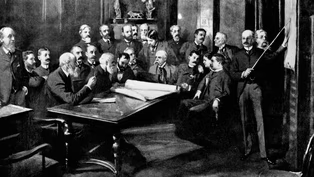 New
NewVideo has Closed Captions
Burnham, Root, and Olmsted set out to design the White City. (7m 19s)
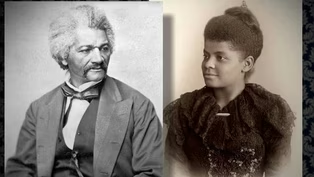 New
NewFrederick Douglass and Ida B. Wells Protest the Fair
Video has Closed Captions
Douglass and Wells object to the exclusion of African Americans from the World’s Fair. (3m 3s)
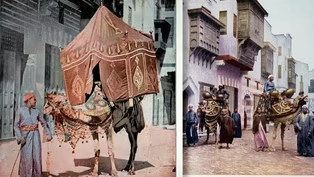 New
NewThe Spectacle of the Midway Plaisance
Video has Closed Captions
The Midway Plaisance offered a different kind of energy at the World’s Fair. (7m 46s)
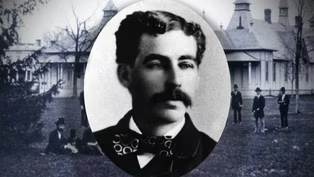 New
NewVideo has Closed Captions
H.H. Holmes moves to Chicago, and a young woman later goes missing. (5m 23s)
Providing Support for PBS.org
Learn Moreabout PBS online sponsorship












Support for PBS provided by:
Chicago Stories is a local public television program presented by WTTW
Lead support for CHICAGO STORIES is provided by The Negaunee Foundation. Major support is provided by the Abra Prentice Foundation, Inc. and the TAWANI Foundation.