
The Heat and Warmth Fund, remembering Tony Brown
Season 54 Episode 28 | 26m 46sVideo has Closed Captions
A look at a nonprofit helping Michigan families and the career of television journalist Tony Brown.
We’ll talk about how The Heat and Warmth Fund is helping improve the quality of life for Michigan families year-round. Plus, we’ll remember journalist Tony Brown and his groundbreaking contributions to public television.
Problems playing video? | Closed Captioning Feedback
Problems playing video? | Closed Captioning Feedback
American Black Journal is a local public television program presented by Detroit PBS
The Heat and Warmth Fund, remembering Tony Brown
Season 54 Episode 28 | 26m 46sVideo has Closed Captions
We’ll talk about how The Heat and Warmth Fund is helping improve the quality of life for Michigan families year-round. Plus, we’ll remember journalist Tony Brown and his groundbreaking contributions to public television.
Problems playing video? | Closed Captioning Feedback
Where to Watch American Black Journal
American Black Journal is available to stream on pbs.org and the PBS app.
Providing Support for PBS.org
Learn Moreabout PBS online sponsorshipon "American Black Journal," we'll talk about how the Heat and Warm Fund is helping improve the quality of life for Michigan families year round.
Plus we'll remember journalist Tony Brown and his groundbreaking contributions to public television.
Stay right there, "American Black Journal" starts now.
- [Narrator 1] Across our Masco family of companies, (uplifting music) our goal is to deliver better living possibilities and make positive changes in the neighborhoods where we live, work, and do business.
Masco, a Michigan company since 1929.
Support also provided by the Cynthia and Edsel Ford Fund for Journalism at Detroit PBS.
- [Narrator 2] The DTE Foundation is a proud sponsor (upbeat music) of Detroit PBS.
Through our giving, we are committed to meeting the needs of the communities we serve statewide to help ensure a bright and thriving future for all.
Learn more at DTEFoundation.com.
- [Narrator 1] Also brought to you by Nissan Foundation and viewers like you.
Thank you.
(upbeat music) - Welcome to "American Black Journal!"
I'm your host, Stephen Henderson.
Since 1985, the Heat and Warmth Fund, also known as THAW, has provided energy and utility assistance to more than 335,000 Michigan households.
The nonprofit's goal is to keep families healthy, safe, and warm, but the need for assistance doesn't wait until the temperatures drop.
Financial hardship can hit at any time throughout the year.
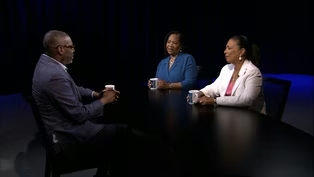
Here to talk more about THAW's mission and its upcoming fundraiser is the organization's new CEO, Katrina McCree, along with Tanya Hill, the Executive Chair of THAW's Board of Directors.
Welcome both of you to "American Black Journal."
- Thank you.
- So I want to start with, with you, Katrina talking about the time that we're living through right now and how different it is and how hard it is for families.
I'm asking everybody who works in this sector to kind of share with people what it's like, and to really kind of highlight how real the hardship is.
- Well, I mean, things are tough, not just for our low income families, but as you indicated, just a general, just generally and just around the country.
You got the inflation is much higher.
Prices of everything have gone up, food, gas, and just the overall cost of living is extremely challenging right now.
- And so does that for you sort of manifest in more requests for help?
Are you getting more people coming to you saying, "We just can't make it? "
- Absolutely.
I mean, we do service those that have a one-time need, right?
And then there are those who just for whatever reason experience you know, something that just sets them back or they just don't meet, you know, they don't have the financial means to carry the household.
And it could be a change in, you know, the family dynamics.
Someone loses a job or they get laid off.
So, yeah.
I mean, there are many things that could happen that would cause a crisis in a family.
- Yeah, so let's talk about the need to, - Yeah, so let's talk about the need to, for people to think about THAW and think about the folks who benefit from THAW more than just in the winter.
You're really focused on a year-round approach to this.
- Oh absolutely.
Because THAW not only provides heat support, you have people, you know, that need, you know, air conditioning in the summer.
And, you know, people can't pay their water bills.
Water has become very essential for people now.
You know, we used to didn't think about paying your water bill.
Well, now a lot of people cannot pay their water bills.
- Cannot, right.
- So THAW steps in with that support as well.
- Yeah.
Yeah.
When when you are thinking about the support that you guys give I think there's a tendency for some people to think, "Well, this is just temporary and it doesn't help people get to a better place where maybe they don't need support."
But that is not really the right way to think about this kind of support.
Is that right?
- Yeah, I mean, there are many circumstances Stephen, but the goal is really to move them to longer to help them sustain their lifestyle, to reduce their recidivism, right?
And then coming back and returning.
And so we look deeper- - So what kinds of things do you have to do to try to move people to a better space?
- Wonderful.
So when we bring them in, there's a whole process.
We have an intake.
We have them speak to a case manager.
We take a look at their circumstance.
Help them get on an affordable payment plan.
We provide energy education.
We may conduct a whole-home assessment for those individuals so that they can understand their energy usage.
We want to lessen the energy burden that people are experiencing.
And so it's just not, you know, we bring them in, pay the bill.
But we're looking at it holistically.
- Yeah.
- And making sure that we implement solutions that are long term.
- Right.
What about connections with other organizations that do this kind of work, this sort of supportive work?
I mean, I would imagine that there's a lot of network, I guess, that exists.
- Absolutely.
Yeah, absolutely.
I mean, we couldn't do this work alone.
We partner with many community partners.
A lot of people come through us through those partners through our, the churches in the community.
They refer individuals.
So there's a whole referral partnership that we have.
And so some people come and we understand that they need food.
They need clothing.
There are many things that individuals need that we perhaps might not be able to provide.
And so we rely on our partners a great deal to help support our people.
- As chair of the board, I wonder what you make of the sort of current landscape, I guess, of these kind of organizations in our city.
We talked about the new burdens or the excessive burdens that exist now.
But in a longer term sense, how are we doing with providing this kind of support, not just at THAW, but at other places to make sure that people have what they need?
- Unfortunately because of the state of our country and funding and lack thereof, there are a lot of nonprofits that are struggling.
A lot of them depended heavily on federal funding.
Fortunately THAW was not in one of those foundations.
- Right, right.
- And so we are in a, I would say a much stronger position to be able to provide for the community and support the other nonprofits who quite frankly are struggling.
I know of some who have had to reduce their staff because of the federal cuts that we're seeing.
And so with, under the leadership of Katrina, the plan is to obviously expand, you know, our footprint of donors, supporters.
And fortunately, like I said, we're not as dependent on federal dollars.
So it really puts us, I think, in a really good position to be able to continue to provide what we're doing now and to expand.
- Yeah, you were talking about giving support to other organizations that might be having a tough time.
I wonder if that's financial support, is that other kinds of support?
Like how does that work for THAW?
- No, it's not financial.
Unfortunately we wish we could, but no, we're not in that position.
(laughs) - (laughs) We need your money for your- - Yeah, we need it for our clientele.
But, just being there when their funding dissipates, you know, they can reach out to us and say, you know, "We have a client that really needs emergency assistance."
We've worked with, you know, an agency like DAA, for example.
They have a lot of seniors that- - Detroit Area Agency on Aging.
- Agency on Aging.
I'm sorry.
Yes.
- That's okay!
(laughs) - Detroit Area Agency on Aging.
- Yes, (laughs) you know, that's an example of one agency that will refer us clients who, you know, may need some additional support on the energy side.
And so- - Yeah.
- We're there to provide that help.
- There is some possibility that some organizations may not make it through because of- - Yes.
Unfortunately, a lot of agencies were very heavily dependent on federal funding.
And when that was just cut off they found themselves not being able to service clients, which is another reason we fortunately are in a much better position because we're not that heavily dependent on federal dollars.
And so I think under the leadership of Katrina, which we're very grateful to have.
She's going to be able to expand our donor base beyond just, you know, government.
More in the private sector and other agencies that provide funding for foundations like ours.
So we're excited about that.
- Yeah, I mean, I think that, you know, building these strategic partnerships are important.
Tanya mentioned DAAA, and DAAA has, you know, home repair funding, right?
And so we were meeting to talk about how can we leverage the funding from both.
Like for instance, if the homeowner needed a roof and they only had money for windows, how we can leverage that relationship and be able to provide, you know, the windows and the roof for those individuals.
And so I think it's important because funders want us to leverage those relationships, right?
Because we're all competing for the same dollars.
And so we want to be able to be there for those partners and rely on each other when the time is most needed for our community.
- Yeah.
Katrina, you are somewhat new to THAW.
- I am.
- Tell us just a little about how you came to this role and some of the other things you've done.
- Well, thanks for asking.
I have over 30 years of leadership experience that span over many industries.
And so most recently, prior to coming to THAW, I was at a neighborhood service organization serving as a chief community impact officer, so raising money to help support the unhoused.
And so, you know, this journey for me is personal.
I was afforded the opportunity to throw my name in the hat and I jumped on it very quickly because THAW has been so much to so many.
They supported my family in a time of crisis.
And so to be able to come to the organization, continue to lift up that mission, I'm just proud and excited and just want to do great things to live out the mission.
- Yeah.
And I would be remiss if I didn't ask you guys about the upcoming fundraiser for THAW and kind of how important that is.
- Yeah, it's important in a number of ways because people tend to think that THAW is more activated when it's cold.
But people need support year round, you know, support paying their water bills, support keeping their houses cool.
I mean, there are people that are on medications, or taking, utilizing systems where they have to have the house at a certain temperature, so, those people need help year round.
And we have a golf outing coming up at Northville Golf Course, July 17th.
So we have a few more days left (Stephen laughs) for registration.
And if people don't want to play golf or can't play golf, they can just come to the dinner and enjoy a nice dinner and raffle prizes and you know, Katrina will be our host and she will be, you know- (Stephen laughs) - You'll be entertaining.
- Drive riding around the golf course.
- Driving around the golf course.
- Welcoming our guests.
- And thanking our donors.
I mean, that's the thing that's most important to me.
But this is an opportunity for people to come out and volunteer.
We still need volunteers to support the event.
And also it's a great networking opportunity, right?
For people to come and meet other people in different industries and who knows what might happen from there.
- Yeah.
Yeah.
Okay, well, congratulations on all the work.
And of course, I hope that things get better for everybody.
But thank you - Absolutely.
- For being here with us on "American Black Journal."
- Thank you, it's been a pleasure.
- Thank you for having us!
- Thank you.
- We would like to take some time now to remember veteran, television journalist, educator, to remember veteran, television journalist, educator, and civil rights advocate, Tony Brown.
Everybody knows that name who passed away last month.
Brown's legacy includes launching the program you are watching right now in 1968.
The show was originally called "CPT" or "Colored People's Time."
Imagine that being the name of a television program.
And it was one of the nation's pioneering Black public affairs television program.
"CPT" provided a voice for African Americans at a really pivotal point in Detroit's history, just a year after the 1967 rebellion.
Here's a portion of one of the earliest episodes produced and hosted by Tony Brown.
(energetic music) (audience applauding) - Good evening.
I'm Tony Brown and welcome to "CPT."
An experience in living color.
Tonight we're going to see the second part of the Olympic revolt.
We're going to hear the Inkster Community Choir and the Brothers of Soul.
Also, we have two special guests tonight, Wild Bill Davis and our own Martha Jean the Queen.
Sandy, what's on the grapevine?
- BOBTAT will be explained.
Whatever happened to the ex supreme.
what Detroiter will be starring in a stage hit at the Fisher Theater?
Who is "CPT"'s Together Sister of the Week?
And the "CPT" players will present Langston Hughes' Jesse B. Semple to life.
And now tonight's newsman, Reggie Wilson.
- Tonight on "CPT News," we'll hear of an urban league study which shows that the brother occupies fewer city appointed jobs now than in 1963.
A Black congressman gives his opinion of the Nixon candidacy and "CPT" has an exclusive speech by Stokely Carmichael delivered at an international conference.
Tony?
- And now the conclusion of the Olympic Revolt.
(energetic music) Last week in part one of the Olympic Revolt, "CPT" took a look at the illustrious history of Black athletes in the Olympics.
We talked to some of the past champions and probed their feelings on Olympic competition.
(uplifting music) This week we will discuss the idea of a Black boycott of the Olympics.
Tonight, we'll talk again with those past champs and also we will hear what the brother and the sister on the street thinks about the boycott idea.
It's clear that Black Olympic champions may face severe problems when they return home from their tours.
This was the chief complaint of the organizer of the boycott, Professor Harry Edwards, former sociology instructor at the San Jose College in California and now at Cornell University.
Edwards is the man that some people accuse of stirring up trouble in paradise with his talk of a Black Olympic boycott.
But Edwards insists that paradise has always been full of snakes.
When he announced the boycott, Edwards said that he intended to show the exploitation of Black athletes by the U.S.
who, despite being champions on the field, are only second class-citizens when they return home.
Edwards also indicted the U.S.
for playing politics and its scheduling of tours for Black and white athletes.
He cited the world tour of Tommy Smith from California.
Black runner and Richmond Flowers, white sprinter from the University of Tennessee.
This tour designed to show racial teamwork in the U.S.
was called hypocrisy by Edwards, "Beneath the dignity of the Olympic Games."
Basically, he sees athletics as a wedge to improve the second-class position of Blacks who dominate track and field.
Edwards explains.
- [Harry] In the movement which sent upon the athletic arena in the United States and also to a large extent on international level, particularly when it regarding the question of South Africa, the strategy was entirely different.
We did not concern ourselves and waste our energies with time to get rid of a individual cracker, a individual racist, or an individual cog in a wheel which is grinding out racists every day.
We moved against the system in its athletic and its social and its economic spheres.
The use of Black athletic talent was challenged.
The legitimacy of the use of Black athletic talent by the system was challenged under these circumstances that existed in the United States.
The U.S.
will never again be able to assume carte blanche that Black athletes will serve as propaganda fodder, as economic capital in its 20th century gladiators for the corrupt and genocidal system that exists in the United States.
(audience clapping and cheering) - The white sports columnists and sports officials were infuriated.
They blasted the boycott and pointed to gains they felt Blacks had made through sports despite discrimination.
Some sports figures, Blacks and whites, did more than become infuriated, according to Edwards.
Some Black athletes working for white interests joined the boycott and worked to destroy it from within.
Edwards said that some professional teams took reprisals against any Black athlete who supported the boycott.
In an exclusive interview with "CPT," Edwards cited the case of University of California's Bob Smith.
Promised a position on the Los Angeles Rams, Smith found himself totally ignored in the draft following his support of the boycott.
Edwards told "CPT" that he would name names of Blacks and whites who conducted reprisals in his soon to be published book, "Racism, Politics and Athletics: The Revolt of the Black Athlete in America."
- When Tony Brown left Detroit, he became the host and executive producer of the national program "Black Journal," which was based in New York.
That show later evolved into "Tony Brown's Journal" and it aired for several years on public television.
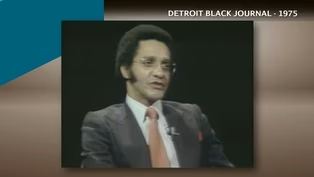
Brown returned to Detroit in '75 for a guest appearance on the show he helped create, which had been renamed "Detroit Black Journal."
Here's a clip from that interview.
- Good evening and welcome to this edition of "Detroit Black Journal."
Tonight we are very privileged to have as our guest one of the, if not the pioneers in Black public television broadcasting in Detroit and around the country, Tony Brown.
How did it feel coming back into WTVS Channel 56?
- (laughs) It feels kind of nostalgic.
I was looking at the studio and it was nothing like this when I left.
(laughs) - [Candy] Well, how long ago did you leave?
- I left in 1970.
I went to New York to take over "Black Journal."
And a couple years after that, I think Channel 56 moved into these very luxurious headquarters.
We were way out in the country in Southfield.
I was looking at the garage and I told a friend of mine, "That's what we used to be."
(both laugh) - And now public television has taken off and it's pretty popular around the country.
And as far as the Black media, you had probably most to do with that.
- Well, I was very involved.
I like the fact that when I was doing Black-oriented programs on Channel 56 before I started doing "Black Journal," that I was out of step.
When I started doing "Black Journal," I was out of step.
As the revolution and times progressed, I became mainline and now I'm out of step again.
I think my new out of stepness has a lot to do with the fact that I've come to become terribly critical of the concept of desegregation and its ally integration and how that is applicable in programming.
I remember when I first started doing Black-oriented programs on Channel 56, I was called a separatist.
Channel 56 at that time to some extent because of the program was called separatists.
Of course when the so-called riots happened in Detroit, there were responses.
So they weren't called separatists.
But at this point I've watched the entire evolution of alleged integration and desegregation and we now see it so explicitly in television programming.
And it says that any program that is oriented to Blacks with a Black perspective is segregation.
And that Blacks can have a role in television if it's integrated.
And they have these real cute things they do about the American family.
One family is Black.
Or they have these cute things they do about the workers.
One worker is Black.
Or the cute things about Blacks in, people in broadcasting, one person is Black.
So in effect, the new concept in integrated programming, and I would have to say that public television has the leadership in that coinage of that concept, is that there is no place for a Black presence which I find regressive.
I find it a throwback on the other side of when we struggled to get into television at all.
- It sounds as if you're saying that this integration is not portraying a Black perspective.
- No, what I'm saying is that integration is a game.
There's no polite way to say it.
Integration is a noble, wonderful idea like motherhood, but all women aren't good mothers, like being a good Christian, but all Christians aren't good Christians.
Like Judaism, but all Jews aren't good Jews.
They're good ideas.
When you get down to the reality of it, when you say, "Let's desegregate."
If you desegregate, you don't always have to have a white majority.
If you are saying that desegregation means a white majority, you're saying you have a new definition for racism and we're being destroyed.
Black people are being institutionally destroyed by the practicing concept of desegregation, which is probably most conspicuous in most forms of television programming.
- Is this happening because there are no Blacks in control of programming making executive decisions?
- No, that's not true.
Frederick Douglass said, I forget the exact quote, but the endurance of whatever the exact quote is, he said, "An oppressed people will determine the measure of oppression by the amount of oppression that they will tolerate."
White people are not oppressing Black people in broadcasting.
They're not oppressing Black people in education.
They're not oppressing Black people in business.
Black people allow themselves to be oppressed.
The Jews, particularly the young Jews, have a saying "Never again."
We will never tolerate the treatment that the previous generation of Jews took.
Blacks don't understand that.
Blacks take it.
If we allow ourselves to be oppressed and subjugated, if we believe that being 1 out of 10 or 1 out of 100 always a minority is the way for America to be, then how can we blame white people for doing it?
- Tony Brown was 93 years old.
We thank him (upbeat music) for being an African-American trailblazer and pioneer in public television.
We are proud to follow in his footsteps by elevating African-American voices and perspectives every week here on "American Black Journal."
That's going to do it for us this week.
You can find out more about our guests at AmericanBlackJournal.org and you can connect with us anytime on social media.
Take care and we'll see you next time.
- [Narrator 1] Across our Masco family of companies, (uplifting music) our goal is to deliver better living possibilities and make positive changes in the neighborhoods where we live, work, and do business.
Masco, a Michigan company since 1929.
Support also provided by the Cynthia and Edsel Ford Fund for Journalism at Detroit PBS.
- [Narrator 2] The DTE Foundation is a proud sponsor (uplifting music) of Detroit PBS.
Through our giving, we are committed to meeting the needs of the communities we serve statewide to help ensure a bright and thriving future for all.
Learn more at DTEFoundation.com.
- [Narrator 1] Also brought to you by Nissan Foundation and viewers like you.
Thank you.
(uplifting music)
 New
NewHow The Heat and Warmth Fund is helping to stabilize and empower Michigan families
Video has Closed Captions
Clip: S54 Ep28 | 11m 56s | Host Stephen Henderson sits down with Katrina McCree and Tanya Hill from the nonprofit to learn more (11m 56s)
 New
NewA look back at the legendary career of television journalist Tony Brown
Video has Closed Captions
Clip: S54 Ep28 | 12m 25s | Remembering journalist, educator and civil rights advocate Tony Brown who passed away last month. (12m 25s)
Providing Support for PBS.org
Learn Moreabout PBS online sponsorship New Episode
- News and Public Affairs

Top journalists deliver compelling original analysis of the hour's headlines.

- News and Public Affairs

FRONTLINE is investigative journalism that questions, explains and changes our world.

 New Episode

 New Episode
 New Episode

 New Episode
 New Episode
Support for PBS provided by:
American Black Journal is a local public television program presented by Detroit PBS