
New Arthur Horwitz memoir, Artist-in-Residence Joe Lovano, The Heidelberg Project
Season 10 Episode 41 | 26m 46sVideo has Closed Captions
Sitting down with Arthur Horwitz, Joe Lovano and this year’s Kresge Eminent Artist Tyree Guyton.
Longtime publisher of the Detroit Jewish News, Arthur Horwitz, discusses his soon-to-be published memoir about his life as the son of a Holocaust survivor. We hear from saxophonist Joe Lovano, this year’s Artist-in-Residence for the Detroit Jazz Festival. Plus, we’ll talk with the 2026 Kresge Eminent Artist, Tyree Guyton.
Problems playing video? | Closed Captioning Feedback
Problems playing video? | Closed Captioning Feedback
One Detroit is a local public television program presented by Detroit PBS
New Arthur Horwitz memoir, Artist-in-Residence Joe Lovano, The Heidelberg Project
Season 10 Episode 41 | 26m 46sVideo has Closed Captions
Longtime publisher of the Detroit Jewish News, Arthur Horwitz, discusses his soon-to-be published memoir about his life as the son of a Holocaust survivor. We hear from saxophonist Joe Lovano, this year’s Artist-in-Residence for the Detroit Jazz Festival. Plus, we’ll talk with the 2026 Kresge Eminent Artist, Tyree Guyton.
Problems playing video? | Closed Captioning Feedback
How to Watch One Detroit
One Detroit is available to stream on pbs.org and the free PBS App, available on iPhone, Apple TV, Android TV, Android smartphones, Amazon Fire TV, Amazon Fire Tablet, Roku, Samsung Smart TV, LG TV, and Vizio.
Providing Support for PBS.org
Learn Moreabout PBS online sponsorship- Coming up on "One Detroit."
Longtime publisher of "The Detroit Jewish News," Arthur Horwitz talks about his new memoir about his life as the son of a Holocaust survivor.
Plus, we'll hear from this year's Detroit Jazz Festival artist in residence, saxophonist Joe Lovano.
And we'll talk with the 2026 Kresge Eminent Artist, Tyree Guyton.
It's all coming up next on "One Detroit."
- [Narrator] Across our Masco family of companies, our goal is to deliver better living possibilities and make positive changes in the neighborhoods where we live, work, and do business.
Masco, a Michigan company since 1929.
Support also provided by the Cynthia & Edsel Ford Fund for Journalism at Detroit PBS.
- [Announcer] The DTE Foundation is a proud sponsor of Detroit PBS.
Through our giving, we are committed to meeting the needs of the communities we serve statewide to help ensure a bright and thriving future for all.
Learn more at DTEFoundation.com.
- [Narrator] Nissan Foundation and viewers like you.
(upbeat music) - Just ahead on "One Detroit," the Detroit Jazz Festival artist in residence, saxophonist Joe Lovano talks about his musical connection to Detroit, and artist Tyree Guyton reacts to receiving Metro Detroit's highest arts honor.
But first up, Yom HaShoah, a Holocaust Remembrance Day begins the evening of April 13th.
Later this month, journalist and community leader Arthur Horwitz, will release his memoir titled, "Dual Identities: Living in Meier's Shadow."
In addition to telling his story as the son of a Holocaust survivor, the book details personal and professional aspects of Horwitz's life, including his role as publisher of "The Detroit Jewish News."
"One Detroit" contributor, Marty Fischhoff, spoke with Horwitz, who is a former chair of the Detroit PBS Board of Trustees.
(light upbeat music) - [Marty] We are at the Zekelman Holocaust Center in Farmington Hills to talk with Arthur Horwitz, longtime publisher of "The Detroit Jewish News" and esteemed community leader about his memoir, "Dual Identities: Living in Meier's Shadow."
- The dual identities are mine and my mother's little brother.
My mother was a Holocaust survivor.
Her little brother didn't survive.
I am named in his memory.
And as I was looking at all of that, I realized that, you know, there's a story right at the core, and the story relates to my mother, a Holocaust survivor, my father, American born, in fact, born in New Haven, Connecticut, and me as the child of a survivor.
And recognizing as I fought back and looked at other kinds of books that had been written that children of survivors are mostly writing about their parents' stories.
And what I saw was an opportunity to give voice to my own story, to speak for kind of a generation called 2Gs, children of survivors, who sometimes weren't really willing or able to talk about what it was like growing up post World War II America as a child of a survivor.
- [Marty] Just before our interview, Horwitz spoke to a group of eighth grade students at the Zekelman Center.
He recalled rummaging through his mother's wallet as a kid looking for money.
That's when he found a photo that would change his life.
- This guy's in her wallet.
And I asked her, "Who is this?"
I already knew, because growing up in a household as a child of a survivor, you're exposed to this photo.
This is, if you say, is there one image that captures the brutality of the Holocaust, this would be one of those, if not the photo.
- [Marty] The boy in the photo was about the same age as the brother his mother lost to the Nazis.
She had no photos left of her brother, and she would claim this was him.
- So I already knew it wasn't her little brother.
And I said, "It's not your little brother."
She said, "Yes, it is."
I said, "No, it's not.
You said you had no photos of any of your family members."
And by the way, she could name 91 family members who were killed, murdered.
And there were six who survived.
And it was like at that point, Marty, that my mother decided that I would be living two lives, mine, as I mentioned, as related to the title of the book and the one her little brother didn't have.
And from that point forward, my life, my family, my media career was through a filter or a frame of living two lives.
And for a 12-year-old, or for anybody, it's hard enough to live in your own life, let alone two.
- [Marty] And thus, the book's title, "Dual Identities."
While some Holocaust survivors were hesitant to tell their stories, Horwitz remembers his mother, Sally Horwitz, speaking to student groups back in Connecticut, just as he does today.
- My mother would speak about the Holocaust and she would speak to groups of children, school-aged children, you know, in New Haven.
And she would share her story.
And I went back and I looked at some of the scribblings that she had made of her presentations.
And the thing that stood out wasn't the bitterness, it wasn't revenge of clearly from almost being wiped out, you know, having, you know, children, grandchildren, great-grandchildren, you know, who followed her.
It's a miracle in and of itself.
But for her, the key was, this is a great country.
And she would say in her presentations, "You know what?
God bless America.
Don't take freedom for granted, protect our democracy.
Remember that we were all from somewhere else, somewhere originally."
- You spent a lot of time speaking to students here from all over the state.
How did you get involved in that?
- I had been approached by the Zekelman Holocaust Center, it was actually late in 2020, early 2021.
They were putting together a cohort, a first cohort of children of survivors to be trained over a period of several months to present to the thousands and thousands of students who were coming through the Holocaust Center since 2016, when Michigan Governor Snyder signed into law a public act that mandated Holocaust education in public schools.
As these kids were starting to come through, the Zekelman Holocaust Center realized they had a little challenge.
Well, there were fewer and fewer survivors.
So their motive, meaning the Zekelman Holocaust Center, was can we get some of their children and train them, not just to parrot or repeat their parents' stories, but to weave their own stories into it.
So Gina, my wife is also a daughter of a Holocaust survivor.
Her mother was on the Kindertransport.
And I talked to Gina, I said, "Is this something I should do?
I'm not sure I want to go there and dig up some of what's there in my past."
She encouraged me to do it.
It was the most important thing that I've done on a personal level, maybe my entire life 'cause it freed me up.
It gave me the opportunity to both extract what was inside of me, but also it allowed me to honor my mother and her family.
And it allowed me to leave a message of hope, which I thought was really important for these children.
Now, let me tell you about Gogatz.
Gogatz was a foreman, Polish foreman pressed into service by the Germans at my mother's first slave labor camp.
I took after my mother, as she reminded me, she was always pushing the envelope.
She was always taking risks.
She snuck out of her camp, she got caught.
German puts his rifle to her head, that's it.
But no, Gogatz intervenes, pushes the rifle away, says, "She is my best worker.
I need her, I will take responsibility for her."
German could have pulled the trigger twice, once to put a bullet in my mother's head and once to put a bullet in Gogatz's head.
Instead, he hits Gogatz over the head with his rifle butt and goes off, okay.
No Gogatz, I wouldn't be here.
But what's important with Gogatz is he just did the right thing.
Okay, he saw something, he spoke out.
He wasn't a bystander.
- [Marty] After the war, Arthur's mother tried to find Gogatz, but learned he had been killed by the Germans.
- He'd been murdered.
That particular message, and that my mother, when she would present, when I looked through her notes, would bring up Gogatz as an example of somebody who spoke up and spoke out.
There he was, in my mother's writings, there he was in that interview.
He was the ideal person to remind thousands, thousands of children that it only takes one person, and Gogatz saved my mother, which meant by extension he saved me, he saved my siblings, he saved my grandchildren.
And some of them have done things as physicians, et cetera, that have truly saved lives and extended lives.
And here's this guy 80 plus years ago who saved my mother's life, probably couldn't put his finger on a map of Michigan, and we're talking about him.
So that was my message, to try to leave.
Stand up, say when you see something wrong, don't be a bystander.
And if there's one person of all of the people I've spoken with, who in a year, 10 years, 20 years, 30 years, remembers the message of Gogatz and does something that helps repair the world, that helps save lives, then that's both a tribute to Gogatz himself, it's a tribute to my mother.
And it's a tribute to telling the stories to students in hope that someday the dividend will come back and they'll do something not just for somebody who's Jewish, but really beyond for humanity, if you will.
That's the hope, that's Gogatz's hope.
- [Marty] Then Horwitz shows the students a photo of his extended family.
- Because for my mother, on a personal note, this was her revenge.
This was how she fought back in the end against the Nazis, against the Germans, she brought life into the world, children, grandchildren, great-grandchildren, and in my family, three children, seven grandchildren, that was her revenge.
- [Marty] "Dual Identities" is a book about many aspects of Horwitz's life, his childhood, the journalism career that culminated in leading one of the most influential Jewish newspapers in the country and his life as a son, husband, father, and grandfather.
But what we may remember most are the lessons it teaches us about history and what we as people and a nation should never forget.
- And the Zekelman Holocaust Center in Farmington Hills is hosting a book launch for "Dual Identities" on May 7th.
The event is free and open to the public.
Let's turn now to the 47th Annual Detroit Jazz Festival taking place at Hart Plaza over the Labor Day weekend.
This year's artist in residence, saxophonist Joe Lovano recently held a workshop for music students at Wayne State University.
He sat down with "One Detroit" contributor John Penney of 90.9 WRCJ, to talk about growing up in a family of musicians and Detroit's influence on his career.
(lively saxophone music) - I am here today with the artist in residence for the 47th Annual Detroit Jazz Festival, Joe Lovano, it's a pleasure and an honor to be here with you.
- Thank you, John, for me as well.
- Joe grew up in Cleveland in a very musical family.
Father being Big T, Tony who played the saxophone, and his brothers, I guess, were also musicians.
You picked up a saxophone when you were six, it was an alto, you had to grow into the tenor, and your first teacher was your father.
And one of my favorite stories that you told once was how you were one day practicing scales and your father came in and said, "Play them like they're melodies."
- This one day I'm playing, I'm going up and down the line, you know, it's like an exercise.
And he's listening and he was upstairs, he wasn't giving a lesson at the time.
I was in the basement practice.
He comes down with his horn and he said, "Oh yeah, Joey, yeah."
And then he took a major scale and he just played it (harmonizing scale).
He made it sound like a song.
The same notes of the same sequence that I was running around the horn, you know?
And man, that changed everything.
And then he just split.
(lively orchestra music) - You know, you, again, teach at Berkeley and you had a workshop with the kids here at Wayne State today.
What do you want them to take away from this workshop?
- Well, I just like to stress all the time about living in the library, the sounds and spirits of the masters on every instrument, no matter what your instrument is.
Anyway.
If the more you do that, you know where people are from, who they came up with, how old they were on a certain record you love or whatever, you know, it's up to you to create how you discover things.
You know what I mean?
What influences and how your influences can take shape for your, two and four, artistry.
- [John] The career has just been astounding and it's been a real pleasure to listen.
And you have really deep roots in Detroit.
- First of all, I'd just like to say, it's a blessing to live in the world of music and put some ensembles together through the years and develop within the embrace of some amazing masters of the music.
And quite a few of them were Detroit masters, the Jones family, Hank Jones, Thad Jones, Elvin Jones.
I had a chance to be a part of the Thad Jones/Mel Lewis band, and then the Mel Lewis Band when Thad went to Copenhagen, played in "Elvin Jones: Jazz Machine" and toured Europe with him in 1987.
And then he recorded with me on one of my blue note releases, "Trio Fascination" with Dave Holland on bass.
And then Hank Jones documented some recordings on Blue Note.
- You first came to Detroit, I think in '74, I believe.
- 1974, I got the call from Dr.
Lonnie Smith, who was living around the corner from Baker's Keyboard Lounge.
He was looking for a tenor player and played in Cleveland with Lou Donaldson and had heard about me and someone gave him my family phone number and I got the call.
So I flew to Detroit and started to play with him.
And that led to a lot of everything.
- Jason Moran talked about a particular Detroit sound, he described it as like "the Detroit bounce."
What is it?
Is there a Detroit feeling?
- The way I heard everything was through, it was a real like feeling in the beat and the harmony and the execution of ideas that were personal.
There was a certain sweetness in the way Katz played also, it wasn't like an aggressive kind of approach.
(lively orchestral music) - As the artist in residence this year, tell people what you're gonna bring to the festival.
- I'm gonna present my current quartet called the Paramount Quartet with Julian Lage on guitar, brilliant young guitarist, Asante Santi Debriano on bass, who played a lot with Archie Shepp and Randy Weston and others, and Will Calhoun on drums, who's an amazing, explosive, beautiful musician.
- What makes it the Detroit Jazz Festival?
What's unique?
I mean, is it unique?
- Well, it's amazing to have like such an incredible venues to play at and have the audience and have it be a free open festival.
It's one of the most beautiful opportunities for all of us that are on tour all the time to see each other and hear each other and feel the beautiful space and the audiences here in Detroit that are so hip because of the history of the music here.
- Each year, Kresge Arts in Detroit celebrates the lifetime achievements and contributions of a Metro Detroit artist with its Kresge Eminent Artist Award.
This year's recipient is Tyree Guyton, a Detroit born artist known for creating the Heidelberg Project in 1986.
The outdoor neighborhood art space has attracted international attention.
"One Detroit" contributor Stephen Henderson of "American Black Journal," spoke with Guyton and his manager Jenenne Whitfield.
(light upbeat music) - I first just want to get your reaction to the announcement and the honor.
- Well, I would say to you, life is full of surprise, surprises.
- You couldn't have been that surprised.
I mean, maybe a little.
- Well, yes and no that, I didn't expect it.
And that day, I was in a cloud.
I couldn't believe that it was me, but why not me?
- (laugh) Right?
- Why not me?
- So, I'm somebody who grew up here in the '70s and '80s, and I remember distinctly when you started the work over at the Heidelberg Project, and it has been part of the narrative here in the city since then.
Let's go back though to that beginning and talk just a little about what you aimed to be saying with what you were doing and what impact you thought it would or could have on that part of the city and on the city as a whole.
- Well, that's a lot.
I wanna see if I can answer some of those questions.
First of all, I believe, for me, I found my purpose, I found my calling.
I believe that everything in this world happens at the right time.
In 1986, that beautiful day, the sun was shining.
I was standing in the doorway looking out at that neighborhood.
I had this epiphany and oh my goodness, I went out there and the first thing I did, I started to clean up that community, the neighborhood.
As I sat here, we have had 144 countries to come and visit us.
Jenenne and I, we have traveled around the world and I just knew in my soul that it was going to do something for the city and the world, and it's happening.
- Yeah.
- I'm living my dream.
- Jenenne, I wanna bring you into the conversation here and have you talk also about this honor and the work, but also about this other kind of milestone that's being reached, which is that the Reuther Library at Wayne State is going to archive and catalog all of what's happened at the Heidelberg Project.
- Yeah, that's exciting because this is our 40th anniversary and we have collected and held onto all of the different organizations, the different papers, the different court cases, you know, the accolades, all of that we've just been collecting and holding onto because we knew that it would be important because it is such a Detroit story like you talked about.
So, being able to assemble these documents, having Wayne State to play a big part in organizing them and preparing them so that people, Wayne State University is also a research institution known internationally, and the Heidelberg Project is known internationally, so it's a perfect marriage and it is, as you say, a very important Detroit story.
- Yeah, yeah.
Tyree, in the next year, as you are the eminent artist, I mean, you'll have opportunities to send this message into, I guess, maybe a different space than it has been.
I wonder if you've given a lot of thought yet to what you want to do in that space, in that year.
What message you want to project from all of this work over 40 years?
- Well, 40 years, if I sit here listening to your question, I decided I was gonna just take a break.
(Stephen laughs) I've been busy.
I've been busy for 40 years.
- Yeah.
- I think there comes a time where you have to take a break and regroup, and that's what's happening.
- Yeah.
- It's also time to slow down.
It's time to just make some time for Tyree.
That's what I want.
- Wow.
Wow.
So, and then, in that time, what are you discovering?
What are you feeling, I guess, and what is that doing for you?
- Well, it's doing, golly, so much.
I mean, it's, well, first of all, the award came at the right time, and I'm gonna repeat that, the right time, it's been a big help.
I'm finding myself, I am rediscovering who I am for Tyree and I'm so excited about that.
- That'll do it for this week's show.
Thank you for watching.
Head to the "One Detroit" website for all the stories we're working on, follow us on social media and sign up for our weekly newsletter.
(light upbeat music) - [Narrator] Across our Masco family of companies, our goal is to deliver better living possibilities and make positive changes in the neighborhoods where we live, work, and do business.
Masco, a Michigan company since 1929.
Support also provided by the Cynthia & Edsel Ford Fund for Journalism at Detroit PBS.
- [Announcer] The DTE Foundation is a proud sponsor of Detroit PBS.
Through our giving, we are committed to meeting the needs of the communities we serve statewide to help ensure a bright and thriving future for all.
Learn more at DTEFoundation.com.
- [Narrator] Nissan Foundation, and viewers like you.
(light upbeat music) (dramatic piano music)
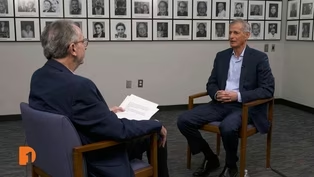
Arthur Horwitz: The memoir of a second-generation Holocaust survivor
Video has Closed Captions
Clip: S10 Ep41 | 10m 36s | The book details aspects of his life, including the impact of being the son of a Holocaust survivor. (10m 36s)
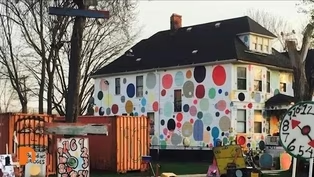
A conversation with Tyree Guyton, the Detroit-born artist known for creating The Heidelberg Project
Video has Closed Captions
Clip: S10 Ep41 | 5m 26s | Kresge Arts in Detroit celebrates the lifetime achievements of a metro Detroit artist each year. (5m 26s)
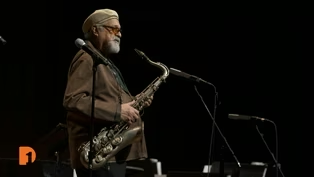
Sitting down with the Artist-in-Residence for this year’s Detroit Jazz Festival
Video has Closed Captions
Clip: S10 Ep41 | 6m 10s | Joe Lovano takes center stage as this year’s Artist-in-Residence for the Detroit Jazz Festival. (6m 10s)
Providing Support for PBS.org
Learn Moreabout PBS online sponsorship
- News and Public Affairs

Top journalists deliver compelling original analysis of the hour's headlines.

- News and Public Affairs

Today's top journalists discuss Washington's current political events and public affairs.










Support for PBS provided by:
One Detroit is a local public television program presented by Detroit PBS