Here and Now
Steve Vavrus on Wisconsin's Rising Risk for Extreme Weather
Clip: Season 2400 Episode 2441 | 5m 34sVideo has Closed Captions
Steve Vavrus on a growing level of extreme weather and actions to safeguard against risks.
Wisconsin Initiative on Climate Change Impacts co-director Steve Vavrus describes a growing level of extreme weather conditions in the state and actions to mitigate costs and safeguard against risks.
Problems playing video? | Closed Captioning Feedback
Problems playing video? | Closed Captioning Feedback
Here and Now is a local public television program presented by PBS Wisconsin
Here and Now
Steve Vavrus on Wisconsin's Rising Risk for Extreme Weather
Clip: Season 2400 Episode 2441 | 5m 34sVideo has Closed Captions
Wisconsin Initiative on Climate Change Impacts co-director Steve Vavrus describes a growing level of extreme weather conditions in the state and actions to mitigate costs and safeguard against risks.
Problems playing video? | Closed Captioning Feedback
How to Watch Here and Now
Here and Now is available to stream on pbs.org and the free PBS App, available on iPhone, Apple TV, Android TV, Android smartphones, Amazon Fire TV, Amazon Fire Tablet, Roku, Samsung Smart TV, LG TV, and Vizio.
Providing Support for PBS.org
Learn Moreabout PBS online sponsorshipagain.
>> Reporting from Fremont.
I'm Steven Potter for here and Now.
>> Climate disasters like flooding and storms are on the rise across the state, resulting in added human and financial costs.
A new report projects we'll see more intense storms into the future and more rapid shifts between very wet and very hot conditions.
But there are ways to encourage climate resiliency, according to Steve Vavrus, co-director of the Wisconsin Initiative on Climate Change Impacts.
Just out with its 2026 assessment.
And thanks very much for being here.
>> Thank you for having me.
>> So are the current floods and last week's 24 tornadoes across the state, evidence of a changing climate?
>> I think last week's severe weather outbreak is a combination of random weather variability, i.e.
bad luck in this case, and also climate change.
And the climate change fingerprints are on it because climate change favors the warm, humid air masses that we saw out of season, we typically don't hit 80 degrees and have humid weather in the middle of April.
But if we do, we have the fuel that generates severe storms.
>> So according to your assessment, what are other trends for climate impacts going forward?
And some examples of that.
>> One of the the key terms or key phrases I like to use is warmer and wetter.
That describes the climate change we've seen to date, and also the climate change we're expecting in the future.
In Wisconsin, for example, the 2020s are currently the warmest decade in state history.
The 20 tens were the wettest decade in Wisconsin's history, and we've seen an increasing number of heavy rainfalls punctuated, unfortunately, with the state record last year.
Last summer in Milwaukee, dumping 14.5in.
>> And your report said something that stood out.
It was March used to be part of winter, but now it's part of spring.
>> Yeah.
And that's an interesting new finding that came out of the State Climatology office.
And the reason we talk about it that way is that in the past, starting in the most of the 20th century, the majority of time in Wisconsin, March was below freezing, below 32 degrees.
And recently in the past decade or so, that's flipped.
And now we spend the majority of March above freezing.
And that has big consequences in terms of whether we get rain or snow.
If we get snow, how long it sticks around, and when our lake ice melts in the spring.
very measurable.
And yet there is still, if not scientific political skepticism around climate change.
What is that like for a climate scientist?
>> More and more people understand that the climate's changing.
The evidence is all around us.
It's hard to miss the politics.
Enter into it in terms of how serious a problem it is compared with other issues that we're dealing with, and also what can we do about it, or what should we do about it, and how much resources should we put in terms of climate change and other other issues that we're facing?
So I think that the shifts there's been a shift in terms of how we talk about climate change, and the surveys show that increasing numbers of Americans understand and are aware of climate change.
>> Your report looks at ways Wisconsin can mitigate against the impacts like nature based strategies.
What's an example of that?
>> Yeah.
So we talk about in the wiki report, the wiki assessment, a range of options ranging from what we call traditional mitigation strategies, which is cutting carbon emissions, reducing the source of climate change to adaptation.
And that is accepting that there will be impacts.
And now figuring out what to do with it.
We try to promote nature based impacts.
These are things like green infrastructure.
Instead of relying strictly on traditional infrastructure.
So for instance, with more heavy rainfalls, the traditional engineering approach is to build bigger stormwater pipes, increase the size of culverts.
But there are also nature based green strategies such as rain gardens and green roofs, and bioswales and wetland restoration that can all be as effective or more effective, and also more reduce the costs as well.
>> How well does Wisconsin's infrastructure hold up to these changing climate impacts?
>> It's a mixed bag.
One of the ways that we're struggling right now is with these increasing numbers of extreme rainfall, because much of Wisconsin's infrastructure was built 40, 50, even 100 years ago, in some cases for a different climate.
And that climate was cooler and it was drier than the climate we're experiencing now.
And so certain ways that we used to manage stormwater just aren't valid anymore.
They aren't as effective.
And so the infrastructure can't hold up as well.
>> So is there a dollar figure on how much it would cost to make Wisconsin climate resilient infrastructure and otherwise?
dollar amount.
But I like to bring up the old adage that an ounce of prevention is worth a pound of cure.
And a lot of studies show that a dollar invested in becoming more resilient pays off many times over in terms of reduced damage.
And a good example of that was with Milwaukee becoming much more flood resilient over the years.
The Milwaukee Metropolitan Sewerage District in particular, has done a number of things that have made the city more resilient to climate change and heavy rainfalls, and the damage from last summer's rains would have been much, much worse been much, much worse
 New
NewHere & Now opening for April 24, 2026
Video has Closed Captions
Clip: S2400 Ep2441 | 1m 15s | The introduction to the April 24, 2026 episode of Here & Now. (1m 15s)
 New
NewTJ Semachin on Importing Coffee and Pursuing Tariff Refunds
Video has Closed Captions
Clip: S2400 Ep2441 | 6m 22s | TJ Semachin on how tariffs have affected his business and the system to apply for refunds. (6m 22s)
 New
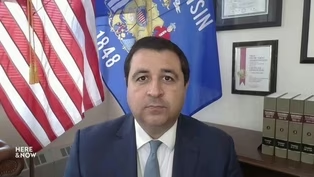
NewWisconsin Files Suit Against Prediction Market Businesses
Video has Closed Captions
Clip: S2400 Ep2441 | 59s | Wisconsin is suing prediction markets for serving as platforms for illegal sports betting. (59s)
 New
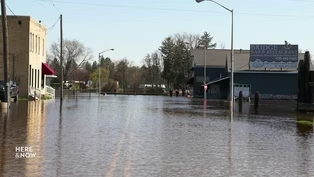
NewWolf River Communities Deal with Flooding — and Insurance
Video has Closed Captions
Clip: S2400 Ep2441 | 5m 53s | Residents who live near the Wolf River are dealing with the aftermath of historic floods. (5m 53s)
 New
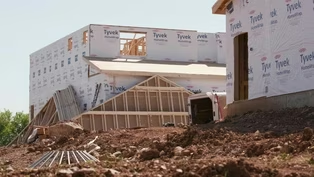
NewWisconsin's 2026 Governor Candidates on the Cost of Housing
Video has Closed Captions
Clip: S2400 Ep2441 | 6m 5s | Candidates in the 2026 race for governor on the high cost and limited supply of housing. (6m 5s)
Providing Support for PBS.org
Learn Moreabout PBS online sponsorship
- News and Public Affairs

Top journalists deliver compelling original analysis of the hour's headlines.

- News and Public Affairs

FRONTLINE is investigative journalism that questions, explains and changes our world.












Support for PBS provided by:
Here and Now is a local public television program presented by PBS Wisconsin