Here and Now
TJ Semachin on Importing Coffee and Pursuing Tariff Refunds
Clip: Season 2400 Episode 2441 | 6m 22sVideo has Closed Captions
TJ Semachin on how tariffs have affected his business and the system to apply for refunds.
Wonderstate Coffee CEO TJ Semachin discusses how tariffs on imported beans have affected the Wisconsin-based business and the court-ordered system to apply for refunds from the federal government.
Problems playing video? | Closed Captioning Feedback
Problems playing video? | Closed Captioning Feedback
Here and Now is a local public television program presented by PBS Wisconsin
Here and Now
TJ Semachin on Importing Coffee and Pursuing Tariff Refunds
Clip: Season 2400 Episode 2441 | 6m 22sVideo has Closed Captions
Wonderstate Coffee CEO TJ Semachin discusses how tariffs on imported beans have affected the Wisconsin-based business and the court-ordered system to apply for refunds from the federal government.
Problems playing video? | Closed Captioning Feedback
How to Watch Here and Now
Here and Now is available to stream on pbs.org and the free PBS App, available on iPhone, Apple TV, Android TV, Android smartphones, Amazon Fire TV, Amazon Fire Tablet, Roku, Samsung Smart TV, LG TV, and Vizio.
Providing Support for PBS.org
Learn Moreabout PBS online sponsorshipwithout that.
>> All right.
Well, Steve Vavrus, thanks very much and thanks for your work.
>> Thank you.
>> The federal government is being forced to return more than $165 billion in collected tariffs to domestic importers and the online portal to request those refunds went live this week.
The U.S.
Supreme Court struck down President Trump's tariffs, resulting in the order to refund the import taxes.
Wisconsin businesses are looking to get some relief, including Viroqua based Wonderstate Coffee, with its three locations across the state.
CEO T.J.
Semanchin joins us now from Viroqua.
And thanks a lot for being here.
>> It's good to be here.
Thank you.
>> So first question, how much did tariffs cost you?
>> Yeah, we paid almost $140,000 in tariffs last year.
>> That's that's a that's a big number for any business.
But but in this tariff discussion is coffee unusual because it's almost all imported.
>> Yeah.
We have been saying this from the get go that we really didn't understand the purpose or the intent of taxing and tariffing a product that we can't even, you know, promote.
Domestic production of all coffee is grown in the tropics.
There's a tiny bit grown in Puerto Rico and Hawaii, but not close to being able to meet the U.S.
demand.
So we were, you know, paying a tax that we didn't even understand what the the impact was, was for.
>> So describe for me where you source your coffee from.
What country?
>> Yeah, we source a lot of coffee from Latin America, from places that people think about when coffee like Colombia, but also Peru, Guatemala, Honduras, Mexico, and then also in Africa.
We bring in a lot of coffee from Ethiopia, which is the birthplace of coffee, and also smaller countries like Rwanda and Burundi, Kenya.
>> What of the cost of the tariffs meant for your business?
>> Yeah, last year was really challenging.
It was unexpected.
You know, my 25 years in coffee, we've never even once considered a tariff on our coffee that we import.
So it was a curve ball.
And already in a challenging business climate where other costs are going up, like health care, shipping costs, things like that, that this was just one more headache.
And, and again, not being expected at all.
We had to deal with these costs.
One of the things that people don't quite realize is we, we had to pay for the tariff before we even got the product in the country.
So, you know, this is before we could even sell it, we had to borrow money to pay pay the tariff.
So we were then paying interest costs on, on the, the money we borrowed for the tariffs.
So all these things were compounding and just making it harder and harder for us.
>> Have you gone online to request a refund and if so, how is that process going?
>> Yeah, we technically are not the importer of record, so we work with brokers who do a lot of the logistics for us.
So their names are the ones that are on record for being the importer.
So we're working with them and they as, as one of their clients and they are, they're applying for those refunds.
And we haven't gotten any word of what the progress is or, you know, there's a lot of uncertainty on how this process is going to unfold.
>> To those tariffs, as significant as they were for a small business get passed along then to your customers.
>> Yeah.
In some way or fashion they did.
We had again, last year was challenging in a lot of ways.
Coffee itself, the cost, the commodity price of coffee skyrocketed last year.
So we were paying a tariff on what was already historical costs for for coffee.
So all these things were compounding.
And we did have a price increase last year that we passed on to our customers.
And tariffs were a part of that.
So the you know how much of that was the tariffs gets a little confusing.
And you know just because there was a lot of factors.
>> What has business planning been like over the course of these changeable tariffs.
>> We had to reforecast our profit and our budget last year.
We even pulled back on some investments in growth.
We decided not to buy a piece of equipment last year just because of the the business climate.
This would have been expanding our production capabilities.
And we, you know, this was a piece of equipment that the one that we're looking at was mostly built in Wisconsin.
So we we did not, you know, invest.
And we did not make that purchase.
So you could see even where the ripple effects might be.
But we did pull back on, on our kind of expectations for growth and profit and even hiring and being able to invest in our staff that, you know, coming into 2026 with the change in tariffs.
And it feels like, you know, we we are a little more optimistic kind of going, we're going back a whole year where we kind of came into 2025.
We're kind of coming back into 2026 with that perspective.
But I would say that it felt like a whole year of just kind of a holding pattern.
>> How optimistic are you that you will get the tariffs that you paid refunded?
>> I'm a pretty optimistic person, so I put our chances at better than 50%.
But again, I'll believe it when the money is in our bank.
Because again, this has been such a uncertain process from the beginning.
We're hoping that the administration doesn't fight as the, you know, as this portal is open and money starts flowing, that they don't cut off those funds.
But we don't, you know, we don't know.
We're not we're not counting on it until we actually have the money in our bank, which might be months, months or a year from now.
months or a year from now.
 New
NewHere & Now opening for April 24, 2026
Video has Closed Captions
Clip: S2400 Ep2441 | 1m 15s | The introduction to the April 24, 2026 episode of Here & Now. (1m 15s)
 New
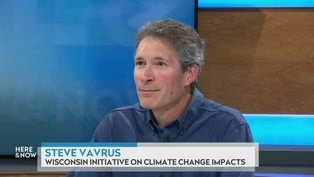
NewSteve Vavrus on Wisconsin's Rising Risk for Extreme Weather
Video has Closed Captions
Clip: S2400 Ep2441 | 5m 34s | Steve Vavrus on a growing level of extreme weather and actions to safeguard against risks. (5m 34s)
 New
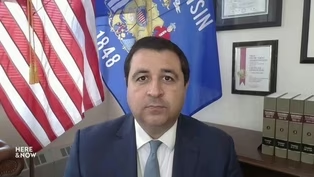
NewWisconsin Files Suit Against Prediction Market Businesses
Video has Closed Captions
Clip: S2400 Ep2441 | 59s | Wisconsin is suing prediction markets for serving as platforms for illegal sports betting. (59s)
 New
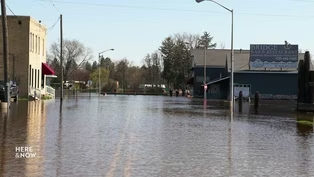
NewWolf River Communities Deal with Flooding — and Insurance
Video has Closed Captions
Clip: S2400 Ep2441 | 5m 53s | Residents who live near the Wolf River are dealing with the aftermath of historic floods. (5m 53s)
 New
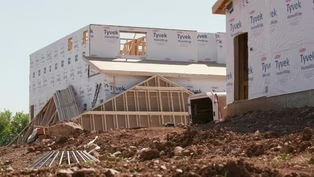
NewWisconsin's 2026 Governor Candidates on the Cost of Housing
Video has Closed Captions
Clip: S2400 Ep2441 | 6m 5s | Candidates in the 2026 race for governor on the high cost and limited supply of housing. (6m 5s)
Providing Support for PBS.org
Learn Moreabout PBS online sponsorship
- News and Public Affairs

Top journalists deliver compelling original analysis of the hour's headlines.

- News and Public Affairs

FRONTLINE is investigative journalism that questions, explains and changes our world.












Support for PBS provided by:
Here and Now is a local public television program presented by PBS Wisconsin